Archive | Fall 2012 TV Season RSS feed for this section

Fall 2012 Review: Arrow

15 Nov

The titular Arrow is DC superhero Green Arrow, on whom the show is based, although I don’t know exactly how close.  My knowledge of Green Arrow is more or less limited to his name, Oliver Queen, his city, Star City, his sidekick, Speedy, and the fact that he and Green Lantern had a well-known comic in the ‘70s where he was liberal and Lantern was conservative.  I probably know a little more if I rack my brain, but I decided to leave it at that for this viewing and review, and save any further Green Arrow research for after.  So I’m not sure how accurate this show is, and can’t be angered/buoyed by changes made/not made for better or worse.

Oliver Queen has just been rescued, when we come in, from an island where he spent five years after a shipwreck in which he was the only survivor.  A super rich twenty-something playboy beforehand, Oliver changed profoundly on the island (seems plausible enough that five years on an island alone could do that), but he’s trying to convince many people he hasn’t, especially not telling them about his city-rescuing alter ego, a dude in a green hood with mad archery and not-getting-killed-by-guys-with-guns skills (which he gained on the island somehow?  I’m willing to suspend disbelief for a comic show).  He was apparently inspired by his dad (played by evil Homeland vice president Jamey Sheridan), who was on the boat too, and did everything he could to ensure that Oliver lived, pushing him to make up for all the bad that the family company had done after he was rescued, and somehow transmitting a very Revenge-like list of villains that have something come to them.

He reconnects with the people in his life, introducing them to us as they get reintroduced to him.  There’s his mom, who is now married to a former partner of his dad’s (if this was Castaway, she’d be Helen Hunt, and the new husband Benjamin Bratt).  There’s his sister, nicknamed Speedy (hint, hint?), who may have developed a drug problem in Oliver’s absence.  There’s his best friend, Tommy, who wants to rush Oliver right back to his playboying ways, throwing a big party to celebrate his return.  And finally, there’s his ex-griflriend, Laurel, now a do-gooder lawyer fighting for legal aid, whose sister died in the shipwreck, where Oliver was cheating with her, on Laurel.  Oh, and she’s now kind of seeing best friend Tommy.  Awkward.

We know he’s out to get all the people on his list, but no one else knows yet, and he shows his island-gained bow and arrow abilities in a couple of nice action scenes, taking out a shady corrupt businessman from the list and his legion of guards.  Oh, and his mom apparently was behind a kidnapping of him, which he escaped from towards the beginning of the episode.  So that’s about something.

I know more about comics that most people, but less than anyone who has ever seriously read comics, so as I said, I’m not judging this with the comic in mind.  I thought there was a chance that I would like it based on the little I knew and assumptions I made in my head, and I did enjoy it, which I think that’s more of an achievement than it seems.  I didn’t think it was great or a cinematic achievement or was blown away by it or plan on immediately telling everyone I know to watch.   I am going to watch the second episode though, and that’s pretty good; only a few series get that far every year  (the TV show equivalent of getting my Top Chef jacket and making the main competition – sorry, just watched first episode of new Top Chef season).

I enjoyed the set up and I think there’s promise in exploring the mysteries behind the shipwreck, his history, and what his mom is out to get, and I liked the characters and actions scenes enough to feel like I wanted to watch another episode after this first one finished.  There’s not much to the characters right yet, other than the broad strokes the episode generated – reformed playboy, debaucherous best friend, legal aid maturing ex, troublesome sister, but I think what kept me interested most was that it seemed to hit the right feel between serious and light and feeling comic book-y, where broad strokes, at least to begin with, are part of the natural order.

Random note:  The three things we see Tommy refreshing Oliver on which happened during his five years on the island –  Super Bowl winners, Black president, Lost ending (which, rightly, he doesn’t understand).

Will I watch it again?  Yeah, I think I will.  It’s not an instant must-watch by any means but it’s certainly at least on the level of Revolution which I gave a few more episodes, and I’ll at least give it two or three more and see if I stay intrigued or fall away.

Fall 2012 Review: Cuckoo

7 Nov

Cuckoo is a BBC comedy (BBC 3 to be precise, but please don’t ask me what the difference is) about a normal-ish family trying to get along with their weird new son-in-law.

While I was watching the first episode, various comparisons kept coming to mind, but my brother crystallized it best –  Cuckoo most closely resembles Meet the Parents in reverse.  Instead of a normal, if easily intimidated and sometimes awkward, workaday guy, being forced into bizarre uncomfortable situations with a super weird and intense parent of his fiance, it’s about a normal workaday family, the father, especially, being forced into bizarre uncomfortable situations with a super weird and intense son-in-law his daughter brings home after marrying him during her gap year abroad (could you get more UK than gap year?).

While the rest of the actors haves some British cred (Greg Davies, who plays the father, is the head of sixth form in other recent British comedy hit, The Inbetweeners), the only one known to Americans is Andy Samburg, who plays the new son-in-law, who calls himself Cuckoo (hence the title).  While I imagined Samburg would play his standard doofus-y type character which I thought would fit seamlessly into this plot, he plays just as ridiculous and over the top a character, just not what I was expecting in that vein from him.  He’s a super arrogant, super non-self aware, eastern-philosophy type, pretentious and with no basis in reality.  His work is writing his magnum philosophical opus, and he casually insults the father unwittingly within just a couple of days of knowing each other (how this is unwittingly is a mark of how extreme the lack of self-awareness is) by calling his beautiful English countryside shit, compared to all the beautiful places Cuckoo has been, and by calling the father a worker, while he, Samberg, is a thinker who works on a higher plane while the workers handle more menial tasks.

If you haven’t guessed yet from just the description so far, well  the show doesn’t really work.  It doesn’t really work on either of two primary levels, idea and execution.  It starts with kind of a simple, stale idea, and doesn’t bring anything particularly new or innovative to the idea nor even take advantage of what humor can still be mined out of that existing idea.

It’s really difficult to understand what the daughter, Rachel, sees in Cuckoo, but even taking that as a given and putting it aside, it’s just not very funny.  Rachel really wants her parents to like him, but she’s amazingly oblivious to his inappropriate and weird comments, and not even really trying to make excuses for his behavior, like you’d think someone would.  There’s lots of sitcom standard miscommunication, where two characters are talking on different frequencties, and we the viewer realize this at the time, while they realize this later on, and there in allegedly lies the humor.  Primarily at one point in the pilot, the father thinks he’s convinced Cuckoo to take some of the father’s hard earned money and leave for good, for Rachel’s sake, so she can have an ordinary university life, where Cuckoo naturally doesn’t get what the father’s saying at all and uses the money to buy a ridiuclous truck, and soon the father realizes he’s wasted his money but has to claim otherwise to save face with the rest of his family for are trying to be more considerate to Cuckoo.  Cuckoo’s so wacky and oblivious!  It’s awkward for everyone without being funny to compensate properly.

Will I watch again?  No.  It wasn’t awful; it mostly was stale instead of cringe-inducing, and there were one or two moments where I laughed.  It just wasn’t very good and was rather disappointing; I’m not sure I had any reason to expect more from this show, but for some reason (likely that I generally like Andy Samberg) I did.

Fall 2012 Review: Chicago Fire

24 Oct

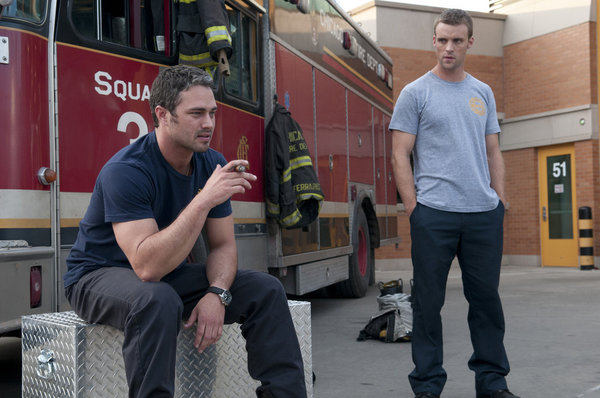
 Chicago Fire (I’d make an MLS joke here, but no one would get it, in fact I’ll spell out Major League Soccer, which has a Chicago Fire team because I think most people don’t even know what MLS stands for) is about a group of firefighters and paramedics in Chicago.  In the first five minutes, we see one of the team die in a fire, and two of primary figures at the firehouse are at loggerheads a month later over responsibility for the death, while trying to live on with their daily responsibilities at work and home.

The rest of the hour is a day in the life the crew.  They fight fires and rescue people, putting their lives on the line every job, while taking the risk that if they make the wrong decision in the heat of battle, it’s on them.  We learn about life at the firehouse and the mostly bonding but occasional infighting that goes on there, between the different cliques,including  the regular firefighters and the rescue squad.  The new guy comes in and the other firefighters show him the ropes, horse around, and have a couple of laughs at his expense.  The revered veteran chief  (played by Eamonn Walker, better known to me as Said from Oz) offers wisdom, and does his best to separate the fighting parties when conflicts arise and unite his men (and women, but mostly men).

Our main firefighter, Matthew Casey (played by House’s Jesse Spencer, who shed most of his hair and his native Australian accent for the role) has trouble at home, as he’s quasi-possibly-separated from his fiancé, (which he hasn’t told any of his friends/coworkers), due at least partly to the impact of his friend and fellow firefighter’s death.

Man, being a firefighter is some seriously heavy shit, but they have their moments of levity as well.  There’s the towering  highs of saving a little girl’s life from a dangerous car accident side by side with the painful lows of another firefighter getting injured and requiring serious surgery, along with the feel good tomfoolery of watching their chief fight in a fire-police boxing match.   Then, just in time, when a fire strikes, the two enemies from the beginning unite in the heat of battle.

We’ve seen this show before, it’s just usually with cops and sometimes doctors, rather than fireman (I haven’t seen Third Watch but I imagine this is similar).  It’s fine.  It is what it is (an irritating expression, but still apt here).  There’s families, there’s hurt, there’s that camaraderie that only comes from being members of the same tribe that puts their lives on the line every day.  We’re meant to feel like we’re getting an insider’s view on the special relationships that go on inside that firehouse and that our emotions are on the line every time they step into a blaze.  There’s nothing that lifts this show above the realm of the generic though, no outstanding dialogue, or artistry, or characterization.

Note:  I keep calling this show Chicago Code, a short-lived cop show from a couple of years ago, that probably nobody remembers, and I didn’t realize I did until I keep calling this show that.

Will I watch it again?  No.  As I said above, it’s fine.  I’m sure some people would like it, and that’s okay. I wouldn’t call it bad as much as I would rather say it just doesn’t stand out.  It’s one of those shows that is exactly what you think it is, and you don’t really need to watch it to know whether you’re going to like it.  It’s more unmemorable than it is good or bad, which is inherently not positive, but compared to many shows, relatively not negative.


Fall 2012 Review: 666 Park Avenue

22 Oct

666 Park Avenue is a supernatural soapy horror, a super specific genre which happens to mean that the writers have narrow waters to navigate regarding the show’s tone.  If it’s too serious, it’ll be impossible to swallow the level of over the top silliness involved in an evil apartment building, while if it’s too jokey, it loses the scary horror element altogether.  Scary horror and fun but kind of silly horror can be combined (note: Shaun of the Dead, though that’s with satire instead of soap), but it’s a delicate balance.  I definitely think 666 sees Revenge as a model, following the formula of serious plot and soapy personal relations meant to be both serious and fun, but featuring a supernatural theme instead of a rich powerful family conspiracy.  It’s kind of fitting that on the other end of the spectrum from Revenge is ABC’s third Sunday night drama, the pretty bad (although quite successful) Once Upon a Time as a model of what not to do, which takes on fables, but far too over the top and silly, rather than serious, without being either fun or funny enough to make that trade off worthwhile.

Of course, the building isn’t actually 666 Park Avenue; that’d be a little too on the nose.   It’s actually 999 Park Avenue, but looks like 666 in the shadows.   It’s a large, old, building and our main characters Jane and Henry are wannabe yuppies, a young couple with lots of ambition and education but low on funds.  Their prayers are answered in the form of a building manager position at the building, which gets them a free room far above what they could normally afford.

Terry O’Quinn plays building owner/SATAN/SATAN associate Kevin Durand, resembling more later season Locke, when he was actually the Man in Black, then the regular Locke (yeah, I didn’t understand the last couple seasons of Lost either).  Vanessa Williams portrays his wife Olivia.  They’re somehow seeking to corrupt Henry and Jane (I wonder if having them be unmarried rather than married was a nod to the horror trope of disapproving of pre-marital sex?), while Henry and Jane are bowled over by their generosity before they start noticing slightly odd occurrences around the building.

Aside from the main plot of the two building managers getting settled in their new home, the episode plays out almost like a series of Goosebumps stories, which basically all have the same classic horror message:  Be Careful What You Wish For (I can’t find a clip for the life of me, but this always makes me think of the Simpsons Monkey’s Paw episode where Homer wishes for a turkey sandwich, “The turkey’s a little dry…the turkey’s a little dry!  oh, foe and cursed thing, what demon from the depths of hell created thee!”).  The first of two examples we see in the premiere is in the opening scene.  As a demonstration of both Durand’s power and his shady intent, a violinist who apparently had no talent and made a deal for ten years of greatness, is sucked away into the building after his time runs out, although he begs Durand for more.  Second, a man who agreed to kill on Durand’s command to bring his dead wife back to life is, well, sucked into a wall when he doesn’t.  Here’s a tip from someone admittedly not qualified to practice law:  Don’t sign contracts that oblige you to you know, die in ten years, or kill people, or sell your soul to any number of devils, etc.  About every five minutes out of Durand’s mouth comes some attempted witty ominous crack about how all people have needs and wants and must be willing to do what it takes to get them, or some such.

Note:  I do have a lot of doubt about the enforceability of these contracts in a court of law, though I guess that’s immaterial to Durand.

I’m not sure how many of the characters are regulars and how many episode of the week residents there will be, but besides O’Quinn and his wife, and the main two characters, there’s a young couple where the husband is a playwright who keeps staring at some woman in the window, and a young girl who apparently steals things and then maybe sees people’s futures in the items, or something. Going in, with the huge building filled with mostly rich people, compared to the cash poor main characters, I thought there might be an opportunity for some wonderfully heavy handed satire, They Live-style, but sadly, that element seems to be absent.

Will I watch it again?  Probably not.  Not because it was so bad as much as because it’s at least fifth in the picking order amongst new shows.  After one episode, I think it can be a good show but is unlikely to be a great show, and while I think watching the next episodes could possibly be enjoyable, it doesn’t quite cross the necessary threshold at this point.

Fall 2012 Review: Nashville

16 Oct

I always love to hear of a pilot that doesn’t immediately sound like any other program I can think of.  Sure, when you get down to the nuts and bolts, almost every show incorporates elements from other shows, and that’s natural.  It’s not the most important factor into whether a show is actually good, but it is amongst the most important factors in determining whether a new show sounds interesting before you actually watch.  Nashville, based around the country music world in the titular city, seems very likely to be both new and good, based on the pilot, a rare and welcome combination.

Nashville has a fairly decent amount of moving parts for a show that’s not a complicated conspiracy show like Last Resort or Revolution.  Connie Britton (Friday Night Lights’ Tami Taylor) plays aging country star Rayna James, who finds out to her dismay that she doesn’t have as much juice as she once did, and her record and upcoming tour aren’t selling..  Because of this, her label wants her to open for hot young country thing Juliette Barnes (Heroes’ Hayden Panettierre), who is after James’ bandleader, for personal and professional reasons, as well as her fame.  Neither of the woman like one another; James sees Barnes as a flash in the pan making adolescent garbage, while Barnes sees James as an aging fossil whose time has come.

As if this music angle wasn’t enough, it turns out that James’ father Lamar Wyatt (Powers Boothe) is one of the most powerful men in Nashville.  The two of them don’t get along great, but they communicate through James’ sister, who is being groomed to take over the family business when their father retires.  Lamar wants James’ husband, Teddy, frustrated with not being the breadwinner in his family for years, to run for mayor against James’ friend, Coleman Carlisle (played by The Wire’s Bunny Colvin himself, Robert Wisdom).  James then has to deal with conflicting loyalties personally and professionally, which deal with her career, the future of country music, and the future of the city of Nashville.

I’m not sure exactly who else the other main characters are going to be, and what kind of role they will be play, but there’s a legendary old songwriter who is friends with James, James’s bandleader’s niece, who is a poet and possibly an up and coming songwriter, the niece’s boyfriend, a bad boy type, and some other young songwriter, all of which I didn’t get a great feel for initially due to the logical focus on James and Barnes in the first episode.

James and Barnes were plenty compelling on their own even after just forty minutes.  While ostensibly James is the hero and Barnes the villain, both characters already seem like they should be far more multifaceted than that.  James exhibits occasional diva-like behavior, and though understandably upset with her lack of popularity, is less than graceful when coming to terms with the reality of her difficult situation.  Barnes is mostly an ambitious man-hungry prima donna who has trouble being nice even for a few minutes, but her possible character building set up involves a drug addict mother constantly calling her for money.  I think there’s lots of possibilities for complex relationships between characters which are neither perfect nor evil, and these are good things.

Will I watch it again?  Yes.  From pilot alone, I think it’s the best hour long I’ve seen this season, with Last Resort the only other in contention.  I was excited before I saw it, and I’m even more excited afterwards.  We could have the makings of a really strong show.  This show received the greatest possible endorsement when, after finishing the first episode, I realized I wished I had a second to throw on right away.

2012 Review: Made in Jersey

15 Oct

You’ve been waiting for it, I’ve been waiting for it, we’ve all been waiting for it.  Sure, it’s been cancelled already by the time you read this, but you weren’t going to watch it anyway, and don’t tell me you’re not the least bit curious.

Here’s the thing; Made in Jersey is bad, just like everybody could have easily anticipated, and that’s clear and pretty obvious from the get go.  Unlike 2 Broke Girls, though, it doesn’t make me angry or sad, it’s just hilariously bad and destined to fail, everyone kind of knows it, and this makes watching and reviewing it surprisingly enjoyable.  It’s lame duck television.

Let’s start out with what you have to know.  Martina Geretti is a lawyer who used to work for the Trenton DA’s office but now recently started working for a large prestigious white shoe Manhattan firm.  She gets into a mini-scuffle with a rude biker in the first two minutes of the show, letting you know that she’s got an accent, she’s got attitude to spare, and she’s a lawyer so she can threaten you when you piss her off.

Here’s what you also need to know.  She showcases her Jersey Smarts ™ several times in the episodes, which I will catalog, but basically, she gets promoted quickly into a high profile position.  Her head boss in Kyle McLaughlin, who doesn’t really do a lot.  Her next boss is some other guy who is literally constructed out of cardboard (yes, obviously not literally).  Her immediate co-worker who is slightly senior to her however, is played by Law & Order: SVU’s Stephanie March and has apparently made it her mission to be a total bitch to Martina because she’s a stupid Jersey know-nothing.  When I saw what the show was about, I thought everybody would be out to get Martina, and mock her for her Jersey ways, but it’s really just Stephanie March, although she does it often enough to count for everyone.  Basically, the rest of this review will be me listing examples of Martina using her Jersey Smarts ™ and me listing how Stephanie March is crazy mean to her.

Jersey Smarts ™ #1:  In one of the first scenes, before Martina heads to an important meeting she accidentally stains her blouse.  She quickly refashions her outfit to make herself presentable.

Jersey Smarts ™ #2:  Kyle McLaughlin brings up an important murder case in a huge meeting, noting that the police think that pliers were the murder weapon.  Martina explains that the pliers weren’t a weapon, but rather a fashion accessory for helping the girl put on tight jeans.  She’s immediately promoted for her pluck and gumption.

Her next client then, hearing her accent, thinks she must work for the lawyer, and March castigates her that Trenton isn’t New York.  Take that!

Jersey Smarts ™ #3:  When her client comes in for court with ratty hair that will make her look guilty, Martina uses her salon skills to fix it up on the fly.

March comments that Martina would be excellent at talking to some small time witnesses, because she “speaks townie.”  Burn!

Jersey Smarts ™ #4:  Martina, as a Jersey lawyer out of water at a big New York firm, understands not to judge people at first sight; the same mistake many are making about her client.

March makes a Real Housewives of New Jersey reference, in regards to Martina.  Come on, you knew it was coming at some point.

Jersey Smarts ™ #5:  Martina recognizes that possible blood on a doorknob may instead be bleach from when the defendant was changing the color of her hair, something that dawned upon her on a trip to the salon.

March shows off how out of touch she is; When talking about beauty supplies and highlights, Martina mentions how expensive and difficult to afford they can be, and March mentions that hers cost $300.

Jersey Smarts ™ #6:  Martina figures out that the defendant, a poor college scholarship girl, used the bleach to imitate “resort hair,” to pretend she had been on vacation, like a rich kid.

Oh, Martina eventually is picked by the boring lawyer to do the important cross examination and wins the admiration of the judge for her spunk and passion.  She also talks a tattoo parlor into giving a refund to her niece because, lawyer, but then gets a tattoo herself!  She’s a woman of contradictions.  Yay, New Jersey.

Will I watch it again?  No, because even if I wanted to, it’s not on anymore.  And no, it’s a bad show.  Still, I had a surprising amount of fun with this, I’m tempted to watch the second to do another write up.

Fall 2012 Review: Elementary

11 Oct

When something is on CBS, I expect it to be somewhere on a range from bad to mediocre.  Is that harsh and unfair?  Well, yes; I should come into every show fresh, and I do my absolute best to evaluate every show fairly and put aside my preconceived notions, though, as I said, I consciously attempt to put them aside, rather than pretend they don’t exist.

CBS’s wheelhouse exists mostly on a spectrum from what I think are largely terrible comedies to bad-side-of-mediocre to good-side-of-mediocre police procedurals.  My initial thought was to say this is most of CBS, but not all, but looking at the fall schedule, it covers everything but The Good Wife, which is a slightly serialized law procedural, despite what others may try to tell you (unless it’s changed very drastically in the last couple of seasons, which is possible though unlikely – from the commercials you’d have no idea it was a procedural at all). It’s then unfair for me to expect a groundbreaking serial drama from CBS, but maybe what I can reasonably expect is for them to do what they do well.

The brand of comedies they make are very, very difficult to make actually good (I have a complicated relationship with How I Met Your Mother, but let’s save that for another day).  However, procedurals, while not generally my cup of tea (my strange near-obsession with the original Law & Order aside), are not inherently bad.  And if there was to be a particularly good one, then why not, as my friend pointed out, an adaptation of the original procedural, Sherlock Holmes, for which each original story was a short few pages about him taking on one mystery.

Here’s a preconception I’ve had about this show since the day it was announced.  There’s already a Sherlock on BBC, it’s great, and thus, any version on CBS will jwithust be hopelessly inferior.  After all the saber rattling between Sherlock creator Steven Moffat and CBS over who might or might not be ripping off who, I immediately sided with Moffat and basically figured the new version would just be a watered down, worse cast Sherlock.

After all that exposition, you may not be surprised to read that CBS’s Elementary was actually pretty good.  Yeah, I still think it’s not as good as the BBC’s version, but it’s still far better than I anticipated it to be after reading it was getting made. Johnny Lee Miller, who has fiddled around with TV before, as the villain in the fifth season of Dexter, and the eponymous Eli Stone, does a solid job of evoking the classic Holmes characteristics – sharp, astute, biting, and unable to precisely fit in with the emotional demands of ordinary humans, while occasionally making a very small effort.  The police captain who gives Holmes access to the scenes largely stays out of things (and is played by Aidan Quinn), making the show about Holmes, and secondarily about Watson, who seems to be more an easily irritated but also fascinated sidekick/babysitter compared to Watson in Sherlock, who is more of a friend and a bit closer to a partner, though perhaps the relationship changes over time.  Also, Watson is a woman, played by Queens native Lucy Liu, so take that, tradition.

Otherwise, you probably know how a Holmes mystery is supposed to work; Holmes constantly detects little observational clues at the crime scene which others miss and slowly point him to the killer, and eventually enable to him to prove his theories.  He’s the original Psych or The Mentalist.  The case in the pilot was well-crafted and featured Holmes both figuring out a lot of information towards finding the killer, and then knowing who he was and figuring out more information to prove it, with a key assist from Watson, and her ability to actually interact with people thrown in.  It’s a well crafted procedural, and credit to Miller for making it go.

Note:  Okay, I’ve given a largely positive review and this is a relatively silly point that isn’t important at all.  However, in the last scene of the pilot, Watson and Holmes are watching the Met game, and Holmes says the game is very scientific and predicts exactly what the next three batters would do.  Sure, there are probabilities, but that’s pretty much what baseball is – I’d have to run some math above my level, but I’m fairly sure the likelihood of him predicting the outcomes of the next three hitters in a row (it’s center field fly out, though if I recall correctly, and I’m not willing to watch again for this, he says pop out, and it’s hardly a pop out, intentional walk – and of the three this is clearly the most predictable, and then grounded into double play) is pretty unlikely.

Second note:  This is just a pointless thought; but this is the place for it.  So, in a world like this, or the BBC’s Sherlock, the Sherlock Holmes stories have to never have been written.  Otherwise, they current day Holmes would think it was just too bizarre a coincidence, and every person who met them would say, “you’re just like Sherlock Holmes from those stories”.  So the world they live in is nearly identical to ours, except that Sherlock Holmes stories never existed.  Did Arthur Conan Doyle exist, but never write those stories, or is he gone too?

Will I watch it again?  Again, it’s a procedural, so probably not.  At this point, I just don’t value hour long shows without major serial components very highly – those I do watch I either primarily watch with others, or are British shows, meaning there are so few episodes, that it’s more inconvenient not to watch.  If this had only six episodes in a season, I would probably bang them out.

Fall 2012 Review: The Neighbors

9 Oct

The Neighbors is about a classic sitcom family (you know the type – largely functional and loving but having about one major disagreement per episode) which moves to a suburban development that turns out to be filled with friendly but super weird aliens.  It’s important to note first, that it’s not a very good show, but second that it’s uniquely unlike any other bad show that has debuted in the past few years.  It’s a show out of it’s decade; it feels much more like something from the ‘90s or ‘80s, and I don’t mean because of a laugh track or a multi-camera format, both of which it doesn’t have.  Rather, it’s just incredibly silly and wacky, like several old alien comedies, and relies on a lot of sight gags.

Most bad sitcoms largely consist of attempts to mix and match a combination of the classic multi-camera family/workplace sitcoms from the ‘90s and ‘80s (The Cosby Show), the edge, bawdiness and pop culture references of hipper successful comedies (The Office), and the youngish-friends-hanging-out boom that started from Friends (Friends).

The Neighbors doesn’t really take much from any of these, except from the classic family sitcom, with the family dynamics (men want to be men, unruly petulant teenager, woman are tired of not being listened to and respected).  It’s not edgy.  It’s not absurdist.  It’s silly.  It’s men are like men, alien or human, while woman are like woman, alien or human.  There’s a crazy amount of physical comedy and sight gags just based on the aliens being weird and not human like.  It’s an heir to the long but largely dormant tradition of silly aliens-in-suburbia comedy, including 3rd Rock from the Sun, Coneheads, Mork and Mindy, Alf.

They’ve got lots of kooky alien quirks.  Basically, a segment of an alien civilization is trapped on earth and all collectively moved into a New Jersey housing development.  The primary alien family has humorously named themselves after American sports stars (Larry Bird, Jackie Joyner-Kersee, Reggie Jackson, Dick Butkus), and speak in all sorts of different accents.  They actually look like slimy green creatures, which they turn into when they clap their hands a certain way.  They travel around in weird colored clothing on golf carts, and like most classic humorous aliens, try to imitate humans, without entirely getting it right – they all bring the new family pies to welcome them in, leaving dozens of pies.  They read instead of eating, and have sex by staring at each other and raising their hands up.  They throw dishes out the window instead of cleaning them.  Aliens are super weird, guys.

It’s not subversive.   It’s not even relevant.  There are different ways to take on aliens humorously.  Darker absurbism and biting social commentary seem like they would be obvious possibilities, but silly is tried and true.  The humor is old-timey (or timeless, if you want to take that view) – the main plot of the first episode involves the human husband being jealous that the alien husband orders around his wife, while the human wife encourages the alien wife to stand up for herself.

Note:  Though I’ve barely talked about the cast here, the human father is Zeljko Ivanek honoree Lenny Venito.

Will I watch it again?  Nah, but I’m glad I did once; it’s not a success or good but it’s a breath of different air, which, well, it’s the kind of show that’s I’ll explain the pilot to someone humorously in a couple of years, whereas there will never be any reason to remember Partners.

Fall 2012 Review: Vegas

8 Oct


Here’s how I would describe what I think Vegas is, after one episode.  It’s a police procedural, but with a twist.  The twist is that it’s western-tinged, and set in the 1960s in a Las Vegas on the grow.

Note on “with a twist”:  My friend decided he likes straightforward classics, but “with a twist.”  While the value of that position is certainly debatable, my other friends and I eventually divined what he meant.  An example of this would be Snow White and the Huntsman, which takes on a traditional fairy tale, but with a twist.  CBS has been doing this a lot lately with the procedurals which are its bread and butter – while CSI and NCIS are about as traditional as it gets, Person of Interest’s got a twist, Elementary is modern day Sherlock Holmes procedural, and Unforgettable (hardly! ha!) was a cop procedural with an eidetic memory detective (Mentalist is kind of similar).

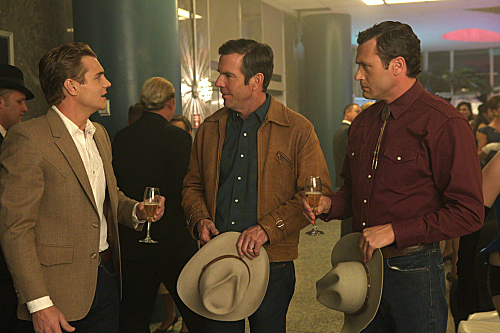
Back to Vegas – Dennis Quaid plays Ralph Lamb, a no-nonsense rancher with a nose for asking the right questions, a skill which he used during the war (World War II, probably, but conceivably Korea) as an MP.  He’s called in by the mayor, an old army buddy, to solve a particularly connected case (a relative of the governor!) because the regular sheriff is missing, and when that sheriff, who was corrupt, is eventually found dead, Lamb is recruited full time.

He uses the help of his ranch partners, each with his own set of complimentary skills, and fights to discover the truth while going up against the corrupt district attorney and the mob, which is looking to grow its influence around Vegas as well.  Basically, I’m guessing, there will be a new murder each week (maybe just a rape sometimes? do they have those in the ’60s?), and a new cast of possible suspects, with less complex formal serial plot than simply dealing with some of the same antagonistic characters over and over.

The only wild card that makes me a little bit confused as to what exactly the show will be is that one of these would-normally-be occasional antagonists is billed as the second main character in the show.   Vegas has been promoted as co-starring Dennis Quaid, who plays the obvious lead, Lamb, and Michael Chiklis, who plays the new head of the local mob, Vincent Savino.  Traditional procedurals don’t really have primary antagonists, at least in the appears-in-every-episode sense.  Primary villains, if they exist, appear once or twice a season as the crazy psychopath killer with potential personal ties that the protagonist can never catch.  Chiklis though, is second billed, and got a couple of scenes by himself in the first episode, showing him straightening out shoddy mob practices that were going on before he arrived.

If this was not on CBS, and was not a procedural, Quaid and Chiklis would be alternating protagonists, both rising up in the world of the new Las Vegas, one through the law, and one through crime, and it’s not that much of a stretch to imagine this show fitted for that.

It’s unclear exactly where Chiklis fits.  How much of his own story line does he get, versus how much is he just being slowly built to be relevant as an archrival to Quaid?  The fact that I don’t know exactly how this goes, and that the fit is unclear is probably more positive than negative overall; it’s actually something slightly different, or at least potentially different, which isn’t necessarily good but at least is indicative of a show that is trying.  It bears keeping an eye on (CBS pun!), because some decisions do need to be made about how the show works.

Also, I  really feel for some reason that the s in Vegas should be a dollar sign.

Will I watch it again?  Honestly, probably not.  I’ve got four new shows by last count I’m committing to for at least the next month and schedule space is tight.  That said, if I was looking for a procedural to watch, I might choose this one based on the one episode, which I mean as some reasonably but not incredibly favorite praise.

Fall 2012 Review: Partners

4 Oct

Note:  In a testament to the terribleness of the user experience of watching programs on CBS’s website, I accidentally watched the second episode of Partners instead of the pilot (another issue with the CBS.com experience mentioned later).  I had already written a substantial part of the review before I realized I watched the second episode and had an internal debate over whether I had to go back and watch the pilot, especially because, as you’ll read, this is a show I never wanted to watch again in my life.  I settled on the compromise of playing the episode, but not being committed to the level of concentration I normally afford a pilot.  Be forewarned though, that I may reference second episode events, in case you plan on being an avid Partners watcher.

It was a race to get in this review of Partners in before the show’s near inevitable cancellation.  A few days ago, I declared Guys with Kids the worst new show I had seen so far this season.  Well, ladies and gentleman, we have a new champion.

First, if I’ve said this once, I’ve said it a thousand times, and it’s going to reach that number eventually, but laugh tracks are terrible, for so many reasons.  They’re loud, they waste time, they’re insulting to the audience, they screw up timing, etc, etc, etc.  Enough, let’s move on.  Oh, and there’s also an obnoxious clapping sounds between scenes which is just supposed to indicate transition but is a really poor sound choice.

There’s no one passage I can dissect and tear to bits like in now Monday night stalwart 2 Broke Girls’ debut, and it’s less particularly offensive to one certain type (New York, hipsters) than it just offensive to people with senses of humor.

Partners is the story of four people (one of the few shows in fact, where I recognize all the main cast members, albeit there are only four).  Two are best friends and architectural partners at work, Joe (Numb3rs and Harold and Kumar vet David Krumholtz) and Louis (Ugly Betty’s Michael Urie).  They clearly go back a ways and care very much for each other.  They’re both involved in serious relationships with Ali (One Tree Hill’s Sophia Bush) and Wyatt (Superman himself, Brandon Routh), respectively.  The trouble of course comes in when they both meddle substantially in each other’s relationships.

Basically, it’s just painfully unfunny.  Some sitcoms I deride as old-fashioned.  This is that, but it’s a a pretty lousy old fashioned sitcom; it would have been bad at any point in time..  There’s so much classic miscommunication in just two episodes it blows my mind.  Both episodes I watched were actually incredibly similar featuring Louis both causing and solving problems of Joe’s by talking to Ali, hammering home the central joke that Joe and Louis are in a relationship with each other, just like they are with their fiance and boyfriend, respectively.  There’s even a extremely sassy non-whit female assistant.

Even the small percentage of jokes that have seeds of potentially working are murdered by a combination of the laugh track, poor timing, and simply not enough care.  Most “jokes” though don’t even make it to that level, being fundamentally faulty.

A couple of more notes on how terrible the CBS.com viewing experience is. It’s hard to click and get the episode you want.  The repetitive commercials on Hulu have always been a source of complaint, but CBS showed me this absolutely terrible Macy’s ad FOUR times in a row.  There is absolutely no excuse for that.

One last note:  Also appearing as Ali’s dopey, borderline mentally challenged assistant is Jillian Bell, who is best known for playing the dopey, borderline mentally challenged bosses assistant on Workaholics.

Will I watch it again?  Absolutely not.  Do I even need to explain further?  It’s wretched.  Do not watch.  Luckily, by the time you read this, it may not even be an option.