Archive | September, 2011

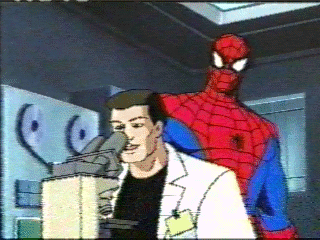
Show of the Day: Spider-Man: The Animated Series

9 Sep

My friend recently informed me that the Spider-Man cartoon from the mid-90s was on Netflix.  I grew up watching this Spider-Man, as part of the stable of ‘90s superhero cartoons along with X-Men, Batman and Superman.  Spider-Man has actually had seven different animated incarnations, from the first in 1967, to the MTV series in 2003 starring Neil Patrick Harris and Lisa Loeb, which attempted to be a little more adult, to, most recently a kids series in 2008.  This ‘90s Spider-Man, which ran from 1994 to 1998, longer than any other Spider-Man series, was, more than any other source, where I got everything I knew about Spider-Man.  I was so disappointed in the 2002 movie largely because it was so different from the cartoon which I loved.  Having not seen any episodes in at least ten years, I decided to watch the first episode of the series to see how it held up.

First things first, in this edition, Spider-Man (and of course his alter ego Peter Parker) is voiced by Christopher Daniel Barnes, whose best claim to fame outside of Spider-Man is playing Greg Brady in The Brady Bunch Movie.  Other notables include Ed Asner as J. Jonah Jameson and Hank Azaria as Eddie Brock/Venom.

The theme song is pretty unmemorable, especially compared to the contemporaneous X-Men cartoon’s theme, which I’ve had stuck in my head at least once a year for the past fifteen years.  I did appreciate, though, the appearance of the episode title at the beginning, a tradition which virtually doesn’t exist anymore.

Something else I appreciate greatly is the lack of origin story.  This is actually very difficult to believe for me.  Spider-Man’s origin story is so entwined with his character, probably more than any other prominent superhero (bit by a radioactive spider and so forth).  Yet, this series either takes on faith that you already know it, or decides that it’s really not that important.  I love it.  Maybe I wouldn’t agree back then, but the origin story has been done too many times, film included, and is so rote, and frankly not all that interesting.  I say get on with him being Spider-Man.

Another thing I love about this portrayal of Spider-Man which was probably the single biggest reason I couldn’t stand the movie was that in this version Spider-Man is wise-cracking and self-assured, constantly entertaining us with his inner monologue.  I understand this isn’t necessarily the most canonical version, but I like to think that, as Spider-Man’s in college by this point, he got over all his self-pitying identity issues and guilt over the death of Uncle Ben in high school.  Tobey Maguire’s emo Spider-Man was the antithesis of the cartoon’s version, and I just couldn’t get over it.

The cartoon is clearly aimed at kids, and it doesn’t have the darkness, ambition or animation quality of Batman: The Animated Series, which is probably the go-to for great cartoon comic adaptations.  That said, I was hardly dying of boredom either; the show was simple but still relatively entertaining.  I’m not sure I’ll start marathoning the series, but I might watch a few more of my favorite episodes.

The first episode is self-contained and features as a villain the Lizard, whose origin story is vaguely similar to fellow Spider-Man villain Dr. Octopus.  The Lizard was a great scientist, Curt Connors, who wanted to use reptile DNA to grow back people’s limbs, and when he tries it on himself, the reptile DNA takes over, turning him into a lizard-man hybrid.  The machine he used was called the “neogenetic recombinator,” a clumsy phrase which they manage to work into the episode at least half a dozen times.  The Lizard then invents a device which can turn other people into lizard creatures, and tries to turn it first onto his wife.  Spider-Man intervenes and for some reason, by the two-negatives-equal-a-positive school of thinking, turns the device onto the Lizard himself, turning him back human and leading all to be well.

Quick final note: it was also interesting to me that Spider-Man referenced fellow Marvel superheroes in the episode, at one point name-checking The Avengers, the Fantastic Four, and the Hulk.

Overall, I was pretty pleased with the way the series held up.

Ranking the Shows That I Watch – 24: Top Chef

8 Sep

I love Top Chef.  It’s the only weekly airing non-scripted show I watch (exceptions made here for Daily Show and Colbert Report) regularly (I’m a sucker for the occasional Pawn Stars and I love No Reservations but don’t watch it weekly) and that says a lot about how compelling it is.  It’s kind of like a sporting event, if sporting events were judged by people who usually are but don’t have to be experts (does Lorraine Bracco have that much expertise in food tastery?) and there was no way you could tell how the players did from home except for by what the judges said.  (Imagine a player hits a ball somewhere on baseball field that no one can see, and then umpire says it’s a double because he feels like that’s what it would be using his expertise and there’s no way can verify that but you just have to go with it).

Top Chef, though, like individual sports more than team sports, is all about a combination between personalities and winning.  Some of the best contestants are the most cocky, like Stefan in season 5, but he was able to back up his cockiness with wins.

Season 6 was indisputably my favorite season – it contained four chefs I pegged as the best from right from the beginning, I really really liked all four, and they all made it to the final, the season playing out exactly as it should.  There’s not much joy in Top Chef upsets generally, as it just means weaker contestants get lucky because of a fluky week.

There was something really gratifying when Richard Blais won Top Chef All Stars last season.  It was one of the moments that happen in sports all the time, when you can’t believe how strong you’re rooting for someone until the event actually happens and you’re excited and anxious and, for me, loud.  I would do weekly Top Chef Thursday morning quarter backing (can’t think of a proper equivalent for cooking quickly) with my friend and we would discuss both how we thought the results should have gone, as well as our continued praise for Richard.  It’s interesting to me because in Season 4, the first season of Top Chef I really watched as it was on and became engrossed in, I definitely didn’t feel the same way about Richard, and watching All Stars, I have absolutely no idea why.  Maybe it was because I have an unfair bias against the south; I must not have known he was originally from Long Island.  Either way it’s unforgivable in hindsight because Richard is by far the most similar to me of any contestant I can recall on Top Chef.  Most contestants are either really cocky, or really schmoozy, or really insecure, but Richard is none of these.  He expects to win every challenge, is severely disappointed if he doesn’t, but doesn’t maintain an attitude of arrogance around the other contestants, just a nervously chatty relatively honest analysis of how he feels.  He is harsh on himself when he disappoints, not always agreeing with the judges, but not always disagreeing with them either, which makes it seem more believable when he does disagree.  Immediately after he cooks, he thinks everything he makes is crap and he is petrifyingly nervous after every challenge until the results are given.  This guy is my hero.

Why It’s This High:  It combines the addictiveness and competitiveness of a sporting tournament with glorious food porn

Why It’s Not Higher:  I can’t have an unscripted show go higher – part of what I love about good TV is how intricately it’s crafted, and you can’t craft something like this, which means you get some flops – lack of script is for sports

Best episode of the most recent season:  “Restaurant Wars – One Night Only” – it feels weird to pick top episodes for a reality show, but did any Top Chef fan have any doubt that I’d pick restaurant wars, everyone’s favorite Top Chef challenge (it was either that or the finale), especially when Richard and Dale’s team put up one of the best restaurants ever seen in the show

The Zeljko Ivanek Hall of Fame: Kari Matchett

7 Sep

(The Zeljko Ivanek Hall of Fame is where we turn the spotlight on a television actor or actress, and it is named after their patron saint, Zeljko Ivanek)

A slightly more obscure Hall of Famer,  Kari Matchett has quietly developed a strong television career for herself.  A Canadian, her career started with single episode appearances in 1996 in Canadian series The Rez and Forever Knight.  She then got a chance to appear as a recurring character on Canadian teen drama Ready or Not, which aired in the US on Showtime Movie Channel and later on the Disney Channel.  After appearing in a couple of television movies and an episode of Poltergeist: The Legacy (another Canadian-based show), she got her first chance to appear as a regular in Gene Roddenberry’s Earth: Final Conflict, a science fiction show created after Roddenberry’s death, based on his notes, as guided by his widow.

After two seasons, she was back in the throes of Canadian TV, showing up in drama Power Play.  The show, about a sports agent who becomes general manager of the fictitious NHL team Hamilton Steeleheads, starred Matchett as the GM’s boss.  UPN aired a couple of episodes of the show in the US, but it was quickly pulled as the second episode had the impressive distinction of being the lowest rated prime-time series episode ever aired.

Matchett got a couple of film roles in Angel Eyes and Cube 2: Hypercube before getting her next regular gig, in the US finally, showing up in A Nero Wolfe Mystery, starring Maury Chaykin and Timothy Hutton, on A&E in 2001.  Matchett played Hutton’s sometimes girlfriend Lily Rowan.  She went back to Canada afterwards, portraying a detective on Canadian series Blue Murder, which was about a group of detectives in Toronto, and then had a three episode stint on the one season Wonderfalls.  She got her next starring role in 2005’s Invasion, broadcast on ABC.  Invasion, one of several attempts to capitalize on the popularity for supernatural serial show Lost, showcased Matchett as a doctor, and one of several townspeople inFlorida dealing with an alien invasion of water-based life-forms which took over humans.  After the show was cancelled, Matchett became a recurring character in season 6 of 24, as the personal assistant and girlfriend of Vice President Noah Daniels, portrayed by Powers Boothe.  She was also sleeping with a lobbyist, who turned out to be a secret agent, and was feeding him information.

2007 was a big year for Matchett.  In addition to 24, she showed up in five episodes of Studio 60 on the Sunset Strip as a lawyer with a romantic interest in Matthew Perry’s character.  She also was in the main cast of Heartland, a TNT series starring Treat Williams, about a hospital and the world of heart surgery (great literal show name).  In the same year, she also began a five episode run on ER.  In 2008, she showed up in single episodes of Criminal Minds, The Cleaner, and Ugly Better, and appeared in a six episodes of the Starz series Crash, based on the movie of the same name.  The next year, she showed up in three episodes of Leverage as main character Timothy Hutton’s ex-wife.  She also showed up in episodes of Flashpoint, The Philanthropist, and Miami Medical.  Currently, she is co-starring in USA’s Covert Affairs.  She plays secret agent Piper Perabo’s boss, Joan Campbell, who happens to be married to the CIA’s Director of the National Clandestine Services, played by Peter Gallagher.  Not bad for a Canadian.

Ranking the Shows That I Watch – 25: Entourage

6 Sep

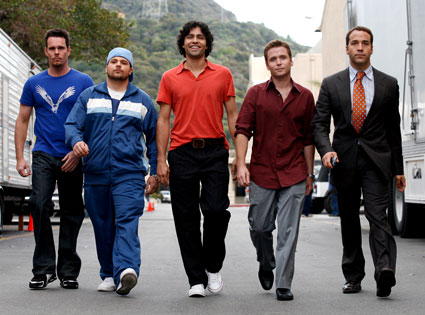
Here’s the funny thing about Entourage. It’s not the best show in the world; there aren’t a whole lot of levels, there isn’t much subtlety, and you’re not going to get layers of deeper meaning on every subsequent viewing (not that these are things you need to be a great show, just some possibilities).  However, I enjoy watching it more than I sometimes enjoy watching shows I think are better.  Now, I admit that sounds wrong at first, and if I always liked watching it more then, well, it probably is better.  Still, I always look forward to a new Entourage.  In today’s world of super awkward comedy and tension filled dramas, there’s room in my life for some popcorn, for a show that, even in the depressing and dark last season is still a total relative joy to watch.  Call it hanging out with the boys, if you will.

If Entourage truly had fallen off, and I think that’s mostly debatable, (I’d say it’s a lot more repetitive than it ever was bad) it had a bit of a boost last season, oddly due to its dark direction for Vince.  If you explained to me that things would go downhill, and not just career-wise but personally and with a drug addiction and all that, I probably would have thought that it would be a bad idea because it would involve taking from Entourage its essence, that it’s an escapist show about fun and good times.  I would have been completely incorrect though. Watching the downward spiral was not just good television, but it was surprisingly watchable for such a objectively depressing situation.  There were a couple of legitimately brutal scenes, including one where Vince hits on Minka Kelly and gets his ass kicked by a couple of NBA players at a party, but for the most part I still got a sense of enjoyment while also treading over ground Entourage hadn’t crossed before.

One note:  Entourage contains an example of a trap that television and movies often fall into when coming up with fictional content.  In the last season, formerly rogue drugged out director Billy Walsh conceives of a cartoon project for Johnny Drama, as a monkey who doesn’t fit in with the world.  In the world of Entourage, everyone absolutely loves this idea, and thinks it’s brilliant.  However, it seems terrible from the little bits that we see.  If you can’t make fictional content good, just never show it.  It’s not that hard.

Also worth saying:  Entourage may do the best job of celebrity cameos of any show around.  Obviously, it has more opportunity than most shows – why would celebrities be roaming around say, Scranton, Pennsylania, or Pawnee, Indiana? (though they manage to grab Detlef Schrempf twice which is super laudable)  Entourage takes advantage of this opportunity and does it well, having celebrities play outsized versions of themselves, or just invented absurd versions, proving to America that they don’t take themselves too seriously – such as Jeffery Tambor as an especially needy client of Ari’s, or John Stamos as so competitive that he can’t accept losing to Johnny Drama in ping pong.

Why it’s this high:  I really enjoy watching episodes of Entourage

Why it’s not higher:  I really do enjoy it, but I don’t crave it, pore over it endlessly, quote it (aside from “I am Queens Boulevard”) or laugh out loud watching it

Best episode from the most recent season:  How about “Bottoms Up” – Vince hooks up with Sasha Grey and begins becoming full-fledged down the vicious cycle that will be seventh season (man, this show has been on a long time) for him, resulting in awkward humor when he brings her to a meeting with Stan Lee.

Power Rankings: Cheers

5 Sep

(Power Rankings sum up:  Each week, we’ll pick a television show and rank the actors/actresses/contestants/correspondents/etc. based on what they’ve done after the series ended (unless we’re ranking a current series, in which case we’ll have to bend the rules).  Preference will be given to more recent work, but if the work was a long time ago, but much more important/relevant, that will be factored in as well)

RIP Nicholas Colasanto.  That said, let’s go.

9. George Wendt (as Norm Peterson) – Wendt, along with Rhea Pearlman and Ted Danson, was one of the only three actors to appear in every single episode of Cheers.  It’s a good thing, because it’s been a pretty brutal stretch afterwards.  He got his own starring vehicle in the George Wendt Show in 1995 where he was a mechanic with a radio show, but after its failure, he didn’t get much else, except occasional TV movies and guest appearances.  He showed up in a couple of episodes of Sabrina, the Teenage Witch.

8.  Rhea Pearlman (as Carla Tortelli) – she appeared in the film adaptation of Matilda, a 1996 short-lived sitcom called Pearl where she starred a middle-aged woman going back to college, and another failed series called Kate Brasher, starring Mary Stuart Masterson in 2001.  She most recently appeared in a few episodes of Hung and an episode of Wilfred.

7.    Shelley Long (as Diane Chambers) – after leaving almost halfway through Cheers’ run, Long didn’t really take full advantage.  She appeared in Troop Beverly Hills, Frozen Assets, and a couple of Brady Bunch movies.  She showed up in Dr. T and the Women, and most recently featured as Ed O’Neill’s ex-wife in Modern Family.

6.  Bebe Neuwirth (as Lilith Sternin) – Neuwirth, outside of Cheers, may best be known for her theater work, most notably Chicago, where she originated the role of Velma Kelly in the mid-90s revival, and won a Tony (with a couple of Emmys for Cheers, she’s halfway to the EGOT).  She co-starred in Oliver Platt one season series Deadline in 2001, and showed up in a few episodes of David Morse series Hack.  She also starred in attempted Law & Order spin-off Trial by Jury, which lasted a season, and appeared in a dozen episodes of Frasier.  Amusingly, her wikipedia also contains the sentence, “ She is not easy in groups, and the thought of a cocktail party where she must meet a lot of new people strikes terror in her soul.” which is clearly a case of “citation needed”.

5.  John Ratzenberger (as Cliff Clavin) – Ratzenberger’s main claim to fame post-Cheers is his appearance in every single Pixar film, sometimes in bigger roles than others.  His bigger roles include Hamm, the piggy bank, in the Toy Story films, and Mack the Truck in the Cars movies.  He appeared in Dancing with the Stars, Season 4.  He also appeared in a few episodes of 8 Simple Rules.

4.  Kirstie Alley (as Rebecca Howe) – Alley had the unenviable task of replacing Shelley Long in Cheers, but performed admirably for six seasons, winning an Emmy.  In the mid-90s, she appeared in some lackluster movies, including Village of the Damned, It Takes Two, and For Richer or Poorer, along with being part of the ensemble in Woody Allen’s Deconstructing Harry.  In 1997, she started the first of three seasons as the star of Veronica’s Closet, in which she portrayed the head of a lingerie company.  The series met with middling reviews and ratings, but earned her an Emmy nomination.  She appeared in one season of sitcom Fat Actress in 2005, and now is starring in her own reality show, Kirstie Alley’s Big Life, about her attempts at weight loss.  She also appeared in Season 12 of Dancing With the Stars in 2011.

3.  Kelsey Grammar (as Frasier Crane) – this is mostly predicated on one role, in fact, the same role that he played for 9 seasons on Cheers, that of Frasier Crane.  Frasier, his spin-off, in which his character moved back to Seattle, lasted for 11 seasons and was a critical and commercial success, earning Grammer four Lead Actor in a Comedy Emmys for his work.  Since Frasier, his career has suffered a bit, as his two attempts at new sitcoms, 2007’s Back to You with Patricia Heaton and 2009’s Hank both failed quite miserably.  His second most famous role is probably an animated one – the villainous Sideshow Bob from The Simpsons. Grammer has appeared 12 times as Sideshow Bob in such classic episodes as Cape Feare and Sideshow Bob Roberts and he won an Emmy for the role in 2006.  He also appeared as Beast in X-Men: The Last Stand, and as himself in a 30 Rock.

2.  Woody Harrelson (as “Woody” Boyd) – the only Cheers cast member to become a bona fide film star, Harrselson is continuing to bank major film roles.  Immediately after Cheers, he starred in White Men Can’t Jump, Indecent Proposal and Natural Born Killers, cementing his status as a movie lead.  He followed these with Money Train, Farrelly brothers comedy Kingpin, and The People vs. Larry Flynt, for which he gained serious critical acclaim, including an Academy Award nomination for Best Actor.  He played supporting roles in Wag the Dog and EDtv, closing out a very successful 1990s.  The first half of the ‘00s was a bit slow for Harerlson, as he took no films roles until 2003, though he appeared in a few episodes of Will & Grace.  After taking these couple of years off, he had supporting roles in Anger Management and After the Sunset.  In 2007, he had a small but important role in No Country for Old Men, and in 2009, he earned another Academy Award nomination, this time for Best Supporting Actor for The Messenger.  He most recently starred in Zombieland, and appeared in Friends with Benefits.  He’ll be in a Zombieland sequel and in teen book adaptation Hunger Games.

1.  Ten Danson (as Sam Malone) – His first attempt at a sitcom after Cheers was the unsuccessful Ink with his wife Mary Steenburgen.  He then starred in an acclaimed adaptation of Gulliver’s Travels, in minseries form.  For a remarkable six seasons, he starred in Becker, featuring him as a pain-in-the-ass doctor who cares deep down inside.  After another failed sitcom called Help Me Help You, Ted Danson began a string of successes which hasn’t abated yet.  He started appearing in Curb Your Enthusiasm as himself, and has appeared in a number of episodes.  He became a regular in the first season of Damages, playing the villainous Ken Lay clone Arthur Frobisher, who appeared in several episodes of the second and third seasons as well.  In addition to that, he appears  in HBO’s Bored to Death as magazine editor George Christopher, a serial womanizer and pot-smoker.  Although the entire show is great, Danson may be the highlight.  If all this weren’t enough, Danson will be starring in CBS procedural giant CSI in this upcoming season.

Breaking Bad – Season 4, Episode 5: Shotgun

4 Sep

(A few weeks ago, I started these Breaking Bad recaps, and then fell a bit behind.  Not one to give up without a fight, they’re still coming, just a tiny bit late.  I’m going to dump a few of them today, so read them if you wish, and if you don’t watch Breaking Bad, turn off your computer and start it today)

The episode begins with Walt, realizing Jesse’s not in the lab, becoming immediately concerned that Jesse has been harmed, or is about to be.  Honestly, I can’t blame Walt for that reaction. In his position, I would think the exact same thing.  However, he goes about it in a naïve, impulsive and foolishly headstrong Walt fashion, driving right to Los Pollos Hermanos to confront Gus, with the thoroughly unrealistic expectation he would just walk in unharmed and kill Gus.  Before he can do anything even dumber, Mike calls and lets him know that Jesse’s all right.

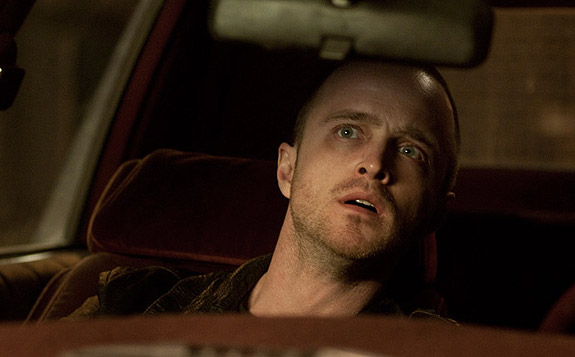
Jesse’s a passenger as Mike picks up cash at a bunch of different drop spots throughout the state.  He can’t figure out why he’s here, and even though Mike knows what the plan is, he really doesn’t understand it either.  Eventually, at the last drop, while Jesse’s in the car, a couple of armed gunmen come down towards Mike’s car, and Jesse is moved from his malaise to back the car into one of them and make a clean get away, realizing that maybe he’s not quite ready to die after all.  When Mike meets Gus later in the episode, we learn what I had suspected right away, that the attack was part of a plan to make Jesse feel like a hero and stop fucking up, and even better, that it seems to have worked so far.

Walt and Skyler are getting along again, and after a heated bout of love-making, Skyler suggests Walt move in again.  Walter Jr. seems pretty excited about that prospect, but Walt, not as much.  While right after he was kicked out all he wanted to do was come back home, Walt has changed in the past couple of months.  After a family dinner, Walt finds himself drinking a glass of wine by himself before rejoining the party.  I at first thought Walt is now bored by this sedentary suburban life that he was apart of for so many years before his cancer, but I think it’s more at least that he’s so terrified of Gus and Mike harming him or his family but doesn’t want to let his family know about it.

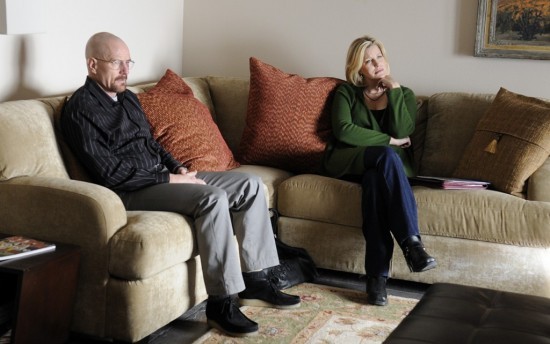
Hank notes at the dinner table that it looks like Gale was Heisenberg after all, and notes what a true and real genius Gale must have been.  Walt’s ego is shattered, and Walt feels like he must pipe up, no matter the fact that it would have been awfully convenient for his criminal enterprise for Heisenberg to have been thought dead.  Walt suggests Gale’s work shows he was a mere student, and that the teacher, the true genius must still be out there.  Walt’s desire to speak up is obviously partly a product of ego, but it might be of boredom as well.  Too much stress may be frustrating, but Walt may need a little bit to get excited anymore.

Breaking Bad – Season 4, Episode 4: Bullet Points

4 Sep

(A few weeks ago, I started these Breaking Bad recaps, and then fell a bit behind.  Not one to give up without a fight, they’re still coming, just a tiny bit late.  I’m going to dump a few of them today, so read them if you wish, and if you don’t watch Breaking Bad, turn off your computer and start it today)

First, a couple of notes about the cold open, in which Mike holes up in a truck and then kills a couple of guys who have machine guns.   I said in an earlier recap that Breaking Bad so often has great scenes, even aside from the context of the show.  I can’t see the actual reason this scene adds to the plot, as we had the scene we needed to show how insanely superhumanly badass Mike is when he took down that asian warehouse last season.  The only thing I can think of is if the ear injury gets referred to again.  Either way, though, bravo, great scene.

The scenes of Walt and Skyler working on the story they’re going to tell Marie and Hank about Walt’s gambling addiction highlight both the differences and the strengths and flaws in their two personalities (something we dealt with in last episode as well).  Skyler is detail-oriented (her resume would read) and well-prepared – she wants to be practiced down to the word, and down to the exact emotion.  That said, lying doesn’t come easy to her.  Walt is impatient and impulsive, but he also has a point in realizing that to some extent the story is just going to have to flow naturally.  They can plan a general guide for the story, but there’s something stiff about trying to actually write a script to the letter.  The story seems to go over pretty well when the Walt and Skyler go over to Marie and Hank’s for dinner.  Walt actually made money at cards, so his son doesn’t exactly understand why this addiction is a bad thing.

Hank brings Walt and Walter Jr. to check out the absolutely amazing video of Gale singing Major Tom karaoke, and Hank asks Walt to examine the notebook.  When Hank points out the initials WW, for the first time I felt as if Hank didn’t believe Walt 100%, but I may just have been reading in deeper to the situation because of what I know as the viewer.

Walt, frustrated with everyone, and stressed out about being captured or killed, fumes at Saul Goodman, using his lawyer session for therapy, but is still unwilling to commit to going into hiding.  He still thinks he can find a way out.

Jesse continues his vicious cycle of nihilism that he began in the first episode of the season, but it seems like something has to give.  Walt is furious at Jesse that he didn’t take proper care at the crime scene, and even more so that that doesn’t even seem to bother Jesse, oblivious to the difficulty Jesse is having when reliving the murder.  After some junkies burglarize Jesse’s funds, Mike gets it back for Jesse, who doesn’t seem to care.  Mike and Gus are clearly concerned about Jesse too, and we’re left wondering exactly how concerned when the episode ends with Mike taking Jesse on a ride.  Maybe it’s to his death, or maybe for ice cream.

Breaking Bad – Season 4, Episode 3: Open House

4 Sep

(A few weeks ago, I started these Breaking Bad recaps, and then fell a bit behind.  Not one to give up without a fight, they’re still coming, just a tiny bit late.  I’m going to dump a few of them today, so read them if you wish, and if you don’t watch Breaking Bad, turn off your computer and start it today)

Plenty to unpack here as usual.  First, the car wash.  This whole situation highlights Walt’s flaws, and that Skyler is everything that Walt’s not.  Where Walt is bold and impetuous, Skyler is patient, shrewd and detail oriented.  It’s almost comical watching Walt decide Skyler’s plan is a failure after waiting five hours without a call, hopping up and down next to the phone like an anxious middle school girl, and then decide even faster that Skyler’s negotiating tactics have failed after she intentionally lowballs the car wash owner.  Walt is unconcerned that his grand gesture of buying a ludicrously expensive bottle of champagne might look out of place for an unemployed school teacher because after all, he paid cash.  Walt has had his fair share of victories in the show due to his willingness to be bold and act quickly and aggressively, but that’s also a path to getting himself arrested or killed.  He would never have come up with as intricate a plan as reporting a false EPA violation.  It’s great to see Saul again as well, mocking Skyler’s stated intentions to buy the car wash, and send a message, but just without hurting anyway, openly, and yet she figures out a way.

Marie gets a big chunk of plot this episode as well – she begins to lose a little bit of the sympathy she was gaining, as she turns back to her own shoplifting ways. She goes to open houses, inventing new lives for herself, and takes personal items each time.  Luckily, she has a DEA husband with connections in law enforcement to get her off.  She’s immature, certainly, and enjoying her flights of fantasy and escape from Hank being, well, simply mean to her.  Getting on her case because she confused Fritos and Cheetos?  Harsh.  Pretty immature of Hank as well.  Maybe she’s back to her shoplifting because she wants to get arrested for attention like a teenager and wants Hank to notice or take care of her.

Jesse wants to go og-carting with Walt after work, but Walt takes a raincheck.  Walt at least does him the courtesy of pretending to consider it, but go-carting is below him.  Jesse is at heart still interested in the simple pleasures of Go-carting; he’s just a kid.  He’s not getting what he wants to out of the go-carting, though. He can’t seem to enjoy it.  Either it’s because he’s still devastated over killing Gale, or was so thrown for a loop by being nearly killed and watching Gus kill Victor, or probably both, but just the like in the last episode, he’s dealing, but with a new strategy.  He tried to hang with friends in a non-stop party last episode but it only worked for so long.  Now he’s at a drug den, giving money away.  Blood money, perhaps?  While Walt has become a master of rationalizing away anything he does,  Jesse can’t even justify the things he did that were actually necessary.  He’s punishing himself. While Walt thinks he’s always the good guy even as he breaks increasingly bad, Jesse always sees himself as the bad guy, even when he’s not.

We get the return of Gale’s notebook in this episode.  Clearly foreshadowed in the first episode, we knew it was only a matter of time until it came into play, continuing the set up of Walt being squeezed by both Gus and the police.  That’s about it for the notebook for now though, as a fellow detective puts it into Hank’s hands, but its importance is unquestioned.

Show of the Day: Heil Honey, I’m Home

2 Sep

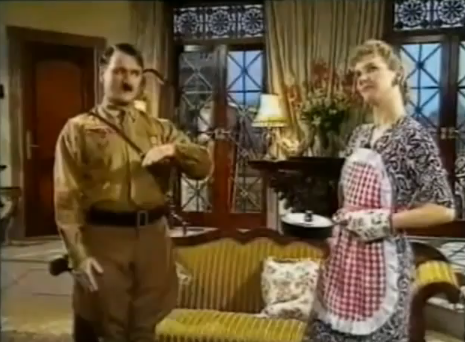
From the title, even if you didn’t have the picture, you could pretty much guess that it was a show about Hitler.  For whatever else you can say, it was certainly daring of anybody, even almost fifty years after World War II, to make a show about Hitler, mockery, satirical or not. I suppose in an abstract way I appreciate the willingness to push the bounds.  For whatever else, the appearance of Hitler as a main character also probably meant the show was ill-fated from the start, and frankly it’s amazing that an episode even made it on the air, especially in Britain which felt the effects of Hitler’s Germany much more than the United States.  The show just lasted an episode before it was pulled for good.

The premise was that Adolph Hitler and Eva Braun were a highly domestic couple living next door to a Jewish couple (Arny and Rosa Goldenstein, I kid you not), leading to awkward relations between them.  In the one episode that ever aired, Neville Chamberlain and his wife are arriving for a dinner party at Hitler’s.  Hitler begs his wife to hide the party from the Goldensteins, but, of course, it slips out, and the Goldensteins crash the dinner, leading to all manner of wacky hijinks.

The program attempted to skate controversy by portraying a foolish, absurdly silly Hitler, in the spirit of The Producers, The Great Dictator, or the Nazis in Hogan’s Heroes.  Its gimmick (as if starring Hitler wasn’t enough) was that it was a show from the ‘50s recently discovered, filmed in black and white, and in the style of I Love Lucy, or The Honeymooners.  It was supposed to lampoon that sort of canned comedy between husband and wife.

I thought this premise sounded so absurd and ridiculous that I explained it to everyone I met when I found out about it a couple of years ago.  I got together a bunch of friends and put it on.  I expected it to be bad, but bad in an enjoyable way.  It wasn’t.  It was just bad.  We watched for about five minutes and then lost all interest.  We didn’t even see a point in finishing the episode.

It’s worth talking quickly here about a show or movie being bad.  It’s not enough to describe something as bad.  There are levels of bad.  There’s bad, like Two and a Half Men, bad.    It’s not good by any means, but it’s not incredibly cringeworthy (usually) and it’s more or less tolerable, if stupid, for a couple of minutes.  There’s so bad it’s funny, such as many Mystery Science Theater 3000 movies, like Reefer Madness and Santa Claus Conquers the Martians.  Even lower than so bad it’s funny is simply so bad it’s bad, so bad that you can’t even enjoy reveling in its badness, you’d rather simply be doing almost anything else than watch.  That’s Heil Honey, I’m Home.  Even with all its gimmicks, it, a show about Hitler in the style of a ‘50s sitcom, still couldn’t manage to be funny bad, and that’s maybe the most impressive thing.

That said, the first episode is entirely on Youtube if you want to try it for yourself.

Ranking the Shows That I Watch – 26: Psych

1 Sep

Psych is the spiritual heir to Monk in the USA family that seems to be coming up a lot early on the list.  What makes Psych work is chemistry between leads James Roday as Shawn, the faux psychic detective who assists the Santa Barbara police department in solving homicides, and Dule Hill as Gus, his life long best friend and more conservative and skeptical partner, who plays a comedic Scully to Roday’s comedic Mulder.

We’ve been comparing USA shows, but forget spiritual heir – an episode of Psych operates almost exactly, plotwise, as an episode of Monk.  Somebody dies, then the tottering/incompetent/helpless police force can’t figure out who the culprit is, which forces them to call on outside help –  a consultant whose prodigal observational powers and ability to see insanely complicated Agatha Christie-esque plots help solve the crime, often leading to a heated confession from the suspect, explaining exactly how and/or why the crime was committed, much to the dismay/shock of the police, who can’t believe they couldn’t figure out what the consultant did.

The difference is in the snark level, which is significantly higher in Psych, and Psych’s emphasis on pop culture references.  Commercials for Psych include a meta-commentary about how Shawn is a real-life version of The Mentalist, and a performance of Hall & Oates’ “Private Eyes” by the main characters all dressed up in 1980s costumes.  Not an episode goes by without back and forth zinger references between Shawn and Gus, often at the expense of the other characters on the show (or each other) and often coming at the most inopportune times.  Some episodes take on specific styles (or particular movie or TV homages), such as a Twin Peaks-like episode and a Fast and the Furious streetracing episode, among many others.

Sometimes it seems like the show should be a half hour, and it’s a little bit silly in a way that most modern television shows aren’t, though that’s not necessarily a bad thing, being just about the only one.  Even though it’s easy to watch, it’s not as easy to marathon, as too much too soon it can feel repetitive, because even though each murder is a result of some different cockamamie scheme, the process gets to feel really similar.  As long as not watching them back-to-back-to-back though, you can avoid this feeling well enough, and the similar process becomes a comfort – you know what you’re getting, and it’s pretty good – rather than a burden.

Why it’s this high:  Much like Entourage, Psych is easy and fun to watch, and there’s something to be said for that – it’s tv I can sit back and relax and enjoy

Why it’s not higher:  The USA low-ceiling formula continues to have this problem – most episodes are solid, but very few make for all-time memorable television

Best episode of the most recent season:  “Viagra Falls” – guest stars William Devane and Carl Weathers play a proto-Shawn and Gus from the previous generation, crotchety old detectives with their own unique methods and chemistry, who come out of retirement to compete with Shawn and Gus to solve the murder of their old police chief.