Tag Archives: The Bridge

Ranking the Shows That I Watch – 2014 edition: 31-28

13 Feb

Four more shows on my list. A great show coming off its worst season, a cancelled show coming of its best, a new show, and a consistently good but not great sitcom.

Intro here and 43-40 here and 39-36 here and 35-32 here.

31. Jane the Virgin – 2013: Ineligible

Jane the Virgin

Jane the Virgin is an excellent new entrant to the TV sphere. The first word that comes to mind as emblematic of the show is delightful. Jane is more than that – it’s funny, clever, heartwarming, and emotion-packed, but on the whole, in the wake of so much heavy, humorless, prestige television, like the recently covered AMC’s The Walking Dead, Jane the Virgin is a real pleasure to watch. The writers traipse across the world of telenovelas and soaps with a winking meta-eye, but in the course of that wondering, develop a world of characters we care about. The best of these are Jane and her family, including her mother, grandmother, and recently discovered father, all of whom (except occasionally Jane, who is occasionally a little too sainted) are riddled with believable flaws, and then strung together by love and the ability to see past these flaws for the bigger picture. Gina Rodriguez delivers an absolute breakout performance as Jane who centers the show. The overall vision is occasionally muddled; from episode to episode, the tone can be inconsistent, veering more serious, or more humorous, more real, or more absurd, but on the whole, Jane the Virgin is a treat.

30. The Mindy Project – 2013: 30

The Mindy Project

The Mindy Project has struggled to find itself, with many minor problems over its first couple of seasons. The one major problem was the show’s utter inability to develop solid supporting characters, which continues to this day. The show got one thing really, really right though, and it had the smarts, like The Bridge which I wrote about earlier, to recognize what the core of the show should be when it appeared even if it wasn’t part of the initial plan. In the first two seasons, Mindy went through a series of love interests, several which were more appealing than most of the other regular characters on the show, until she finally started dating Danny. While I’ve often complained about the cheap and unsatisfying strategy of going to the main-characters-dating-each-other well, Mindy is an example of a show in which that trope simply works. Mindy and Danny as the core of the show are strong, both as individual characters and in their relationship. The show is still constantly struggling to work around them. Side characters are in and out, the show has struggled to make meaningful plots using Jeremy, the only other remaining character from the premiere, while Adam Pally, who had been the best tertiary character outside of Morgan, is leaving. The Mindy Project has the Mindy and Danny relationship, however, despite all that, and that counts for a lot.

29. Justified – 2013: 5

Justified

Justified has been, over the course of its life, a great, not good, show, and it pains me to put it so low. Unfortunately, in this golden age of television, one slip, like this past weakest season of Justified had, and so many other show are ready to jump right ahead. The fifth season, after a promising start, was largely a disappointment. The writers didn’t really know where they wanted to go, and it showed. Justified relies on its antagonists to provide a strong contrast for our heroes; like the better seasons of Dexter, the antagonist is in some part, a vehicle against which Raylan Givens measures himself. The rival Crowe family, led by Wendy, a lawyer trying to go legit, and her brother, Darryl, part somewhat competent and somewhat incompetent crime boss, and the Kendal, a boy torn in the middle. Justified specializes in both competent and incompetent criminals, and it seemed as if it couldn’t make up its mind about which one Darryl, the lead antagonist should be. Eva’s prison side plot had potential but felt disjointed throughout. While even this inferior season had occasional highlights, including the performance of surprisingly excellent kid actor Jacob Lofland of Mud as Kendal, the season on the whole was a letdown.

28. The Bridge – 2013: 40
The Bridge

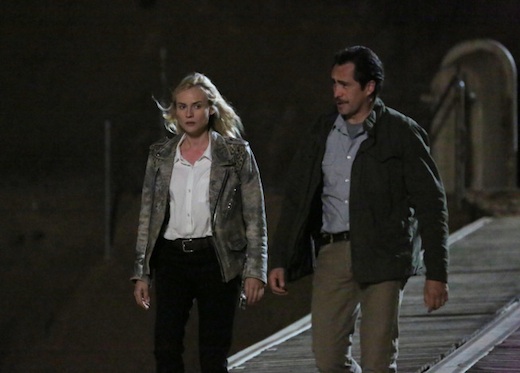
The first season of The Bridge was a mess. There was potential, and some things worked, but it never quite came together. The two main actors were fine, and the idea of exploring the border between Mexico and Texas and the drug trade which overwhelms everything else in the area was promising. That exploration though seemed to just be a stalking horse for a psychopathic serial killer with a personal vendetta against one of the protagonists, which was a disappointment. The second season, though, exhibited a rare quality. The creators clearly went back, saw plainly what worked and what didn’t, and doubled down on what worked, while slowly peeling away what didn’t. This seems like an obvious approach, but it’s shocking how infrequently it happens, either because writers don’t see what’s wrong with their shows, don’t want to see, don’t want to risk messing up what they have, or feel unable to improve it. The reporter side characters, a highlight of the first season, had much larger parts, while Charlotte and creepy Linder, obvious weak points, were slowly written out. Rather than one freak serial killer, the season dived into the murky corruption and government rivalries and tensions at the heart of the Mexican-American relationship. Because of this stark improvement, I was particularly saddened that The Bridge was cancelled. It’s sad to see a show really finding its feet only to have its head chopped off.

Ranking the Shows That I Watch – 2013 Edition: 40-37

1 Jan

Okay, we’re full on into shows I actually like. There’s a lot of good tv out there these days, eh? Being in the 30s doesn’t mean a show is bad, it simply means I watch too much television.

40. The Bridge

Not about Chris Christie

The Bridge is the last show on this list that I have genuinely mixed feelings about; everything above it is pretty safely in the like camp for now. A new 2013 entrant with an up and down, up and down first season, I liked a lot and I didn’t like a lot about The Bridge. The show was strangely paced, sometimes greatly to its benefit, sometimes to its detriment. There are loads of good ideas but the writers sometimes didn’t know which plots to focus on and which characters were the most interesting. Matthew Lillard was one of the better returning characters and I hope he’ll be sticking around. The primary two actors are very good and they’re at their best when they transcend the standard police murder mystery stuff and dig deeper which they do, well, sometimes. I left the season not having any idea how confident to be about the second season but I’ll at least watch.

39. House of Cards

Ace of Spaces

This is not a great show, but it is a good pot boiler that keeps you watching through the end – the all-at-once netflix format serves it well. The show is a bit nutty and goes a little off the rails, but while the plot doesn’t totally make sense, it makes enough sense that you can follows the convoluted steps in your head if you don’t think too hard about. Not every angle truly works and a tad more restraint may have pushed it a little higher. It’s an absolutely credit that the plot, which could have fallen apart easily and is pretty pivotal to the show, actually worked enough to make it a success, and credit the Netflix system and the guarantee of 13 episodes for giving it any chance at all to pace itself the way the writers wanted it. Does it all make sense? Well, enough, and that’s exactly enough. Kevin Spacey’s southern accent is equal parts grating and delightful and while I’m not on the edge of my seat awaiting the second season, I’m going to watch it. Corey Stoll’s role as a troubled Pennsylvania congressman was one of the season’s highlights.

38. Siberia

Siberia

As I mentioned above, I genuinely enjoyed Siberia and the fact it’s #38 simply says more about the amount of good tv out there than about Siberia itself. I’m fairly sure I know the only three people who watched this show. It’s based on a strange, brilliant, high-concept idea of making a scripted reality competition show, and the creators actually kind of delivered on the idea. It was trippy, weird, campy, and it didn’t always work but it was surprisingly fun. I honestly think this is the type of show that really deserved a little cult that simply never developed around it. It did a much better job of mimicking reality show types and the bad acting that accompanies them than any comedy I’ve seen. One day, I’ll make a shirt with the revealer on it and walk around with it and absolutely no one in New York City will ever recognize it. If you have a day when you’re snowed in and doing nothing, marathon this guy. It’s not an all time series by any measure and there are no brilliant deeper layers but I think you’ll be pleasantly surprised. As long as you don’t take it too seriously, it’s an awful lot of fun.

37. Family Tree

Family Tree

Light and delightful and fun. I’m not the biggest cult fan of Christopher Guest’s mockumentaries but I do generally enjoy them and I felt the same way about this show. If you like those movies you’ll love it, if you hate those movies, you’ll hate it, and if you’re somewhere in the middle I think you’ll be like me. Chris O’Dowd is an eminently liekable star and it’s just a cute and generally feel good piece of media about a man trying to discover his ancestry to learn more about himself after a break up. It’s awkward and weird but unlike British Ricky Gervais awkward it’s the kind of awkward that more often than not (albeit not always) works out all right in the end. It’s generally innocent and weird and well-meaning rather than vicious. There aren’t a ton of laugh out loud moments, but there are a few, and there’s more moments that just make you smile.

Summer 2013 Review: The Bridge

12 Jul

They're on THE BRIDGE

A body is found on a bridge which connects America and Mexico across the Rio Grande, between Juarez and El Paso.  A determined local young female American detective who presumably has a form of mild autism – probably Asburgers or I’m not sure if it’s just autism spectrum disorder now – (Diane Kruger, of Inglorious Bastards) is determined to make the case her own.  She works by the book, and due to her disorder, often rubs people the wrong way with a lack of empathy and social norms. She’s guided by her mentor, the only figure in the police station who seemingly she respects or respects her, Lieutenant Hank Wade, who oozes old-school Texas charm (Ted Levine, who has come a long way from Buffalo Bill in Silence of the Lambs) and who appears to be somewhere between Fred Thompson in Law & Order and Tommy Lee Jones in No Country for Old Men.

Wade agrees to try to hold off the feds and other cops from her case, but she’s forced to work with a Mexican detective, Marco Ruiz (Academy Award nominee Demián Bichir), who, after turning the case over to her initially, shows renewed interest when it turns out one of the bodies was a young woman whose other remains (only the legs were found on the bridge) were found near his home.

They start investigating as a duo.  She’s the more classic single-minded cop, focused on doing things immediately, correctly, and following procedure – she wants to report the Ruiz for allowing an ambulance through part of the crime scene on the bridge where the bodies were found even though the man in the ambulance likely would have died if he hadn’t (he dies anyway, but that’s not the point).  He’s more laid back, but interested, an honest detective who from a city where everyone is corrupt either because they want in, or because everyone else is already doing it, so what’s the point in even bothering.  She constantly lambastes him for the shoddy procedure he and the entire Mexican law enforcement division shows, not understanding the challenges he faces and that he has to carefully save up his reserves of actually giving a shit for when it can do something.

Juarez is famous for both its overall murder rate, its drug violence, and its mysterious and prolific murders of women, largely young women who work in the factories and manufacturing centers that have come to dominate Juarez’s landscape (If you’re really interested, I recommend Roberto Belano’s excellent but crazy long novel 8666 about a fictional Juarez equivalent).

This presents an interesting angle to work with above and beyond the simple solving of a murder, such as the  cooperation and divide between Mexico and America, trying to find justice navigating the famously corrupt and troubled Juarez government.  The border is a contentious area, and it’s certainly remarkable the difference that the border makes; El Paso is extremely safe, while Juarez is crazily dangerous and Mexican authorities have struggled to get any handle on the crime problems, trying to figure out to supply effective law enforcement without being paid off or intimidated by the cartels.  Now, it was entirely unnecessary and weirdly on the nose then for a recorded message from the presumed killer to spell this out blatantly, telling our detectives that El Paso’s a pretty safe place, while Juarez is crazy dangerous, and hell, that ain’t fair, so he’s going to be terrorizing El Paso for a while.

There’s two other strands to the plot, outside of the primary buddy cop duo.  First, the man who was in the ambulance crossing the bridge at the beginning ends up dying at the hospital anyway.  His widow starts to find out some shady parts of his life she didn’t know about, leading to a scene at the end of the first episode when she opens the barn door that will seemingly lead to some sort of unsavory surprise.

Secondly, there’s an American in a trailer in the desert who has kidnapped a young girl from Mexico.  We don’t know if he’s related to the main murders or not, but he seems at the least like he’s up to no good, and one presumes he’ll be connected in to the main plot somehow or another if not as simply the killer.

The first episode of The Bridge was above average, but not great.  The police scenes seemed to only be a couple steps ahead of the standard police tropes, and sometimes got lazy and fell back into them for a minute or two.  At its less tropy, The Bridge felt dark but more importantly grittily real, highlighting the fascinating setting of the border through location shots not only of the border but of the police stations and deserts that suggested the surroundings.  At its lesser moments, the three most prominent cop characters settled into established roles, and Diane Kruger’s character in particular recalled, and not in a good way (I don’t think there is a good way), the main character from The Killing.

It’s a cop show.  That doesn’t mean it’s just a cop show, but when you choose to make a cop show, you’re going up in a sense against every cop show that’s ever been on TV.  It’s hard to be new.  When I see a crusty old sheriff, while I should be focusing on just this particular sheriff, my brain rushes to compare him to every similar sheriff character I know, and that makes it harder for any one cop show to separate itself.

There were glimpses of separation, of becoming more than a cop show set on the border, which is the bare minimum I like to see from a pilot that I’m going to consider continuing to watch, but I hope that this is a launching point rather than an exact model.

Will I watch it again?  Yeah, I’ll give it another shot.  The show is only outrunning tropes by a couple seconds at this point, but that’s enough to give it an effort to separate itself.  I’m wary, but there were enough good parts that I’ll hope for the best.

Five Alternative Premises for “The Bridge”

11 Jul

Who wouldn't want this as their title screen?

The Bridge, which debuted on FX last night, is about a Mexican detective and an American detective working together to solve the mystery behind a pair of bodies left on the border between El Paso and Juarez.  It’s not a bad premise, and my review of the pilot will be out in this space tomorrow.  However, upon hearing the show’s title, a couple of far superior premises sprang to mind.  Here’s five of them:

1.  The Brooklyn Bridge is New York’s most famous bridge.  Here’s the amazing story behind the people who built what was then the longest suspension bridge in the world upon its completion in 1883.  Starting with the untimely death of original architect John Augustus Roebling, the show follows his son, Washington Roebling, who had to do his work from afar after he came down with depression sickness, and Washington’s remarkable wife, Emily Warren Roebling who learned about bridge building on the fly as she acted as a crucial link between the sick Washington and engineers on the site.

2.  The Bridge is a period drama centered around the group of German expressionist artists known as Die Brücke (“The Bridge” in German), including  Fritz Bleyl, Erich Heckel,Ernst Ludwig Kirchner, Karl Schmidt-Rottluff and Emil Nolde who came together in Dresden in the early 1900s.  The group of artists dreamed of taking on the current establishment by reviving older artistic traditions, publishing in a statement, “We call all young people together, and as young people, who carry the future in us, we want to wrest freedom for our actions and our lives from the older, comfortably established forces.”  Follow the movement at their studio, where the charismatic and ultra-talented artists flouted social conventions at the same time they were flouting artistic ones.

3.  The Bridge is the in-depth story of some of the megasupporters of Chelsea football, centered on the characters’ time together in the Matthew Harding Stand of Chelsea’s home stadium, Stamford Bridge.  The show focuses on lives of a small cadre of otherwise relatively mild-mannered supporters as they eagerly look to make it through the week to spend their time cheering all out for their beloved Blues and bonding with one another after every Chelsea goal.   The Bridge tells the story of how their obsession with Chelsea both brings their lives completely together for the better while sometimes almost causing them to fall apart.

4.  New York’s Queensbridge is the largest public housing works in North America, with almost 7,000 people residing there.  The Bridge revolves around a few residents of these projects, detailing the constant everyday struggles and little victories, the families making it work everyday in the light of the drug trade, and the young people hoping to get out, some using music as their gateway.  Queensbridge’s most famous ex-resident Nas narrates.

5.  The Bridge begins with a handful of characters making their way in the go-go lifestyle of the late ’80s on Long Island, and is prominently soundtracked by Billy Joel tunes from the album of the same name.  In each episode, we see, in addition, stories about the same characters at different points in time set to contemporaneous Joel music.  The segmented time periods allow for complex storytelling, with each time featuring its own stories, which are cleverly interrelated over the course of a season with the stories from the other eras.  The Billy Joel soundtrack provides a musical connection that both links together the different time periods, while making clear the specific times in which each story is taking place.