Tag Archives: ShowRanking

Ranking the Shows That I Watch – 23: The Killing

13 Sep

The Killing and Game of Thrones started around the same time, and Sundays became a day of excitement.  I started off liking them both the same, but that changed dramatically over time as Game of Thrones went up and up and The Killing went a little bit downward each episode.

The Killing is about a detective trying to solve the murder of a teenage girl in Washington.  For this short description, it drew instant comparisons to Twin Peaks, and though embarrassingly, I haven’t seen all that much of Twin Peaks, I think the differences don’t stop there, but they certainly slow.  There’s no absurdity or essential weirdness that is at the heart of most David Lynch works.  It’s played fairly real, and coupled with a plot about a mayoral candidate that may or may not be somehow involved in the murder, and a plot about the mourning parents and family that can be deeply difficult to watch at times, which is both a tribute to the writers and actors, and something that sometimes I don’t actually want to see.  The show’s city of Seattle provides a suitably dreary, ominous, and rainy mood, which fits the show like a glove (and not one of those ill-fitting one-size fits all gloves).

I must say I’m in a particularly sore mood, because, as I write this, I have most recently seen the third to last episode (though I’ll done with the first season by the time you read this) and it was truly one of the worst this-close-to-end-of-season episodes of a serial show I have ever seen.   Basically, the whole episode was devoted to the random disappearance of her son, who had never been an important part of the plot, and the other two, albeit less interesting over the course of the series, character sets – the grieving family of dead teen Rosie Larson and the mayoral campaign of high-minded candidate Darren Richmond weren’t even shown.  Instead of actually doing their jobs working on the murder case, the two main detectives search around town for her son. Um, there’s a teenage girl’s murder to be solved?  One in which the victim, maybe, didn’t do anything to cause it?  Oh, and POINTLESS SPOILER ALERT (I’m going to make an effort to use this again – spoilers that are so irrelevant that ruining them is not only pointless but makes your realize how stupid the spoilers were) – her son was with his dad the whole time (the first time I typed dad, I accidentally typed ‘dead” – coincidence?  Ominous)!  Oh, the same dad who has maybe been mentioned once offhand in passing in the entire fucking show.  Wow, that was ridiculous.

But yeah, that’s harsh.  The show has probably done more good things than bad, and I enjoy Billy Campbell as the candidate as well as the Swedish guy as the cop with an undecipherable American accent that comes from no real locale.

MEGASPOILER ALERT

I wrote most of this before the last episode of the show – but boy, after watching that finale, what the FUCK?  Holder’s evil?  So it’s the councilman, but it’s not, it’s a framejob by some mysterious person who we may or may not have ever met?  This show just changed entirely what type of show it is, and not for the better I think.  It was a slow, plodding, dark, dreary police investigation slowly leading to a hopefully tense and climactic solution.  What it is now is hard to say, but at the least, it’s no longer a police investigation – it’s a massive conspiracy that no longer allows us to even believe this could be something real.  It’s more into Rubicon territory. I’m not saying that this type of show has to be bad by any means, but I feel lied to and betrayed a bit.

MEGASPOILER OVER

Why it’s this high:  The show has a great feel, and when it’s at its best, the same deliberate pace, which I will decry in the next part, feels natural instead of slow

Why it’s not higher:  Sense of pacing is awful, the plot sort of got out of hand, and yeah, the last episode kind of changed entirely the type of show it is

Best episode of the most recent season:  “Pilot” – it might tell you something about a show when one picks the pilot as the best episode, and if it does say something, it says it here – everything was set up beautifully – a great beginning just to unravel slowly over the course of the season
Ranking the Shows That I Watch – 25: Entourage

6 Sep

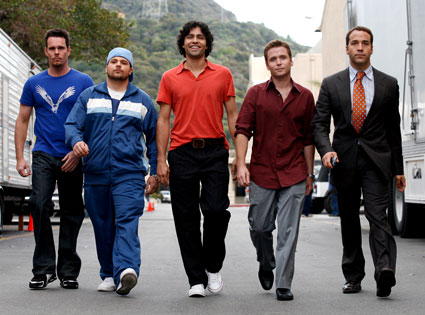
Here’s the funny thing about Entourage. It’s not the best show in the world; there aren’t a whole lot of levels, there isn’t much subtlety, and you’re not going to get layers of deeper meaning on every subsequent viewing (not that these are things you need to be a great show, just some possibilities).  However, I enjoy watching it more than I sometimes enjoy watching shows I think are better.  Now, I admit that sounds wrong at first, and if I always liked watching it more then, well, it probably is better.  Still, I always look forward to a new Entourage.  In today’s world of super awkward comedy and tension filled dramas, there’s room in my life for some popcorn, for a show that, even in the depressing and dark last season is still a total relative joy to watch.  Call it hanging out with the boys, if you will.

If Entourage truly had fallen off, and I think that’s mostly debatable, (I’d say it’s a lot more repetitive than it ever was bad) it had a bit of a boost last season, oddly due to its dark direction for Vince.  If you explained to me that things would go downhill, and not just career-wise but personally and with a drug addiction and all that, I probably would have thought that it would be a bad idea because it would involve taking from Entourage its essence, that it’s an escapist show about fun and good times.  I would have been completely incorrect though. Watching the downward spiral was not just good television, but it was surprisingly watchable for such a objectively depressing situation.  There were a couple of legitimately brutal scenes, including one where Vince hits on Minka Kelly and gets his ass kicked by a couple of NBA players at a party, but for the most part I still got a sense of enjoyment while also treading over ground Entourage hadn’t crossed before.

One note:  Entourage contains an example of a trap that television and movies often fall into when coming up with fictional content.  In the last season, formerly rogue drugged out director Billy Walsh conceives of a cartoon project for Johnny Drama, as a monkey who doesn’t fit in with the world.  In the world of Entourage, everyone absolutely loves this idea, and thinks it’s brilliant.  However, it seems terrible from the little bits that we see.  If you can’t make fictional content good, just never show it.  It’s not that hard.

Also worth saying:  Entourage may do the best job of celebrity cameos of any show around.  Obviously, it has more opportunity than most shows – why would celebrities be roaming around say, Scranton, Pennsylania, or Pawnee, Indiana? (though they manage to grab Detlef Schrempf twice which is super laudable)  Entourage takes advantage of this opportunity and does it well, having celebrities play outsized versions of themselves, or just invented absurd versions, proving to America that they don’t take themselves too seriously – such as Jeffery Tambor as an especially needy client of Ari’s, or John Stamos as so competitive that he can’t accept losing to Johnny Drama in ping pong.

Why it’s this high:  I really enjoy watching episodes of Entourage

Why it’s not higher:  I really do enjoy it, but I don’t crave it, pore over it endlessly, quote it (aside from “I am Queens Boulevard”) or laugh out loud watching it

Best episode from the most recent season:  How about “Bottoms Up” – Vince hooks up with Sasha Grey and begins becoming full-fledged down the vicious cycle that will be seventh season (man, this show has been on a long time) for him, resulting in awkward humor when he brings her to a meeting with Stan Lee.

Ranking the Shows That I Watch – 26: Psych

1 Sep

Psych is the spiritual heir to Monk in the USA family that seems to be coming up a lot early on the list.  What makes Psych work is chemistry between leads James Roday as Shawn, the faux psychic detective who assists the Santa Barbara police department in solving homicides, and Dule Hill as Gus, his life long best friend and more conservative and skeptical partner, who plays a comedic Scully to Roday’s comedic Mulder.

We’ve been comparing USA shows, but forget spiritual heir – an episode of Psych operates almost exactly, plotwise, as an episode of Monk.  Somebody dies, then the tottering/incompetent/helpless police force can’t figure out who the culprit is, which forces them to call on outside help –  a consultant whose prodigal observational powers and ability to see insanely complicated Agatha Christie-esque plots help solve the crime, often leading to a heated confession from the suspect, explaining exactly how and/or why the crime was committed, much to the dismay/shock of the police, who can’t believe they couldn’t figure out what the consultant did.

The difference is in the snark level, which is significantly higher in Psych, and Psych’s emphasis on pop culture references.  Commercials for Psych include a meta-commentary about how Shawn is a real-life version of The Mentalist, and a performance of Hall & Oates’ “Private Eyes” by the main characters all dressed up in 1980s costumes.  Not an episode goes by without back and forth zinger references between Shawn and Gus, often at the expense of the other characters on the show (or each other) and often coming at the most inopportune times.  Some episodes take on specific styles (or particular movie or TV homages), such as a Twin Peaks-like episode and a Fast and the Furious streetracing episode, among many others.

Sometimes it seems like the show should be a half hour, and it’s a little bit silly in a way that most modern television shows aren’t, though that’s not necessarily a bad thing, being just about the only one.  Even though it’s easy to watch, it’s not as easy to marathon, as too much too soon it can feel repetitive, because even though each murder is a result of some different cockamamie scheme, the process gets to feel really similar.  As long as not watching them back-to-back-to-back though, you can avoid this feeling well enough, and the similar process becomes a comfort – you know what you’re getting, and it’s pretty good – rather than a burden.

Why it’s this high:  Much like Entourage, Psych is easy and fun to watch, and there’s something to be said for that – it’s tv I can sit back and relax and enjoy

Why it’s not higher:  The USA low-ceiling formula continues to have this problem – most episodes are solid, but very few make for all-time memorable television

Best episode of the most recent season:  “Viagra Falls” – guest stars William Devane and Carl Weathers play a proto-Shawn and Gus from the previous generation, crotchety old detectives with their own unique methods and chemistry, who come out of retirement to compete with Shawn and Gus to solve the murder of their old police chief.

Ranking the Shows That I Watch – 27: How I Met Your Mother

30 Aug

I have some strong feelings about How I Met Your Mother, both good and bad, but I don’t have time for all of it here, so I’ll focus on a couple of points.

It’s the best old-school style sitcom on television, and though that’s sort of a back handed compliment, it is, well, a compliment.  It’s a multi-camera sitcom – it takes place largely on a set, and it earns at least my slight ire for being a New York set show filming in Los Angeles (enough shows film in New York these days – no real excuse – plus, it’s not like you can’t tell the difference after watching a real and not real New York show for a season – all the buildings in faux New York shows look so generic, and New York shows go out of their way to show off real New York locations that are well known like Washington Square Park).  It also has a laugh track, for which there’s really no excuse this day and age.

Earlier on this list, I talked about how Modern Family subverts the “traditional” sitcom in subtle ways, to make a little bit of a fresh take n the format.  For better or worse, How I Met Your Mother doesn’t do that.  It’s not a traditional family show certainly, but it keeps within expected bounds, and plays by some of the established rules.

As you may or may not have been able to tell from the tone of the article, generally I think these characteristics (and really, more than anything else, limitations) that mark a “traditional” sitcom are negatives, but they are not by any means enough to necessarily sink a show.  Merely, it means that How I Met Your Mother must get out of the hole by being funny.  And that it does, very well, generally, though better in some circumstances than others – sometimes it puts its foot in its mouth and prevents situations from being as funny as they could have been.  Still, the show, and particularly Neil Patrick Harris and Jason Segal, makes you laugh, has some quotable lines, even catch phrases, in a good way, rather than a this feels so forced into my vernacular way.

A couple of notes particularly on the most recent season (SPOILERS).

Quickly, they maybe dipped too often into the Robin Sparkles’ well.  Episode “The Slap Bet,” the first episode with Robin Sparkles, was the best episode of the series, and while I like that they don’t forget about it, every episode in which they’ve tried to recreate another song seems like a pale imitation.

In bigger plot points, what irritates me most of all is the way it feels like they’re forcing Barney into all of a sudden wanting to get married, and then getting married very quickly afterwards.  There’s two issues I have here.  First of all, it doesn’t feel natural at all.  Barney is a womanizer, and he just has a revelation that he’s super unsatisfied in his current lifestyle in one moment, revealing it to us, even though we’ve seen absolutely no evidence before.  Second, okay, the writers decide they want an emotional plotline for Barney.  They already have one with him finally meeting and coming to terms with his dad!  You can’t get much more big and emotional than that, and they’ve been harping about his lack of dad over and over again for the entire show so it feels perfectly natural.  Why can’t they just use that and be happy about it?

I’ll end with a complimentary note –Marshall’s dad’s death and its aftermath was handled very well.  It was a really sad and cruel moment, and I resented feeling so bummed when watching a comedy, but that being their goal, it was well executed.

Why it’s this high:  Neil Patrick Harris makes me laugh, and Jason Segal often does too

Why it’s not higher:  When the show is not being funny, it’s being terrible

Best episode from the most recent season:  It hasn’t been the strongest season, it’s been a slow downhill journey since season 2, but still there are plenty of funny moments and episodes – “Unfinished” I’ll pick mainly due to the plotline in which Barney woos Ted back to designing the building for his bank, by treating him like a woman.

Ranking the Shows That I Watch – 28: The League

25 Aug

I started seeing commercials for The League and thought two things.  First, that the premise of the show – a bunch of guys playing fantasy football – wasn’t really sufficient to hold up as entire season of a show.  Second, I thought that the show looked very bad.  I was right about the first, but wrong about the second.  The show is only peripherally about fantasy football.  It is a constant and recurring plot element in the show, and the writers do make a big deal to talk about it in almost every episode, but the show is more about five guys in their 30s with fantasy football just as a hook to make the show different from any other show about five guys in their 30s.  I have friends who enjoy the show who couldn’t name more than one or two current football players.   The show is actually pretty funny as well.  It’s often fairly silly humor – one of the funniest scenes in the show involves a character wearing a children’s character costume and carrying a knife, another involves Paul Scheer (of Human Giant fame) falling on his ass, and a third involves someone dropping a cake.

The second season got a bit absurd for my tastes.  During the first season, a couple of the characters are weirdos, sure, but the show more or less lived in the universe of reality. Second season plots include an episode which features Rob Huebel as  a ridiculous sex addict with a bunch of odd fetishes as well as a toilet seat used to smuggle in cocaine that one of the main characters is hooked on sitting on.  The show is funnier when it’s dealing with things in the realm of possibility, when one of the outrageous characters would do something stupid, and everyone else would make fun of it.  It’s kind of a formula, and it’s limiting, but it’s a formula that works.

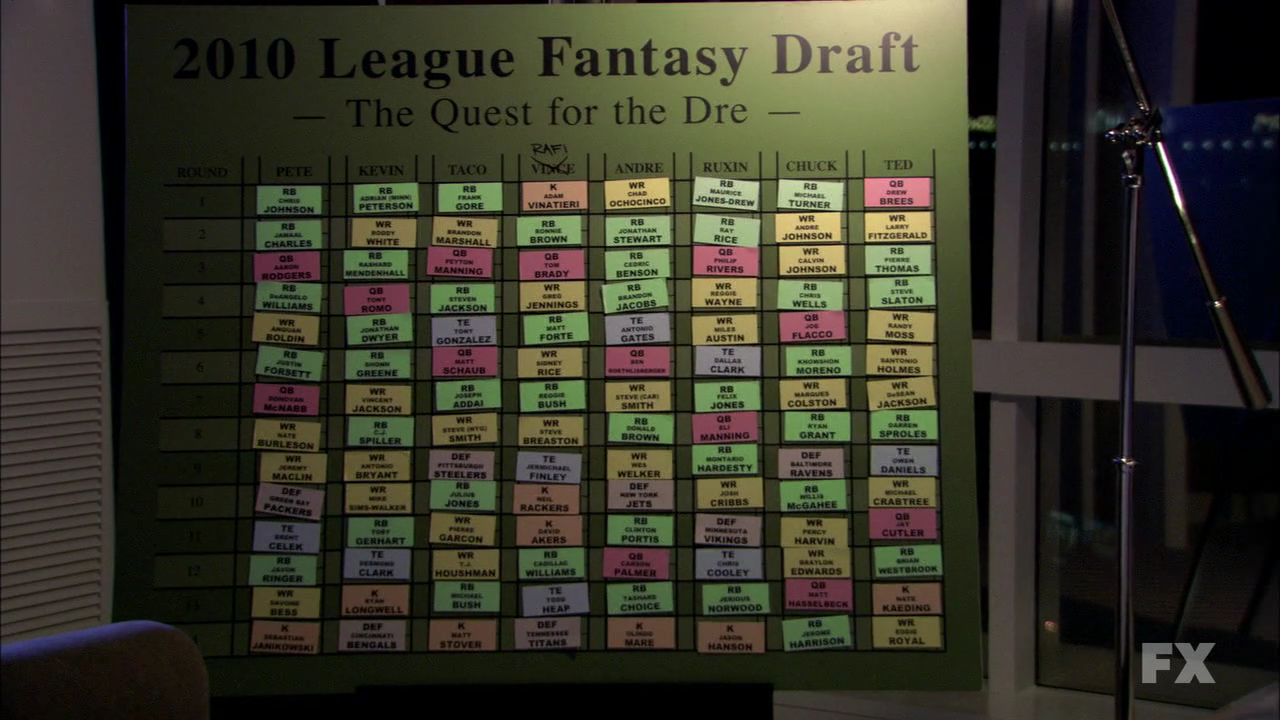
The show gets a couple of cameos from NFL players.  Antonio Gates, Chad Ochocinco and Josh Cribbs all make appearances.  All the devotion to fantasy football though leaves you wondering exactly why the characters are so bad at it.  Many of the football comments made in the show make absolutely no sense to the average sports fan, and that’s even counting for the lead time between the writing of the show and its airing.  The best example of this might in the draft board for the second season, which they didn’t need to show, but show well enough that you can read all the players, and a lot of it makes no sense to anyone who played fantasy football last year.  Two of the stranger choices are Ray Rice falling all the way to 11 and Steven Jackson somehow falling to the fourth round.

Why it’s this high:  It’s a pretty funny show about guys giving each other a hard time and wacky antics, and Paul Scheer makes me laugh

Why it’s not higher:  It’s trending in a direction where the strangeness overwhelms the funny, and the episodes can be very hit or miss

Best Episode of the most recent season:  “The Anniversary Party” – Pete, played by Mark Duplass, one of the founders of the mumblecore movement, runs into his ex-wife, now with a new, older man, and the two have an extremely silly battle to prove whether or not her new man can keep up with Pete at partying

Ranking the Shows That I Watch – 29: True Blood

23 Aug

I currently have this tired out feeling about True Blood – I’ll probably watch it when it comes back on (note:  this was written before the season started but I’ve added an addendum at the end with my short fourth season thoughts), but I can’t say I’m all that excited about it.  It’s hard to think of a show for me that’s gone just as quickly from something that had me glued to the television to something I really don’t care about.  It’s not as if it had made one or two big decisions which violated everything I believed in about the show, which would be the only reason I could think of for normally turning on a show so quickly.  It just got, well, bad, and not because of one thing, but because of a lot of things.

I caught up to True Blood while the second season was airing so I could talk to my friends about it.  The first season took me a couple of weeks, but the second season I really got caught up in.  I watched the last six or so episodes late Saturday night so I would be caught up for the season finale the next day, staying up til 4 AM, even though I was extremely tired.

The difference in seasons is easy enough to explain, though there are other factors I’ll cut out to get to the point quickly.  The second season had two main storylines which swept up just about all the main characters – the Church of the Sun (a church that was forming an army to take out vampires) plot and the Marianne (evil god-like beast who could sort of hypnotize everyone in the town) plot.  These were full season arcs, which built up compellingly and seemed to have a direction – the Church of the Sun arc wrapped up a couple of episodes before the end of the season and the remaining characters from that arc were swept into the Marianne plot, which worked itself out in the season finale.  This isn’t rocket science – it’s your basic plot graph – which is not for all shows, by any means, but there’s a reason that so many people use it.

The third season on the other hand contained a bunch of plots that seemed like they might end up coming together, and make the beginnings seem like mere build up, but instead these plots went nowhere.  For example, the plot about Sam and his family ended up having absolutely nothing to do with anything else in the show.  The plot with Jason and his lady friend and her family ended up having absolutely nothing to do with anything else in the show.  The one major plot, which appeared as if it could be compelling, involved the vampire king of Mississippi, ably and creepily played by Dennis O’Hare.  This plot built up well and seemed to be going somewhere until it reached its climax – (SPOILER) O’Hare appeared on a news show, biting and killing the news anchor and letting America know that vampires were out to take over and rule them.  It was a great scene – probably the best single scene of the series, and in hindsight I wonder if that scene was put in because it was good, without any context surrounding it.  The season pretty much went nowhere after that – the main characters eventually figured out a way to kill O’Hare, but it was thoroughly anticlimactic, and made it seem relatively easy to kill him after all the build up about what a great, old and powerful vampire he was.

Fourth season addendum  Actually, this is easy.  Just about everything I said still stands.  The season has been occasionally intriguing, and extremely trashy, but unable to recapture the rapt anticipation I had in the second season.  After each episode airs, I debate watching the next one, but then generally come around and watch it anyway.

Why It’s This High:  At its height, in the second season, it had everything I could hope for in a trashy soap with vampires

Why it’s not higher:  Everything good about the second season got away from the writers in the third – the plots were weak, seemed pointless, were anticlimactic, and generally less interesting

Best episode of the most recent season:  Episode 9, “Everything is Broken”, in which the climax for the entire season seemed to come, when, at the end, evil Russell, Vampire King of Mississippi shows up on national TV and kills a newscaster and announces war on humans…the season pretty much went down from there

Ranking the Shows That I Watch – 30: Royal Pains

18 Aug

My friend and I saw the commercials in the summer of 2009 – “Some Doctors Still Make House Calls.”  Done.  We were hooked.  We had already decided, as previously mentioned, that we would watch just about every USA show, but now we had a favorite, and it hadn’t even aired yet.  Even better, it took place out in the Hamptons on our very own home island, Long Island!  We declared it our favorite show on TV, and started quoting the catch phrase.  Now, as much as I loathe to admit it, this all was a bit ironic.  We know how to take irony far, though – we don’t half-ass it.  We watched every episode of the first season.  We quoted the part from the first episode which was in the “Previously On” section of literally every single episode –

Okay, this is going to require a brief explanation of the premise of Royal Pains.  Doctor Hank Lawson is a high-powered surgeon in a big New York City hospital.  A crazy circumstance occurs in the first episode, the premise episode, in which he has to choose between treating a rich hospital trustee and a teenager.  He chooses the teenager because he believes the teen has a better chance of living.  He saves the teen, but the trustee dies.  The hospital board is apoplectic, and fires him.  During this scene, the head board member asks him a question about how could he let a trustee die.  Hank says, “I made a judgment call.”  The head board member woman says in response, “You made a mistake”

Those two lines are literally in every previously on.  I’m not exaggerating.  So next time you need to impress a couple of Royal Pains fans, throw them a little “I made a judgment call” action and see if they give you the correct response.  It would be ideal as a call and answer to let Royal Pains fans into a speakeasy.

Basically, after that Hank and his brother go out and visit the Hamptons and due to a crazy set of circumstances, he lives at a mysterious rich guy’s villa and operates as a concierge doctor in the Hamptons, visiting patients, and having an on-again, off-again romance with an administrator at the local hospital.

All this said, the first season wasn’t all that great.  It wasn’t terrible by any means, it had its moments, but it was not the strongest light USA doctor procedural.  But we were committed and it was already cemented as our favorite show ever.

Then we watched the second season, and yeah, it’s no Sopranos, but it became an eminently enjoyable show, making us wonder what the ratio had become between ironic and actual viewing.  The show-runners seemed to get a lot more comfortable with the pieces they had, and though the episodes remain pretty light, and summer-y, as befits the show’s season and location (so far Hank has saved every patient he’s worked on), it’s really not a bad show, and I mean that as a compliment.

Why it’s This High:  It’s on USA, it’s on Long Island, and I’m a sucker for recurring guest star Campbell Scott.

Why It’s not higher:  It’s ceiling is unfortunately low – enjoyable should be what it’s aiming for, and getting, but its aims are not much higher.

Best Episode of Most Recent Season:  “A History of Violins” – honestly, it’s the great title, going more in depth into the plot is meaningless – it’s just a great title.

Ranking the Shows That I Watch – 31: Rubicon

16 Aug

By the skin of its teeth, Rubicon makes it onto the list, as it aired last summer, and well, won’t ever be airing again, but I did watch each and every episode, and I imagine I was one of the few.

I was actually extremely into the show when it started.  The main character, Will, is portrayed by the guy who played CTU agent and Elisha Cuthbert lover Chase Edmonds in the third season of 24 (James Badge Dale), though I would never have recognized him as he looks ten years older.  Will was a  socially awkward but brilliant intelligence agent for a mysterious top secret US intelligence agency in New York.  His family had died in 9/11, an unnecessary detail put in because every serious book, movie or television series set in New York has to show its connections to 9/11 to add drama and depth.  He worked under his father-and-law who dies in an insane train crash in the first episode, and we’re led to believe that this was indeed no accident.  The show set itself up as a long serial mystery show, like Lost, in that there would be a little bit of material given to the viewers in every episode, and if it was done well, its audience would be on the internet checking out what everybody else thought, and coming up with their own conspiracy theories about the conspiracy theories on the show.

The feel was of a classic, Three Days of the Condor-style ‘70s conspiracy thriller.  It got this part exactly right.  The mood was ominous, there were code names aplenty, and paranoia was everywhere.  Within a couple of episodes main character Will became paranoid, and then realized he wasn’t nearly being paranoid enough – his room was bugged, he didn’t know which high level employees were out for him (but at least a couple were), and eventually he had an assassin after him.

There are a lot of reasons why it ended up not working.  One might be that it played too far into clichés.  The plot really was that the events of the world being more or less controlled by a group of old white men (a very white show for a very white genre, I suppose).  Another reason was that the second most important plotline , which involved Miranda Richardson, as the young second wife of an old white man who died mysteriously/was murdered because he violated the terms of his cabal (we didn’t know this exactly at the time), was a lot less interesting than Will’s.

Throughout the show, away from the cabal, we saw the project Will and his team were working on at the top-secret-more-powerful-than-CIA intelligence agency, and the show ended up spending much more time on this plot, which seemed kind of irrelevant, until it was revealed that it was connected to the kind of cabal in a sort of ridiculous and pointless way.  The show had off-the-screen trouble with its showrunner and stuff turnover as it was being filmed, and it was easy to see watching the show.  The show just didn’t seem plotted or paced well, and the payoff at the end was a little bit disappointing and didn’t feel right.  Even though the last episode ended with a cliffhanger and I would have liked to see how it turned out, I didn’t feel all that disappointed that it was cancelled; I couldn’t say it didn’t earn it.

Why it’s this high:  It did a great job of setting mood, and brought back a great underused genre.

What it’s not higher:  It didn’t come together – the plot had no real direction and the pacing was poor and strange to say the least.

Best Episode of the most recent season:  I had to dig back in the archives here, but I think I’m going to say the first episode, because this is the type of show where that was really the high point– experiencing the potential before the execution kind of bungled it.

Ranking the Shows That I Watch – 32: Fairly Legal

11 Aug


My friend and I, some years ago (two, maybe?) swore some sort of blood oath that we would watch every new USA program, or at least give each program a chance.  This may have been at least partially ironic at the time, and it probably still is now, but it has lasted, and we’re still watching them (well, except for In Plain Sight – ironically, we never seem to catch that one).  Also, as a fellow lawyer who doesn’t practice law, I feel like owe it to mediator and main character Kate Reed  to watch her show about same.

In Fairly Legal, Reed (portrayed by the able and sassy Sarah Shahi, best known for her L-word work), a top-flight lawyer at the firm founded by her father decides that her profession doesn’t fit with her ideals, and so instead decides to become  a mediator, to solve disputes between parties without having to resort to the frictions and unfairly legal practices of the courtroom.  Each episode features her mediating a what-looks-to-be-unmediatable case, getting parties that often hate each other on the same page through her sheer charisma and powers of persuasion.

In the great USA program family tree, Monk is the patriarch – he came  from broadcast television, started the family, but now he’s retired and down on his development in Arizona resting and playing golf.  The father, his son, Pysch, took a lot from his dad, but learned some new tricks of his own as well, and is still at hand.  Now, to get to Fairly Legal, we move a couple of generations down the line, and assume that there was either some incenstous behavior or some dystopian cloning leading to Fairly Legal because it’s like a real USA show, but with, well, something a little bit off.  The familiar guidelines are there – lightheartedness, a mix between drama and comedy, largely self-contained episodes with a slow-moving serial plot that makes progress over the course of a season.  However, it’s just not put together particularly well.  The plots are weak, which is a shame, because, by USA standards, anyway, the concept could have some legs (like Shahi, zing).  USA has clearly recognized this and has put new showrunners in charge.

The other interesting note about the show is the unusual premise of starting with Reed and her husband estranged, though not yet divorced.  Her ex, portrayed by Battlestar Galactica’s Michael Trucco (Anders in BSG, Justin in fairly legal), is a San Francisco ADA, who loves Kate but is frustrated by her always putting him off for work, and other things.  Justin is still the main love interest for Kate throughout the first season, and they get back together and break up again a couple of times.  It’s nothing mind-blowing but I can’t think of another show where the series began with the main character and his or her featured love interest estranged.

Why it’s this high:  I watch this show on television, and, hey, it’s about lawyers who decided being a lawyer sucks.

Why it isn’t higher:  Sarah Shahi is pretty great, but the show really isn’t.

Best episode of most recent season:  “Bridge” – they’re really all about the same, but I’ll give the season finale some points for ratcheting up the drama in USA season finale fashion as a custody battle between father and grandmother is in danger of turning into an international incident.

Ranking the Shows That I Watch – 33: Modern Family

9 Aug

In the 2009-2010 television season, two broadcast comedies stood out both critically and commercially and made it all the way to a second season.  Neither of them was divisive, but both had significantly different appeals.  Community was much more of a narrow cult show, full of pop culture homage, and a perfect fit on NBC’s Thursday night block.  Modern Family was a far more traditional family sitcom with many classic elements, which also did a lot of things better than most classic family sitcoms.  It fit in perfectly appealing to a broader audience on ABC.  My friend and I watched both of them that entire year and we enjoyed both, but also had a year long argument over which show was superior – I on the side of the quirkier, much more interesting  Community, while he picked the old-idea-but-new-excellent-execution Modern Family.  I didn’t pick Community because the idea was new – I probably care less about newness and authenticity than almost anybody I know. I just have little love for the traditional sitcom (which makes me very glad I was not born any earlier than I was).  I have fallen behind on Modern Family, but for a rather different reason than I’ve more or less stopped watching Glee.  The decision not to watch Glee eventually became an active choice to stop watching a show that I thought once had a really good direction but lost its way.  The non-decision to kind of stop watching Modern Family came more out of forgetfulness and relative indifference – the show is the same it always was, at the same level of quality.

Now that sounds unduly harsh, so I’d like to take the edge off.  Modern Family is better than I made it out to be by my indifference. I admit it might be a character flaw on my part.  Modern Family, for those who don’t know, is about three related families, a typical nuclear family with two parents and three kids, two gay parents and their adopted baby, and an older man married to a younger woman, and her kid.  The best family is the classic nuclear family led by parents Ty Burrell and Julie Bowen, who are the highlights of the show.   Phil (Ty Burrell) is lovably awkward, an uncomfortable dad, but ultimately a good one.  And, similarly maybe most to Friday Night Lights, which I’ll talk about later in the rankings, the show showcases essentially working families, rather than dysfunctional ones.   For all their arguments, the parents are good ones and there’s no question that even when things temporarily go bad and tempers flare that everyone loves each other.

At its best the show plays by traditional sitcom rules, while at the same time subverting them in simple but important ways – the best example of this I can think of offhand is when, in a first season episode, Ty and Julie’s anniversary is here, and as opposed to the traditional sitcom (think, say, Home Improvement or Everybody Loves Raymond or countless others) in which the husband is always forgetting important dates, Ty remembered and plotted an elaborate series of gifts, while Julie had forgotten all about it.  It’s a small thing, but an important one, which makes the show interesting.

Why It’s This High:  It’s very well done, and although it’s not my favorite, it’s admittedly more a personal preference than because of the show’s failing – what it sets out to be, it is

Why It’s Not Higher:  What it wants to be is just not entirely up my alley – I can appreciate it, but I can’t develop a hunger for it

Best Episode of the Most Recent Season:  I haven’t watched a lot of the most recent season, but I’ve seen a few and I need to follow my own rules, so I’ll say “Unplugged,” in which the Ty Burrell attempts to wean his family from technology by having a contest to see who can go the longest without using it, and accidentally promises their oldest daughter a car if she wins it; when she does, they’re forced to admit they were lying