Tag Archives: Show of the Day

Show of the Day: Pawn Stars

7 Oct

I readily admit that this blog focuses by and large on scripted shows and I’m more than happy with that; scripted shows are far and away what I like better and care more about.  That said, I wouldn’t be human if there weren’t a couple of reality chinks in my armor, and Pawn Stars is one of them.  I’m not the only one captivated either, as Pawn Stars was the second highest rated reality show on cable behind Jersey Shore this year and the highest rated show on the History Channel ever (though I suppose that’s not necessarily saying that much).

Here’s how it works.  A man or woman walks into the Gold & Silver Pawn Shop in Las Vegas with something to sell, often something unusual, sometimes a collection, sometimes a firearm or a historical object.  One of the employees will talk to the man or woman, and ask him or her a bunch of questions about the object, such as what it is, and where he or she got it from.  Most often the employee will be Rick, the owner of the shop, but sometimes it will be his father, his son, or his son’s slightly dim-witted friend, Chumlee.  If it’s a particularly unusual object, Rick will call on an expert that he knows in the particular area of the item (a handwriting expert for autographs, an antique firearms expert for guns and so forth) and Rick will talk to the camera about how cool the item is and how much he’d like to have it in the store.  After he gets some information from the expert, the employee will ask whether the object holder would like to sell or pawn it, and what he or she would like for it.  They will then bargain, and more often than not strike a deal, but not always.  This will happen four or five times in any episode.  Occasionally, a pawn shop employee will go off premises to check out an item, find out how much it costs to get an item restored, or to try out a new purchase, like a gun, but that’s the general gist of it.

What makes the show so compelling is the combination of the diversity and randomness of the items plus the money angle involved.  It seems simplistic to say putting prices on items just makes them more interesting, but it really does.  Like some other shows I watch, there’s a joy in seeing the familiar but distinct aspects of the show.  I’ve often discussed making a drink game out of them.  Drink whenever Rick calls in an expert.  Drink whenever the seller is angry and thinks his item was worth a lot more than the pawn shop did.  Drink whenever a deal is struck.  Drink whenever they get an item restored.

Most of the items brought to the pawn shop are jewelry, but they rarely feature on the show because that’s less interesting.  Some would cite this as being misleading, but I really couldn’t care less.  I probably wouldn’t want to watch the actual everyday business of a more normal pawn shop (there’s Hardcore Pawn to get a little closer to that if I really want).

What is even better is that as the show has become more popular, the shop has become more popular, and the show then gets more and more interesting items; the longer the show goes on, strangely enough, the better it gets.

Pawn Stars has become a big enough sensation that it’s spawned a plethora of imitators and similar shows.  These include an actual spin-off American Restorations, about the shop of one of the restorers they use, similar History Channel programs American Pickers, TruTV pawn copycat Hardcore Pawn (you can’t make a series with a porn pun) and Discovery Channel’s Auction Kings.  They’re all watchable, and some are better than others, but none of them, unsurprisingly, top the original.

Show of the Day: Century City

23 Sep

I referenced this show in an earlier post about Nestor Carbonell, but since I find the concept so intriguing I wanted to spend some more time on it.  Started in 2004, the show starred Carbonell, Hector Elizondo, Viola Davis, and Eric Schaeffer as law firm partners and Ioan Guffudd (who I can tell without even looking it up is Welsh) and Kristin Lehman as associates.

The premise is this.  In 2030, in Los Angeles, the law firm of Crane, Constable, McNeil and Montero deals with all manner of law cases which come up, all of which involve questions which wouldn’t exist in our present, largely due to technology that doesn’t exist yet.  Some of these issues hit upon what would clearly be hot button political issues, while some of them are more light-hearted.  I’ll break down the issues in the pilot below, but issues that come up later on include virtual rape (I honestly don’t know exactly what this is without having watched the episode yet), whether baseball players can use mechanical eyes to improve their vision, a woman fighting for possession of her dead husband’s computerized likeness, and the gay gene.

The lawyers fit different roles.  Davis is the no-nonsense skeptical of pro bono work lawyer, while Elizondo is the wise beyond his years tells-random-stories-and-calls-it-advice senior partner.  Carbonell is a former politician who doesn’t really understand the law but knows how to read people while Schaffer is the skeevy sexually harassing lawyer obsessed with his self image.

The idea of the show is genius for many reasons.  For one, let all the existing law shows crowd around the existing legal issues.  Sure, there’s a lot, but they’re still bound to repeat with so many shows and so many episodes. Century City is the only show that can tackle the tough issues that don’t even exist yet.  Second, the license for creativity is infinite.  Most law shows aren’t truly bound to a high level of accuracy, but they at least generally feel like they have to try and pretend. Century Citycan claim that laws have changed, the legal system has changed, and precedents have changed any way they find convenient for drama.  Third, you get both a science fiction and a legal procedural audience with one fell swoop.

I decided to rewatch the first episode, which is on Hulu, to assemble some thoughts.  This episode deals with two main legal cases.  The first is about cloning, a hot button issue in any time.  A client played by David Paymer comes to the firm asking them to represent him, as he’s trying to obtain from the government a cloned fetus that was taken from him at customs.  He had it cloned in Singapore, where cloning is legal, as everyone knows, but tried to take it to the US, where cloning is banned.  He had the clone created from his son because he needed a liver transplant to save his son, whose liver was failing.  This would be created, so the science goes, by either taking the fetus to term and having a new kid, and taking half the liver for his son, or by somehow making it so the fetus just creates a liver.  The firm argues the case against a US attorney played by BD Wong.  Though it looks bad for a time, when it’s discovered that the son itself is just a clone of Paymer, an extremely moving speech by the Crane lawyer saves the day and sways the jury, leading the government to settle to save face.

The second, lighter case, involves a contract made by an aging rock group.  Three of the members have used future surgery and medical techniques to keep them looking young, but the fourth, the lead singer, has decided to revert to looking his age, which is 70.  The three want the fourth to take the pills and look young, and claim it’s part of a contract they all signed, but the old-looking lead singer, who the firm represents, disagrees.  They go back and forth, fighting, and disagreeing, until towards the end of the episode, one of the younger looking members, really 72, dies of a stroke.  At the funeral, the two younger looking members left go up to perform their hit song, allegedly from the early ‘80s, and in a warm moment, the old looking lead singer is finally persuaded to join them by the lawyer, after which the plot isn’t exactly resolved any further.

There are several tips towards the future, aside from merely the topics of law.  First, summary judgment motions don’t require actually entering a court room.  They can be conducted via hologram in the hologram room that every respectable law firm in the future has.  The judge even makes a joke about appearing upside down in hologram-form.  Cherries now don’t have pits, Elizondo notes – perhaps the greatest invention of the 21st century!  He’s even old enough to remember when grapes still had seeds.  Kristin Lehman’s character we learn is part of a cloning project (the “genetic prototype project” to be technical”) in which specially designed humans were let into society to see if they could fit in properly; she has a short identity crisis moment in the episode.  An offhand reference is tossed out to a happy patch people can take to stay happy, though it could just mean drugs.

Unfortunately the show lasted a mere nine episodes.  If this had been a success, would this be the wave of the future?  Shows about typical television professions in the future?  I could easily imagine a doctors of the future or a cops of the future.  Sure, there have been future cop shows, but 90% of these involve time travel.  What about future cop shows they just deal with new types of crime and non-time travel techniques.  What about a primetime television soap or a coming of age high school drama set in the future?  One can only imagine sadly.

Show of the Day: Greed

16 Sep

In 1999 the phenomenal, hard-to-believe-just-how-good success of Who Wants to Be A Millionaire spawned a generation of game shows.  Never ones to be denied an easy chance to ride a trend, TV execs everywhere thought the game show was back in a big way and were determined to make sure they all had entrants in the field.  Each game show created during this period had its own feel.  The Weakest Link was all about the host, nefarious Englishwoman Anne Robinson while  21 evoked a retro feeling for when game show scandal was in.  Greed was the Machiavellian entrant into the game show conversation.  Like all of the major game shows of this wave, trivia was the show’s stock and trade, but it was the gimmick that made the show.  In Greed that gimmick was that it was a team game that slowly turned team members against one another as they chose between team success and the risk/reward of greater personal gain.  Trust and team versus individual became of issue in the reality game shows developing around the same time, particularly Survivor, where alliances and assurances became key, but I can’t think of another game show which so gleefully turned constestant on contestant.  The Weakest Link employed voting contestants out, but there wasn’t the one-on-one animus as in Greed, or the sense that it was a choice; you were required to vote for someone.

Hosted by game show veteran Chuck Woolery (original Wheel of Fortune, Love Connection, Scrabble), a game of Greed began with six contestants asked to answer a question where the answer was a number between 10 and 999 (this was Greed’s rough knockoff of Millionaire’s fastest finger, in which contestants quickly ordered four choices – I’m not sure how many people would recognize that term now, but it was one of several Millionaire terms to enter the lexicon back then).  Based on how close they got to the answer, the contestants would be ordered from one to five, with the sixth being magnanimously thrown back into the contestant pool for another shot in a later game.  The first person became the captain, who has all the power in the world of Greed, and two through five line up after him or her.

The game begins.  The first four questions are asked to each of the contests, starting with the fifth, and moving up, towards the captain, with each increasing in dollar value.  The questions are multiple choice.  It’s important to remember in Greed that the captain has all the power.  The captain can choose to accept any contestant’s answer or can reject the answer and replace it with his or her own.  In addition, the captain can choose to walk away with the money the team has won after any question, with that money being redistributed evenly amongst the team.

Here’s where the real Machiavellian aspects begin.  After the fourth question, if the captain chooses to continue forward, a device known as the “Terminator” chooses one contestant at random and offers them $10,000 win or lose to challenge a contestant of their choice.  The stakes?  Whoever wins gets the losing contestant’s share of the prize money, and if the losing contestant is the captain, the winner gets the captain’s seat as well; the loser is eliminated from the game.  Many shows would simply rely on the contestant’s own ambition and confidence as fuel for challenging another contestant.  That’s not enough for Greed, though.  Greed gives you 10K for this privilege.  You could lose all your money as a team, but if you take up the challenge, you’ll take home with 10 grand, no matter what.  That’s an incentive that’s hard to resist.

Later questions had multiple correct answers, necessitating each member of the team to give correct answers one by one, with the captain having the choice of accepting or rejecting any part of the answer.  If the team continued to move on, another “Terminator” or two would come along potentially reducing the team to just a couple of players.

Sometimes you’d see a lamb of a contestant actually refuse to take the money for the Terminator, only to be challenged in the next Termination round, making his or her weak decision look foolish.

On later, high value questions, with four or five answers required, when Woolery showed them that they had all but one answer correct, the producers would offer the players a bribe – a small percentage of the total money to each contestant.  Each contestant would make their own decision to keep going and bet on their answer being right or to walk away with the bribe. If there are fewer contestants than answers in a round, the captain can answer them all him or herself or can pass off that duty to any fellow contestant.

Greed began airing in November 1999, right on the heels of Millionaire’s success and sadly stopped in July, 2000, never to return.  It was by no means must-watch TV, but I always thought it was a cut above a lot of other game show clones.  Greed was also the first game show to give away $2 million in one shot, which you can watch below, on a rather easy question mind you.

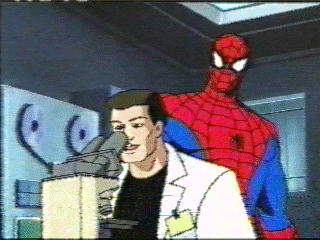
Show of the Day: Spider-Man: The Animated Series

9 Sep

My friend recently informed me that the Spider-Man cartoon from the mid-90s was on Netflix.  I grew up watching this Spider-Man, as part of the stable of ‘90s superhero cartoons along with X-Men, Batman and Superman.  Spider-Man has actually had seven different animated incarnations, from the first in 1967, to the MTV series in 2003 starring Neil Patrick Harris and Lisa Loeb, which attempted to be a little more adult, to, most recently a kids series in 2008.  This ‘90s Spider-Man, which ran from 1994 to 1998, longer than any other Spider-Man series, was, more than any other source, where I got everything I knew about Spider-Man.  I was so disappointed in the 2002 movie largely because it was so different from the cartoon which I loved.  Having not seen any episodes in at least ten years, I decided to watch the first episode of the series to see how it held up.

First things first, in this edition, Spider-Man (and of course his alter ego Peter Parker) is voiced by Christopher Daniel Barnes, whose best claim to fame outside of Spider-Man is playing Greg Brady in The Brady Bunch Movie.  Other notables include Ed Asner as J. Jonah Jameson and Hank Azaria as Eddie Brock/Venom.

The theme song is pretty unmemorable, especially compared to the contemporaneous X-Men cartoon’s theme, which I’ve had stuck in my head at least once a year for the past fifteen years.  I did appreciate, though, the appearance of the episode title at the beginning, a tradition which virtually doesn’t exist anymore.

Something else I appreciate greatly is the lack of origin story.  This is actually very difficult to believe for me.  Spider-Man’s origin story is so entwined with his character, probably more than any other prominent superhero (bit by a radioactive spider and so forth).  Yet, this series either takes on faith that you already know it, or decides that it’s really not that important.  I love it.  Maybe I wouldn’t agree back then, but the origin story has been done too many times, film included, and is so rote, and frankly not all that interesting.  I say get on with him being Spider-Man.

Another thing I love about this portrayal of Spider-Man which was probably the single biggest reason I couldn’t stand the movie was that in this version Spider-Man is wise-cracking and self-assured, constantly entertaining us with his inner monologue.  I understand this isn’t necessarily the most canonical version, but I like to think that, as Spider-Man’s in college by this point, he got over all his self-pitying identity issues and guilt over the death of Uncle Ben in high school.  Tobey Maguire’s emo Spider-Man was the antithesis of the cartoon’s version, and I just couldn’t get over it.

The cartoon is clearly aimed at kids, and it doesn’t have the darkness, ambition or animation quality of Batman: The Animated Series, which is probably the go-to for great cartoon comic adaptations.  That said, I was hardly dying of boredom either; the show was simple but still relatively entertaining.  I’m not sure I’ll start marathoning the series, but I might watch a few more of my favorite episodes.

The first episode is self-contained and features as a villain the Lizard, whose origin story is vaguely similar to fellow Spider-Man villain Dr. Octopus.  The Lizard was a great scientist, Curt Connors, who wanted to use reptile DNA to grow back people’s limbs, and when he tries it on himself, the reptile DNA takes over, turning him into a lizard-man hybrid.  The machine he used was called the “neogenetic recombinator,” a clumsy phrase which they manage to work into the episode at least half a dozen times.  The Lizard then invents a device which can turn other people into lizard creatures, and tries to turn it first onto his wife.  Spider-Man intervenes and for some reason, by the two-negatives-equal-a-positive school of thinking, turns the device onto the Lizard himself, turning him back human and leading all to be well.

Quick final note: it was also interesting to me that Spider-Man referenced fellow Marvel superheroes in the episode, at one point name-checking The Avengers, the Fantastic Four, and the Hulk.

Overall, I was pretty pleased with the way the series held up.

Show of the Day: Heil Honey, I’m Home

2 Sep

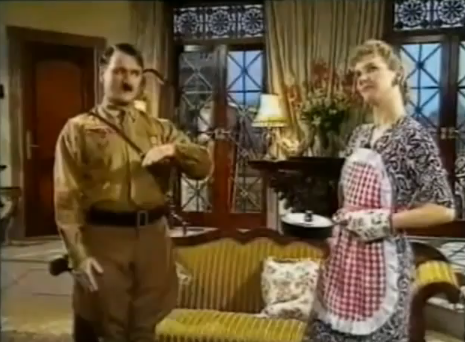
From the title, even if you didn’t have the picture, you could pretty much guess that it was a show about Hitler.  For whatever else you can say, it was certainly daring of anybody, even almost fifty years after World War II, to make a show about Hitler, mockery, satirical or not. I suppose in an abstract way I appreciate the willingness to push the bounds.  For whatever else, the appearance of Hitler as a main character also probably meant the show was ill-fated from the start, and frankly it’s amazing that an episode even made it on the air, especially in Britain which felt the effects of Hitler’s Germany much more than the United States.  The show just lasted an episode before it was pulled for good.

The premise was that Adolph Hitler and Eva Braun were a highly domestic couple living next door to a Jewish couple (Arny and Rosa Goldenstein, I kid you not), leading to awkward relations between them.  In the one episode that ever aired, Neville Chamberlain and his wife are arriving for a dinner party at Hitler’s.  Hitler begs his wife to hide the party from the Goldensteins, but, of course, it slips out, and the Goldensteins crash the dinner, leading to all manner of wacky hijinks.

The program attempted to skate controversy by portraying a foolish, absurdly silly Hitler, in the spirit of The Producers, The Great Dictator, or the Nazis in Hogan’s Heroes.  Its gimmick (as if starring Hitler wasn’t enough) was that it was a show from the ‘50s recently discovered, filmed in black and white, and in the style of I Love Lucy, or The Honeymooners.  It was supposed to lampoon that sort of canned comedy between husband and wife.

I thought this premise sounded so absurd and ridiculous that I explained it to everyone I met when I found out about it a couple of years ago.  I got together a bunch of friends and put it on.  I expected it to be bad, but bad in an enjoyable way.  It wasn’t.  It was just bad.  We watched for about five minutes and then lost all interest.  We didn’t even see a point in finishing the episode.

It’s worth talking quickly here about a show or movie being bad.  It’s not enough to describe something as bad.  There are levels of bad.  There’s bad, like Two and a Half Men, bad.    It’s not good by any means, but it’s not incredibly cringeworthy (usually) and it’s more or less tolerable, if stupid, for a couple of minutes.  There’s so bad it’s funny, such as many Mystery Science Theater 3000 movies, like Reefer Madness and Santa Claus Conquers the Martians.  Even lower than so bad it’s funny is simply so bad it’s bad, so bad that you can’t even enjoy reveling in its badness, you’d rather simply be doing almost anything else than watch.  That’s Heil Honey, I’m Home.  Even with all its gimmicks, it, a show about Hitler in the style of a ‘50s sitcom, still couldn’t manage to be funny bad, and that’s maybe the most impressive thing.

That said, the first episode is entirely on Youtube if you want to try it for yourself.

Show of the Day: Eerie, Indiana

26 Aug

Eerie, Indiana is the story of a boy who moves from New Jersey to the title location, a medium sized suburban town in which all manner of the bizarre, grotesque and supernatural reside.  The show aired for one season on NBC during the 1991-92 television season.

Eerie, Indana was intense, but silly, scary but absurd, sort of like X-Files with a couple of preteens and a sense of humor.  There was certainly a bit of commentary on what lies beneath the generic conformist suburbs a la Pleasantville or The Ice Storm, albeit clearly less serious.  The introduction sequence of the show tells the tale.  Marshall Turner, the main character, a thirteen year old boy, narrates, explaining that his dad, a super scientist, sought to move him and his sister away from the grime and crime of New Jersey, and to a more traditionally suburban environment.  However, Eerie,Indiana wasn’t what they had bargained for.  The rest of his family doesn’t seem to know it, though.

I rewatched the first episode which I hadn’t seen in well over a decade (handily, every episode in on Hulu) and discovered pleasantly that the show holds up fairly well.  In the episode, Marshall’s family is visited by a housewife, who looks like she came right out of the early ‘60s.  She lives nearby and tries to sell them a food storage product, like Tupperware, called Foreverware, which promises to preserve any food product forever, as long as it’s sealed properly.  She comes with her two twins, both seventh graders, also dressed in early ‘60s fashions.  One of them slips Marshall a note on the way out with the words, “Yearbook 1964.” Marshall discovers that those kids were the same age then, and through some investigating with his friend Simon, finds out that the housewife is using giant foreverware containers to keep herself and her children the same age as they were when her husband died in 1964.  Spurred on by the ‘60s twins and his fear that his mom will soon be purchasing foreverware, Marshall and his sidekick invade the house, open the foreverware beds, thus letting the twins out, who do the same for their mother.  The show ends as we see that the twins and mother have aged 30 years in a day.

Other episodes have similarly supernatural premises, often with a twist of the suburban.  The show does well to last half an hour, rather than an hour – it moves right along, without any wasted time.  Marshall, played by Omri Katz, who has appeared in just about nothing else, is charming and likable, if not the finest acting talent around.  The plots are reasonably clever and well written, and while not groundbreaking, it’s nice to watch a supernatural show with a sense of humor.  The episodes are played straight – there aren’t a whole lot of laugh out loud moments, but the atmosphere of the absurd is felt throughout.  Honestly, after watching the first, and realizing I can finish off the show in about two days, I’m seriously considering taking it on again.

The Fox Kids Network revived the show for a spinoff for a season in 1998 as Eerie, Indiana: The Other Dimension, with original characters Marshall and Simon showing up in the first episode communication through dimensions to the new characters in parallel world’s Eerie.

Show of the Day: Bull

19 Aug


To say that something is long forgotten assumes it was once remembered to begin with, which is why that phrase would not be applicable to Bull.  I’ve never met another person who remembers the existence of the show.  That said, even if you’ve never heard of the show it holds an important distinction in the annals of cable TV.  It was the first ever original series on TNT.  Now there are Leverage and Dark Blue and The Closer and Saving Grace and Rizzoli and Isles and all of them owe a little something to Bull, as the oldest child it may not have been the most successful, but it paved the way.

Bull was almost doomed from the start.  Named after the Bull market that seemed ready to last forever, the show aired as the dot-com bubble began its crash, making it look very out of place with circumstances.

Bull was a story of a group of young ambitious investment bankers who were about to break apart from the large, well established investment bank they were part of.  Making this transition even more controversial was the fact that the leader of the breakaways was the grandson of the founder of the investment they were all leaving.

I didn’t know a damn thing about investment banking when I watched the show (I don’t know all that much more now), but they managed to make it seem like a crazy, exciting, high-stakes world where the success of their young firm hinged on ten things going right every episode.  In the first episode, the rebellion from the old firm begins led by proud WASP scion Robin Roberts III, played by actor George Newborn, who might best be known for providing the voices for Superman in the Justice League series of cartoons, and Final Fantasy character Sephiroth in any English language incarnation of games that featured him.  His dad was portrayed by Ryan O’Neal, and his grandfather, known as the “Kaiser” who would become the primary antagonist of the show, was played by Donald Moffat, a British actor who might best be known for playing the evilUSpresident in Clear and Present Danger.  The show also featured Elizabeth Rohm who went on to a stint as Assistant District Attorney on Law & Order for a couple of years, and Stanley Tucci who played a more experienced negotiator who the team needs on their side to survive, but whose loyalty is in debate in nearly every episode.

Basically, in each episode they try valiantly to stay afloat, as the old firm tries to bring them down, attempting to sabotage their every deal.  There’s plenty of personal tension abreast as well.  We never got any resolution; Bull was cancelled halfway through its run, and I know of know way to get my hands on the second half of the season – though a youtube commenter on the preview above mentions that they showed the whole thing in Finland.

Did Bull make television history?  No, not really.  But I watched it, it deserves at least a rememberance that it once existed.  A marked grave, if not necessarily a yearly candle on its day of death.  I don’t think that’s too much to ask.

Show of the Day: Murder in Small Town X

12 Aug

It was the year 2000, and reality competition shows were just beginning their hey day, ushered in by Survivor’s magical 1999 season.  Fox debuted what would turn out to be the only season of Murder in Small Town X.  Unlike straightforward reality competition like Survivor, Amazing Race and The Mole, Murder in Small Town X is harder to categorize.  Is it a reality a show?  Well kind of – there are a bunch of real life contestants competing over a prize.  But unlike your typical reality competition show, there’s a pre-written  dramatic plot – it plays like a murder mystery.

Basically, ten contestants are brought together as detectives to solve a series of fake murders in a fictionalMainesmall town.  Just about everyone in town was a suspect.  The contestants/investigators each week would be sent on various investigatory missions to learn more about the crimes – clearing suspects as they did it.  At the end of the first episode, the investi-testants (my quick, and albeit not great shorthand for investigator/contestants) are given a video from the killer, narrowing their suspect pool to 15, which are slowly eliminated over the course of the season by the players answering questions correctly, or because other suspects are murdered along the way.  At the end of every episode, two investi-testants would be chosen to investigate two separate leads.  One of these would result in an important clue while the other would result in being murdered by the villain and eliminated from the game.

The murder plot was oddly compelling, even game show aspect aside, as intricate as any Agatha Christie novel.  It all started, for the investi-testants, with the murder of a family known as the Flints, and continued with the murder of four of the 15 suspects.  It turned out that the story dated back to the 1940s, when the members of another local family, the Duchamps, were murdered on orders of a secret society made up of the big wigs in the town after the Duchamps discovered a secret illegal liquor smuggling operation being conducted by the society.  One of the family members survived the fire set to kill them, and this “Burnt Face Man” as he would become known left a number of clues for the investi-testants to find, videos for his son.  The “Burnt Face Man” killed one of the members of the secret society before guilt turned him to suicide, but his son turned out the be the killer, murdering still living members of the secret society and their descendants.  His son turned out the business partner of the patriarch of the family murdered at the beginning of the season.  I had to avoid a great deal of detail to sum up the story quickly, but if for some reason, you want more you can find unbelievably detailed recaps of each episode here.

Show of the Day: Time Trax

5 Aug

Show of the Day:

Originally, I figured I’d highlight mostly little-known or relatively obscure shows in this feature, but I want to leave the door open in case I have an itch to scratch about a more popular show for whatever reason.  Here’s the first entry:

Time Trax

This entry is a tribute to my friend, who has a healthy love of all things time travel-related, and is singularly obsessed with a show called Time Trax (obsession is relative – for a show of Time Trax’s level of popularity I consider owning and having seen all the episodes multiple times as obsessed)..

Time Trax ran two seasons, from January 1993 to December 1994, for a grand total of 44 episodes.  The basic plot is as follows – Darien Lambert is a police detective in 2193, two hundred years in the future, in a world where everyone is fitter, smarter, and generally more attractive, due to some sort of Gattica-like natural selection, or something less dystopian – it’s unclear and not really important, though it is noted that white people are in the minority, and “blanco” is a vicious racial slur.  Lambert is portrayed by Dale Midkiff, a TV veteran who has bounced around a bit, and might be best known for starring in Pet Semetary.  The villainous Dr. Mordecai Sahmbi, played by Peter Donat, possibly best known for his role as Fox Mulder’s dad in the X-Files, is a brilliant scientist who has invented a form of time travel technology, and springs a whole bunch of criminals from jail, and sends them back to 1993, where their knowledge and genetic superiority could enable them to take over the world.  Lambert must go back in time to 1993 himself to apprehend the fugitives, at a pace of something like one a week, and send them back to the future where jails can handle them.

Lambert doesn’t have to do it alone, however.  He’s always guided by his handy hologram Australian guide, SELMA(short for Specified Encapsulated Limitless Memory Archive) – kind of his equivalent of Al, from Quantum Leap.  (The show even has an opening narration which is similar to Leap’s).  She’s a computer, but seems to have feelings, and has a motherly relationship with Lambert, who she councils and finds out information for (plane times, crazy things about 1993 with which Lambert is unfamiliar).  Lambert uses his knowledge of martial art Mosh-T, which is a combination of the most effective techniques of martial arts of the past, and the 22nd century’s standard police weapon – an MPPT, or Micro-Pellet Projection Tube, which, although it looks like a mere keyless car remote, is capable of capturing a fugitive in a field of energy, paralyzing him and making it possible to send him back to the future.  (The plot is kind of a reverse Brimstone, an even shorter lived obscure show, which may well be worth its own entry in the future).

Persuaded by my friend, I have seen a number of episodes.  The two I remember most, aside from the pilot, which featured Ferris Bueller’s Day Off’s Mia Sara as a young prodigy who evil Sahmbi is obsessed with, are The Prodigy, which featured a young Rider Strong (of Boy Meets World fame) and Beautiful Songbird, which deals with Lambert trying to protect a young country singer, who he knows will go on to become famous, from a future criminal.  Time Trax was apparently unsuccessful enough to be last new production of Lorimar Productions, which was behind a number of successful shows, including Eight is Enough and TGIF standards Full House, Perfect Strangers, and Hangin’ With Mr. Cooper.  It was successful enough, however, to inspire a truly terrible Super Nintendo game.

I never quite figured out why my friend has such an abiding love for the show, aside from simply the fact it had time travel, but it was by no means a bad show, and certainly deserves a little rememberance.