Tag Archives: NBC

Fall 2012 Review: Revolution

27 Sep

One of two new long-form serial shows on network TV, along with Last Resort (which I preferred),  the central premise of Revolution is  that all electricity in the world has turned off for some mysterious reason.  This is far more science fiction than Last Resort, which is more hard-boiled political thriller, and it has the JJ Abrams good conspiracykeeping seal of approval.  There’s a whole lot of premise and plot in the first episode to attempt to put the show on solid footing going forward, so some plot now, and more opinion at the end.

The show begins in the current day with a family in Chicago, composed of a father, a mother (played by Lost’s Elizabeth Mitchell), and a little girl.  The father says something like, it’s happening, and that means that the world is losing power, which he knew would happen; he calls his brother, in the military, preserves a USB key which is placed on an unnecessarily special looking necklace (Chekov’s USB key? Also someone should tell them that it doesn’t matter what the USB key looks like, it works the same).  And then it happens; power goes out everywhere, planes fall from the sky, people die, mass hysteria.

It’s now 15 years later.  A bunch of people are living in an old fashioned village, and a portly dude with glasses (where do they get glasses from?  I guess he just had the amazing fortune to never break or lose his glasses in 15 years of mass hysteria) is telling a group of kids about how the world used to be.  The father from the first scene is here along with his two kids, teenagers, Charlie, the elder girl, and Danny, the younger son.  They’re part of a family unit with their dad’s new girlfriend, an Australian doctor, who joined up after his wife died (sidenote:  we, of course, know she’s not dead, because Elizabeth Mitchell is in the main credits, so unless there’s just a shit ton of flashbacks, or hallucinations, she’s somewhere).

Representatives from some sort of evil-seeming militia, the Monroe Republic, come up on horseback with weapons, led by Giancarlo Esposito (on a villainous streak coming off playing Gus on Breaking Bad).  When the father assures Esposito they’ve paid their taxes, Esposito explains that’s not why he’s here; he wants the father and his brother Miles.  The father doesn’t want to go, but on threats to the rest of his family, he agrees, asking just a moment to say goodbye.  The members of the little town, including Danny, don’t understand, and stupidly try to turn their weapons on the much better equipped militia.  The father ends up being shot and killed in the crossfire  which means Esposito, to save his own hide, takes Danny, the son, instead.  The father, before succumbing to his wounds, tells his daughter that she needs to seek out his brother Miles in Chicago.

Off to Chicago!  The great journey begins!  The daughter, Charlie, the new girlfriend, Maggie, and the fat dude, Aaron, all set out to find Miles, who will hopefully help them rescue Danny.  Charlie runs into a young attractive dude with a bow and arrow and tells him where they’re going.  The crew tries to sleep on the plane (en route, the fat dude, says he used to be a multi-millionaire from some company name Google, but that’s all worthless now), where they’re assaulted by some hooligans.  They attempt to rape Charlie, but the crew escapes because the hooligans drink some of Maggie’s poisoned whiskey, and the young bow and arrow dude from before shoots another hooligan.  Nate, the bow and arrow dude, accompanies them; while Maggie pleads with Charlie not to trust him, his act of helping them out wins the day.

That’s it, they’re in Chicago.  That was fast (their speed in reaching Chicago reminds me of this Flight of Conchords scene).  They go to a random bar, and naturally the first person they meet, the bartender, is Miles, though he doesn’t want to admit to it, and he talks to Charlie in private, and tells her he can’t help.  Also, he discovers that new friend Nate is a spy, and warns Charlie and crew to get the fuck out of Dodge for their own safety.  The militia comes in and it turns out Miles is a super duper badass who kills just about every militia member and at the end of the battle it also turns out that the rest of the crew stuck around to help him.  So, his niece convinces him to join with them and find her brother.  Meanwhile her brother escapes, is taken in by a woman and helped, then caught again at that woman’s house.  The woman also has a crazy USB key which she puts into a super old PC and types in the command prompt to someone else.  Power still exists!

So there’s obviously one huge question hanging over the entire show – why did the power go out?  Then there’s also, why do these people have ridiculous USB keys, and all of that.  Initially I’m less impressed with the characters than Last Resort, as they seem more likely to be cardboard action-adventure clichés and I almost wish this show was just set in this post-apocalyptic society, and there were no USB Keys, and no crazy power conspiracy, but then it wouldn’t be a JJ Abrams show, would it.  For all the later disintegration of Lost, damn, that pilot was captivating and I haven’t seen one as good in a Lost-type show since.  I do wonder though whether the end of Lost has made me look for the potential future problems in all of these first episodes.  When I watched the Lost pilot, I was innocent and naive, assuming the writers had a brilliant plan for how the series would be laid out just as good as that first episode.  If I had to guess there’s ten ways this show can come apart and at least one will happen, either due to the plot, or due to everything else being uninteresting besides the plot.  It doesn’t have to go that way though, and it’s unfair to judge the pilot simply on the likeliness that that will happen.

I also misjudged how the show would work, even in the first episode.  I thought the quest to Chicago would be an epic multi-episode spanning arc in which we’d slowly learn more about the world that exists in Revolution, but instead it took about five minutes.  This isn’t in and of itself bad, except that it leads to likely pacing problems in the future.  Shows like this want to have extremely plot-heavy first episodes to get the viewer involved, but if the next few episodes end up becoming much slower to compensate, it basically defeats the point.  There’s so many more ways to screw up long form serial conspiracy shows than to get them right that it makes one very dispirited just trying to think past a pilot.

Will I watch it again?  Yeah, I’m going to watch a couple more.  The more I think about it, the more I expect the show to get at least mediocre and then quite possibly bad, but because I desperately want one of these types of shows to succeed and be good I’ll give it a couple of chances.  My report and opinion after five episodes will carry a lot more weight than this first impression.
 

Fall 2012 Review: Guys with Kids

25 Sep

Personal branding has become a big industry in TV, as more and more showrunners and executive producers and creators pop their names on different projects.   You’ve got the actual people who run the show day to day like The Shield’s Shawn Ryan behind Last Resort and The Office’s Mindy Kaling taking on The Mindy Project, but you’ve also got the producers with whom it’s unclear how big their role is on the show – Judd Apatow behind Girls and JJ Abrams behind Revolution, for example.  Guys with Kids has been promoted heavily as being produced and “from” NBC Late Night host and longtime SNL alum Jimmy Fallon,  and is being sold on that name more than any of the actors or anything about the show itself.

Now, I haven’t always been the biggest Jimmy Fallon fan (I think SNL is the most overrated cultural institution of the past 30 years and never dug his weekend updates), and I just about never watch non-Daily Show/Colbert Report late night TV, but from what I hear, Fallon’s show is actually kind of pretty good, and every once in a while I’ll see a decent segment that becomes viral. So, I’m not exactly expecting the world when Jimmy Fallon puts his name on a show, but I do expect better than a retrograde laugh track-y sitcom about men trying to stay men.

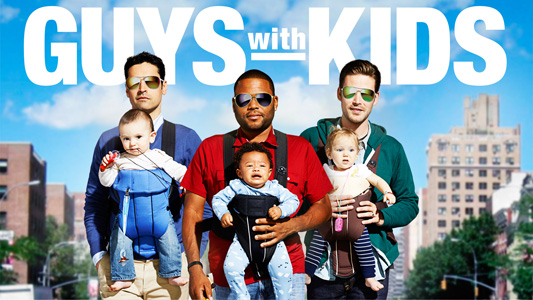
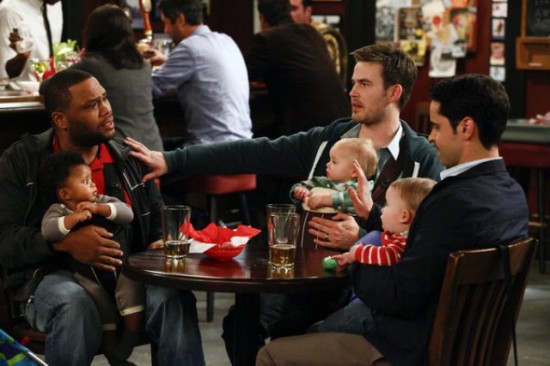
Three best friends and dads with young children hang out and try to stay cool even with all the responsibilities placed on them by having kids.  They’re played by Anthony Anderson, who has four kids, Zach Cregger, who has two, and Jesse Bradford, who just has a baby. The former two are married, while the latter is divorced. The only minor “twist” on typical sitcom family structure is that Anthony Anderson is a stay-at-home dad, while his wife, played by The Cosby Show’s Tempestt Bledsoe, works. In every other way, the jokes are typical and the laughs are canned, filled with lots of familiar ground like that men and woman are different, and which activities are and are not masculine.

The first episode plotwise as well is loaded with typical sitcom situations shown and portrayed in a typical way. Typical doesn’t have to mean bad, but in this case it does. Divorced Bradford wants to go on a date to the Knicks game (Go Knicks!), but his crazy ex-wife (played by Childrens Hospital’s own Erinn Hayes) won’t watch the kid, or allow him to hire a babysiter because she has her own date, with Kareem Abdul-Jabbar (and, yes, from the moment his name was mentioned I put the odds at 85% that he would actually show up, and he does, and I wonder how much he got paid). Hilarity ensues when the babysitter bails, Cregger has to watch the baby, and Bradford has to rush back to his apartment when his crazy ex, who still has a key, decides to pay an impromptu visit to check that he wasn’t lying about the babysitter. Cregger on the other hand, angers his wife (Meadow Soprano herself, Jamie-Lynn Sigler) by agreeing to watch Bradford’s kid on the night they’re supposed to go out to a silly Titantic themed event for their daughter’s school. The event is ridiculous, he thinks, why would she care, not realizing she just wants to get out of the house, after spending much time indoors with the kids, as stay-at-home dad Anderson explains. Come on dude! Marriage 101!  He makes it up to her with an adorable fake Titanic dance when she gets back, and all is forgiven in the name of love.

Even the most boring and trope filled plots can be played with and reworked endless times in genuinely interesting ways. However, I spend time describing the plot because 90% of the time, you actually can guess accurately from just reading it whether the show is going to be good or not. I think this is one of that 90%.  I don’t think the premise is the real problem though; rather, it has all the pitfalls of most multi-camera shows that appear these days (I don’t think multi-camera shows have to have these problems, but they tend to); the timing is terrible, the few jokes that could be funny aren’t, and everything feels boxed and forced instead of free and natural.  I like Anderson and think that if he was put in a better situation to succeed he could be very funny; but the mediocre dialogue in addition to the format are stacked against him.

This would be a show not worth watching 15 years ago, but at least it wouldn’t have stood in such stark contrast to the really good comedies on TV.  The best I can say about it is that it’s not offensive like the truly awful comedies, the Last Man Standings, and the Rob!’s, but that’s very small praise.

Will I watch it again? It’s nice to have an easy no.  It’s too bad Jimmy Fallon couldn’t use his newfound critical acclaim to put his name on something better.

Fall 2012 Review: The New Normal

14 Sep

Maybe I had this preconception going in, so it’s unfair, but The New Normal felt like it definitely oozed a lot of the Glee Ryan Muprhy sensibility (probably not as much American Horror Story).  Not so much songs, but very slickly and cleanly produced and very quirkly, while also wearing social and racial issues on its sleeve, without a trace of subtlety.  This is exemplified by the grandmother character played by Ellen Barkin whose one note is calling everybody racist or homophobic names, and who comes off as a very poor man’s Jessica Walter in Arrested Development.

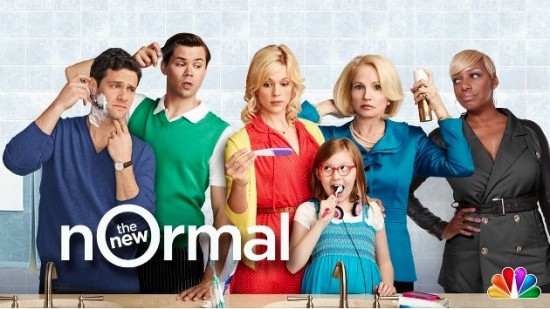
Let’s start with our premise.  An otherwise contented and career-wise successful gay couple decides they want a child.  The more flamboyant of the couple does something or other in an office where he has a sassy black female assistant who he lavishes with gifts that she buys with his dime, while the sport-loving more masculine member (played by Doug, the groom from the Hangover’s Justin Bartha) is a gynecologist.  The two find an egg donor they love (she looks like Gwyneth Paltrow) but the original surrogate for their baby attempts to blackmail them, threatening to smoke and drink unless they cater to her expensive needs.

Meanwhile, somewhere in the Midwest, Goldie is working as a waitress/bartender (guessing based on uniform) and regretting her past mistakes, having a kid at 15 (her greatest mistake, in both senses of the word, etc, etc) which never let her live out her dream of going to law school.  She’s on her way to work with her aforementioned homophobic, racist, grandmother, and her daughter, when she has to stop back at home after forgetting something.  She finds her douchebaggy husband having sex with another woman, and sees this as a moment to leave everything behind and drive straight to the west coast.  Although she is originally consigned to coming back, having no money, she decides to attempt to stay, forge a new life out west, and make a go of it.

Eventually our two halves are matched up as David and Bryan (the gay couple) get matched up with Goldie who has decided to be a surrogate and as it turned out specifically requested a gay couple.  Everything’s going swimmingly as Goldie and her daughter and David and Bryan get along famously, until her grandmother storms implores her not to carry a gay couple’s baby (using more choice language, I assure you).  Goldie goes through with it, and she’s back with the couple and her daughter and we’re right about to see whether the baby took or not when the show ends (I’ve got a sneaking feeling it did).

It’s kind of Modern Family light.  There’s a big all families are different but loving message and although unorthodox totally the opposite of dysfunctional (well, grandmother aside, maybe).  It’s probably warmer and sweeter than it is funny, and generally quirky without being over the top ridiculous.  It’s not bad at all.  I felt glad for the couple too, and for Goldie to start her new life, in just that episode.  It’s not that good either though.  There’s nothing, after watching it that really pulls me back.  With comedies, it’s not really about seeing a finished product as much as it is seeing signs that can improve into something you want to watch every week.  To its credit, the show seems to come out fully formed.  Unfortunately fully formed, while not bad, is not good enough.  I have a hard time seeing this turn into a show I eagerly anticipate the next episode of .

Will I watch again?  I don’t think so.  I don’t think it’s bad, but there’s nothing compelling enough to come back for a second episode with so many other choices out there.  Even Modern Family, which had strong moments was never really my favorite kind of show.

Fall 2012 Preview and Predictions: NBC

11 Sep

(In order to meld the spirit of futile sports predictions with the high stakes world of the who-will-be-cancelled-first fall (now spring!) television season, I’ve set up a very simple system of predictions for how long new shows will last.  Each day, I’ll (I’m aware I switched between we and I) lay out a network’s new shows scheduled to debut in the fall (reality shows not included – I’m already going to fail miserably on scripted shows, I don’t need to tackle a whole other animal) with my prediction of which of three categories it will fall into.

These categories are:

1.  Renewal – show gets renewed

2.  14+ – the show gets thirteen or more episodes, but not renewed

3.  13- – the show is cancelled before 13)

NBC

NBC has the first debuts this year so we’ll start there.  The last place network, which is coming off a super popular Olympics high, has six new shows initially scheduled to air this fall.  Let’s take a look.

Go On – 9/11

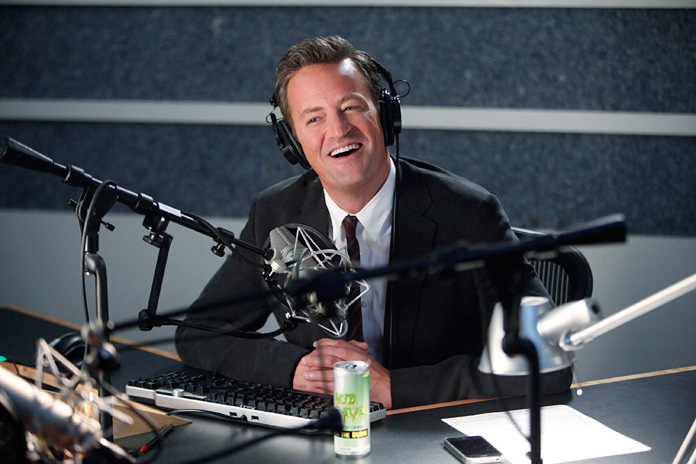
Go On aired a special pilot sneak preview in August, as NBC tried to take advantage of the one time people were actually watching, during the Olympics to promote a couple of its new shows.  You can read my full review of the pilot here, but here’s the basic premise.  Friends veteran Matthew Perry is an egomaniacal sports talk radio shock jock who is forced by his employers to attend grief therapy while dealing with the death of his wife.  He helps out the other members of the therapy group, while also learning from them, etc, etc.

Verdict:  14+ I don’t see it going that far – it’s just not that good, and while obviously that means little to nothing in what happens to shows on network television, I don’t think audiences will connect – I don’t really see it’s audience – not Community enough for that crowd, or Whitney enough for that crowd (I hope that’s not really a crowd).  Perry’s name will get it the full season pick up though.  Also, it’s better than Mr. Sunshine, which is worth something I suppose.

Animal Practice – 9/26

The other NBC show which got a shot at airing during the Olympics, a full review can be found here.  It’s about a veterinarian who loves animals, but not so much their owners.  He’s now forced to work with the new owner of his animal hospital, who is an old flame, who is returning after having not seen him for a couple of years.  Also a couple of wacky sidekicks and a monkey that does human stuff.  So that’s cool.

Verdict:  13-  Honestly, a quick look over the fall shows (and maybe I’ll regret this when I get to CBS or Fox) tells me there are far fewer crazy obvious instant cancellations like The Playboy Club and I Hate My Teenage Daughter (and Last Man Standing…oh, wait).  Something’s got to get cancelled.  Probably quite a few somethings.  This utterly forgettable show will likely be one of them.

Chicago Fire – 10/10

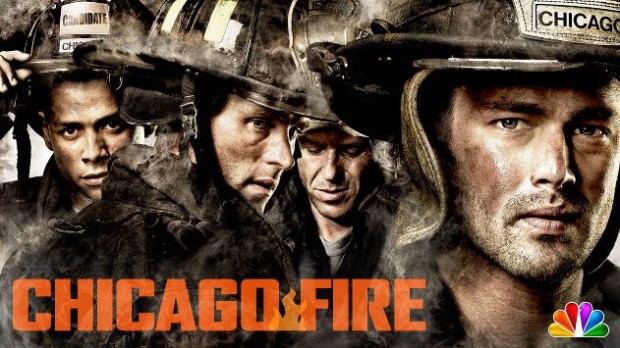
Too soon for a reference to a disaster that killed hundreds and destroyed over three square miles of downtown Chicago?  House’s Jesse Spencer is the lead in an ensemble show focusing on the exciting and fast-paced lives of firefighters and paramedics in Chicago (the non-police two thirds of Third Watch).  It’s less overused than cops for sure, so small amount of credit there, but it offhanded screams out generic procedural (I really think the logic was um, cops, been there – how about firefighters?), maybe with some personal life business to get you all attached to those characters.  We’ll see though.

Verdict:  Renewed – crapshoot 101.  NBC has not been a big home to procedurals of late, but they’ve got new management and probably want to follow the CBS model to success, with at least one.  Prime Suspect did fail miserably last year, but boy, NBC would take almost anything right now.  Oh, and it’s produced by a guy named Dick Wolf who used to have some pull around NBC.   Dick Wolf claims he chose Chicago over Law & Order’s NYC to be different but if you don’t think it’s because of the name you’re kidding yourself (future overseas spin off The Great London Fire?  Think about it).

Guys With Kids – 9/26

Jimmy Fallon co-created this sitcom which stars Law & Order verteran Anthony Anderson, Whitest Kid U Know Zach Cregger, and general actor who is in a bunch of things but no one super notable role Jesse Bradford as three dads with young kids, “desperately trying to remain dudes” as the official NBC web site tells us.  Two are married, one is divorced.  Anderson is married to Cosby Show daughter Tempest Bledsoe and Cregger is married to Sopranos daughter Jamie-Lynn Sigler.  Can they remain “cool” with little kiddies by their side?  Only time will tell.  It seems incredibly uninspired but who knows these days.

Verdict – 13- – it’s got the Jimmy Fallon backing and early reports say that it might be better than I instinctively thought (any show about dudes trying to remain dudes just reeks off the bat but comedies are less premise dependent than dramas) But again, it’s NBC so I have to assume that a fair amount of their shows will get cancelled.

The New Normal – 9/11

Ryan Murphy kind of owns television these days.  Glee is still going str…well, going.  American Horror Story made some splashes last fall and will be back.  And this year he’s got a more traditional comedy featuring a less traditional group of folks.  A career oriented gay couple decides they want a kid, and hire a surrogate mother from the Midwest who has an 8 year old kid of her own who comes out west where they live.  She’s accompanied by her racist, homophobic grandmother (I’m kind of guessing about the racist, homophobic part).  And now, they’re THE NEW NORMAL.  It smells a lot like Modern Family, for better or worse.

Verdict:  Renewal – Ryan Murphy’s on something of a role these days, and what network wouldn’t kill for even a shot at the next Modern Family, which will be winning Best Comedy Emmys like Rafael Nadal wins French Opens (Congrats Andy Murray by the way!).

Revolution – 9/17

JJ Abrams 101.  A post-apocalyptic future where the power is out, for good.  Without electricity, the world descends into chaos with militias and warlords and what not ruling their own patches of earth.  Is the supernatural involved?  Who knows.  Our own roving band of misfits is being pursued by a particular militia.  Actors included Twilight grad Billy Burke, Lost grad Elizabeth Mitchell (and a star of V, cementing her sci-fi TV cred), Gustavo Fring himself, Giancarlo Esposito, and a bunch of relative newbies.  After failure after failure (see:  Terra Nova, The Event, V., Flashforward), hope for the next Lost remains.

Verdict: Renewal – I know this is wrong, I just know it, I’m making the exact same mistake I made with Terra Nova, but man, one of these shows has to succeed eventually, right, or they’d stop making them?  Plus the JJ Abrams imprimatuer could buy it a couple of extra episodes at least?  Maybe?

Fall 2012 Review: Animal Practice

24 Aug

When you watch so many pilots, sometimes you see episodes that really generate strong opinions, either positive or negative, and sometimes you see episodes that really just don’t generate strong feelings at all, and the words don’t flow so easily.  The debut of Animal Practice was in the latter category (I probably wouldn’t be wasting words on this if it was in the former).  And yet, we (I) must find something to say.

Here’s the premise in short:  Veterinarian, loves animals, hates people.  Here’s the episode sum up in slightly longer:  Justin Kirk, best known as Nancy’s ex’s bro from Weeds, is a vet, George Coleman, who loves animals, loves sleeping with women, but yes, still hates people.  He’s big dog at an animal hospital (pun intended), and works aside a couple of his other main characters, er, colleagues.  One is a Korean with a mustache who mentions several times how whipped (pardon the colloquialism) he is by his wife.   Another is an insecure co-worker who was just dumped by his girlfriend and is apparently very socially awkward.  Third is a super weird women who well, is well more socially awkward that the awkward guy.  Their everyday routine of caring about animals, while ignoring humans is put to a stop by the arrival of some woman (apparently named Dorothy – with names like George and Dorothy, it feels like this show should be set in the 1950s), who we learn was George’s ex, but walked out on him a couple of years back never to appear again until now.  This was because, we learn, when she told him she loved him,  he responded with, “awesome.”

Also, apparently her grandmother owned the animal hospital George works in, and that grandmother died, so she’s taking over the hospital.  He threatens to leave because she wants to change the way things are organized – pay more attention to the lousy people who own the animals.  Eventually she understands his point of view (ie – some of the pet owners (Matt Walsh in the first episode) are jerks who deserve George’s disdain) and he decides to stay and keep working there, with the probability of some serious sexual tension between the two at about 99.9%.

I actually kind of like Justin Kirk.  I don’t really have a good reason for or against that position, but I like him.  I watched two seasons of Weeds, which I found to be generally a disappointing show, but I liked Justin Kirk as an actor even if I didn’t always love his character Andy.   Animal Practice is single camera and the humor is fairly generic. I don’t remember any particular lines or laughing much, though not never, and there was nothing offensive or cringe worthy, which is saying something, even if a backhanded compliment.

Wacky side character alert:  Angela, who, well I don’t exactly know what her job is, but she’s absurdly ridiculous.  She makes awkward sexual comments to everyone in the show, but apparently they all know her, so it’s not weird.   She seems kind of like a poor man’s Jillian from Workaholics (if you don’t understand that reference, please start watching Workaholics now.  I’ll wait).  All of the non George and Dorothy characters are weirdos (people you’d describe as “characters” in the colloquial sense if you met them) but only Angela is on the level of no-person-is-actually-like-this-in-real-life.

I’ll note that with the casting of Korean Bobby Lee (as the whipped married doctor), Animal Practice immediately moves into number two in the rankings amongst shows with Korean actors, behind Hawaii Five-0.  Also, there’s a monkey in the show that does lots of cool stuff.  I’m not a monster; it’s absolutely pretty adorable.

Will I watch it again?  No, I won’t.  It wasn’t really good, but it was actually better than I thought it would be, which if I was grading on expectations, is kind of a compliment.  I thought it was going to a bad show, and it was merely a thoroughly unmemorable show.

Fall 2012 Review: Go On

16 Aug

In Go On, Matthew Perry plays sports talk radio host Ryan King, who we find out is being suspended temporarily from his radio program to  to deal with the sudden death of his wife.  Before he can come back, his bosses mandate that he must take a 10 session course with others who have lost loved ones, in order to have some proof he’s appropriately dealt with his grief.  King naturally wants nothing to do with this; he doesn’t want to talk about his feelings, but rather wants to get right back to his outrageous sports shock jock broadcasting.  He reluctantly goes to his forced counseling sessions, and when the leader is absent, he takes control of the room of misfits, having them compete to see who has the saddest sob story (if only George Costanza had been a contestant).  When the actually group head arrives, he refuses to take part in her hippie-dippie share-your-feelings exercises, and demands that she sign his form so that he can go back to work.  In his short time attempting to ignore the leader’s instructions in the group, he gets one of the younger members to share about his traumatic experience.  Frustrated, the leader signs the form, but then when King goes back, he has a screaming incident after interviewing Terrell Owens (good sports get!) and realizes that maybe he needs therapy more than he originally thought.  He then voluntarily returns to the group, where he leads the band of merry misfits in  an uplifting activity.

Here’s my first issue.  I’ve never particularly liked Matthew Perry.  I never liked Friends, but I haven’t seen all that many episodes, and though I watched a disturbing amount of Studio 60 on the Sunset Strip, Perry had little to do with why that show was such a disaster.  Probably the primary reason I have an intuitive dislike of Perry is his ability to constantly come off as smug, and smugness is one of my least favorite qualities in a person.  Immediately Perry began to rub me the wrong way in Go On, and though that’s probably partly the intent, it forced me to lower my expectations just a couple of minutes into the episode.

Additionally, It’s hard to watch this show as a Community fan and not think of it in comparison; the premise is that an arrogant, self-centered jerk is forced to take a pause in his career to spend some time with a diverse group of fuck ups who all have some quirky issues, and that this jerk must learn how to become a little less jerky, and does, through the input of the group, while helping lead them through dealing with their issues.

The problem of course is that this isn’t Community.  While Community didn’t manage to flesh out its chracters either until at least halfway through the first season (the first few were the Jeff, Britta, super weird Abed and others show), the pilot was very funny.  If I dissect Go On and look at the parts inside, I can see exactly where the writers scientifically put in all the elements; the wacky side characters, the heart, King’s possible evolution as a person, and such, but the writing’s not as good and it just doesn’t come together the same way.  There’s really only one real character in the first episode, and that’s Perry, and he doesn’t quite have the charisma to sell the show by himself.

Comedy’s a tough game and it takes more than 22 minutes to develop the elements for success, especially when in the first episode time is wasted explaining how we got to where we are, an explanation that should never need to be repeated again.  With that in mind though, in the pilot you hope to see just enough of certain elements that if you model future episodes in your brain these elements flesh out logically into funny, well developed episodes.  This takes a lot of guesswork, and while truly awful shows are obvious from about 3 minutes in (try watching Anger Management or Men at Work), the good shows need time.  However, forced to make a guess here, I’m not seeing it.

Will I watch it again?  I’m not going to watch the next episode.  It’s a comedy, and successful or not,  it is actually trying to be good comedy (it’s not a CBS multicamera sitcom) so I’ll be open to the possibility of chatter that the show is really finding its legs or “hitting the jukebox.”  If I had to guess, I would guess that it won’t, but I’ve been wrong before.

Addendum:  Although a few of the group members are wacky, and they barely have names in this episode, I regret omitting originally my relatively new review segment of “Wacky Side Character Alert” if only because I didn’t pause to comment on the work of Brett Gelman who plays a super creepy nameless guy who is by far the wackiest, and is better known by me for his exemplary work as Brett on Adult Swim’s Eagleheart.

Watch it Again: Community – Season 1, Episodes 3 and 4

20 Jul

A while I ago, I began a campaign of re-watching the first season of Community.  Episodes 3 and 4 of season 1 capsuled and commended on below.

Season 1, Episode 3:  Introduction to Film

Community as the Jeff and Britta show continues, now with some Abed.  The A story is about Abed taking a film class which Britta paid for, in opposition to his dad, who wants him to stay in the family falafel business.  Jeff counsels against Britta getting involved, and the two fight over the benefits of getting involved vs. staying out of it for the entire episode, often while being filmed by Abed, and getting into a fight with Abed’s dad.  Britta and Jeff take on a mom and dad role relative to Abed, and eventually Abed’s film moves his dad to understand.  We get a little bit more of Abed’s inability to relate with people, and his use of film as a medium to help him.  The B story involves Jeff taking a class, which he thinks is the ultimate blow-off class, taught by John Michael Higgins (lawyer from Arrested Development, Christopher Guest movie regular, saying “Owner of a Lonely Heart” a capella in those vaguely memorable commercials for The Break Up) whose only criteria for an A is “seizing the day.”  Jeff desperately tries to manufacture a day seized, failing to fool the professor until he kisses Britta, thinking she was into him, but she was only trying to help him ace the project.  The tiny C story involves Pierce trying to teach Troy how to sneeze manly, and converting Troy’s baby sneeze into a far more imposing sneeze (that is way too many times to use sneeze in a sentence).

The C story actually gets the best bang for the buck; Chevy Chase is at his finest when he’s demonstrated the different sneezes in his arsenal.  John Michael Higgins shows of his impulsiveness a couple of times, and he’s used just enough so that he’s not overused; the best scene is the episode may be when he chastises Jeff for ordering an ordinary coffee, and then tears up the coffee menu and asks for a birthday cake.

Rating 7.0 – it’s a good episode, but it’s not a great episode.

Season 1, Episode 4: Social Psychology

The episode starts with a relatively pointless encounter between Chang and Annie.  I’ve never liked Chang.  He’s always been my least favorite part of the show, primarily because Ken Jeong shows absolutely no restraint.  He’s more over the top than any character, ruthlessly so, with the possible exception of the Dean, but, well, the Dean is generally funnier and doesn’t get as big parts.

The A plot of this episode involves Shirley and Jeff learning the only thing they have in common is a love of gossip – Jeff can now stop timing his exit from one class to avoid having to awkwardly walk with Shirley to the next.  Their favorite gossip topic is Britta’s new boyfriend, hackey-sack loving hippie, Vaughn.  Vaughn is a ridiculous stereotype of course, but he gets some choice lines, such as “What makes Frisbee ultimate?  If I had a nickel for every time I wish someone asked me that”  Britta, learning to be friends with Jeff, trusts him with too much information, particularly considering he still has feelings for her.  Although he tries to be a good friend, when Britta shows him the awful poem Vaughn wrote for her, he cracks, and shows it to Shirley, who, incorrigible gossip that she is, shows it to the group.  Of course Vaughn catches them laughing about, and dumps Britta, making her not too pleased with Jeff.

The B plot involves Annie joining Professor Duncan, who is back, in order to help prove his “Duncan Principle,” which is that left waiting for something, in this case, a fake experiment, over time, even the calmest person will erupt in a fit of insane anger.  Annie recruits Abed and Troy to be test subjects for the Duncan principle, however, Abed ruins the principle altogether by sitting calmly in the room for hours upon hours, even when everyone else has broken, forcing Duncan to give up, and Annie to be mad at Abed.

The little C-plot involves Pierce’s use of ear-noculars, which are the equivalent of binoculars for your ears (kind of the same purpose as that awesome directional microphone in Metal Gear Solid, but a lot more dopey looking).  It’s small, but pretty funny.

Worth noting is that Matt L. Jones, better known as Badger from Breaking Bad shows up for just a second as a stoner-y friend of Vaughn’s.  Also, Abed makes an Indiana Jones and the Kingdom of the Crystal Skull reference which probably was current at the time.

All right, I feel bad that these episode ratings keep going down, and I know they’ll be going up at least a couple times later in the season, but I guess that’s just the opening pattern.  Remember, all the ratings are simply relative to the first one, which I didn’t want to rate too high (I still rated it fairly high) lest I leave no room for improvement (not to mention, the farther I go in the season, the more ticky-tacky the ratings will naturally get).  There’s plenty of funny parts – John Oliver in particular – but it’s not top level.

Rating:  7.2 – I still don’t understand why John Oliver couldn’t have been shepherded into more episodes instead of Chang – one of Oliver’s best lines, out of context, was “Youre an eight, which si a British 10 – I’m angry.”

Watch it Again: Community

11 Jun

In order to celebrate the three wonderful years of Community before Dan Harmon was fired, and the show may or may not be terrible and cancelled, in that order, I’ve begun a re-watch of the first season.  I was curious to see how it held up to the later seasons, but in terms of how funny it was, but also in terms of tone and personality.  As I watch, I’ll be writing up little summaries and notes, and assessing each episode with a rating, all relative to whatever arbitrary rating I give the first episode.  If you’ve already seen Community, consider this an invitation to re-watch yourself, or at least read and remind yourself of the good times.  If you haven’t seen Community yet, no better day to start than today, what may have been the best comedy on TV of the past couple of years.  Here we go:

Pilot

It’s very different than what the show has become, but not quite as different as I imagined it would be going back.  We have to deal with the whole introduction to the show, which comes out of Jeff wanting to hook up with Britta, and Community is hardly the ensemble it’s become; rather it’s a Jeff show, with a bit of Britta.  John Oliver shows up as Professor Ian Duncan, a former client of Jeff’s who Jeff tries to get answers to, and it seems like he would be in more episodes from this pilot.  The dean appears for a second with his mangled opening speech, which is a hilarious way to start off the show.  There’s basically two plots which both star Jeff; Jeff arranging the study group to hook up with Britta, and Jeff trying to get the answers from Professor Duncan.  The two parts I remember as particularly memorable are Abed imitating Emilio Estevez from The Breakfast Club and Jeff’s speech about how humans are the only animals who observe Shark Week.  Abed seems far less socially adept in the pilot than later on, though obviously he gets super crazy in other, evil Abed Dreamatorium ways.

Overall, I remember being instantly hooked on the show, and though I was worried this would pale compared to some of the newer episodes, although it was different, I can see again why I was hooked.

Rating:  7.8  – This number is completely arbitrary yet is the number by which I will judge all subsequent episodes; I would put it higher, but I want to give some solid room so I don’t have most episodes crowding between 9 and 10, say.

Spanish 101

Still the Jeff and Britta show, but Pierce becomes our first additional character to play a major role.  The A plot is Jeff and Pierce being paired together for a Spanish project; Jeff trades cards and shirts with Abed to be paired with Britta, but Britta’s traded cards as well, so he’s paired with Pierce.  Jeff’s been avoiding Pierce, and after getting sick of him while Pierce turns a five minute Spanish project into an hours long extremely racist whiskey session, finally comes back around and decides to join Pierce and present their project together.  The B plot is largely forgettable as Annie and Shirley trying to learn from Britta’s protest-y past, forming a protest and candlelight vigil for a Guatamalan journalist, while realizing that Britta talks a big talk about protesting but doesn’t do it herself.

This episode is the birth of the Troy-Abed connection, even thoughTroy’s still barely a character, as they are Spanish project partners, and then conclude the episode in the cold closing with their Spanish rap, which I didn’t realize in hindsight, started as early as the second episode.

The most memorable scenes are probably the Pierce and Jeff performing their Spanish project montage, where they wear all sorts of hilarious costumes, an theTroyand Abed rap at the end.

Rating:  7.2 – it’s not quite as good as the pilot, and the B plot is largely unmemorable.

Spring 2012 Review: Awake

25 Apr

In this reality, his son is Awake

The science fiction – police procedural genre is a limited one to be sure.  Once, in this space, I hailed the original UK Life on Mars as a paragon of the genre.  Awake is a television’s latest play for a standout sci-fi-po-pro.  The high concept of Awake is as follows.  Homicide detective (shows always seem to be made about the homicide detectives, rather than I don’t know, vice) Michael Britten gets into a massive car accident.  After the accident, he lives his life in two separate realities, one in which his wife is alive and his son died in the accident, the other in which his son is alive and his wife died in the accident.  When he goes to sleep in one reality, he wakes up in the other, and he keeps different colored rubber bands on his wrist to remind him which reality he is in at any given time.

He visits two different psychologists in each reality, having been assigned to go by his job after surviving a horrible accident and losing a loved one.  Both psychologists, in different manners, insist that their reality is the true one, and that the other is an incredibly vivid dream.  In each reality, his partner is different as well.  As he goes back and forth, he begins to see strange resemblances between the cases in both realities, and information he remembers from the opposing realities helps him solve them.

One psychologist, played by former 24 president Cherry Jones, is the soft one; telling him that his alternate, though obviously fake, dream world can be very helpful, and he should go with it, taking what he can, while of course acknowledging that it’s not real.  The second psychologist, portrayed by Law & Order: SVU psychologist and Oz priest B.D. Wong, takes a harder-edged approach, telling Britten that all this fantasizing about both his family members still being alive is extremely dangerous, and that if he doesn’t abandon his fake reality, he is in danger of losing his real one.

The best thing I can say about the show, and I absolutely don’t mean this as the backhanded compliment it might sound like, is that the premise is legitimately intriguing.  The premise is more intriguing than the first episode was.  I really like the idea of the multiple psychologists.  Even though he was forced to attend therapy by his job in the world of the show, rather than seek it himself, it seems like a very modern solution to dealing with what seems like an old school sci-fi Twilight Zone or Outer Limits problem.  It’s such a modern first instinct to have doctors in on it, rather than deal with it one’s self – think Sopranos meets science fiction.  I love the psychological parts; it’s the police procedural bit I’m not entirely enamored with.

I liked Jason Issacs, but I felt like I wanted more out of this show than to just be a police procedural where he solves two cases, using his cross-reality knowledge.  I don’t’ think that’s all it’s supposed to be eventually, and if I had to guess, though I don’t know, I’d guess Kyle Killen and co have a bigger plan if the story goes on.  Still, the goal of a pilot besides set up should be to put one’s best foot forward and I’m not sure Awake did that.  It ranks somewhere between Life of Mars (which was better) and Alcatraz (which was slightly worse) in the police produral – supernatural sci –fi mini genre.

Will I watch it again?  Yes.  I’m behind on shows, so it’s hard to say I’ll keep up faithfully, but I’ll watch at least one more.  It didn’t make me immediately wish the next episode was out, which isn’t a great sign, but as far as new shows go these days, it’s more interesting than most.

Spring 2012 Review: The Firm

24 Apr

The Firm and wife chat

The Firm is the sequel to the mid-90s film based on a John Grisham movie which no one asked for or needed, but that is here anyway.  The pilot is a double episode, so it was a pretty much a movie-length first episode of The Firm I was subjected to.

The show begins with the most overused gimmick in the television business – a flashforward to much later in the story, which then moves back six weeks earlier so we can find out how we get there.  I have plenty more to say on why this is a lazy and overused plot device but we’ll save it for another article.  Suffice it to say, it’s not used well here.  For at least the first half of the pilot, I expected to get back to the flashforward by the end of the episode, but realized eventually it just wasn’t going to get there.  I just really don’t understand what the point of these gimmicks are.  Do the creators really think I’m more likely to keep watching to get to a part of the story that seems so disconnected from where the narrative is now that it doesn’t even connect?  In this flashforward, protagonist Mitch McDeere is on the run, searching for THE TRUTH, and meets with a mysterious man in glasses, who may have answers, but, as he’s only a middleman, he decides to jump off of his hotel balcony, killing himself, rather than face the wrath of his superiors.  Flashforward over.

Moving on.  Tom Cruise’s Mitch McDeere has been transformed into Josh Lucas, and Jeanne Tripplehorn’s Abby McDeere into Molly Parker (of Alma Garrett on Deadwood fame, but best known to me as Ron’s infatuation in the reunion episode of Party Down – I screamed out “Call an ambulance!” at least three times while watching her on screen – if you don’t get the reference, stop reading this and watch Party Down right now).  Mitch wants to avoid witness protection after the events of The Firm, the movie, but Abby convinces him that they need help, because she’s pregnant.  Ten years later, they’re finally out of witness protection and Mitch has started his own firm in DC.  They’re just started to get used to a life not on the run.  Working with Mitch at his new firm, is his brother, private investigator Ray (Battlestar Galactica’s Callum Keith Rennie) and his longtime girlfriend Tammy is their secretary (Juliette Lewis in the show, Holly Hunter in the film).

McDeere is struggling to get by, as most of his clients can’t afford to pay.  He’s already shown the judges around town that he’s a competent lawyer, so a judge asks him to take up two different murder cases.  One for a woman named Sarah, which we see virtually nothing more of in the first episode, and two, for a 14-year old African American named Donnell.  Donnell’s being accused of murdering fellow student Nathan Williams.  Donnell claims self defense, but after some investigation by the brothers McDeere, it turns out Donnell was lying, and he actually killed Williams because he was getting in between Donnell and a kid Donnell was planning on giving a beat down to.  Though disgusted, Mitch must be a good lawyer and argue that Donnell be tried as a juvenile, and his vicious cross-examination of a witness angers the victim’s family.  This plot continues with a fairly uninteresting plot angle in which the victim’s father attempts to hire a hitman to kill Donnell out of grief.  The brothers McDeere catch his attempt on tape, and out of respect for a moment of weakness as a grieving father in an otherwise good life, work out a deal with the district attorney which keeps Williams out of jail and with his remaining daughter at home.  That plot is just about over.

The other plotline in the episode is that an acquaintance of Mitch’s invites Mitch to join his far larger firm, which is run by fierce managing partner Alex Clark (BSG’s Tricia Helfer – two Cylons getting to reunite here).  Mitch fiercely wants to remain independent but works out an arrangement in which he can keep his own office while being associated with the firm after he realizes he needs their resources to fight a tort case which he thinks is a winner.  He thinks the firm wants him for the tort case, but we learn, while Mitch doesn’t, that they’re really interested in the Sarah whatever-her-name-is murder case, and if Mitch learns the truth to that case, all these high powered lawyers will go to jail (BUM BUM BUM).  Way to raise the stakes after an hour and twenty minutes of a Law & Order episode.  Apparently, the client of this new evil law firm is the glasses wearing man who kills himself in the flashfoward, which we’re reminded of, since we haven’t seen him in about an hour and 28 minutes.

Also, the son of the mob leader who went to jail because of Mitch may be after him and his family.  Just sayin’.

So The Firm is an all right legal procedural/thriller that clearly aspires to be Damages, (I must credit a critic on wikipedia for making that allusion, which seemed so obvious once I saw it written on the page) straight down to the flash forward format.  The main case was a bit tedious and not terrible interesting, but it is a my dad-approved legal thriller, which means it can’t be too slow and boring, because my dad would certainly not tolerate that.  It really wasn’t bad; it was seriously and entirely unironic, but not The Practice-level over the top.  If you like legal procedurals that could turn into thrillers at the drop of a hat, The Firm might be for you.  That said, legal procedurals have been done so many times that it’s very difficult to stand out, and nothing about The Firm did that.  Without the long-term angle, I don’t think it’d have a leg to really stand on.

Will I watch it again?  Probably not, but I’ll ask my dad for some sum ups of where the conspiracy goes, because I’m that low level of interested.  I can’t wait for The Chamber the series.