Tag Archives: HBO

Game of Thrones: Season 3, Episode 9 Notes

3 Jun

Please scroll down immediately past this post if you have not seen this episode yet.  I’ll wait.

Robb Stark of House Stark

Phew.  Okay.  So, Red Wedding.  That’s what it’s called if the internet hasn’t told you a million times already and you haven’t read the books.  Red cause of you know, all the blood.  I have some broader Game of Thrones thoughts I’d like to posit after the season’s done. First, though, some notes on the Red Wedding, and Robb’s ultimate road leading up to it, now that it can be viewed as a whole.  This post ended up being much longer than I had planned, so apologies, but who doesn’t get carried away by Game of Thrones sometimes.

The notion of honor has often been at the crux of Game of Thrones, particularly since the dead patriarch of our main family, the Starks, was known for it, and passed it down as a crucial value if not the most important value, to his sons and daughters.  More than honor, unbending honor, to the point where it was not only not practical or smart, as Ned learned the hard way, and sometimes even difficult to comprehend by our modern standards of what’s important.  Although it’s hard not to like Ned overall (especially in memory), it’s also hard to sympathize with his position that Jaime is despicable and beyond redeemable for being an oathbreaker when killing the Mad King, even though Jaime’s decision may have spared hundreds or thousands of lives (though Ned is hardly the only one who feels this way, as this is a world moral absolutism, and as I’ll discuss below, there’s a reason for that sometimes). Ned sees honor as black and white; Jaime’s oath and his duty toward the king was bound in stone, while his opportunity to save random King’s Landing residents was not. Ned’s children all struggle with how to live honorably, as their father taught them, in a world that can be extremely dishonorable.  They try to figure out where the line is between keeping their heads, hopefully, while, at the same time, doing their father proud.

I think the Red Wedding was handled spectacularly on the show and overall I’ve been thrilled with the show and many of the adaptation choices they’ve made.  I’d like to dwell briefly on one I think was ill-advised.  In both the book and the show, Robb, in order to pass through a precarious patch of country known as the Twins and gain a large component of men for his army, agrees to marry cantankerous and bitter Lord Walder Frey’s daughter.  He violates that oath by marrying someone else.

In the show, he falls in love, and believing love to be more important than keeping a promise (or at least this promise), he chooses to marry the woman he falls in love with and deal with his broken oath to Walder Frey later.  While it’s nice to think that in this world people can actually be in love with the people they marry (I’m not being sarcastic. It is nice), I thought it came off as somewhat selfish, especially when his mom and his other advisers so ardently recommend that he not get married, at the least during the war, when violating the oath would have practical consequences. He just doesn’t listen and does it anyway.  For someone who values honor above all else (something we see again with his decision to execute Rickard Karstark), it’s hard to understand how his decision to marry Talisa would be consistent with his policy of honor above any other value, even love. This would have been a lesson his father, himself in an arranged marriage with his deceased brother’s former fiance, taught him at least.

In the book, Robb’s recovering from an injury suffered from battle far away from his mother and top advisers.  He’s recovering in the house of some minor nobles, and stricken after finding out the news that Theon betrayed him, took Winterfell, and killed his brothers. After he learns this news, his nurse, a young minor noble herself, decides to, uh, comfort him, above and beyond what’s normally expected of a nurse.  Robb, feeling ashamed after taking her virginity (which is a big deal in this world (also in Downton Abbey!), decides the honorable thing to do, being a Stark, is to marry her.  He’s not making the decision out of love, but rather out of his perhaps misguided view that the honorable path in the moment of marrying the girl supersedes the honor of keeping the oath.  His mom is not there to advise him otherwise; she’s miles and miles away and is horrified when she finds out, but it’s too late.  I think the immaturity is accentuated by the fact that Robb’s younger in the book.  While making all the characters a few years older in the show makes sense because actors age, this is one spot where the actions seem more excusable if Robb is younger, and just the couple of years could make a significant difference.  Certainly to some extent, immaturity is also a factor in his not appreciating the value of an oath in the show, and he certainly could have been firmer in refusing to have sex in the book. Still, I think the book both painted a more sympathetic figure of Robb and also doubled down, properly, on how honor, the essential value of the Stark family, played into his decision. It’s possible he was wrong, or at least questionable in balancing the honor at stake in the book, but at least it makes sense from his perspective.

The Red Wedding of course, is about the exact opposite of honor.  Not sadism or brutality, but total disregard for the rules, the willful violation of social norms that everybody in a society believes in to function where there doesn’t exist a modern state with clearly defined rules and well-enforced law.  These norms can be held together by religious beliefs, or a cultural belief so strongly shared that violating it would prompt instant outrage from society at large (in GoT, it’s both religious and cultural).  Oaths, in this world, have that kind of power.  Like in the Ancient Greek world, an oath is a bond.  It’s more than an oath would mean today when there’s so many other ways to enforce promises – we have contracts and courts.  The oath Robb broke is serious business, which can’t be underestimated, and they do a good job on the show of making out what a big deal this is (as mentioned above everyone still refers to Jaime as Kingslayer for his oath violation years and years ago).  You don’t have much more than your word.  Ned Stark wouldn;t have smiled on Robb’s choice in the show.

That said, there’s an even greater breach here in the Red Wedding which isn’t articulated so much in the show but which at least comes across strongly in the visuals of the scene.  I’m not sure it was a focus, but they definitely made a point of mentioning, in the scene in which Robb and his entourage arrived at the Freys, that the visitors were to receive bread and salt.  This means, book readers know, that, as guests, they’re now under the protection of their hosts.  Guest right is a sacred and important tradition in Westeros, much like it was in Ancient Greece, where it shows up crucially in both the Odyssey and the Illiad.  Once visitors have been welcomed with bread, they can not be harmed until they leave the premises.  This is so sacred that it’s basically unheard of; one famous song in the Game of Thrones universe known as the Rat Cook tells of a violation and the horrible consequences that came to the violator, and serves as an admonishment to would be guest right-breakers.  Both the shock and the disturbance of the betrayal by his allies are heightened by this visceral break with hundreds of years old tradition.  The fact that it’s a not simply a normal stay, but a wedding, a sacred and joyful ceremony, only multiplies the deeply felt wrongness of the perpetrators’ actions. This breach puts those who violated outside of the normal social order of Westeros. This may win the war for now, and it may be difficult to overstate the value of that, but this will not be something soon forgotten by anyone in the realm, just as Robb’s oath violation wasn’t forgotten.

Robb’s issues of course extended beyond breaking his oath to Walder Frey.  His campaign, while winning battles left and right, suffered from numerous off-the-field problems, chief among them, besides his marriage, his mother’s decision to release Jaime Lannister and his questionable decision to execute Rickard Karstark.  Still, even these blunders simply cover up a more basic issue with the Robb Stark strategy: there isn’t one.

Robb’s tactics are excellent; his strategy is non-existent.  It’s brought up explicitly by his wife when they’re first getting to know each other.  What’s the goal of his war and how does he make it happen.  He tells his soon-to-be-wife that he wants to get to King’s Landing and kill Joffrey, and she rightfully asks, what then.  He says he merely wants to be King of the North, but that means he has to find a way for whoever rules at King’s Landing to both accept his secession, and find a way to preserve a more permanent peace (who’s to say the next King wouldn’t seek to reconquer the North?) The goal becomes muddled, and even before he gets mired in problems with his troops, he doesn’t really know the best way to reach this goal. When the North gets taken over by Ironborn, his path to victory gets even more questionable and confusing, considering he doesn’t even possess the only place he claims he wants to be in control of.   Maybe if Robb decided he wanted to put himself on the throne, or put someone else on the throne, it would be just as unsuccessful but at least it’d be a coherent goal.  His plan to capture Casterly Rock seems like a desperate gambit that may provide only a temporary lift, even if successful.  It reminds me of the Confederacy’s plan to capture Washington D.C. during the Civil War (note for longer entry: compare the Confederacy’s secession to the North’s in Game of Thrones).  They knew they were outgunned and outnumbered, and no matter how many battles they won, the North just had more of everything.  They imagined if they had taken the heart of the North (US, not Winterfell), they would destroy morale, and break the North’s will.  There’s a world in which this strategy could have worked work, but luckily for the US, Lincoln’s will, like Tywin Lannister’s was indomitable.  Maybe taking Casterly Rock would have caused a lesser or less stubborn leader to give in, but I have a hard time seeing Tywin conceding.  Robb needed manpower and allies, strength, and those he was hemorrhaging, and probably never had enough of to begin with.


Summer 2013 Review: Family Tree

27 May

Family Tree

Family Tree is a new HBO show from Chris Guest, the man behind cult mockumentary style films Best in Show, A Mighty Wind, Waiting for Guffman, and For Your Consideration, as well as his most famous but most different from the others, This is Spinal Tap, which came several years before the rest.  Many directors and writers have recurring elements and favored actors and actresses, but Guest is much more consistent than most in both of these matters.  Basically all of his films, and this TV show, are satirical documentaries, with people talking to the camera, and a high rate of overall silliness and bizarre characters, just taking on different subjects – a reunion concert of folk bands, a film festival, and a dog show, for example.  In addition, he’s developed a full repository of actors who appear in all of his films; Michael McKean, Ed Begley Jr, Catherine O’Hara, John Michael Higgins, Fred Willard, and others.

Family Tree is also co-produced by the BBC so we know that Britain or British people will be involved somehow, and indeed England is where we begin.  The premise of Family Tree, advertisements and trailers have told me,  is that it’s about a young Englishman searching for and discovering his crazy family, full of Christopher Guest players, in Los Angeles.  However, I would never have known that from the first episode which doesn’t even get out of Britain.  Family Tree is the only show I can think of which doesn’t actually get up to its ostensible premise in the first episode.

What does happen is this.  Chris O’Dowd (Kristen Wiig’s love interest in Bridesmaids) plays a young man who has been kind of depressed of late, having lost his job and his girlfriend in the past few months. He and his sister meet his dad for dinner, where he finds an old photograph in a chest left by a deceased family member as part of a shabby inheritance.  He begins to investigate the photo, taking it to an old expert on these things who lets him know that the photo is not of his relative, but rather was taken by his relative.  That’s where we end up. Presumably that somehow leads to his eventual family history trip stateside as he continues to learn more information.

What this does contain is many classic Christopher Guest elements.  Every single character, with the exception of our straight man, played by O’Dowd, is extremely bizarre and quirky.  His sister is a ventriloquist who must carry around a monkey puppet at all times to ensure her continuing mental stability; we see a quick scene of her working at a bank with the monkey.  Their dad, portrayed by Michael McKean is a very strange dude who retired to begin his life’s work of creating a great invention.  All he has so far is a shoehorn attached to a fan which keeps your shoes cool on a hot day before you put them on.  The man to whom O’Down is directed to bring his photograph for research purposes is a very odd older gentleman with his own distinctive strange mannerisms, and he creates landmarks in a bottle, which he considers vastly superior and more interesting to ships in a bottle. O’Dowd watches ten seconds of a fake TV show Tudors rip-off, The Plantagenets.  Even the minor characters are a bit off.  O’Down is set up on a date with a seemingly nice girl who seems to believe the Loch Ness monster is real.

It wasn’t mostly laugh out loud funny, though there were a couple of solid moments, but I did enjoy the experience overall.  If you like Christopher Guest movies, you’ll probably like it, if you don’t, there’s a good chance you won’t.  Chris O’Dowd is an extremely likable straight man, and I think his presence may increase the chance of people liking the show who don’t like Christopher Guest movies, as those sometimes don’t even have any normal characters to center them.  It wasn’t quite as exciting as I was expecting right off the bat, but it’s a promising enough beginning.  It doesn’t promise at this juncture to be an overall classic but it seems like some solid programming.

Will I watch it again? Yes, but at least as much based on the track record of the people involved in the show than on the quality of the episode alone.  That’s not to say it was bad; rather it felt more incomplete than nearly any other show I can remember watching.  More than most pilots, this felt like the first half hour of a movie, or at least a miniseries, rather than a self-contained episode pitching a premise for an ongoing series.  I look forward to revisiting the whole when it’s all done and seeing how it stacks up.

End of Season Report: Season 2 of Girls

27 Mar

Girls, one by one

Season 2 of Girls was largely more confident and sure of itself, compared to the first, especially in the early episodes, where it picked up a lot faster and didn’t have to waste time setting up the characters into place. The weakest episode of the season, unfortunately, was the final episode in which a show which prides itself on being a little bit different (this is HBO, after all), solved a couple of major issues with simple solutions that didn’t really hold up after thinking them through.  Still, there was more good than bad on the whole.  Let’s break it down Girl by Girl.

Jessa is my least favorite character in the show by a long shot, but I do think Girls went some way to make her more sympathetic with a showcase episode about her visiting her dad; we get to see part of what made Jessa Jessa and it was handled well.  I do think both her disintegrating marriage and her time spent with her family humanized he and fleshed out her character much more than in the first season.  I’m just not sure it’s not too little at this point for me.  Jessa just happens to be the type of character I’m most likely to find irritating; she’s extremely flaky, impetuous  and makes critical life decisions on a whim without thinking about it.  While I think the marriage to Chris O’Dowd led to some interesting episodes, the decision to get married just like that is exactly the kind of bad decision Jessa continues to make over and over again.  Forget bad decisions though; everyone makes those.  She’s not there for her friends when they need her and floats in and out of their lives with no notice.  She did the least of the four girls this season, partly due to Jemima Kirke’s pregnancy. I did like her featured parts a lot more than her segments in the first season, but she has a long way to go.

In contrast to the much heavier personalities of the other characters, Shoshanna is largely bubbly and inoffensive, even when she’s struggling. I enjoyed both the Ray and Shosh romance through the season and the fact that they broke up in the season finale.  I don’t think they ultimately make a ton of sense together and I think it’s probably best for both of them to break up, but I think the relationship spurred some serious movement in both characters for the better.  Both kind of fell into the romance and were doubling down merely because the relationship spurred its own momentum.  Ray needed an impetus to break out of his life rut, and he got it with his promotion, even if the relationship ended anyway.  The relationship also gave Shoshanna a clearer view at what she really wanted, or at least what she didn’t want.  Ray might be my favorite character on the show, and I think these plots were handled really well throughout the season.  My favorite Ray plotline may have been when him and Adam teamed up to return a dog Adam stole to its owner on Staten Island, and while they frequently fought, while Ray was wrong, possibly as often as Adam, I generally sided with Ray.

Marnie next.  In some respects I have sympathy for Marnie’s second season troubles; her dreams for her life in the art world is falling apart, one she’s sought out for years.  Still, she’s so arrogant, condescending, and cruel to Charlie that it makes it difficult to feel bad for her as I would towards most people in her position.  She goes through a lot of shitty situations, but she never quite changes her attitude through them. I was hoping that as a result of all her struggles, she’s realize some of these negative qualities at stop them, or at least work on stopping them.  She loses her job, and that’s understandably frustrating, but she constantly teases her old boyfriend Charlie, wanting him back when she’s down, and then when anything else comes along, putting him aside, only to get easily jealous and cruelly tease him when he seems to be doing better than her.  Her past behavior towards Charlie renders the should-be heartwarming re-getting together of Charlie and Marnie at the end frustrating; he deserves better, or at least for Marnie to have changed one iota from when they first broke up.  He was a super irritating emo whiner sad sack at the beginning of the series but he’s seemingly matured, while she hasn’t at all.  I’m not sure whether we’re actually supposed to be annoyed, or whether we’re supposed to think that Marnie has grown, due solely to the events in the last episode, but it didn’t quite work for me.  It was only in the second to last episode when she belts out her super inappropriate Stronger rendition at Charlie’s company party.

Lena is my favorite character by a longshot, and I think her plots throughout most of the season are by far the best.  I really enjoyed the bottle-y episode that was basically her and Patrick Wilson having a two night affair, and I’ve always enjoyed her relationship with her parents, where I often feel sympathy for both parties.  I love the minor character of her editor, and I sympathize with her inability to write on the spot. She’s absolutely more ridiculous than a normal person. As a neurotic myself, I have sympathy with the general way she acts, even if the show magnifies it to an over the top level.  In fact, probably more because she’s so over the top, I don’t treat her as a normal person, which makes some of her insanity easier to swallow.  She’s wrong a lot; she’s unnecessarily mean to Eli and Marnie and several other characters and she does a lot of stupid things for stupid reasons, but I still like her best.  I just hate that simple ending in the last episode, in which Adam picks her up and shows the ultimate romance that prevails in that final moment, even after all the shit that had happened between the two of them over the course of the season.

I’m not sure where Girls will take us next season.  I’m looking forward to it; I think overall, it’s a better show, and I appreciated the opportunity to watch Girls without the massive lovefest and hatefest that accompanied the first season.  Girls is neither as good as its biggest fans say not as bad as its detractors say, but it’s interesting television, and definitively worth watching, which I think is a fairly good place to be for a tv show.  I just wished the last episode had been a little bit different; I know I was supposed to feel super heartwarmed by the reunions of Marnie and Charlie and Adam and Hannah but neither really worked for me.

End of Season Report: Season 1 of Enlightened

25 Mar

Amy Jellicoe

I reviewed Enlightened when it first aired, and I wasn’t that impressed.  There may have been a number of reasons I decided not to come back for a second episode, but far and away the main one was that I couldn’t stand the main character, Amy Jellicoe, portrayed by Laura Dern.  Not merely that I hated her; I’ve loved several shows where I’ve disliked the main character with various degrees of intensity.  Rather, I found her incredibly annoying.  Some of this was due to the British comedy type of awkwardness, but it was more than that, because, even though I’m as uncomfortable with the awkwardness as anyone else, I’ve become pretty good at getting through it.  More than that, I didn’t like watching her, and I didn’t feel like I gained enough from putting up with her irritating personality.

However, I’ve been wrong before and I’ll be wrong again, and when the internet and friends both combined to tell me that Enlightened was worth watching, I decided to head on over to HBO on demand to give the show another shot.  With so much praise from all quarters, I decided to go in whole hog, marathoning the entire (admittedly short) first  season over a weekend, and I’m glad I did.  The problem with watching it in a compressed period of time is not the length, the episodes are only a half hour long and there aren’t that many of them; it’s that it’s extremely depressing.

Main character Amy Jellicoe is a former corporate executive for a huge faceless company who suffered a nervous breakdown, attended an island rehab center which focused on the power of positive thinking, and then came back to work, determined to change both herself and her work life.  She’s now focus on things that really matter like the environment rather than the corporate bullshit she strove towards for the past fifteen years when she was only driven to climb the career ladder.  However, when she comes back to work, she’s only given a job because of legal reasons, and is demoted to a particularly meaningless job in the basement on a secret program designed to measure worker productivity and figure out who to lay off.

On one hand, Amy is extremely irritating, naive, has no sense of decorum, and kind of had this coming.  She was the one who broke down, while everyone else seems to manage to just shut up and do their work, and even when she has opportunities, she just doesn’t know when to talk and when to listen, and when to bide her time for even just a short while.  That said, as we peer deeper into her life through later episodes, it’s hard also not to feel for her at least somewhat.  She has no good friends, and her only close relations are her depressed and repressed mother and her depressed and drug-addled ex-husband.  And we can also understand or empathize with what it’s like to be crushed in corporate America, doing work that is not merely useless busy work, but actually hurting other regular people while lining the pockets of the one percenters at the top.  This is all magnified by her boss, a tech savant who wrote the program her group is working on, who acts like a cool boss, but is an immature douche at heart who is given free reign by his superiors to pretty much treat the workers however he wants because it’s his program.

One of the best episodes of the season explored the point of view of Amy’s mother, Helen (played by Laura Dern’s real life mom, Diane Ladd), who is even more depressing than Amy.  While Amy at least shoots for the stars, only to get knocked down time and again, Helen has given in to life and has largely stopped trying.  We see some of the background behind how Helen became negative and anti-social, and one particularly sad scene showed her running into a perky high-energy grandmother she was acquainted with in a grocery store, and having to listen to stories about kids and grand kids, while seeming desperately uncomfortable having to explain that her only daughter is back living at home.

I don’t think I’d want to spend more than a couple minutes with Amy, and I didn’t think I wanted to watch her either, but there was a lot more to Enlightened than met the eye, and I improbably still found myself rooting for her by the end of the season to at least move up and regain some minimal amount of control of her life.  We can also understand her feeling of resignation when, after pursuing a job that will fulfill her personally at a homeless shelter, she realizes she’ll never be able to pay down her debt with the salary they offer.  Everyone deserves better than this.  Even irritating Amy Jellicoe doesn’t deserve be trampled on by the world over and over.

End of Season Report: Treme

10 Dec

Father and Son Lambreaux

The Wire, my favorite hour long program of all time, is what David Simon’s legacy will always be tied up with, and on balance, The Wire, though it has its share of happy stories, is more soul-crushing than optimistic, especially in the last couple of seasons, with a ballpark ratio of maybe 65% soul crushing to 35% optimistic (note to self:  make a ledger of major season ending events in The Wire and come up with an actual ratio).   The point here is that it’s a great show, but it’s also a depressing show, and David Simon made his mark because of many of the great aspects of The Wire, one of which is that he took on a city, Baltimore, warts, and all, and wasn’t afraid to paint a pretty bleak picture.

Treme isn’t that.  Treme is probably the flip of Wire, optimism-wise, with the results being 65% positive.  There’s plenty of negative, particularly with David Simon’s two favorite areas to hammer on, the police department and politics and government, but there’s far more stories about regular people overcoming adversity, facing down difficult obstacles, and more often than not coming together and triumphing at least slightly more than they fail in the end.

When searching for something or other regarding the show, I came across an Atlantic Wire article bashing Treme.  There were a number of complaints in article, but they ultimately boiled down to the central complaint that Treme is boring and the reason for is this is because it is too much of a love letter to the city of New Orleans; that Simon should have given the The Wire treatment to the city, the way he did to Baltimore.  I think his argument is both wrong and misses the point.  You know what?  Treme isn’t the Wire, and it shouldn’t have to be.

What Treme is is just about everything that’s right with this type of long term serial show, a serial show not based on action or tension or adventure, but built around the everyday lives of an ensemble of largely unrelated characters in a number of professions.  In fact, Treme could easily be boring; and the writer tries to make that point here by using the HBO online plot synopses, which sound like, “Antoine Batiste is doing right by the young people” and “Janette Desautel has found her groove at Lucky Peach” or “Sonny is moving forward on all fronts.”  He’s right as far as these descriptions absolutely do sound boring.  But that’s as far as it goes; it really is the genius of the show, that these boring sound events add up to a full hour episode every week that’s absolutely not boring at all.  About half the plots revolve around New Orleans music, a scene I could not care less about, and yet, it’s still not boring at all.

It’s because the characters are so rich.  There’s lots of emotion and feel-good moments, but it’s earned over the course of getting to know the characters for three seasons; it never feels manipulative.  It’s okay to be happy for characters.  I love The Wire and it’s soul-crushingness, and I like when some things don’t all end well and everything doesn’t work out perfectly but that doesn’t mean that I don’t like for things to work out for characters sometimes.  What I don’t like is when it’s cheap, and when it’s easy or when it happens to characters that I don’t care about at all.

David Simon knows how to make characters that are deep, compelling, and interesting.  It’s a true ensemble show in the sense that there’s really no main character, and most of the major characters get approximately equal screen time.  All of them are treated with care, as are many of the slightly more minor characters and seem like real living people.

Does David Simon have his peccadilloes?  Sure.  Treme too preachy and sanctimonious sometimes, but honestly, far less than The Newsroom in my opinion (obviously, that’s not saying a whole lot).  His characters do tend towards being too good and redeemable maybe sometimes, but that’s a minor sin at best.  He obviously loves New Orleans a lot more than I ever could or ever will but even though I don’t, the infectiousness and enthusiasm rubs off.  I don’t think it means he loves the city too much or that the people within are faultless, and if he romanticizes a little bit, that’s okay by me.  It’s a love letter, but one that’s built on fantastic writing and strong characterization.  If real life New Orleans isn’t really this great, that’s fine; I’m willing to watch a show through the filter of someone who genuinely loves it and I don’t think that takes away from the show’s quality at all.

There’s plenty of great shows on television now, but nobody else right now is making long form TV that invests in regular people real-life type characters in a not overly stylized way as well as Simon (and his partner on this endeavor, Eric Overmeyer) does on Treme (for example, some of the other current best hour longs:  Breaking Bad, science teacher-turned-meth-overlord, Homeland, CIA, Mad Men, crazily stylized ’60s advertising office, Game of Thrones, fantasy kingdom).  I loved Friday Night Lights along with everyone else, but in my mind, distilled to its essence, Treme is a similar show done even better.  Plenty of people loved Friday Night Lights who couldn’t care a whit about football, because it was really about the characters and their relationships and personalities, and the same is true for Treme, but with New Orleans instead of football.  Treme has the touching moments that anchored Friday Night Lights but feels like a full world instead of one with 12 people in it.  Anyway, I don’t really want to get into a full blown comparison, though that’s an idea for another entry.  What I wanted to get at is that fans of Friday Night Lights should give Treme a try.  Treme is the story of a city, sure, but it’s also the story of families and relationships that feel realer than anything else out there and if more than 10 people would ever watch it they’d find that out.

End of Season Report: Boardwalk Empire

5 Dec

Nuckie and Friends

This was certainly the weakest season of Boardwalk Empire’s three year run (the second was definitely the high point, the first is just a little better than this one), and it ended with a not entirely unsatisfying conclusion, but a not entirely satisfying one either.  I hashed out a much longer article breaking down this season of Boardwalk character by character a couple of episodes ago, and I still may post that, but I’d like to post some general thoughts on the Boardwalk finale and third season in general while it’s still fresh.

One of the primary reasons for the inferiority of the season on a whole is the lack of focus.  Nuckie, the star, continues to be the strongest character; he’s generally treated with the complexity and depth he deserves, and Buscemi carries it off well.  Beyond him, however, the show is a bit of a mess.

His wife, Margaret Thompson, is clearly the second most important character, and in her vast amount of screen time, she provided the worst and least interesting major multi-episode plot this year; her struggle to fight within her limited means as a woman at a Catholic hospital towards medical progress in women’s medical care.   It’s the stuff of a an hour and a half Julia Roberts movie, “The story of one woman’s fight against the government and the church to make pregnancy safer for women” and while it certainly could be inspirational, it was boring, repetitive, didn’t belong in the greater scope of the show, and felt like it was just there to show us that Margaret wasn’t useless, and that she was a powerful women who could fight the man.  Again, I’m not saying this general story couldn’t have ever worked in some form, but it didn’t work in context, and it was clumsily handled.  Her other major plotline was her affair with Owen.  This only interested so far as the effect it could have had on Nuckie, and frankly kind of took away from the other Owen storylines.

The lack of focus was especially clear in the finale when side characters who were largely absent most of the season all of a sudden came back to play large roles, while other characters to whom much more time was devoted during the course of the season were entirely absent.  I by no means believe every character needs to be in every episode or have an equal amount of screen time, but if certain characters are going to be more important at the season’s climax, they should get some more screen time, and I think the time was parceled out very poorly this season.  Additionally, I don’t think the creators necessarily understand which of their characters deserve more screen time in general.

For example, Chalky White, who was basically a non-entity through the vast majority of the season, comes around to play a crucial role in the last two episodes.  I would go so far even to say Chalky has been a non-entity for the vast majority of the entire run of the show; in my longer piece, one of my pieces of advice was that since the writers have decided he’s not important enough to devote more time to, that they should just trim the fat and cut him out entirely.  I do think Chalky can be an interesting and worthwhile character, but I think the writers should have shown more dedication to him over the course of the show if they want us to care about him and treat him as an important character, like they try to in his maybe one showcase episode a season.

Richard Harrow has become a fan favorite, and for good reason; he’s one of the few characters that seems to get just enough screen time and have just enough going on to keep him both interesting and relevant.  While his relationship to the main storyline was often tenuous, it was still significantly closer than say Nelson, and it was easier to take because his arc was compelling enough to live on its own.

Arnold Rothstein, Al Capone, Lucky Luciano, Meyer Lansky; these are all sideline characters; they’re great to have in a show, but they’re characters who are important mostly in how they alter the behavior and decisions of our more major characters.  Capone, for example, gets a small little moment where we see him interacting with his son, but for the rest it feels largely like the show is just telling us to keep watching as Capone moves up to conquer Chicago, like we all know we will.

Primary season 3 antagonist Gyp Rosetti was that was as well; he was a force to be reckoned with, but there wasn’t much going on with his character other than he was a violent psychopath determined to take down Nuckie.  There were some beautifully rendered hyper violent scenes showing just how crazy he was (it seemed like one an episode) and Bobby Cannavale handled the part very well.  Still there wasn’t much going on in terms of motivations or subtitles with him; he mostly existed to put Nuckie in a jam.  Again, it’s fine to have characters like this, who are pretty cool but relatively one-dimensional, but Boardwalk could do a better job investing either more time in the characters on the map that have a little more emotional depth going for them, or add some more subtle layers of depth to these characters.

Nelson Van Alden, who may have gotten the third most screen time during this season after Nuckie and Margaret, didn’t even appear in the finale.  I would have eliminated Nelson’s plot if I was planning out the third season.  Not because I don’t think his character could have any value, but because it just didn’t seem to fit and I don’t find his character in and of itself compelling enough to support his own entirely unrelated subplot, especially when I think focus is such a pervasive problem on the show.

Overall, I think the finale represented a smarter blend of characters than the majority of the season.  Margaret and Nelson’s being largely absent was notable more because they’ve occupied such huge roles over the course of the season than because they were missed in the plot or the flow of the episode.

Okay, these couple of thoughts have gone on far longer than I intended, but I’ll wrap up here.  The second season really came together in the last few episodes over the rise and fall of Jimmy Darmody and Nuckie’s ability to stand up against a series of ultimate betrayals by people he trusted.  The third season felt far more haphazard, zigging and zagging in odd ways to make sure that it reached a resolution after exactly 12 episodes.  Going forward, I’d advise Boardwalk Empire to plan better from the start of the season, to trim the fat, and to take more time to consider who the show is spending what amount of screen time with.

Summer 2012 Review: The Newsroom

27 Jun

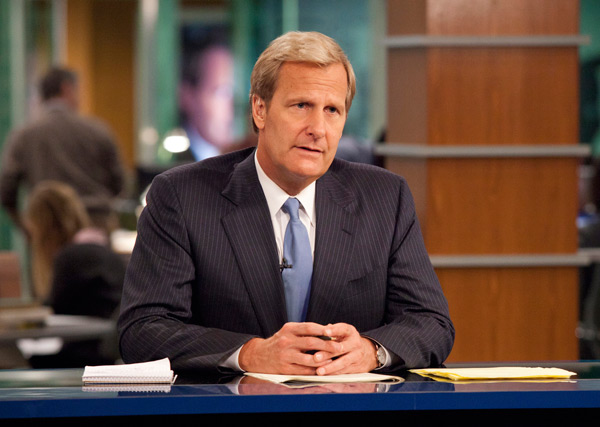
The Newsroom is about a, well, newsroom, putting on a nightly news show.  The show is headed by anchor Will McAvoy, played by Jeff Daniels, and helmed by executive producer MacKenzie McHale (Emily Mortimer), under the guidance of news division head Charlie Skinner (Sam Waterston – I heart Jack McCoy forever).

Aaron Sorkin is clearly an extremely skilled writer, of dialogue in particular, even though I’ve vacillated on how much I enjoy his writing (Joss Whedon is my preferred TV staple dialogue-writing cult figure).  It’s good though, for the most part, it’s sharp and crisp, and though it can be exhausting sitting through some Sorkin conversations, they have a rhythm and a cadence that gets more comfortable over time.

Aaron Sorkin, when he’s creating a show, rather than writing a movie, is also a creator of worlds, and here his talents are not quite as proficient.  Sorkin is an utter optimist and believes things can be better; this show is about running a BETTER Newsroom; his most successful show.  I capitalize better because the problem lies in the fact that Sorkin think he knows what’s objectively better.  There’s nothing wrong with an optimistic show; not every show has to be as soul-crushing as season 4 of The Wire or Six Feet Under.  However, there’s optimistic and generally light in tone and then there’s preachy and sanctimonious, which unfortunately is where the show lies some of the time and comes awful close to lying some more of the time.

(Having briefly mentioned The Wire before, I think it’s worth noting that in fact, in many ways The Newsroom looks to be the flipside to season 5 of The Wire’s journalism plot.  Where David Simon has just as much preaching to do about the state of the journalism industry, in Simon’s world view, the good guys lose about 70% of their games, while in Sorkin’s the guys guys win that many.)

There’s also this crazy and kind of disturbing romanticism for the past; a time when enws was NEWS and the greatest generation and blah blah.  I hate past romanticism more than anything; things were different but not better in every way; we used to not give gay people rights, let along black people.  Sure, some things are always better and some things are always worse; things are different.  Jeff Daniel’s character exclaims in a controversial speech in a panel at the beginning of the show that America is not the best country in the world, but then eventually says it used to be.  I was totally with him on the first part; my-country-is-best grandstanding outside of sporting events is on of the silliest ideas prevalent throughout the U.S. that I don’t understand.  Sure, I love my country, and I’ll root for it at the World Cup but I hardly think it’s objectively better overall than every other country; it’s better in some ways, and worse in others.  Once Daniels started on the second half that America used to be better, I was turned off completely.  Not to mention this continuing idea of bemoaning the rampant partisanship of America.  My belief is, for most things, some variant of fuck compromise – I believe strongly in one side and think the other is dead wrong.

That was a little bit off track, but it wasn’t entirely because the point is, while Aaron Sorkin’s world makes it seem like a great place to leave, it’s not real life, and it’s not somewhere you’d want to be real life, and that’s because it doesn’t work.

After writing about it, I realize I think I like it less than I thought I did right when I finished the episode.  I feel confident in everything I’ve written, but it’s worth remembering before I leave off what a talented writer Sorkin is; the show has good things going for it countering the bad.

One more quick note:  The show makes the kind of odd decision to set itself on the day of the BP oil spill in the Gulf of Mexico in 2010, and then conceal that fact until about halfway through the episode where it’s revealed as if it’s a crazy reveal; can you believe they’re starting a news show on this day?  I don’t really understand why, if they really wanted to start that day, they couldn’t have just revealed the date at the beginning.  It’s not as if most people know the date by heart as they would September 11 or D-Day.

Will I watch it again?  Yes, Sorkin is a big enough name and a talented enough guy that I’m going to give him a little bit of leeway despite my objections.  Also, I have no other way to get my Sam Waterston fix.  I may just fast forward to Waterston parts at some point, though.

Spring 2012 Review: Veep

3 May

Elaine Benes is the Veep

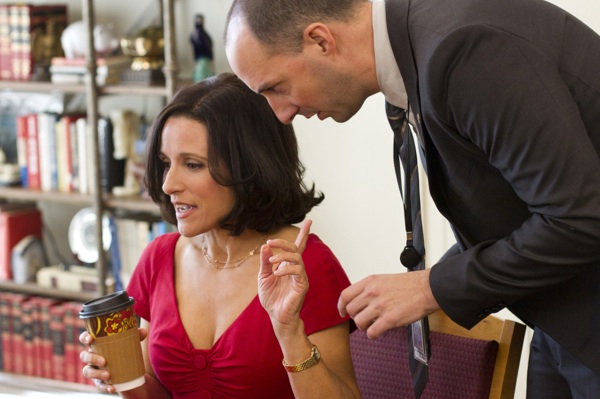
Some shows have forms of comedy that are very difficult to explain the concepts behind, while some shows have types of comedy that are far easier to describe.  The basic ideas behind Veep, I think are the latter.  Here’s the idea.  Veep is a half hour comedy about Vice President Selena Meyer, portrayed by Julia Louis-Dreyfuss, and her work life, her professional comings and goings (it’s basically an office sitcom).  Veep is designed to be good of course, but it’s designed to make you laugh, not to speak to all manner of generational issues like Girls, or to keep up with dramatic soapy storylines like Entourage.  Curb Your Enthusiasm might be the closest modern HBO comedy parallel, though Veep exists in a much more realistic world, relative to Curb.

While the president is in theory competently working on important matters of state with a huge entourage while meeting influential leaders, the Veep is borderline incompetently toiling away at stupid things that don’t really matter with a shoddy cast of incapables (why has there never been a movie called “The Incapables”  I call it, I just need to come up with a premise).  First and foremost, that’s the grand joke of the series.  Take something highly serious seeming like WashingtonD.C., and politics, and the vice presidential office and make it a combination of mundane and ridiculous.  Show that this allegedly rarefied area is occupied by people who waste their time just like people in any boring office job.

Meyer’s staff includes her Chief of Staff, Amy (Anna Chlumsky, the titular girl in My Girl) who seems to be the responsible one, her body man, Gary (Arrested Development’s Toby Hale), who seems a little slow of mind and exists solely to help Meyer, even when he’s not really helping, and press secretary Mike (Matt Walsh – former Daily Show correspondent) who doesn’t always seem to be on the ball either.  In the pilot, she welcomes new hire, ambitious tool Dan, who all of her fellow employees decry as a little shit, but whom she hires because she feels that’s exactly what she needs.  Other characters include her executive assistant, Sue, and the white house liason, Jonah.  The joke with Jonah is that he’s not only super annoying, but that he exchanges maybe five words with the president in a week, but he’s still in charge or ordering around the vice president’s office from the president.

Wacky side character alert:  Sadly, no one stands out – everyone’s a little bit wacky – there’s no true straight man/woman, but no one is so far wackier than everyone else. Gary is probably the strangest, but it’s incompetence within reason, rather than impossible to believe.

Will I watch it again?  Yeah, I probably will.  It seems fairly episodic so I feel like I can just tune into one or two more without worrying for better or worse about getting sucked into a season-long plot.  As goes without saying, but I’ll say it anyway, the success of a show like this depends largely on its writing and the comedic timing of the actors;  I don’t know much else from the writers, but the actors certainly have it within them, so there’s reason to be hopeful for a successful show if not perhaps an all-time classic.

Spring 2012 Review: Girls

16 Apr

Three Out Of Four Titular Girls

It’s hard to review this show because there’s been so many lines already written about it, before the show even aired, that I feel like I’ve become burdened with expectations, good and bad, though mostly good, that have far outweighed whatever the mere half hour of television that I’ve seen could possibly offer.  I don’t think I can remember the most recent show to come out of the gate with such critical buzz (I’m sure there was one, but I can’t pull it at the moment), and I feel handcuffed.  I’ll probably take another stab at this when three or four episodes are under my belt.  However, it’d be cheating if I didn’t at least try based on the first episode.

For whoever may actually not know what Girls is about, it’s about four women in their mid-20s trying to put their lives together in New York City.  Let’s specify further.  It’s about four white, fairly entitled, women, in their mid-20s, trying to put their life together.  I don’t mean anything by adding those qualifiers to my description, but it’s important, and much of the early criticism of the show has centered on either the all-white or the entitlement aspect, neither of which I think, on their face are fair.  I generally don’t agree with straight out subject matter criticism, except in terms of the difficulty of bringing something new to a ground trampled so many times before, and that’s really more of a problem for police and lawyer and doctor shows, than just about any show about women of any age or status anyway.

So here are the actually contents of the show.  Primary character Hannah, portrayed by creator, auteur, writer, director Lena Dunham, who has been interning for a year without pay while writing her memoir, finds out that she’s getting cut off, financially, from her Midwestern professor parents.  She’s despondent, having no cash, and has to figure out how to deal.  She also goes over to her boyfriend’s (maybe just a fuckbuddy (one word or two?) type) place, an actor/carpenter who doesn’t respond to her texts and appears to not really care much about her, and proceeds to have sex with him, leading to one of the most-talked about aspects of the show, the super awkward uncomfortable sex scenes.  I thought the hype here was a little overblown.  It’s unquestionably awkward, and certainly not glamorous, but hardly revolutionary or worth expending thousands of words over (maybe there’s plenty more to talk about in the next few episodes?).  Hannah’s friends include Marnie (I honestly had to look up the names of these characters, besides Hannah, I couldn’t figure them out/didn’t remember them from the episode), who is dating an oversensitive wus, who she can’t stand the touch of, but seems to be afraid of breaking up with.   The other two main characters are Hannah’s other friend, European Jessa who appears to be everything Marnie is not, flighty and pretentious, and Jessa’s roomate, Shoshanna (I really don’t remember hearing this name) who appears at least mildly airheady, who makes the obligatory lampshade hanging Sex and the City joke, acknowledging the parallel, that for good or ill, it’s impossible not to draw about a half hour show on HBO about four female friends.

An article I read felt that Girls’ closest contemporary, rather than Sex in the City was FX’s Louie, and in this short time I can see some resemblance.  Girls has funny lines, but it’s not a traditional comedy, in either having jokes, or in any kind of significantly “ha ha” moments.  It’s focus seems to be more on being poignant and “real;” far less absurdist than Louie, but probably trying to get at the same ideas.

Basically, I feel like I don’t know how I feel (that’s a ponderous sentence, no).  It was a watchable, and interesting, if not please-sir-can-I-have-some-more viewing experience, and I do feel fairly confident I’d at least come back for seconds without all the expectations hanging over the show.  As an entitled 20-something white person, albeit a male, I fit at least some of the categories the show is discussing, so I’ll grant that the show has the potential to have more resonance for me than for some others.  I’m not blown away into the sphere of what a visionary Dunham is, but hey, it’s just one episode.

Will I watch it again?  Yeah, I need to know more for better or for ill.  I really do think it will be for better, though.  Can this many critics be wrong?

Spring 2012 Review: Luck

19 Jan

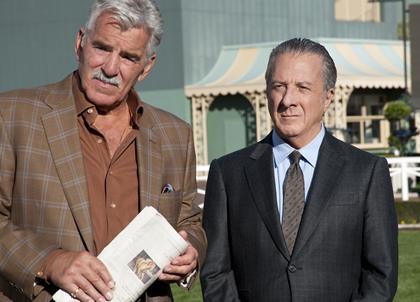
To watch Luck is to be whisked away into the less than glamorous world of horse racing.  The show opens with the release of Chester “Ace” Bernstein, portrayed by Dustin Hoffman, from a California prison. He’s picked up by his driver, played by Dennis Farina.  Berstein is eager to get back in the game, , the game being something shady but ostensibly money making involving horse racing, and because as a convicted felon he apparently can’t own horses anymore, he has his driver get a license.  Hoffman meets with an old acquaintance and has a discussion about getting back into the game,  though it seems later in the episode that the meeting may have served a different purpose entirely.

Degenerate gamblers are a plenty.  Luck focuses on four of them, one of whom seems to be a expert handicapper, which we can tell because a security guard at the track is willing to pay him fifty bucks just for his picks.  The four gamblers pool their money towards the lucrative pick six, the big jackpot reserved for picking the winners of six consecutive races.  This day luck runs their way and the four of them win a couple million between them.  Other characters include a couple of trainers working to get their horses ready for their races, a green jockey who doesn’t understand his role, and the jockey’s agent who tries to straighten him out.

I don’t know anything about horse racing.  I can count the number of times I’ve been to the track on one hand, and all of those times were with my great uncle; when he came to visit from Florida, we’d all go to the track.  The track to me, in spite of years of the “Go, baby, Go” campaign, has already represented sleaziness and Luck seems to reinforce that image, though making the sleazy behavior far more interesting than anything I’d previously imagined.  I’ve always found the idea of handicapping fascinating, that someone can go through reams of data and beat the odds, but I have no idea how it works.

Luck is created by David Milch of Deadwood fame, and like Deadwood, the language spoken on the show is English but a strange dialect of English which will inevitably take me a few episodes to understand.  I spent some time on the internet looking up a couple of terms that were used in the show.  I was quite confused after the first episode of Deadwood and it took me at least three episodes before I began to figure out what was going on.  I don’t mean this as a criticism; in fact, more the opposite, and distinct language can be a rare commodity on TV.  That said, if I hadn’t made the decision ahead of time to watch more of Deadwood, and hadn’t heard other good reviews I may not have stuck around long enough to understand the language.  I know better this time around.

It’s a world though that I’m interested in learning more about.  There were two primary angles for season long plotlines that came out of the debut.  First, Bernstein, it seemed like, was concocting some sort of plan, possibly to get back at the people who put him in jail (I actually had to watch the least scene again to try to figure out exactly his plan, and I still don’t).  Second, figuring out what the next step is for the four gamblers and newly minted millionaires (well, half a millionaires).  Beyond these two, there’s certainly ample ground for plotlines involving the agents, jockeys and trainers that not as much time was spent on in the first episode.

Will I watch it again?  Yes, I will.  I’m not sure it will be great, but it certainly looks as though it has a shot at it, which is more than most shows can say.  There are some strong actors and an interesting subculture.  David Milch knows how to put together a show, and I’m willing to give at least half a season to him to see him get started.