We’re halfway there. Four more. Young series all. Two debuts, a second year, and a third year, three comedies, and a drama. Let’s go.
Intro here and 43-40 here and 39-36 here and 35-32 here and 31-28 here and 27-24 here and 23-20 here.
19. Brooklyn Nine-Nine – 2013: 16

Co-created by Parks and Recreation creator Michael Schur and writer Dan Goor, Brooklyn Nine-Nine was more fully formed out of the box than Parks and Rec. While Paks and Rec modeled itself after the Office, Brooklyn Nine-Nine modeled itself after Parks and Rec. Parks and Rec took itself from a shaky at best first season to an excellent second season, and while Brooklyn Nine-Nine started higher, and has remained up to first season standards, it hasn’t quite made that jump. Brooklyn Nine-Nine is, no matter what else, a very solid, funny, and enjoyable show, and I look forward to watching it every week. Andre Braugher is a national treasure who should be kept in a museum when not filming the show for preservation purposes. I mean it as a sign of my high expectations for the show rather than an insult to say that Brooklyn Nine-Niane, while continuing to be good, hasn’t quite become transcendent the way recent similar network comedies The Office, 30 Rock, and Parks & Recreation did at points relatively early in their run. Brooklyn Nine-Nine always has some laughs, but it can be a little inconsistent, it hasn’t always found its own tone, and most of the characters are still working towards really being fully formed. Parks didn’t really hits its heights until the third season though, so I haven’t lost hope for this jump yet, and I’ll continue to laugh away in the meantime.
18. Silicon Valley – 2013: Not Eligible
 A new entrant on this list, Silicon Valley is a spot on satire of the tech sector and is laugh-out-loud funny to boot. Only in actually watching Silicon Valley did I realize how shocking it was that there hasn’t been a well-regarded satirical take on such an easily parodied industry that has played such an important role in the American cultural landscape for nearly two decades. Silicon Valley takes advantage of this lapse and mines the industry for all its worth. It seems (from external sources including my brother who worked there) that there is lots of truth to Silicon Valley’s portrayal, even if gets some details wrong or exaggerates for comedic purposes. The show definitely has a bit of a woman problem; and while some of that is endemic to the premise of the show (it would be more dishonest realistically to have a group of programmers as split evenly between male and female), dragging the one female character into a romance with the protagonist that doesn’t really fit on screen is forced at best. The characters can on occasion be a little cartoonishly nerd-like, and though the touch is gentle and loving, the nerds-can’t-function-in-society button is hit one too many times. Still, Silicon Valley delivered an extremely promising and funny first season, which gives me great anticipation for the second. Lastly, a moment for the late Christopher Evan Welch who may well have been the break out performer if he wasn’t tragically felled by lung cancer; his venture capitalist Peter Gregory was a delightful weirdo.
17. Fargo – 2013: Not Eligible

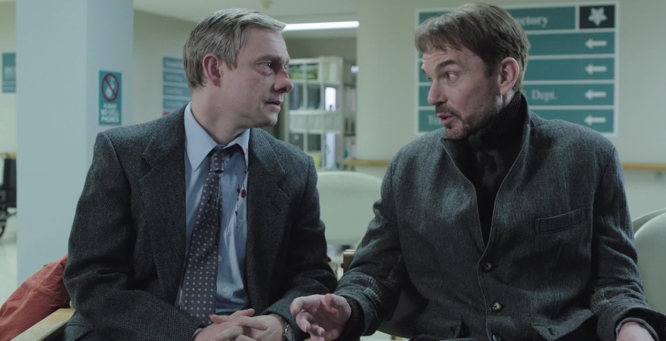
Fargo began from an unusual idea; creator Noah Hawley didn’t want to remake, or make a sequel or prequel to the much-lauded 1996 Coen brothers movie Fargo. Rather, he wanted to set a similar story in the world of Fargo, keeping the tone and atmosphere that make that film so successful. It was an unusual idea and a bold one (the closest I can think of offhand is Ron Moore’s BattleStar Galactica remake – but that was almost the reverse – the new show appropriated characters and concepts, but changed the tone completely). For the very most part, it worked, and was one of the best new shows of the year. The show deftly married dark humor and riveting drama, created similar analogues to the movie’s characters that were different enough to stand up to the rigor of a TV season where characters have to develop and grow. The four major characters were each entertaining and brought something different to the show, and many of the secondary characters were treats as well, as Fargo made good use of playing comedic actors in more dramatic roles. A couple of plotlines seemed out of nowhere, weaving in and out with no real purpose or resolution, and a couple of the characters felt oddly used, sometimes under, and sometimes over. Still, overall, Fargo brought the most important ingredient to its success consistently; its tone; dark, comedic, with an underlying small town warmth.
16. Veep – 2013: 27

Veep has been a steady climber in these rankings. I watched its first season, finding it amusing enough to keep up with, but not to make it a must watch immediately – it frequently got pushed below the hoard of other Sunday shows, and was eventually viewed later in the week. The second season was better. All of a sudden, I made more of an effort to watch sooner. The dialogue crackled a little more. The cast seemed to be more familiar with one another’s timing and comic beats – the chemistry between nearly every two-person pair was sparkling. The third season ramped it up another level. It’s easy to see why Veep, a modest comedy which doesn’t go for the loud humor of It’s Always Sunny in Philadelphia, the high-concepts of Community, or the emotional depths of Parks and Recreation, hides under the radar, but it’s snuck its way to being one of the best comedies on television. Veep simply put together a season of being consistently minute-by-minute funny.
 Television, the Drug of the Nation