End of Season Report: The Comeback, Season 1 – Part 2

19 Aug

The Comeback

Juna, the budding superstar of Room and Bored, and Paulie G, one of the co-creators of the wretched sitcom, represent opposite poles within the show’s universe. Juna, no matter how big and popular she continues to get is unceasingly nice and generous to Valerie. Valerie is generous in return, but half in an attempt to relate everything to herself, to how she was once the up and coming talent. To prove it, she brings in a sexy picture taken of her back in the day when she sees Juna’s sexy magazine shoot and wants to prove that she once had that too. She does have useful advice to offer Juna, and Juna is graceful, always flattering Val. Val is most interested in related to Juna how popular and loved she once was.

Paulie G is Juna’s opposite. He hates, hates, hates Val. There are good reasons to occasionally dislike Val; she has some dislikable qualities. She can be a diva, and it can be irritating for everyone to deal with cameras everywhere when they’re intereacting with her. Director James Burrows, for example, is frustrated with Valerie occasionally but also offers her solid advice. Paulie G’s hatred goes far beyond that. He’s simply a giant asshole to Val at all times. He pretends to have sex with her in the writers’ room, and is just a huge, huge dick, and Val puts up with it and takes it. It’s a strange victory when she eventually punches him in the stomach causing him to vomit. It’s the wrong thing to do; we know this, unquestionably, but he’s just such an utter asshole. He’s particularly cruel at that moment when she’s trying so hard for a laugh, and he makes her do a whole bunch of painful falls for absolutely no reason, that it’s hard not to smile when he gets his. And yet the ultimate twist of the knife is when he gives a lying, bullshit interview to her producers that makes it sound like he was a real nice guy, making her the bad guy on her own show.

And really the story is greater than Valerie. The Comeback is incredibly ahead of its time on reality TV, but it’s correct then, and correct now, regarding the plights of older actresses. I hate using the word older; Valerie is 40, when many male stars are just hitting their strides. But Hollywood does and has for decades marginalized actresses as they age; not only not writing good roles for them, but writing roles like Valerie’s Aunt Sassy. She has to wear an abominable running suit all the time, and the thought of her as a sexual being is disgusting, fodder for jokes, not just within the show, but to the young male writers that nearly exclusively populate the set. If there weren’t other reasons to feel for Valerie, and there are, there’s this, which she has to stand up against. When she tries to challenge the stupid decisions made by the writers on this terrible show (the joke about her eating dog wasn’t even a matter of merely poor taste – it was obviously not funny), she is the one hassled for not being able to take a joke.

I can’t leave this review without talking about the incredible prescience of The Comeback in terms of reality television. Reality when The Comeback aired was dominated by Survivor and early singing competitions, all game-show like reality with winners and losers. This was before Andy Cohen and The Real Housewives and The Kardashians ruled the roost. The Comeback foreshadowed all of that.

I’m going to save more talk about the ending for a piece comparing The Comeback and BoJack Horsement which I alluded to above, but a couple of words in brief. In the finale, everything in Val’s reality show is blatantly misconstrued and taken out of context. She’s furious and upset until it turns out that its outrageousness is exactly what ends up making it popular. And thus it’s a strange kind of mixed victory. In Val’s world, it’s better to be popular and embarrassing than a dud which tells an honest and more complex and accurate story.
End of Season Report: The Comeback, Season 1 – Part 1

17 Aug

The Comeback

I just finished the first season of the Comeback, as part of my effort to catch up on some HBO series I missed the first time around. The Comeback was never hilarious or particularly funny but it was enjoyable, phenomenally interesting, and surprisingly prescient. I’ve broken my lengthy comments into two sections, of which this is obviously the fist.

The Comeback is a show-within-a-show. Valerie Cherish (the excellent Lisa Kudrow) is a forty-something actress who, over a decade ago, was a hot young star of a successful but not life-altering sitcom “I’m It.” Since then, she hasn’t found a lot of work, and as she’s gotten older, she’s not longer seen as the hot young actress she once was, or that she still sees herself as. She gets another chance at the spotlight however, when she’s up for a supporting role in new sitcom Room & Bored, and as part of that process, is invited to star in a reality show called “The Comeback” about her return to TV. The entire series is framed as raw footage for this reality show.

The Comeback is a great parody of Hollywood culture, and specifically how Hollywood treats older actresses. The supporting cast is excellent, but everything rests on Cherish, who due to the format as a faux reality show focused on her big comeback, is featured in almost every scene. She has some classic cringeworthy qualities. She’s part Michael Scott, although since The Comeback debuted before the American The Office, you might say Michael Scott is actually part Valeria Cherish. Valerie has none of the stupidity of Scott or the utter insensitivity of Scott’s British equivalent David Brent but she has the awkwardness, the lack of awareness at how constantly uncomfortable she makes people, and the desperate insecurity and need to be liked.

Valerie peaked early, reached fame easy, and was treated to a world in which she was famous, loved, and respected. Everyone was a fan, and everyone wanted to be her friend. The Comeback has a striking amount of similarities with BoJack Horseman, which I coincidentally I watched immediately before. (I hope to write another post specifically comparing the two). Valerie is desperate to be liked. She’s not hip, but wishes she was; not enough to try to actually be, but enough to claim she is.

The show actually hits Valerie’s attitude and personality right on the nose in an episode in which Valerie goes to Palm Springs with her husband and hangs out with a couple they know casually. The wife, who has survived cancer, sees what we, and what ostensibly everyone in this world sees, and actually speaks to Valerie straight about it, which just about no one else does. This friend notes that ever since she recovered from cancer, she’s been unabashed and unafraid to be herself, and that Valerie ought to try to do the same. Valerie is incredibly uncomfortable in her own skin; she wants so desperately to be liked, to be loved, to be needed. She’s passive aggressive all the time. She’s constantly afraid to just speak her mind, which might make her more unlikable to someone else, but to others it might just sound human.  She’s not hip with the kids, but she tries desperately to be. She tries to insist so strenuously that she can take a joke, while sometimes she should rightfully be angry. She is constantly looking towards the camera, saying yeah when she means no, having her every move securitized but being okay with it because she wants so badly to be relevant again. She wants to prove that she’s cool, that she’s still got it. But she wants it so badly, that she can’t.

For all of her personal frustrations, her relationship with her husband is stable and happy and never dramatic which is both surprising and welcome. Her businessman husband is startlingly comfortable in his own skin. He knows he’s not cool. All he wants is to relax, have a steak, have a drink, play a quick nine, and listen to Cheap Trick. He doesn’t like the cameras, but he puts up with them, because he’s supportive of Valerie and wants what she wants. He’s not the most interesting guy in the world, but he genuinely loves and cares for Val, and knows who he is, and the contrast with Val is sharp.

Valeria is constantly frustrated but tries to mask this frustration with an overabundance of good cheer. She’s at various times both incredibly jealous and narcissistic, but tries not to be obvious about it, even though it’s clear. She doesn’t understand she’s not the star anymore – like an older athlete who can’t realize she’s a supporting player now. She acts extra nice, even though she’s primarily interested in supporting people in exchange for them supporting her, but then again, niceness is still niceness, regardless of the agenda behind it, and Valeria does do real favors and show genuine appreciation to others because it’s what she would want. In fact, she’s most empathetic when others are desperate, because it’s a language she can understand. When only female writer Gigi breaks down because she desperately wants to go to the Golden Globes, Val extremely generously offers to take her as her guest.

The Comeback hues very closely to a line where you are both constantly aggravated by Valerie but also feel really terrible for her. She has to deal with networks and writers and directors who  really don’t care about what she thinks. Room and Bored is a hilariously obviously terrible sitcom that everyone has to pretend is funny all the time because the alternative is admitting that they’re wasting away their year working on utter dreck.

More in part 2.

Summer 2015 Review: Mr. Robinson

12 Aug

Mr. Robinson

Hi, decade of the 90s. You seem to be missing a sitcom. I like Craig Robinson. I think he has some natural charisma and comedic sense. Unfortunately, it’s not well-used in this sitcom which seems pulled straight from 20 years ago.

Of course, there’s the laugh track, but I’ve talked about that many times before, so I’ll merely made the one sentence point of how ridiculous it is that the laugh track still survives, but moving on.

Craig Robinson plays Craig, a substitute music teacher and part-time bandleader. He’s a slightly more grown up version of the classic Seth Rogan-Judd Apatow immature adult. He’s both a little more mature, relatively (he’s actually a teacher, and he’s good at it) and older (about 15 years older than most of the Apatow-esque prototypes) but the idea is strikingly similar. He’s been making nothing of his life – being smooth and charming and well liked but without a real steady career or money to his name. Out of the blue, at one of his shows, he sees an old ex-girlfriend Victoria who he stood up twenty years ago for prom. He finds out she works at the school they went to growing up and he somehow manages to get himself a substitute gig there where he can pursue her further.

There’s a mish-mash of sitcom tropes pervading Mr. Robinson. Mr. Robinson is filled with Characters, characters with ridiculous over-the-top attributes. Mr. Robinson is one, signing, and dancing, and attempting to snake-charm everyone he meets. His brother, his co-band leader, is his fun-loving slightly negative influence who nonetheless is there for him when it counts. The new school principal (played by Frasier’s Peri Gilpin) is immediately suspect of Craig, but her effeminate superior is a big fan of his band and excited to have him on board. The fellow teachers include the most cartoonish character, the gym teacher who prefers to be called “Magnum P.E.” (that-guy TV actor Ben Koldyke who played among other roles, newscaster Don in How I Met Your Mother) and teacher Ashleigh (Spencer Grammer, Kelsey’s daughter, and voice of Summer in Rick & Morty) who both Craig and his brother immediately recognize from her weekend second job at the local strip club. Pretty much all of these characters are ripped from old style sitcoms, each more over-the-top characters with big, loud, distinctive styles and characteristics who rattle off punch lines that stand in for smarter jokes.

The episode ends with a classic sitcom gesture. Craig’s students, who adore him after a mere week, try to help him get together with Victoria by restaging a version of the prom he had stood her up for years ago. The gesture of course works in salving old wounds but is in vain as she hasn’t broken up with her boyfriend like Craig had believed. Craig is forced to attend the prom at the expense of missing the biggest gig yet for his band, a supposed first episode stab at being more mature, but everything works out in the end when he gets to the show late and brings a crowd. Everyone wins, except the viewers.

I may not have explicitly stated it yet, but you probably get the correct idea that Mr. Robinson isn’t very funny, and there’s certainly nothing else redeeming about it that would make up for the lack of laughs. Oh well.

Will I watch it again? No. It was not very good.

End of Season Report: True Detective, Season 2

10 Aug

True Detective

It was several episodes ago that True Detective was deemed collectively by the internet, and not wrongly, a failure, and it seems oddly anticlimactic to have waited until the final episode for the inevitable post-mortem that everyone will be writing. After all, the internet collectively managed to figure out the original setting-the-plot-into-motion mystery as to who killed Caspere, though by that point, the mystery didn’t really seem to matter that much anyway; that aspect of the finale was wrapped up in the first third. Relative to expectation, the failure of True Detective’s second season is one of the most notable in recent TV history (Homeland’s quick descent is probably the best, most recent predecessor) which means it’s spending a few words on what went wrong, but what’s striking is how easily explained the cause of the failure is. True Detective season 2 just didn’t work on any level; the plot, the characters, the writing, the casting, and the cinemetaography didn’t work individually and certainly didn’t work together. There were stray moments, and some actors were better than others, and it wasn’t as awful as much of a relatively failure it was. But it was.

Some failures are extremely instructive. Lost set the path for the return of complicated supernatural shows on television, but also how not to end them; have some semblance of a plan before you jump in. The Killing’s first season finale was a lesson on disappointment and anticlimax; don’t build a show of a certain type, only to try to become a different kind of show at the last minute. Unfortunately, I’m not sure True Detective’s failings are particularly valuable outside of that show itself; their use may be limited to helping Nic Pizzolatto not screw this up en route to a potential True Detective season 3.

The goals, on paper, were noble. A neo-noir seemed ripe for the type of story and type of voice Nic Pizzolatto used in the first season successfully. And yet nothing, right from the beginning, quite clicked, but everyone, myself included, was willing to give it some rope, because we had the first season in our rear view mirror, and because it seemed ambitious enough that we wanted to give it every chance to succeed. But every problem right there from the beginning remained to the end.

For one, it was too confusing. Noirs can be complicated, and there’s nothing wrong with that; shows that don’t baby their viewers should be congratulated. But there’s a difference between being complex and being needlessly hard to follow; the alphabet soup of names were thrown around without an appropriate background to get a hold of them, and it started to become a joke. Burris. Stan. Holloway. Who were they, and why did we care?

The major characters were a big part of the problem as well. Vince Vaughn never was able to quite pull off gangster Frank, though Pizzolatto is at least as much responsible for delivering incredibly stilted dialogue that sounded foreign and awkward. Hyper-stylized dialogue can work in the right circumstances; see Wes Anderson and Quentin Tarantino, each who make their living on their own brand of extremely stylized dialogue. But the dialogue not only sounded incredibly out of place, even in context, it just sounded bad.

The characters were generally shallow and uninteresting, and just wallowing in an incredible amount of self-loathing without much going on besides it. Taylor Kitsch’s Woodrugh, particularly, suffered from this; his entire plot hinged on his suppressed homosexuality, and there was no real investigation into that nor did it serve a role as anything more than another reason for him to hate himself. That’s all he was, and Kitsch was unable to through sheer acting bring anything more to the character. Vaughn and Kitsch had a daunting and perhaps impossible task to make their characters more than their shoddy writing and neither accomplished it.

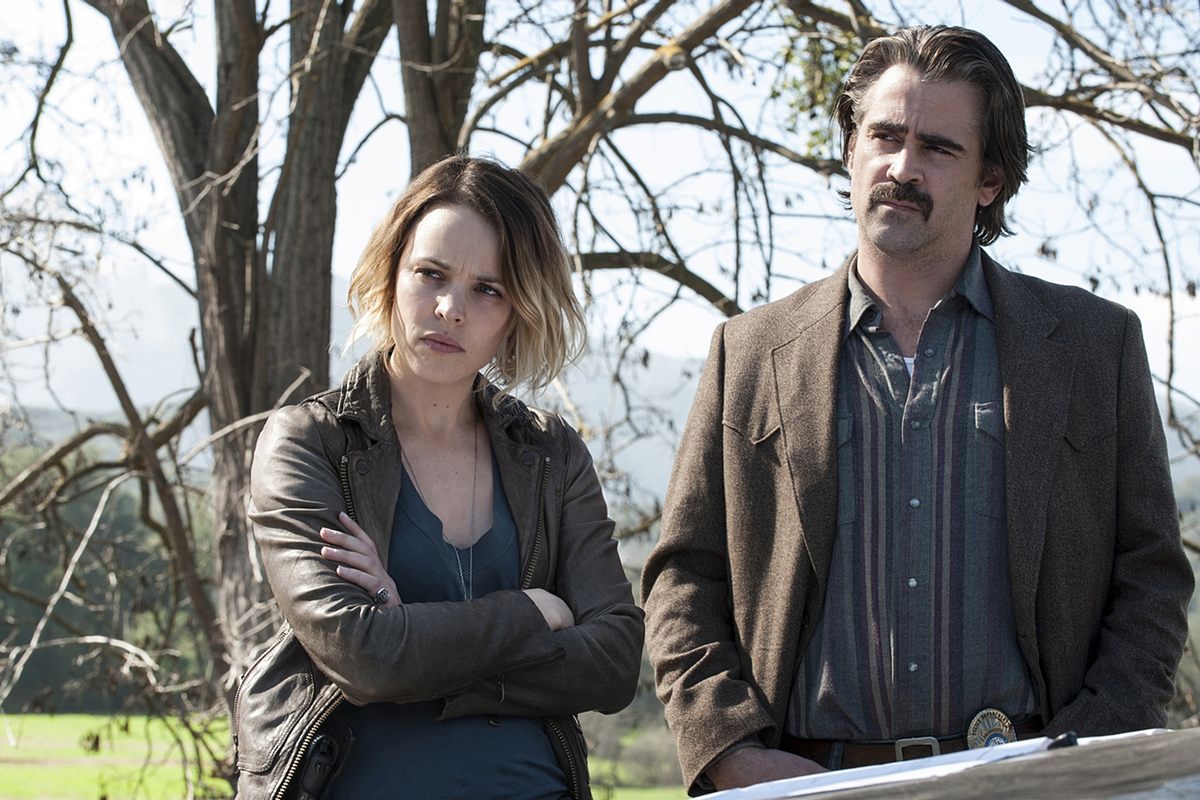
Colin Farrell’s Velcpro and Rachel McAdams’ Bezzerides were only marginally better. Both were very much damaged self-hating sad sacks in the same way; unable to function in normal society with normal people. Both had a combination of ever so slightly deeper characters and somewhat better cast actors to raise them a notch above Frank and Woodrugh, but no further.

The plot was confusing and never enticing, and that’s important to note. But plot is often the great McGuffin of a noir. Many a noir have been told on a plot that was a hook, only to tell a story that was hardly about the plot itself. Neo-noirs Big Lebowski and Inherent Vice both have incredibly convoluted plots (the latter less coherent than the former) but plot is not paramount to either; the atmosphere, the dreamlike sequences, the characters, the personalities, the cinematography, the dialogue, and the interactions makes those movies go. True Detective doesn’t have any of those to stand on.

Nic Pizzolatto clearly understands what’s in a typical noir. This was just a failed exercise every which way. An uninteresting confusing plot, which was unsatisfying, weak and poor dialogue, poor casting and acting, and no directorial quality which lifted any of this up. A couple of these elements may have made a season worth watching, but unfortunately, it’s back to the drawing board for season 3.

Summer 2015 Review: Difficult People

7 Aug

Difficult People

Difficult People comes from a long tradition of a certain type of sitcom, dipping into the well that Seinfeld created and Curb Your Enthusiasm doubled down on (It’s Always Sunny in Philadelphia is another foremost practitioner of the style). Here are the general tenants of such comedies. The main characters aren’t necessarily unlikeable, but don’t particularly care about being likeable either. They live in their own world and don’t care what other people think. They get into constant tiffs and situations with other people, who basically exist just to be irritated and bemused with and by our protagonists. Sometimes the protagonists are in the right, and the people they’re speaking with are crazily unreasonable, sometimes the protagonists are obviously unreasonable, and sometimes the line is grey. Coincidence plays a huge role in these types of shows; a person who the protagonists pissed off or got into a fight with earlier often shows up later in the most awkward and uncomfortable place. The first episode of Difficult People checks off all of these boxes. 

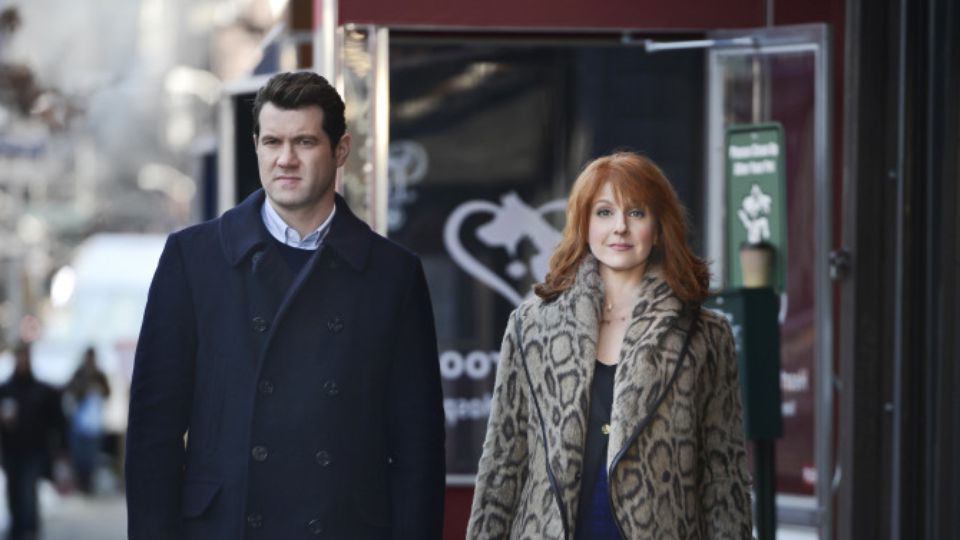
Best friends and comedy partners Billy Eichner and Julie Klausner play best friends and comedy partners Billy Epstein and Julie Kessler. They live in their own world, constantly inundated with social media; both are constantly on their phones and one of the recurring bits revolves around a joke which Julie made and then deleted on Twitter. Billy and Julie get into two arguments/awkward situations in the episode. First, with a mother at the theater who doesn’t like their language around her kids, and second, with a start up CEO who is unimpressed and confused by Julie and Billy’s idea to bottle and market school library water fountain water. These two people, both of whom they ticked off, end up being married and show up at Julie’s boyfriend’s boss’s party that everyone is at at the end of the episode, making everything extra awkward.

The supporting cast includes Julie’s boyfriend (played by the voice of Venture Bros.’ Dr. Venture, James Urbaniak), her mother, and Billy’s boss and coworkers at the café where he waits tables. 

Billy and Julie are big personalities; if they rub you the wrong way, and I can see how they might, the show isn’t for you. But that wasn’t a problem for me, and if you like the shows mentioned above that Difficult People mimics, Seinfeld, Curb, and Always Sunny, I don’t think it will be a problem for you either. The jokes were hit and miss, but the style is a proven one, and while it does copy a lot of the Seinfeld-ian mode, it still works, and it separates itself from those shows by bringing the protagonists personalities to bear on that style of humor.

Difficult People won’t blow your mind, and it wasn’t a smash from the first episode. But it had funny moments, it’s a breeze to watch, and frankly there’s a shortage of good comedies on TV so I’m willing to give them some leeway even if every episode isn’t perfect.

Will I watch it again? Yes, it was generally funny, and while it wasn’t wall-to-wall hilarity, it was very easy to watch. I like this type of show in general, it’s 20 minutes, so why not?

Summer 2015 Review: Significant Mother

5 Aug

Significant Mother

I’d like to thank the CW for making a show that rather than being about something everyone was thinking about but not making, was about something that absolutely no one was thinking of. A not-uncommon current formula for a network comedy is to pick a crazy non-nuclear family arrangement, and then have the characters, some of whom are not accepting of the new arrangement initially, have to make it work, no matter how uncomfortable and how many hijinks ensue. Think of The New Normal, or One Big Happy (well, you probably won’t remember anything about either of these quickly-cancelled series, but trust me, they’re about unusual family arrangements, and having to deal for the betterment of all involved). Significant Mother, for which like Scrotal Recall, the title is far and away the most noteworthy and memorable thing about the show, tries to top these crazy-family-hooks with one of its own.

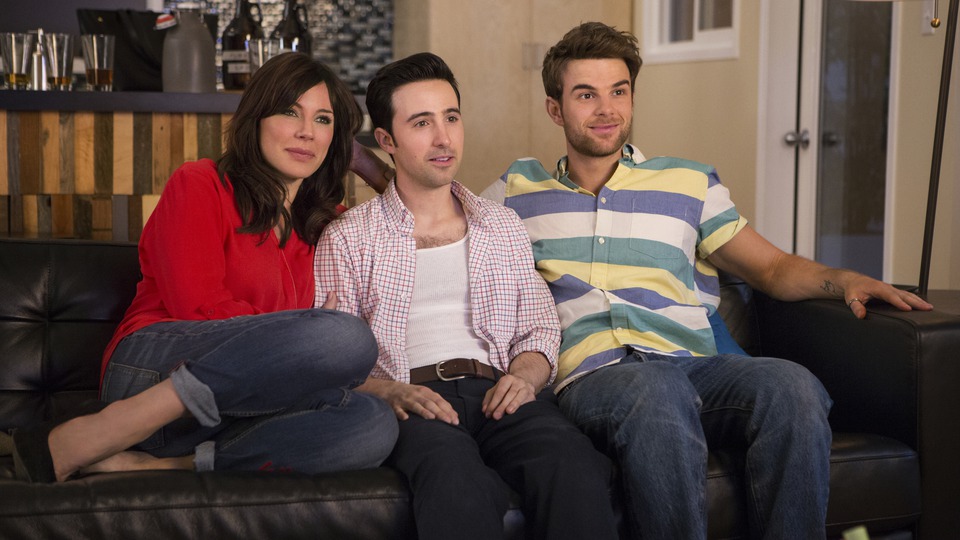
Nate, an up-and-coming chef comes back home to Portland from some sort of vacation or business trip to find out that his best friend is sleeping with his mother. He’s naturally grossed out and furious at both of them. He’s further disgusted when he finds out that this is more than merely a one-night stand and that they’ve been doing this for a little while. He’s angry and frustrated. His mom and best friend, separately and together, both try to talk to him, initially promising that will never happen again. This is complicated when they both realize that they actually have feelings for each other and want to see where this goes. Eventually, as happens at the end of pilots in these types of shows, Nate begrudgingly accepts the situation, realizing it’s not going away, and that he doesn’t want to end his relationship with his friend or mother, nor keep them from happiness.

Other peripheral characters include Nate’s dad, who separated from his mom recently due to his serial philandering, but is still hoping to convince Nate’s mom to reconcile, refusing to sign divorce papers. Sam is Nate’s close friend who works at his restaurant and who he’s had a crush on for some time; unfortunately, she’s dating an organic farmer.

It’s not funny, but it’s not really cringeworthy either; it’s more ridiculous in terms of the concept than it actually is bad. There’s nothing else particularly noteworthy about it. There’s no reason you’re going to watch this show, and there’s no reason you should. I really have absolutely nothing to say about the characters or the dialogue; they’re not good in any way, but there is nothing obviously terrible worth talking about either. They’re utterly forgettable, following a sitcom template to a T. If that makes this a cheat review, I apologize.

So, if you ever hear of this show again in the future, which you probably won’t, you know what you need to: the title, and the nutso premise. That’s about it.

Will I watch it again? No. I’ve seen about all I need to.

Summer 2015 Review: Sex&Drugs&Rock&Roll

20 Jul

Sex&Drugs&Rock&Roll

Sex & Drugs & Rock n Roll charts the path of a legendary almost-but-never-quite-made-it band that faded just before Nirvana hit and made rock huge again (think maybe Mudhoney) as they are drawn back together in the present for the first time in many years. The Heathens were led by ultimate heathen Johnny Rock, played by Denis Leary, who drank and drugged his way through life, getting by on oozing charisma and competent songwriting chops while generally being an asshole to everyone, particularly his bandmates.

The show starts as a docudrama with Dave Grohl and Grug Dulli talking about The Heathens and just how equally important, influential, and unsuccessful they were. (I have to put in a note here that none of the language thrown around by Dulli and Grohl actually sounds anything like the little music we here the Heathens’ play; they sound more like the New York Dolls than a band that would immediately influence Nirvana.) In the present, Johnny visits his manager and finds out he’s out of options; there’s no market for his music and he’s too old to start over again, but too young to retire. He’s reduced to considering a position in a low grade but decent paying tribute band; selling out is everything Johnny has fought against, but money is money.

Later at a bar, he hits on a woman, Gigi, (Victorious’ Elizabeth Gillies) far younger and more attractive than himself he believes is making eyes at him, only to find out that she’s been doing so because she’s actually his daughter that he never knew existed. He lucks out when the next day it turns out that Gigi has some money and wants to make it as a singer in NYC, and despite her lack of interest in him as a paternal figure, she wants his help as a songwriter, if he can convince his old songwriting partner, the Heathens’ former guitarist, Flash, to join forces with him. Convincing Flash (John Corbett) is difficult as Johnny was a huge asshole and Flash is much more successful currently, making bank as Lady Gaga’s traveling guitarist. Gigi, sensing this might be an issue and knowing the way to all musicians’ hearts, texts Leary a provocative picture to show Corbett, and the old crew against all odds is up and running.

Gigi performs a classic Heathens song with the band; everyone can see she’s got actual talent, and we’re in business.

The biggest problem with Sex&Drug&Rock&Roll is a sense of a tonal dissonance. I’m not quite sure what the show wants to be, and it might be more successful if it pulled further in one of a number of directions rather than where it currently is. There are some good ideas here for a show; skewing the music industry, both modern, and classic, and the notion of the fading rocker, the Keith Richards type tried to keep up. Sex&Drugs&Rock&Roll at times seems like it is trying to be an edge, satirical, black comedy, that pulls no punches, with characters who are not necessarily likeable. On the other hand, Sex&Drugs&Rock&Roll wants to have a heart, and tell the story of a complicated relationship between father and daughter, that’s a little more serious and more sentimental. In this way, it almost has the vibe of a feel-good movie redemption story, like Music & Lyrics but about a father-daughter relationship instead of a rom-com.

The jokes aren’t funny, which is a problem for the black comedy aspect. One approach would be to tone down the jokes, keep a light, comic tone, but up the ante on the plot and depth of characters. A biting satire could work as well but the writing would need a lot of tightening; if a satire isn’t funny, it doesn’t work: see The Brink. There may be gray areas between these approaches, or others, but Sex&Drugs&Rock&Roll’s isn’t working currently, and that’s the chief problem. The jokes aren’t funny, the music sensibility seems weirdly out of date; the Lady Gaga jokes for example feel a couple of years well too late.

Will I watch it again? No. There’s an idea here and I like the cast. But it’s just not there without a bit of a stylistic overhaul.

Summer 2015 Review: The Jim Gaffigan Show

17 Jul

The Jim Gaffigan Show

The Jim Gaffigan Show attempts to pull the trick that relatively few shows have pulled off, and which Modern Family has pulled off most successfully – to relatively modernize the classic sitcom. Modern Family brings in the single camera and cuts the laugh track, but leaves in the close knit family, the wacky hijinks, and the heart. I don’t particularly care for the show on the whole, but episode to episode, and scene-to-scene, I’ve seen plenty of moments that have that formula working.

The Jim Gaffigan Show takes this strange and maybe worthy goal on, ultimately unsuccessfully. The ‘90s were dominated by family-oriented sitcoms, with the last two great editions being Everybody Loves Raymond and The King of James before the genre largely died out as a major force. The genre was both medium and message; there was a format – multi-camera with big canned laughs and a lot of big obvious punchlines – and a style – warm, family friendly, not too edgy. Most revivals of the style have brought back both elements, leaving them to appear extremely outdated. Modern Family hit the jackpot, bringing in both traditional sitcom watchers and younger viewers who also enjoyed The Office.

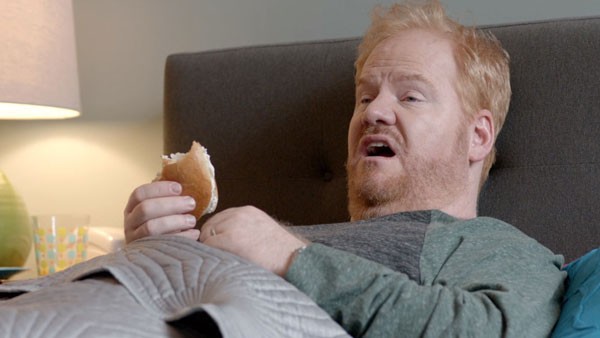
The Jim Gaffigan Show is another attempt to mix modern form with traditional style comedy in the wake of Modern Family. It has everything you could want – a hype-immature American male (think: Tim Taylor or Ray Barone or Phil Dunphy) who has juvenile tendencies, who knows his wife is far more competent and put together than he is, but occasionally wants to show that he can do parenting and life too, if he can get himself off the couch for five minutes. There’s a classic TV mix up in the pilot. Jim has three letters, two to deliver, and one to take home and he confuses them hanging the letters to the wrong recipients. The poor husband can’t even get one thing right. Luckily, through a serious of screwball happenings, his mistake turns out not to matter, until something else that came up earlier does, but at the end Jim and co. are a sweet, loving, happy family and that’s all that matters. There’s a schlubby-but-lovable-and-funny TV husband married to a much younger, more attractive women, who can’t help but love his foibles at the end of the day because he means well even as she does all the work.

Jim Gaffigan is a funny guy, and that, well kind of comes through in the show, which is about the nicest thing you can say about it. It comes through mostly when Jim is just talking, exposing his natural timing and humorous cadences. Everything else, though. It’s the same old, It’s not cringeworthy, but it’s surprisingly unsophisticated and thoroughly medicore.

Will I watch it again? No. I like Jim Gaffigan’s stand up, but he’s probably a traditionalist at heart, and this sitcom really shows it off. The sheen may be more modern, but the sitcom is gooey, boring, clichéd, and most importantly not funny.

Summer 2015 TV Review: The Astronaut Wives Club

8 Jul

The Astronaut Wives Club

The Astronaut Wives Club was not very good, but more than that the pilot was very odd. Not odd in that it was not linear or hard to follow or particularly complicated or surreal. Rather it was simply a strange, rambling, I-have-no-idea-what-the-goal-for-the-series-is pilot. Usually drama pilots offer some kind of statement for what the show is, and even if it’s not entirely fully formed, dramatic pilots are generally better indicators of the show’s futures than comedy pilots. Usually, there’s an obvious mini-arc that gets the show started and sets the tone for where things will go. Not here. The pilot was regular network drama episode length (43 minutes) but felt like an hour and a hour as it meandered, driving past logical ending points, being incredibly unclear about any sense of scope, or firm definition of character, and leaving me with no idea of what the show is doing.

The Astronaut Wives Club truly feels like a network series, and particularly an ABC series, trying to walk the line between prestige, family-friendliness, marrying the simple and the complex, and meeting none of those goals. The pilot almost feels more like a TV movie and then keeps going when you think it’s about to end. It crazily takes place over the course of two years, which seems like a lot of time to span for absolutely no reason.

The set up is that as the seven (real-life) Mercury program astronauts are chosen, one of whom will be the first American man in space, a reporter (played by Rectify’s Luke Kirby) will be constantly covering them to push the story for NASA, but he’ll be focusing equally on their wives to present America with a truly ‘50s wife-and-kids-support-the-man perspective of what makes American right and good and wholesome and better than the USSR. It’s tough to tell whether the article is going to be a running thread or merely a reason to have the wives get to know each other, and the answer is well, I’m still not sure. The show keeps coming back to the article, but it also doesn’t really have any point. The Astronaut Wives Club is just kind of a rambling tale about the wives mostly, with some focus on the astronauts. I actually don’t really know what it’s about. By speeding two years from the announcement of the Mercury astronauts to the first manned flight, it’s hard to get too much of a beat on any of the characters beyond the broadest characters, and not even those for some; I could not have recited more than one or two of the wives names after just finishing the pilot. Alan Shepard’s wife cheats on him, but she doubles down standing by him, while Gordon Cooper’s wife had been ready to divorce him in response to his cheating, but they stayed together temporarily for his career. There’s something about how as the boys play and carouse, the wives have to stick together and be there for one another? Or maybe not. First there are parts implying that the wives are not going to get along, then they just kind of do.

This disorder is especially surprising for a pilot that seems so relatively straightforward. The idea would be that we’ll try to see how these women in the ‘50s, though housewives, had their own complex lives and interactions, and were every bit as important as the men. It was just shockingly all over the place. From the pilot, I have absolutely no idea where the rest of the show is going, especially considering it spanned two years, from the birth of the Mercury program in 1959 to past Alan Shepard’s flight in 1961, and there were even more events after that presumable ending point. Is every episode going to take this long and just take the through the whole Mercury period?

There’s really nothing to take out of this show. I don’t really understand why it exists, what it’s goal is, and what it’s plan is, and not because it doesn’t want me to know. There’s not really a lot to note.

Will I watch it again? No. It was 43 minutes and felt like much longer. That’s rarely a compliment. It was a strange show, leading nowhere.

Summer 2015 Review: Deutschland 83

6 Jul

Deutschland 83

Deutschland 83 has the proud distinction of being the first German-language series to air on a U.S. network, which is kind of cool. I’m not sure whether the Germans behind it realize this, but it is yet another in a recent string of shows that seem to be modeled in the wake of the fantastic The Americans. Deutschland 83 is better than most of the other contenders, and has some important differences, but it’s still hard not to have The Americans in mind, as a point of comparison, while watching the pilot and it’s unsurprisingly not in that class.

Deutschland 83 takes place in, well, 1983, just about the same time as The Americans. The Cold War has tensed up again for one last moment before the thaw of the second half of the ‘80s, but to those at the time unaware of what the future would bring, it may have as if it could last forever and get inexorably worse. Lenora and Walter work for the East Germany spy organization, the Stasi, while outwardly working for the East German embassy in West Germany. They see Reagan’s tough talk, which increases their concern about the Americans’ and West Germans’ actions, and decide they need a spy placed very close to an important West German general. Ideally, they need someone who could take the place of a young man who was recently appointed this general’s aide-de-camp. Luckily, Lenora has just the right person in mind! Her young newphew, Martin, a devoted East German, currently in the East Germany military.

As a party celebrating Martin’s weekend leave, Lenora gives him the tough sell, with a combination of positive and negative reinforcement. After interviewing Martin, she and her superior kidnap him, bring him to West Germany, but then promise him a house for him and his girlfriend and surgery for his sick mother if he completes just one important mission. Her and a local spy posing as a professor teach him the spy tricks of the trade in a short montage that presumably takes a few weeks, and he’s ready to go, filling in as aide-de-camp acting all natural and West German-like, while waiting to take a photo of some important documents to relay back to his handlers.

He gets the job done, but that’s when things get tricky, He makes a novice blunder at a party held by the general, being overheard by a relative, and realizes he’s in the big leagues when his contact tells him he has to drug the woman, and may have to kill her. He’s doubly thwarted when his boss tells him he can’t go home just yet after all – the content of the photos scared his superiors, meaning his job isn’t done.

The similarities with The Americans are obvious– a communist spy plying his trade in a Democratic country in the early ‘80s. There are some differences as well. Martin is a novice. He’s not a trained spy, and it shows –every bit as experienced and veteran Elizabeth and Philip are, Martin is not, both in his tradecraft, and his emotional responses to his work. While the USSR and the US are seen as polar opposites, West and East Germany are siblings, with as much the same as different. They’ve only been separated by 30 short years of history, but a lifetime in some ways, and literally Martin’s entire lifetime. Martin is overtaken by the indulgent and lackadaisical way West Germans live.

From one episode, I don’t know exactly which direction the show is going to go in. The most obvious would feature Martin having to fall deeper and deeper into the world of espionage, figuring out where his own personal moral boundaries are and how strong his devotion to his country is. Another less likely but possible direction could have him end being somewhat seduced by Western culture and lifestyles. He doesn’t have the years and years of training of Philip and Elizabeth, making him more susceptible to the types of moral quandaries that they’ve hardened to.

The show was decent but not spectacular. It’s somewhat unfair to judge shows in the wake of similar shows that come before, but only somewhat; the existence of The Americans that anything similar has an uphill battle to climb, and in one episode Deutschland 83 doesn’t quite do it. The German aspect though is definitely an interesting parallel to hold on to; there’s something far rawer and more real in the battle between two halves of a divided country that share a border and a history. Watching further will be on some faith that subsequent episodes will develop further the more compelling possible aspects of the show, and deeper Martin’s character, and I could really see the show, while never being terrible, having an equal chance to really impress or limp along in averageness.

Will I watch again? Yes. I wasn’t blown away by any means, but it’s short, which is important, at only eight episodes, and I’m intrigued by watching at least one show from different nations, which admittedly is not in and of itself a great reason to watch, but it really was at least pretty decent, if not great, so a way to break a tie.