Spring 2013 Review: Golden Boy

22 Mar

He is the Golden Boy

Golden Boy is the story of a young Oscar de la Hoya.  No, of course it’s not.  This is CBS.  It’s a police procedural.  But here’s Golden Boy’s special little hook.  The main character, Walter Clark (Theo James), who starts his first day as a homicide detection in the first episode, will, in seven years, go on to become the youngest police commissioner in NYPD history.   In fact, the whole story is actually told from the future, as a journalist played by Richard Kind interviews now police commissioner Walter Clark about his path from young rookie to commish.

At the beginning of the pilot, Clark, a patrol officer, becomes a hero, when he kills a man holding a woman hostage, kills another man, who shot his partner, and helps resuscitate his partner with CPR.  As a benefit of his new-found hero status, the commissioner offers him his pick of where he wants to work.  He hears recommendations for narcotics; a nice modest leap up the latter that will shave a couple years off his career path, but an area he’d be qualified to work in with his level of experience.  Instead, he chooses homicide, to the astonishment of everyone, as he’s far too inexperienced and would be at least a decade away from working there under normal circumstances.

Once he enters the homicide department, we’re back on track for standard cop show routines.  He’s partnered with the older, wiser Don Owen (played by Chi McBride), who early in the show tells Clark he’s no Morgan Freeman, seeming to disparage his role as an older, African-American mentor, but as the episode goes on, he fills that role to a T (he recalls Danny Glover’s character in Lethal Weapon when he lectures Clark late in the episode about how he’s got just two years before he’s done).  Clark gets hazed several times in the episode by Owen and the other veteran members of the department, and gets put in his place occasionally when he gets a little rambunctious for a youngster.  Clark looks up to hotshot detective Christian Arroyo (played by True Blood’s Kevin Alejandro), who alternately gives him a hard time and looks to help him out.  Arroyo at one time berates Clark for making a promise to a victim’s family, something that Clark should know not to do if he’s ever watched a cop show in his life.  Arroyo’s partner is female cop Deb McKenzie, who finds Clark to be cocky but sometimes sympathetic.  Clark’s attempts at being Sherlock Holmes-ian, noticing every little detail to make him seem like a savant are made fun of by Arroyo initially, but then end up being extremely helpful as a tattoo that only Clark notices on a suspect helps find out a piece of crucial information.

While not groundbreaking or pushing boundaries on even the slightest level, there are two minorly noteworthy aspects of the show which are atypical for classic police procedurals.  First, the main character is not particularly likable.  In the first episode, we can already see he’s arrogant, thinks he’s better than others, and is more interested in playing politics or being a media hound if that’s what it takes to not only solve the case but do the best for himself.  It’s definitely intimated with the future commissioner mechanism that he will mature over the seven years following his start as a homicide detective, and he’s still essentially a good person who wants to put away bad guys, but it’s worth noting that he’s fairly easy to dislike to start out.  He also obtains evidence illegally to help put the bad guy away pretty early on in the show, without any real moral qualms, which is kind of dark for CBS.  He shares some characteristics with The Wire’s (the only time in this review you will hear me compare Golden Boy and The Wire) Jimmy McNulty, except that Jimmy is a lot more charming straight off the bat and has earned his stripes.  The second interesting aspect is that two of the four major police characters, Owen and Arroyo, pretty much hate each other.  Cops often get into spats on other shows, but rarely do two straight out not get along at all.

At the end of the episode, we find out that Arroyo, who had been nicer to Clark as the episode went on, backstabbed him, getting his name in a newspaper as responsible for leaking a story to the press.  In addition, mentor and partner Owen tells Clark a story of two dogs fighting, which Clark told us in the seven years later segment at the beginning of the episode, as they bond together at the shooting range.

The flashforward gimmick (which I would like to use another chance to point out is the most overused gimmick in TV and one which I would like to see cut down at least in half) is used to ratchet up suspense, by letting us know in this first episode that a bunch of crazy shit is going to go down, but the tension will lie in waiting to see how it happens.  These include the alleged death of Clark’s  partner, a murder suicide, and a precinct shoot out.  So, future Golden Boy viewers, now you know what you have to look forward to; if you didn’t know that, it would merely be surprising at the time it happened, but now you can watch every episode asking yourself, “is this where the murder suicide happens?”

Will I watch it again?  No.  I did point out, and I think it’s worth noting, that it strays from typical crime procedurals in a couple of important ways, and credit is due to the Golden Boy creators for that.  Additionally it seems like there’s likely to be a stronger serial plot than in many classic CBS procedurals, like CSI, NCIS, and Criminal Minds.  Still, at its heart, it’s a police procedural, and it’s very hard to get me to actually care enough about these to watch regularly.  Quick shout out for being actually filmed in New York, there’s a great shot of the High Line early in the episode.

Show of the Day: Criminal Minds

20 Mar

They use their minds to find criminals

I’ve watched the first episode of every network show the past couple of years (I’m still working on this spring, but I’ll get there) and I’ve seen many of those that existed before, but there’s still quite a few on the air that I’ve never gotten to.  I’ve seen bits and pieces of Criminal Minds over the years, and probably even a 20 minute segment or two, but I don’t think I’d ever seen a full episode.  That is, until bonding with my dad over an episode recently.  Criminal Minds is a favorite of my dad’s, a fairly loyal viewer of CBS procedurals; other favorites include NCIS, Person of Interest, and his new top choice, Elementary.  Every once in a while, I try to suggest a show that I like, that I think my dad would like as well, like Dexter, and sometimes he gets around to them, and sometimes he doesn’t.  When he put on Criminal Minds, I was at first tempted to tell him there was some sort of sporting event I wanted to watch at the time (I don’t remember if there was, but probably), but I decided to see it instead as an opportunity to check off one more currently airing show from my list.

Like any good police procedural, Criminal Minds features a team of do-gooders, in this case, working for the FBI”s Behavioral Analysis Unit.  The two hooks that separate it from just any ol’ CSI rip off is that first, instead of just solving any ol’ homicide, they focus on tracking serial killers.  Second, rather than typical police focused on forensics and evidence, the Criminal Minds team is more focused on profiling, figuring out the murderer by tracing the pattern of behavior.  In addition, rather than being tied to any one city, the BAU travel throughout the country to wherever they’re needed.  The cast appeared to me, at least in this one episode, as a true ensemble without any one or two characters standing far above the pack.  The cast has also changed throughout the series; in my episode, Season 4’s “Conflicted” the core team was made up of Thomas Gibson, Shemar Moore, Matthew Gray Gubler, A.J. Cook, Paget Brewster, Joe Mantegna, and Kirsten Vangsness.

“Conflicted” featured the case of male frat boys in Texas being raped and killed at hotels during spring break.  The team flies down, seals off the scene, and brainstorms a variety of different possible scenarios, trying to figure out who they’re looking for.  The doer is referred to as the unsub, and I don’t know if this is the case in every episode, but they must have said the word unsub at the very least 20 times over the course of the episode.  Matthew Gray Gubler as once child prodigy Dr. Spencer Reid seems to be the chief theorist, positing first that the killer is a woman, and then later on, after that theory didn’t quite fly, that the crimes were committed by a male/female team.  Throughout the episode, we get a couple of flash forwards, which serve to needless confuse and attempt to add suspense, but are, like many flashforwards, pointless at best, and contrived at worst.  Kirsten Vangsness plays the computer-technology expert, mirroring the Pauley Perette character Abby from NCIS.  Aside from Vangsness and Gubler, it was unclear what the singular specialties or traits of the other main characters were.

The super crazy twist in this episode was that the unsub was two people, and was not two people, at the same time.  How, you ask?  It was an unsub (I’m gong to keep using the word to give you a sense of what watching an episode is like) with multiple personalities, a kid Adam with a troubled past, who had a dark female personality who was the one behind all the killing.  The worse part was that, even though everyone agreed he/she was nutzoid rather than criminally liable (nutzoid is a legal term), the events forced the good Adam personality to be trapped below the evil female personality.  Matthew Gray Gubler, who thinks about these things deeply and has a soft spot for the mentally ill, as his mother is schizophrenic, continues to come back and visit the boy, we see, long after the events of the episode are over, hoping he can one day goad the kid’s good personality to the fore.

I don’t see within this episode any reason to elevate or demote Criminal Minds in the pantheon of crime procedurals.  I suppose the presence of deranged and psychotic serial killers, over workaday murders with regular motives, ups the stakes significantly.  They apparently slowly move forward with bits about the personal lives of the characters, but those were largely not in evidence in the episode I watched.  Like most procedurals as well, it was eminently watchable; if it was on at an airport TV, I’d probably try to follow along.  I can’t say I greatly enjoyed my hour viewing the show, but nor did I feel bad about it afterwards.

Also, randomly, this episode was directed by Jason Alexander (He’s also directed a Mike & Molly, a ‘Til Death, and a Franklin & Bash in recent years.  He appeared in an earlier episode and must have enjoyed it so much that he wanted a shot behind the camera.

Power Rankings: Friends

18 Mar

The Friendly Friends at Friends

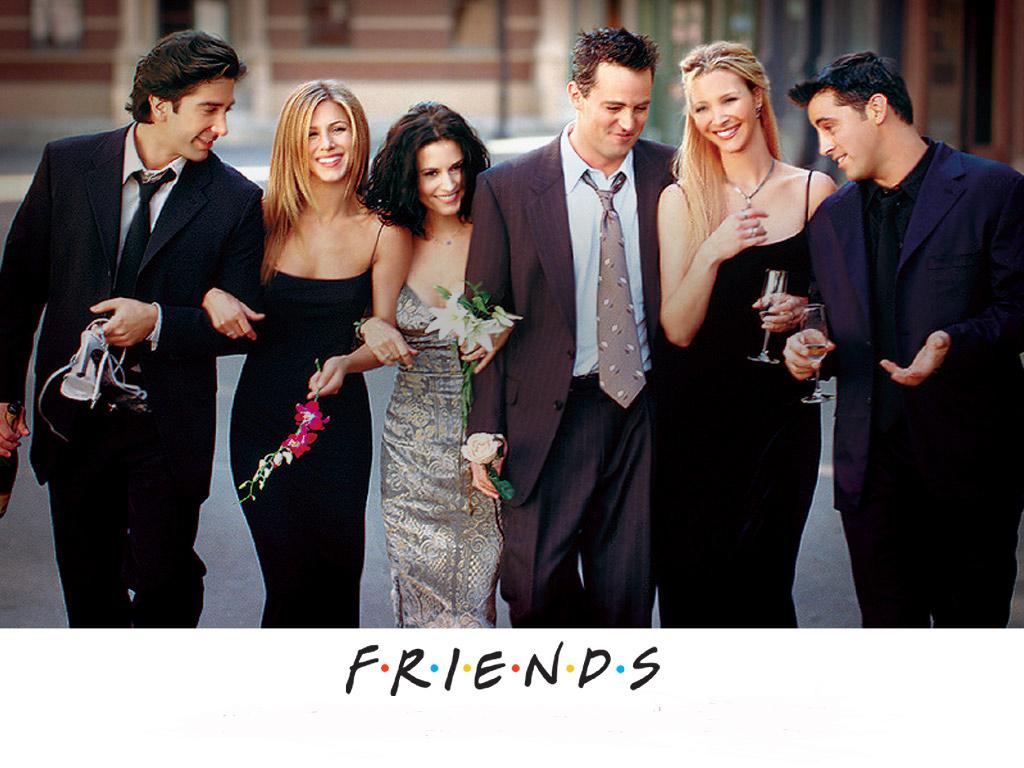
One of the most popular TV series of all time, Friends ended almost nine years ago, in May 2004.  All of the six were crazy famous simply from their time on Friends, but who has done the best and worst in their subsequent work?  After a number of early failures, most of the actors and actresses have managed to get some new-found success in the past couple of years.  Let’s take a look.

6.  David Schwimmer – Most of Schwimmer’s post-Friends work has been off screen, either behind the camera, or in voice roles.  His primary voice role has been as giraffe Melman in the Madagascar series of films.  This has included three films, a direct-to-DVD movie, and a TV special.  He’s directed a couple of episodes of Joey, Simon Pegg film Run, Fatboy, Run, and in-studio segments of Little Britain USA, adapted from the original Little Britain.  He appeared in British indie Big Nothing, and American indies Nothing But the Truth and The Iceman, and directed indie Trust.

5.  Lisa Kudrow – Immediately after Friends, Kudrow appeared on HBO show The Comeback, where she played a former sitcom actress who had descended to B or C level, and was getting another chance at TV fame while being something of a diva.  The show was shot to look like a reality show, as The Comeback was a show within a show, a scripted show of a reality show of her character’s comeback.  The series received some positive reviews as a satire of reality TV, but wasn’t picked up, and aired just 13 episodes.  She appeared in the film Happy Endings, weeper P.S. I Love You, and indie Kabluey.  She was in the kiddie Hotel for Dogs and played an unfaithful guidance counselor in high school satire Easy A.  She also appeared in her own web series Web Therapy, a dark comedy created and co-written by Kudrow, in which she plays a therapist.  Showtime decided to adopt the show, and 2 seasons and 21 episodes aired on the network, with a third on the way.

4.  Matt LeBlanc (as Joey Tribbiani) – Immediately after Friends, he starred in ill-fated spin-off Joey, reprising his character, having moved to LA, for two seasons, and the show was extremely fortunate to have a second.  After that, it was all quiet until he returned to the silver screen with a starring role in Showtime-BBC collaboration Episodes, in which he plays a narcissistic version of himself, cast, within the show, in the American version of a  popular British sitcom.  The show has aired for two seasons so far, and is renewed for a third due to air in early 2014.  I’m giving him the slight not over Kudrow, because I think Episodes is more relevant than Web Therapy, but it’s a close call.

3.  Matthew Perry (as Chandler Bing) – In his first role after Friends, Perry starred in TV movie The Ron Clark Story as the titular Clark, a small town white teacher who tried to make a difference in the lives of New York City minority students.  As cliched as that sounds, Perry received praise for his performance, and was nominated for an Emmy and a Golden Globe.  He was a major cast member in ensemble Aaron Sorkin dramedy Studio 60 on the Sunset Strip, infamous mostly as a huge failture more than as anything else.  He starred in indie films Numb and Birds of America, and then with Zac Efron in Freaky Friday-like 17 Again.  In 2011, he got his next chance on TV, starring in NBC’s Mr. Sunshine, with Alison Janney, which was terrible and failed fairly quickly.   He appeared in one Childrens Hospital episode, and four of The Good Wife.  In 2012, he got his next shot at TV in Go On as a sports radio shock jock who must join a therapy group after his wife passes away.  NBC picked up Go On for a full season, and it seems likely to receive another season, though by no means a certainty.

2.  Jennifer Aniston – If mere magazine covers were a primary criteria in the power rankings, Aniston would clearly be #1.  Alas, they are not.  Aniston’s work primarily since the end of Friends has been in film, as the only time she’s returned to TV is in an episode of 30 Rock, and for individual episodes of Friends cast mate Courtney Cox’s two shows, Dirt, and Cougar Town.  She’s made a career out of making largely mediocre movies, some of which are more commercially successful than others.  Much of her work has been in the romantic comedy genre, starring in films Rumor Has It…, The Break-Up, Marley and Me, The Bounty Hunter, The Switch, and Just Go With It, and mega-rom-com He’s Just Not That Into You.  She was also in thriller Derailed, indie Friends with Money, as well as Management and Love Happens.  The past couple of years have seen her appear with Paul Rudd in Wanderlust and as a supporting player in surprise hit Horrible Bosses.

She puts the Cougar in Cougartown

1.  Courtney Cox – Cox has primarily worked in television since the end of Friends.  She starred in her own FX show, Dirt, for two ten episode seasons in 2007-08, where she tabloid editor-in-chief Lucy Spiller.  She appeared in three episodes of Scrubs, before getting her own series by Scrubs creator Bill Lawrence, Cougar Town.  Cougar Town, also known as the show with the worst name ever, stars Cox as recently divorced mom Jules Cobb trying to get her life together again in her 40s.  The show attracted a cult following and aired three seasons on ABC.  ABC cancelled the show, but TBS saw an opportunity and picked it up again, and the fourth season is airing this spring.  I’m making the controversial call to give Cox the nod over Aniston, because, while Aniston has clearly been in many more movies, they’re pretty much all instantly forgettable.  Cougar Town, meanwhile, while never broadly popular, and not a personal favorite, has a devoted cult following that adores the show, including Community’s Abed.

Spring 2013 Review: Do No Harm

15 Mar

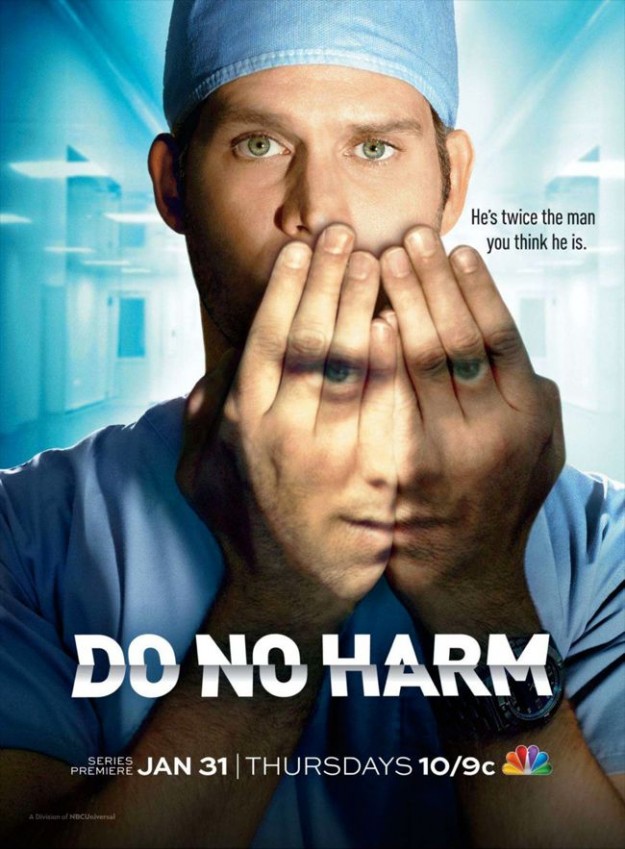
Do No Harm

Do No Harm has already been way cancelled after just two episodes, drawing the worst premiere rating ever for a network drama (some jokester got away with adding to the wikipedia page for Do No Harm, ” (yes, worse than The Mob Doctor!)” to demonstrate how low the ratings were).  Still, we review on, for posterity’s sake, if for nothing else.  Plus, a lot of people worked hard to get this show to air.  The least we can do is reward their effort by watching one episode.

Dual personalities, which are at the core of Do No Harm, have been a handy subject matter for recent failed dramas.  A few years ago, the Christian Slater vehicle My Own Worst Enemy, in which he played a spy who had a chip in his brain which turned him into an innocent who acted as the perfect cover, aired.  Kyle Killen’s well-liked Lone Star was also cancelled after just two episodes, and featured a man living a double life (though by his own choice).  This seems to be something of an obsession for Killen, whose other failed drama, which aired last year, Awake, featured a man who also lived between two different realities – he was always the same, but everything around him was different.

Do No Harm lead character Dr. Jason Cole is a top neurosurgeon who suffers from dissociative identity disorder, or multiple personality disorder.  From 8:25 AM to 8:25 PM every day he’s charming and responsible Dr. Cole, helping patients, taking risks that some members of the hospital brass would rather he not, and charming his colleague Lena Solids (former Law & Order ADA Alana de la Garza), who wants to take their friendly relationship to the next level.  By night however, he’s the sociopathic Ian Price, who lives to wreck Cole’s life, and to take advantage of his money for booze, drugs, women, and whatever else he can find to blow it on (maybe blow?).

For five years, Cole has successfully knocked himself out for 12 hours a day, with the help of an employee at the hospital acting against all policy, supplying him with a special drug.  From 8:25 at night until the morning Cole would simply be unconscious.  Somehow no one at the hospital has ever had occasion to notice that he was available at all during those hours.  However, the drug’s effects have worn off and now Cole is faced with the terrifying reality that his evil twin is back in his life.

Do No Harm is surprisingly uninteresting for a show about a man terrified by his other personality trying to ruin his life and destroy everything he loves.  I just don’t really care what happens.  Cole seems so blandly good, and his other half so viciously evil.  During the episode we basically get the idea that Cole is a pretty amazing dude whose only issue is, well, the big one, of his split personality, but he doesn’t really seem like an interesting guy.I get the whole dichotomy but perhaps some traces of subtlety would go a long way towards making the concept work; if both versions of him were a little more complicated.

In fact the only reason to root for the show is that it gives Samm Levine, who played Neil in Freaks and Geeks, a job.  Levine to this point has been just about the least successful of a phenomenally successful cast, so he could use the work.

Will I watch it again?  No.  Not that there’s all that much to watch even if I wanted to, but there’s not much here other than the hook.  It’s not a bad idea for a hook, but shows that are just about the hook and don’t have strong characters and writing are limited at best.  Again, it’s worth noting for a second that this is another show that is by no means truly wretched, but there’s no reason anyone should waste even half a tear on Do No Harm’s quick cancellation.

The Zeljko Ivanek Hall of Fame: Jim Beaver

13 Mar

Jim Beaver

(The Zeljko Ivanek Hall of Fame is where we turn the spotlight on a television actor or actress, and it is named after their patron saint, Zeljko Ivanek)

Today we’re celebrating the television work of Jim Beaver, a character actor who has only become more prolific with age, first acting in the late ’70s, working more frequently in the late ’80s, and whose biggest roles have come largely in the last 10 years.

Beaver’s first work came in the late ’70s, appearing in tiny roles in TV movies Desperado and something called Dallas Cowboys Cheerleaders starring Jane Seymour, as well as an uncredited appearance as “diner” in an episode of Dallas.  After another uncredited appearance in a TV movie called Girls of the White Orchard as “pedestrian,” he next appeared in a Jake and the Fatman episode in 1987.  He spent the end of the ’80s and 1990 making individual appearances in Matlock, Guns of Paradise, CBS Summer Playhouse, The Young Riders, Father Dowling Mysteries, and Midnight Caller, and TV movies Perry Mason: The Case of the Lady in the Lake, Mothers, Daughters, and Lovers (that’s one title), Follow Your Heart, El Diablo, The Court Martial of Jackie Robinson (featuring a young Andre Braugher as Jackie Robinson), and Gunsmoke: To The Last Man.

He got his first multi-episode role on soap Santa Barbara as the wonderfully named character, “Andy the Rapist.”  He got his biggest role yet in two season odd couple cop drama Reasonable Doubts, which starred Marlee Matlin as a civil liberties-friendly District Attorney and Mark Harmon as an old-school cop.  Beaver appeared as Harmon’s friend and partner Detective Earl Gaddis in 14 episodes.  He showed up in another Gunsmoke movie, an episode of Lois & Clark: The New Adventures of Superman, and TV movie Children of the Dark before appearing again as a regular in two season ABC sitcom Thunder Alley.  Thunder Alley starred Ed Asner as a retired race car driver, and included in the cast a young Haley Joel Osment.  Beaver played Asner’s mentally challenged mechanic, Leland DuParte.

Beaver danced around TV for the rest of the ’90s, appearing in single episodes of Home Improvement, High Incident, Bone Chillers, NYPD Blue, Moloney, Murder One, Spy Game, Total Security, The Adventures of A.R.K. (I have no idea what some of these are), Melrose Place, Pensacola: Wings of Gold, The X-Files, and TV movies Divided by Hate and Mr. Murder (starring the great Stephen Baldwin).  He also appears as bar owner Happy Doug in seven episodes of 3rd Rock from the Sun and in four episodes of long-running soap The Young and the Restless.

He recurred in one season David Krumholtz and Jon Cryer starrer The Trouble with Normal in 2000.  From 1996-2004, he appeared in 26 episodes of soap Days of Our Lives as Father Tim Jansen, the local pastor.  Next, there was more journeying around the world of TV appearing in single episodes of That ’70s Show, The Division, Star Trek: Enterprise, The West Wing, Philly, Andy Richter Controls the Universe, Six Feet Under, Tremors, The Lyon’s Den (Rob Lowe’s ill-fated post The West Wing show), Monk, and Crossing Jordan.

Whitney Ellsworth

Beaver landed the biggest role of his career in 2004, as he was cast in David Milch’s Western masterpiece Deadwood as grizzled prospector Whitney Ellsworth.  Ellsworth was the rare truly honest man in Deadwood, and unlike a couple of the other honest characters, was liked by just about everyone in town.  He’s initially trusted to manage Alma Garrett’s gold claim, and works hard to manage her successful gold operation, fighting off various concerns who want to buy it.

Episodes of The Unit and CSI: Crime Scene Investigation were next, followed by the start of his second biggest role, appearing as a heavily recurring character in Supernatural.  At 54 appearances over the course of Supernatural’s nine seasons, Beaver has shown up in more episodes of the show than anyone except the two leads, Jared Padalecki and Jensen Ackles.  He plays Bobby Singer, a blue collar demon hunter and old family friend of main characters Sam and Dean’s family.  Over the course of the show, Singer shows the boys countless tricks of the trade for dealing with the supernatural, and becomes a father figure to Sam and Dean.

Beaver was busy elsewhere while appearing on Supernatural.  He was in five episodes of the one season Taye Diggs led Daybreak, and in eight of one season David Milch far out HBO drama John From Cincinnati as Vietnam Joe, a pot grower who helps Mexican illegals cross the US border.  He was in three episodes of Big Love and one of Criminal Minds.  He was a main cast member in 2008-09 CBS 13 episode horror/thriller murder mystery miniseries Harper’s Island, playing the sheriff of the titular island, Charlie Mills.  The gimmick of the series, which sounds kind of zany and possibly worth further investigation, is that at least one character, and as many as five, are killed every episode.

Shelby Parlow

Next were single episodes of Psych, Law & Order: LA, The Mentalist, Lie to Me, and Love Bites.  Then, he appeared in two episodes of Breaking Bad, as gun dealer Lawson, selling Walter White guns in episodes Thirty-Eight Snub and fifth season premiere Live Free or Die.  He was in an episode of Dexter’s most recent seventh season, playing Dexter love interest Hannah McKay’s lousy dad, Clint.  He’s also played an important recurring role in Justified as now Harlan County Sheriff Shelby Parlow, appearing in almost every episode this season.  Keep up the good work, Jim Beaver.

Spring 2013 Review: 1600 Penn

11 Mar

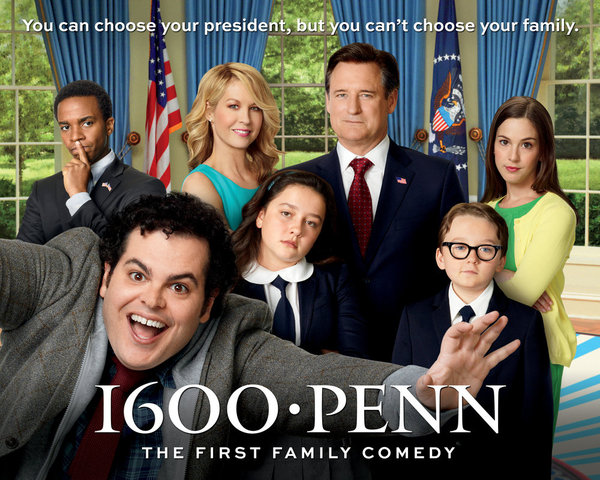
1600 Penn

1600 Penn looked awful in commercials, but it was merely not very good in practice.

1600 Penn is, as the name suggests, a comedic rendition of life in the White House.  The main family and cast members include the father, President Strandrich Gilchrist, played by Bill Pullman (no mention of this could be complete without of course noting that he also played the President in Independence Day), the first lady, Strandrich’s second wife and former campaign manager, Emily Nash-Gilchrist (Jenna Elfman), oldest son Skip (Josh Gadd, a co-creator of the show), daughter Becca Gilchrist (Martha MacIssac, best known as Becca from Superbad), and youngest children Xander and Marigold (Benjamin Stockham and Amara Miller, respectively).

The family’s personal problems are constantly getting in the way of the President’s political goals.  There’s plenty of infighting; Becca still hates her step mom, and Skip is a ridiculous screw up who constantly disappoints his parents by getting into trouble and having to have them, sometimes with the help of the Secret Service, bail him out.  The President likes to win too much that, after a little patriot cheering, he can’t even intentionally lose a tennis match to a Latin American whose support he needs on a crucial vote (played by Miguel Sandoval, who played cock-fighter Marcelino in Seinfeld, and tequila company head Carlos in Entourage).  The day is saved when Skip walks into the room where the Latin American leaders are planning to vote, and Skip drinks with them and unintentionally convinces them to gang up against Sandoval, who apparently has been bullying them for years.

If you can’t tell from the above few sentences, it’s an incredibly silly show.  It’s not particularly funny.  With most of the attempts at laughs, I can see what the show is going for but the jokes don’t really hit.  Josh Gadd is probably the best part of the show, being ridiculously incompetent but kind of likable, but even most of his attempts at being funny are not successful.

Compared to fellow political comedy Veep, 1600 Penn is far more over the top and ridiculous than Veep, which focuses on everyday humor and a bit of satire.  For a show about the President, there’s nothing at all satirical or political about 1600 Penn.  I wouldn’t expect to see any but the most basic jokes about Democrats or Republicans, if that.  While both Veep and 1600 Penn try to create humor out of the contrast of real people’s lives with the majesty of the White House (or the Vice President’s office, but for this point, the same difference), Veep aims for humor out of the mundane, while 1600 Penn attempts to mine the ludicrous not even attempting to resemble real life.  Josh Gadd’s Skip is certainly the most goofy aspect of the show, but he really drives the direction of the show, rather than being the exception.  To give another example, Skip at one point accidentally lights a fire in the White House, while recording a fire safety video, which causes the window to explode and hit a visiting dignitary.  It’s not that this kind of comedy can’t work, it just doesn’t really here.

It’s not a truly terrible show.  It doesn’t make me angry, and it’s surprisingly watchable, in the sense that it doesn’t make you want to immediately get up from your couch mid-episode and turn it off no matter what.   It’s bad enough though that I don’t think there’s any fixing it or making it into a second season surprise.  Even a moderately improved 1600 Penn probably leaves a fair amount to be desired.

Will I watch it again?  No.  I damn it with the faint praise that it’s far better than I originally thought it would be from the commercials, unfunny rather than cringeworthy.  Still, that falls fairly far short of the standard for getting me to watch multiple episodes.

Spring 2013 Review: Deception

8 Mar

Deception

Deception, in five words.  Primetime murder mystery soap opera (quick definition: primetime is not simply a time-the-show-airs issue, it’s an adjective describing the type of soap; priemtime implies a soap that’s a bit classier and less ridiculous (by soap standards, remember, so that’s only saying so much) than daytime soaps).

Now, in longer form.  The premise event of Deception is the mysterious death of socialite and scion of the uber-wealthy Bowers family, Vivian.  Her death appears on its face to be due to a drug overdose, but there are clear signs pointing the police in the direction of murder.  The Bowers family made their millions through the pharmaceutical company currently run by patriarch Robert Bowers (Victor Garber), and it’s a classic dysfunctional rich family fueled by jealousy and greed, which means that everyone’s a suspect.  While the family attempts to mend itself after hearing of Vivian’s tragic death, viewer surrogate Joanna Locasto (Meagan Good) must infiltrate the family to attempt to figure out who the murderer is.  She’s in a unique position to investigate the inter-family dynamics, given that she used to be Vivian’s best friend growing up, when Joanna’s mother worked for the Bowers family.  Vivian and Joanna were BFFs until a falling out about 15 years ago, which is slowly revealed through flashbacks, when Vivian attempted to run away and Joanna, believing she was drug-addled and liable to get herself hurt, tattled to her father, ending their relationship.

Since then, Joanna’s lived her own life as a member of the NYPD, which the Bowers family doesn’t know. With the convincing of her former partner/lover and now FBI agent Will, she agrees to make a return into the Bowers’ lives, ostensibly to grieve Vivian, but with the secret goal of figuring out the murderer.

Suspects include the father and CEO, Robert, son Julian, the bad boy now creating drugs for his father’s company, who Joanna once had an ongoing fling with, ill-tempered older son Edward, who was accused of strangling a woman years ago, but managed to fight off the charge, Robert’s second wife and former secretary Sophia, and youngest daughter Mia.

The investigation turns out to be even more complicated than originally thought when a tabloid journalist who was spying on the Bowers is murdered while waiting to feed Joanna some information, after he relates to her that there are allegations that Bowers’ company is about to put a drug on the market responsible for killing dozens of people in overseas test markets, a drug which was created by Julian.  The episode ends with the dual revelations that Vivian was pregnant when she died, and that she was pregnant once before, right when her and Joanna had their falling out, and that that baby was Mia, who has been posing as Robert and Sophia’s daughter.

Deception is another in the minor trend of thriller prime time soaps started by the minor success of ABC’s Revenge. The incredibly dysfunctional uber-rich family vibe being infiltrated by an outsider who is really an insider which features prominently in Revenge is at the heart of Deception as well.  The feature mystery here is of course the whodunit, and the family members are the primary suspects, though I’d guess there will be more peripherally shady characters entering at some part that could be involved somehow in the plot.

The show wasn’t great, but it wasn’t bad either.  The mystery is intriguing enough, and I”m generally a sucker for a classic whodunit, just not necessary enough to actually watch several hours of TV.  Similar to what feels like the last couple of shows I’ve written about (The Following, The Carrie Diaries), there’s not a ton that makes this show stand out in a crowd, but it’s perfectly respectable in its own right.  I could imagine getting stuck in a rabbit hole of Deception episodes on a Saturday morning on repeats on TNT someday, but it just doesn’t have quite enough to make me place it on my considerably crowded television schedule.  Like most serial dramas, the set up is easy, while the pay out is hard, and the set up here is certainly at least adequate, and honestly, if I heard the the later episodes were excellent and compelling and unpredictable, there’s enough for me in the first episode be interested in coming back to the show, but I don’t have implicit faith.

If Deception does succeed, it will be difficult to avoid the same issue that Revenge faced.  Pace it too slowly, people will get tired of waiting and it will seem needlessly drawn out.  Solve the feature mystery in good time and the writers need to think of something else equally compelling.  Shows like this are exactly why I support the expansion of season-long TV series, American Horror Story-style.

Will I watch it again?  No, I’m not going to.  Honestly though, it’s not a total loser.  It’s not required viewing by any means, but I still haven’t reviewed a truly terrible or even a pretty bad show yet from the Spring 2013 season.  I’m sure it’s coming and I’ve just watched them in the wrong order, but while I’m not going to watch Deception nor tell anyone else to watch it, I’d have no qualms if someone I knew told me they were watching it.  I might even read the wikipedia page later to find out who the killer is if the show makes it that far.

Spring 2013 Review: The Following

6 Mar

The Following

The Following is at its heart a cat and mouse game between a crazy sociopathic serial killer named Joe Carroll (played by James Purefoy) and his troubled FBI nemesis Agent Ryan Hardy (Kevin Bacon).  Carroll was a charismatic literature professor obsessed with Poe and with killing college-aged women, knocking off over a dozen, before Hardy, who was obsessed with the case (think of Hardy as Jessica Chastain to Carroll’s Osama bin Laden in Zero Dark Thirty), managed to crack it, catching Carroll red-handed while saving his last intended victim.

Since Carroll was caught, ten years ago, he’s been in jail, and is sentenced to die soon.  He breaks out of prison at the beginning of The Following’s premiere, with the help of a prison guard he’s seduced into learning to become a serial killer himself.  Carroll then makes a beeline to take care of the only victim he didn’t manage to finish off, who Hardy saved.  Hardy, who has been out of the FBI for years, fighting his own demons, one of which is the bottle, is called back in to help find Carroll, and he’s the foremost expert, having penned a true crime bestseller about his chase for Carroll.

Carroll is rounded up at the end of the first episode and returned to prison after causing lots of damage, but not until it’s learned that in his time supposedly researching his legal appeals, he’s used the internet to round up tens and possibly hundreds of followers, willing to kill for him, die for him, or do any number of insane tasks for the cult of Joe Carroll.  In the first episode alone, it turns out that the gay neighbors and best friends of Sarah Fuller, the last intended victim, are actually cult members, willing to spend three years of their life living as a gay couple just to strike at the moment Carroll got out.  His ex-wife ‘s (Justified’s Natalie Zea) babysitter also turns out to be a cult member.

The Following is created by Kevin Williamson, best known for Dawson’s Creek, the Vampire Diaries, and the Scream series.  The Following is closest out of those to Scream (or Scream copycat I Know What You Did Last Summer, which Williamson also wrote) but without the cheeky meta-humor that was  a hallmark of those films.  There’s none of Scream’s humor in The Following.  It’s not a funny show.  It’s a gory thriller, somewhere along the lines of Seven.  The characters don’t seem particularly well thought out and the cult is pretty ridiculous in the amount that they’re both willing and able to do at the behest of Carroll.  I don’t think there’s likely to be a ton of depth or meaning or themes in this show.  That said, it’s not what the show’s about.  It’s an action thriller, in the vein of former Fox stalwarts 24 and Prison Break, and while I’ll never like a more purely action-oriented show as much as I’ll like Breaking Bad or Mad Men, there’s absolutely room for that type of show on TV.  Thus, if The Following keeps delivering the thrills with plotting that doesn’t seem too farfetched within its own world, it can be successful on its terms.

Repetition is a definite concern looking forward.  It’s a show that seems best designed for an American Horror Story-like single season anthology; I can imagine getting wary after one season of repetitive battles between Hardy and Carroll, knowing neither of them can lose entirely (probably anyway; if Williamson went rogue and killed one of them off at season’s end, it would be a pretty bold and respect-worthy move).  Still, I should at least give Williamson the chance to show that he can avoid seeming repetitive before knocking it.

Will I watch it again?  Maybe.  I was learning towards no at the beginning of the episode, and now I’m slightly leaning towards yes, though it could be a casualty of more spring shows that are better.  It’s flawed and simplistic to some extent; the one on one battle has distinct limits, but as a sheer thriller, some of its flaws take a back seat.  Williamson noted that he brought the show to Fox because his favorite show ever was 24, and I think there’s something that makes sense about that watching The Following.  Like 24, the characters aren’t particularly deep, but if The Following achieves its goals, it keeps you at the edge of your seat every week, and the first episode did a decent job at that.

Spring 2013 Review: The Carrie Diaries

4 Mar

Carrie, '80s style

There was a show you probably heard of called Sex and the City, on HBO in the late ’90s and early ’00s.  Sex and the City was based on the autobiographical columns of New York writer Candace Bushnell.  Sex and the City was hugely successful, spawning two movies (the second less successful than the first), and single-handedly increasing brand awareness of products like Manolo Blahnik shoes, at least among people like me, who would never have heard of them otherwise.  After the fantastical success of the Sex and the City TV show, Bushnell, in 2010, wrote a two-part series called The Carrie Diaries to serve as a prequel to Sex and the City, about Carrie Bradshaw’s life as a senior in high school.  It’s these prequel books that are now being adapted into the TV show The Carrie Diaries.

Okay, so The Carrie Diaries.  The star is of course teenager Carrie Bradshaw, a high school junior in 1984.  It’s part classic ’80s John Hughes movie.  Carrie’s got her own crew wacky friends, where everyone has a role.  There’s bookish Asian girl Jill, who everyone calls the mouse (Ellen Wong from Scott Pilgrim vs. the World, who has to be almost 30 by now), slutty drunk Maggie (played by Katie Lindlay, best known as dead teenager Rosie Larson from The Killing), and a guy, Walt, who’s dating Maggie but is clearly probably gay, staring at pictures of Rob Lowe late in the episode.  There’s a mean girl (exactly how mean has yet to be determined, but you know the type), Donna, and her posse who run around the school like they own the place, and there’s a rich bad boy, Sebastian with a good heart who Carrie clearly likes, Andrew McCarthy in Pretty in Pink style.  There’s lots of ’80s style all around and plenty of period music in the first episode, including Blue Monday, Footloose, Burning Down the House, Just Can’t Get Enough, and several others.

There’s a serious side to the show as well (it is, after all, an hour long and it doesn’t seem like CW does half hour comedies anymore).  Carrie’s mom died just months before the show begins, and her, her dad, and her rebellious sister are all suffering in the aftermath of her death and handling it in different ways.  Her dad looks like a cross between Dennis Leary and Tim DeKay from White Collar, and is having a hard time filling the role of both parents, and knowing when to try to take over his wife’s role, and when he’ll never be able to.  Her 14-year old sister, Dorrit, was the outcast to the good girl Carrie, even before her mother’s death, and she acts out, frustrating both her dad and Carrie, who don’t know how to handle her behavior.  Carrie struggles as well, trying to be the good girl, help her sister and dad, and live her own life.

There’s yet one more important aspect.  In order to help her both grow up and recover from the devastation of her mom’s death, Carrie’s dad arranges for her a one day a week internship at a law firm Manhattan, where she’s always wanted to live (get it?  that’s her future home!).  While there, she meets a crazy artsy socialite, Larissa (played by Freema Agyeman, Dr. Who’s Martha Jones), who has Carrie help her steal a dress from Century 21 and takes her to a super wacky artsy party where she meets a bunch of fascinating people (her first gay people!) and pretends to be older than she is.  She also says the worst line of the episode as she leaves, narrating about how infatuated she was with New York – saying that she doesn’t need a boy, because she’s found her man – Manhattan. Boooooo.

There it is, one part ’80s teen comedy, one part heartwarming dealing-with-serious-issues teen drama, and one part teen pretending-to-be-someone-else in Manhattan.  As for quality, well, it’s okay.  That’s really about it.  The acting was fine, the treatment of the ’80s mimicked the classic ’80s of films without being grossly over the top, and the tragedy of Carrie’s mom’s death seemed well handled by the show in the first episode, with pathos but not overdramatic.  If you like what you’ve heard so far, there’s nothing negative enough about the quality of the show that would recommend against watching it.  If you don’t like what you’ve heard so far, there’s nothing positive enough about the quality that would recommend watching it.  It certainly doesn’t transcend it’s genre, but it’s not an embarrassment either.   CW’s made a number or programs in this vein, and while I don’t think it’s ever going to get close to the kind of buzz of Q rating of its notable progenitor, The Carrie Diaries does seem clearly aimed at CW’s core demographic. As for comparisons to Sex and the City itself, The Carrie Diaries are a little bit more serious, more teen (obviously), thus more emo, and less irreverent, and also, fairly obviously, less bawdy.

Will I watch it again?  No.  This show falls into the vast chasm of shows that aren’t so good but aren’t so bad.  I don’t really have so many bad words for The Carrie Diaries; I could imagine why someone might want to watch it.  It just has nothing particularly interesting for me in a world where there more than enough good and interesting shows out there that I haven’t seen yet.

Spring 2013 Review: The Americans

1 Mar

Johnny and Linda American

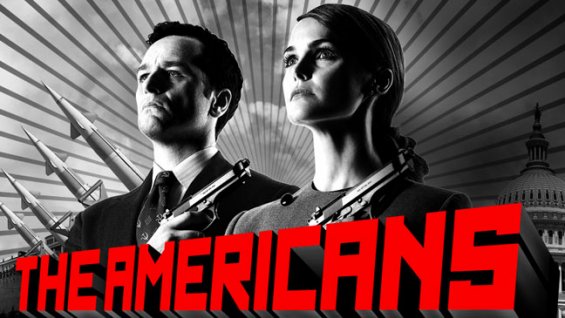
The Americans is about a couple of Soviet sleeper agents living in America, posing as a typically American family during the late cold war period.  I’ll get to more about it, I promise, but follow me for a minute as I take a diversion onto a more general point about the Cold War in pop culture, and then back to The Americans particularly.

I grew up too late to really experience the cold war.  I don’t really remember the fall of the Berlin Wall, and even if I did know it at the time, I certainly didn’t understand what it meant.  The Cold War itself doesn’t seem like a great time in which to live, but for movies and television it seems like a constantly underused time period, especially in terms of the use of Soviet antagonists.  While World War II Nazis are crazy super evil and immediate, reflecting the fact that World War II was a concentrated war centered on armed conflict, Cold War Soviets, at least post-Stalin, are less here and now evil and more mysteriously and michievously villainous.  Everyone knew the Nazis wanted to basically take over the world and kill all the Jews and Russians and whatever other ethnic groups, but no one exactly knew what the Soviets wanted or what they were willing to do to get it.  The beauty of the Cold War from a broad literary perspective is that neither side knew exactly what the other was thinking, and at anytime, one misplaced step could set off a chain reaction to mutual destruction.  And while, unlike in the third easily literarily interpretable international relations event of the 20th century, the Vietnam War, it’s pretty clear we’re the good guys in the Cold War, it’s not exactly clear how bad the other guys are (No one seems to do World War I or Korean War movies in America, aside from M*A*S*H; World War I just doesn’t have the same place in the American psyche as it does in the European, and no one knows anything anymore about the Korean War).

Thus, while World War II works best as a setting for sweeping large-scale action like in Saving Private Ryan or clear cut good vs. evil revenge like Inglorious Bastards, the Cold War plays best to sneaky subterfuge and taut suspense.  There’s a number of already-on-the-way-to-destruction movies like  Dr. Strangelove or Fail-Safe, but in terms of pre-nuclear destruction, The Hunt for Red October is one of the best examples of movies that follows these themes.

So, back to The Americans.  As per that deviation, The Americans fits that Cold War narrative to a T.  The series stars Keri Russell and Matthew Rhys as the Soviet sleeper agents who have been in the US for a decade and a half at the start of the show, set in  1981.  Flashbacks tell us that they were chosen two decades ago to be married and infiltrate the US, and in the present day, they’ve got two kids who know nothing about their true professions.  They’ve started to become Americanized in their home lives while constantly executing missions for their Soviet overlords.  We learn in the first episode that Rhys’ Phillip is more loyal to his wife than to his country, while Russell’s Elizabeth would die before defecting.  It’s unclear whether that dynamic will reappear as a potential stress on the couple in later episodes, but it certainly seems possible.  In the pilot we also see their difficulties in maintaining a normal family life and carrying out these missions, as they get by a couple of very close scrapes in the first hour alone, and a Soviet superior tells Elizabeth it’s only going to get harder.

Across the street, new neighbor FBI Agent Stan Beeman (Noah Emmerich) moves in, completely coincidentally, but Beeman, who works in the counter intelligence department and recently relocated to Washington DC after spending three years undercover, immediately suspects something is off about Elizabeth and Phillip.  Initially, I thought the FBI was going to look pretty naive and incompetent in the show, and Beeman in particular seems bright eyed and bushy tailed, and when he introduces himself to Elizabeth and Phillip straight out as a FBI agent, it seems as if they can spy circles around this guy.  However, smartly, it seems like the FBI in general, and Beeman in particular, are more capable than we think and the episode ends with the FBI declaring war on these sleeper agents.  Shows and movies are almost always better with well-matched adversaries, rather than one  competent side and one incompetent.  Whether we end up rooting for the KGB agents or the FBI, the show has more long term potential if both are relatively capable.

The Americans looks like it will have all the hallmarks of Cold War fiction; simmering tension with punctuated burst of activity, and constant paranoia on either side; the KGB agents that they’re about to get caught at any time, and the FBI agents that KGB sleeper agents could be anyone and anywhere.  The show also reminds me of Breaking Bad in the sense that our primary protagonists are the ostensible villains (Walt, the KGB agents), while our secondary protagonists are the ostensible good guys (Hank, FBI agent Stan).  It’s unclear as of yet exactly how likeable or unlikeable the KGB agents will be as characters, and how they’ll manage to make the FBI-is-or-is-not-onto-them plot keep moving without stalling or engendering the concept of the show, but there are certainly enough possibilities out there to be worthy of seeing where the creators go with it.

It’s also worth noting that there is already some great period music, and hopefully will be more of it.  In particular, the show opened with Quarterflash’s Harden by Heart, which was already a great sign for my liking it.

Will I watch it again?  Yes. It wasn’t amazing or mind blowing (see: Homeland’s premiere) but it was definitely good enough to come back to.  Also, it’s worth noting that FX is creating itself quite a brand; recent solid-or-better dramas include this, Justified, and Sons of Anarchy.