Spring 2013 Review: Maron

24 Jun

Marc Maron is Maron

It’s hard to imagine Maron existing in a world without Louie.  Louie is a good show and an Important show (the capital I was on purpose) but until now has yet to be an influential show, at least in terms of its direct impact on other television programs.  Maron is the first sign of a television world that comes after Louie.

There’s plenty admirable about imitating what Louie does, but it’s dangerous as well.  It’s hard to pull off Louie’s combination of ludicrous and poignant as well as his ability to switch on a dime from comedic to serious and back again.

It’s tough to live in a post-Louie world because sometimes it feels like instead of relaxing watching a television show and just looking to laugh like when watching a New Girl or a Bob’s Burgers, I have to scrutinize every little exchange between Maron and each other character for meaning. Honestly, I’m probably thinking a little bit too hard, but this is what happens when I spent a full season trying to figure out what Louie was about, and now I’m trying to bring that thought process to bear here.

You’re probably not going to laugh a whole lot.  Shows in a post-Louie world by comedians aren’t necessarily designed that way.  It’s as if the comedian has a higher calling, and to some extent, I think it’s admirable not to just be boxed in a corner as funny, even though funny is not inherently a bad place to be.  There’s a couple of solid quips, but there aren’t very many jokes or real laugh lines, certainly not like you’d find in clear comedies like Parks and Recreation or It’s Always Sunny in Philadelphia.

Marc Maron’s a little bit edgier than Louie.  He’s less awkward than Louie but more narcissistic.  Louie wants to be liked, but Maron needs to be.  Louie tries desperately to be nice, while Maron has no problem being mean and combative.  Instead of daughters, Maron has cats.  If Louie is the everyman, Maron plays the id, the man running around with a little less control over himself.  An early scene has Maron run into his ex-wife in a coffee shop with his sick cat.  He previously had made a point about how he wouldn’t know what to do if he ran into his ex-wife. He acts like a dick when he does, being needlessly hostile to her years after their relationship ended.  If Maron needs to be liked, he’s also kind of a jerk, and the show seems to be dealing a lot with that central contradiction.  He addresses this straight on at the end of the pilot when he mentions that he’s okay with the world thinking whatever they want about him, even though we know the opposite is true.

The show is hooked around the most successful thing Marc Maron’s ever done, which is his WTF podcast, which he records out of his LA garage (it’s smart to set his show across the country from Louie’s NYC).  In this first episode, Dave Foley is over to record a show with Marc, and Marc does a couple of a little segments with Foley, as if recording them for his show.

In this episode, Maron and Foley drive over to a comic book store where a guy who has been bashing Maron on Twitter is playing a game of Dungeons and Dragons.  This plot feeds directly into Maron’s needing to be liked, and his reckoning with modern technology, as he must know why this random dude doesn’t like him and insists on shouting it to the world.

Maron, the show, ventures into very dangerous ground by presenting these extremely nerdy looking guys dressed in costumes playing a campaign.  Maron does try to not play it straight, and at least kind of flips the situation on its head by having Maron, the person, come out as the bad guy rather than the nerds.  He’s the one who had to find them in person, and they love Dave Foley who defends them later.  Still even acknowledging the existence of nerds so extreme, strikes a couple of boxes on my Nerd Defamation League checklist.  The primary nerd character is portrayed by Erik Charles Nielson, who plays ubernerd Garrett on Community.  If they didn’t want to drive that point home about how stereotypically nerdy this character was, they could have cast someone else.

I reasonable enjoyed watching the show, but I hardly felt compelled to watch another episode.  I didn’t particularly care for the character of Marc Maron, and I’m not sure whether that is how I’m supposed to feel or not.  I think a show like this can both take more than one episode to really get into, and very likely may need a few episodes to really get running at maximum capacity.  Thus, I’ll try to at least check it out down the line.  But the way it is right now, I could imagine watching, but probably won’t go out of my way for.  It has a little bit of a lot of qualities, but no one aspect really made a strong enough impression to make me immediately want to come back.

Will I watch it again?  Honestly, I doubt I’ll watch every episode of Maron, at least anytime soon.  Since it appears like it will be fairly episodic, there’s a fair chance I’ll catch another episode, and I can imagine marathoning it one day down the line over a couple of days.  It doesn’t really capture me, though to be fair, the first Louie didn’t either, and I now greatly enjoy that show, even if I still don’t think it’s necessarily the best on TV.

Power Rankings: Arrested Development Characters, Part 2

21 Jun

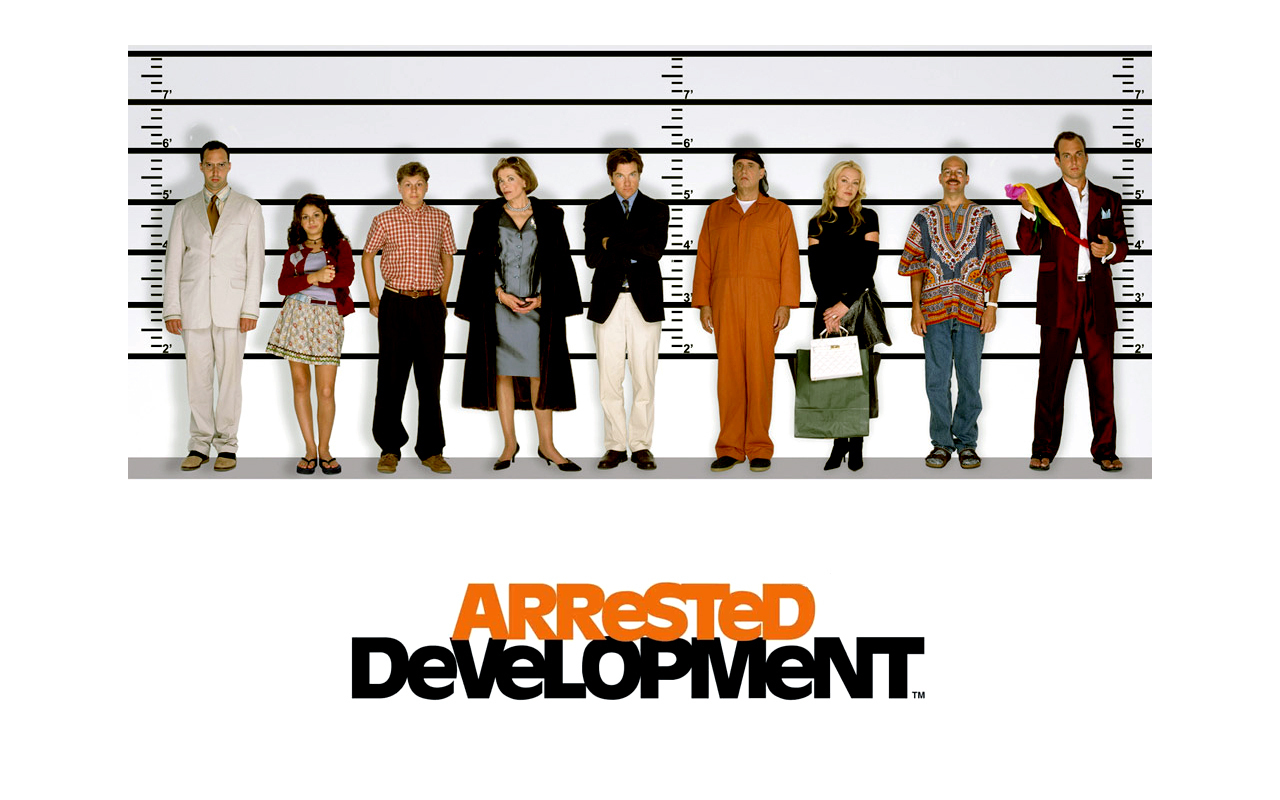
The gang, again

In our continued coverage of all things Arrested Development in the wake of the long-awaited new season, we’ve been ranking the characters.  Part 1 can be found here.  This is part 2, five through one.  Moving on.

5. Tobias – Though everyone gets their share, Tobias and Buster are the physical comedy 1 and 1A of Arrested Development.  Many of Tobias’s funniest moments revolve around bits that sound stupid or infantile when explained, and it’s vastly to David Cross’s credit that he makes them hilarious when viewed.  A top two character in my early viewing of the show, some of Tobias’s bits don’t stand up as well on repeated viewings, particularly the continued poor choices of language he uses and the constant Tobias-is-gay harping.  It’s funny for a while, but sometimes it seems as if Arrested Development doesn’t know when to pull back on a joke and go in another direction.  Still, he sits here because plenty of the bits do work, like his simple awkward getting up on the stage when he’s directing a high school play, and because the writing is so clever that even though you wish they would pull back, they still manage to make his inappropriate language frequently hilarious.  His performance as Mrs. Featherbottom is a highlight. It maximized Tobias’s awkward potential and played on his obliviousness without necessarily smacking you in the face with “Tobias is gay.”   The Arresetd Development line that comes up most often for me in day to day situations is the tail end of Tobias’s ” “No, it never does. I mean, these people somehow delude themselves into thinking it might, but… but it might work for us.”  But for funniest in the moment, it falls just behind the line below.

Best Line:  “You know, first of all, we are doing this for her, because neither one of us wants to get divorced. And second-of-ly, I know you’re the big marriage expert – oh, I’m sorry, I forgot, your wife is dead! ” – Season 2, Episode 3 “Amigos”

4. Lucille – Lucille bumped up into the top four for me after rewatching the first three seasons.  I had her ranked lower in my memory from years ago but after watching all of the episodes again I have absolutely no idea why that could be.  Her acidic put downs of her family members are consistently hilarious and her haughty sense of entitlement is clearly where Lindsay gets hers from, but Lucille’s is funnier.  She’s frequently in top form and gets to rip all of the characters apart. It’s easy enough to insult a Bluth, but no one gets the freedom to say things like Lucille does.  My favorite recurring Lucille bit may be her constant referral to her not caring for G.O.B.  The new episodes show off her personality perfectly when she has the attitude and ability to lead her little prison gang, but soon gets on the nerves of all of the other gang members so much with her constant sniping that they want her out desperately.  She’s far and away the meanest Bluth, which is some shows might be a detriment, but here gives her the freedom to speak her mind.  Her surprise at seeing Gene Parmesan provides a wonderful rare gleeful Lucille moment.   For her line, I’m actually going to cheat and use a snippet that has a Michael response in between, because most of her best quotes involve her responses to other people.

Best line:  Lucille: “I’ll be in the hospital bar.”

Michael: “Uh, you know there isn’t a hospital bar, Mother.”

Lucille: “Well, this is why people hate hospitals.” – Season 1, Episode 4 – “Key Decisions”

3. Michael – In the first three seasons, Michael acted largely as the straight man, but he was far more hilarious than comedic straight men often are.  The elements that turn him away from straight man in the fourth season to just another unsuccessful, troubled Bluth were present the whole time.  The self-absorption and inability to listen to what anyone else says or thinks may not have largely affected his position at the Bluth Company in the first couple seasons but is largely responsible for his downfall in season four.  His frequent retort “I’m leaving this family” turns into self-parody in an oft-repeated scene in the fourth season, as it turns out no one cares except Micheal.  He’s no longer keeping the family together.  This allows Michael even further to show off his comic chops.  I don’t blame him that he got stuck with the difficult job of anchoring the exposition-heavy first episode of the new season. Rather, I credit the fact that he was the most logical character to start off any story of Arrested Development with and make the most out of it.  His series of jokes at not being able to recognize George Michael’s girlfriend Ann is my favorite running bit.  Hilarious moments in the new season include his constant retelling of the four person elimination vote and his extremely extended lie about traffic to his son.

Best line: “Jessie… No, I was just saying your name as you walked away. I didn’t… I have no follow-up.” – Season 1, Episode 11 – Public Relations

2. George Michael – One of the only changes that occurred after viewing the fourth season was that I swapped Michael and George Michael.  They’re still incredibly close, but the first George Michael episode may have been my favorite of the season, and both of his episodes came towards the end which may have skewed my thought process.  I know awkward comedy doesn’t work for everyone, but George Michael’s awkwardness is incredible and consistently leads to laughs.  George Michael was the last character in the new season to realize that he couldn’t break out of being who he was.  We’re led to believe he’s become a successful internet start up founder but learn later that it’s the same George Michael who is only marginally more successful than the other Bluths. The lie about Faceblock grows and grows as George Michael, like his father, tries to continually lie his way out of it rather than tell the truth, putting himself in situations in which the truth is harder and harder to reveal.  His moments with his father are often strong, and their position next to each other on this list is no coincidence. There was surely something unsubtle about the pointing out by narrator Ron Howard of how long it took him to respond to people in the new season, but it was still funny, and his “solve for x” attempt to hit on Maeby was amazing.

Best Line: “Say what you want about America – thirteen bucks can still get you a hell of a lot of mice!” – Season 1, Episode 21 – “Not Without My Daughter”

GOB and Franklin

1. G.O.B. – George Michael and Michael are both high on this list largely because of their relatively subtle humor.  G.O.B. isn’t.  His lines are often over the top.  He’s much more nuts they either of them, and willing to go a lot farther in pursuit of anything (see: pretending to be in a gay relationship with his nephew).  Arnett is so good at this character that he’s portrayed it in other shows, but it’s best here.  He’s constantly insecure and wants to be both liked by Michael and be better than Michael at the same time.  He’s the most easily manipulated Bluth, and perhaps the most incompetent.  He gets many of the best lines, and he turns them into classics with his delivery.  Some of his stupid lines that really have absolutely no reason to be funny are still hilarious.  For example, I keep finding myself repeating or thinking of how he sings to Michael, in the new season, “It’s so easy to forget” when trying to give Michael a forget-me-now, and then calls him out as “Stupid forgetful Michael.”  Honestly, almost all of his bits are hilarious, including nearly everything associated with his magic career as well as his puppet Franklin.  His description of trying to pick up women at a pageant is phenomenal, when he explains that the “First place chick is hot, but has an attitude, doesn’t date magicians. Second place is someone weird usually, like a Chinese girl or a geologist. But third place, although a little bit plain, has super low self-esteem.”  I’m picking one line because I have to, but there’s so many others that spring to mind that are equally hilarious.  I could do a top 10 of G.O.B. without thinking too deeply before I could name two equally funny Lindsay quotes.

Best line:  “Michael if I make this comeback I’ll buy you one hundred George Michael’s you can teach to drive.” – Season 2, Episode 15 – “Sword of Destiny”

Power Rankings: Arrested Development Characters, Part 1

19 Jun

The gang's all here

I promised more Arrested Development posts, and I meant to deliver.  Here’s my power rankings of the nine main characters in the show, in order from least favorite to favorite.  This covers the course of all four seasons, so spoiler alert is in effect if you haven’t finished yet. My opinions have largely remained the same since I watched the first three seasons years ago, but with some slight tweaks due to both rewatching the old episodes recently and watching the new ones.  I’d like to add the important caveat that they’re all great.  There are no bad characters, but, like ranking Beatles albums or Sopranos seasons, something has to be last.  In addition, just for your special edification, every character will be accompanied by a favorite quote of mine. The rankings became slightly unwieldy as I was writing them so I broke them up into two – this is part one.  Now, on to the rankings.

9. Lindsay – Sorry, someone has to be last.  I know I pointed it this out just a couple sentences ago, but I think it’s important to say again.  There are no bad characters.  All nine are great and I love all of them! So think of this less as an insult and more as well, the ninth best compliment. Lindsay is the vainest and the most entitled Bluth (which says a lot for a family with G.O.B.. in it).  Lindsay doesn’t get as many chances to be as funny as a lot of the other characters, but she has her best moments playing on both her vanity and her sense of entitlement.  She also draws from her constant inner conflict between her idealistic dreams of activism and the fact that she’s uninterested in giving up any of the entitlements required to pursue activism, or in learning about what she’s advocating for or against.  Her highlights from the new season involved exactly these contrasts, including her interactions at the Four Seasons Mumbai. In her interaction with the shaman there, which she turns to to speak for spiritual advice, she assumes he is hitting on her.  She tries hard and partly falls for mega activist Marky Bark, but eventually instead succumbs to the glamour of Herman Cain-like conservative candidate Herbert Love who showers her with gifts.

Best Quote:  “He was the house shaman at the Four Seasons Mumbai, so you figure he’s got to be pretty good. Oh, and he turned into an ostrich at the end, so … they’re not gonna have that at the Embassy Suites.” – Season 4, Episode 3, “Indian Takers”

8. George Sr. –   George Sr. doesn’t get quite as many great laugh lines as some of the other characters (a trait the characters that sit at the bottom of these rankings share), and his plots and personality seem to vary the most among the characters, as he gets into some of the weirdest situations.  He goes from a white collar criminal surprisingly loving his time in jail to a sham prophet hawking a series of DVDs to a stir crazy prison refugee hiding out in the model home attic.  His level of competence seems to bounce back and forth more than any other character, and he alternates brilliant prison escapes with believing that he and his wife can’t be convicted of the same crime (to be fair, he had the worst lawyers). Probably my favorite of these phases is his attic hide out, which leads to his wonderful tea parties with the dolls left up there and his wearing of Michael’s dead wife’s maternity clothes.  Tambor’s more impressive acting job may actually be as George’s hippie twin brother Oscar, who gets a pretty juicy part in the fourth season.

Best Line:  ” If you play me, you got to play me like a man and not like some mincing little Polly or Nellie! I get those names confused. Apology. (to dolls) Apologies all around.” – Season 2, Episode 13, “Motherboy XXX”

7  Maeby – Maeby gets the shortest shrift throughout the show, even moreso than Lindsay and George Sr..  She can be very funny when she gets a chance to shine, but she generally gets slightly less of a chance than everyone else.  She’s one of only three characters not to get two starring episodes in the most recent season. While reading over many of her lines, a surprisingly small amount stand out for a show so quotable.  My favorite Maeby plot, which is pretty much what gets her above George and Lindsay to begin with, is her time as a movie executive which began in the second season.  This plotline both gave her a chance to put her superior bullshitting skills to good use and gave her a chance to venture outside of her original gimmick of liking Steve Holt and desperately wanting her parents to notice her. The new season made the most of Maeby’s talents in her episode.  Her continued lying and her ability think on her feat continued to get her far, but also brought her down.  My favorite recurring quote of hers in the series is “Marry Me!” interspersed with the occasional “Babysit Me” but since that works at least in part because of its repeated nature, I’ve chosen a quote I enjoyed from the new season below.

Best Line:  “So you can all go (bleep) yourselves! What? Sure. Please welcome the talented voices of Phineas and Ferb. Go (bleep) yourself!” – Season 4, Episode 12: “Señoritis”

I'm a Monster!

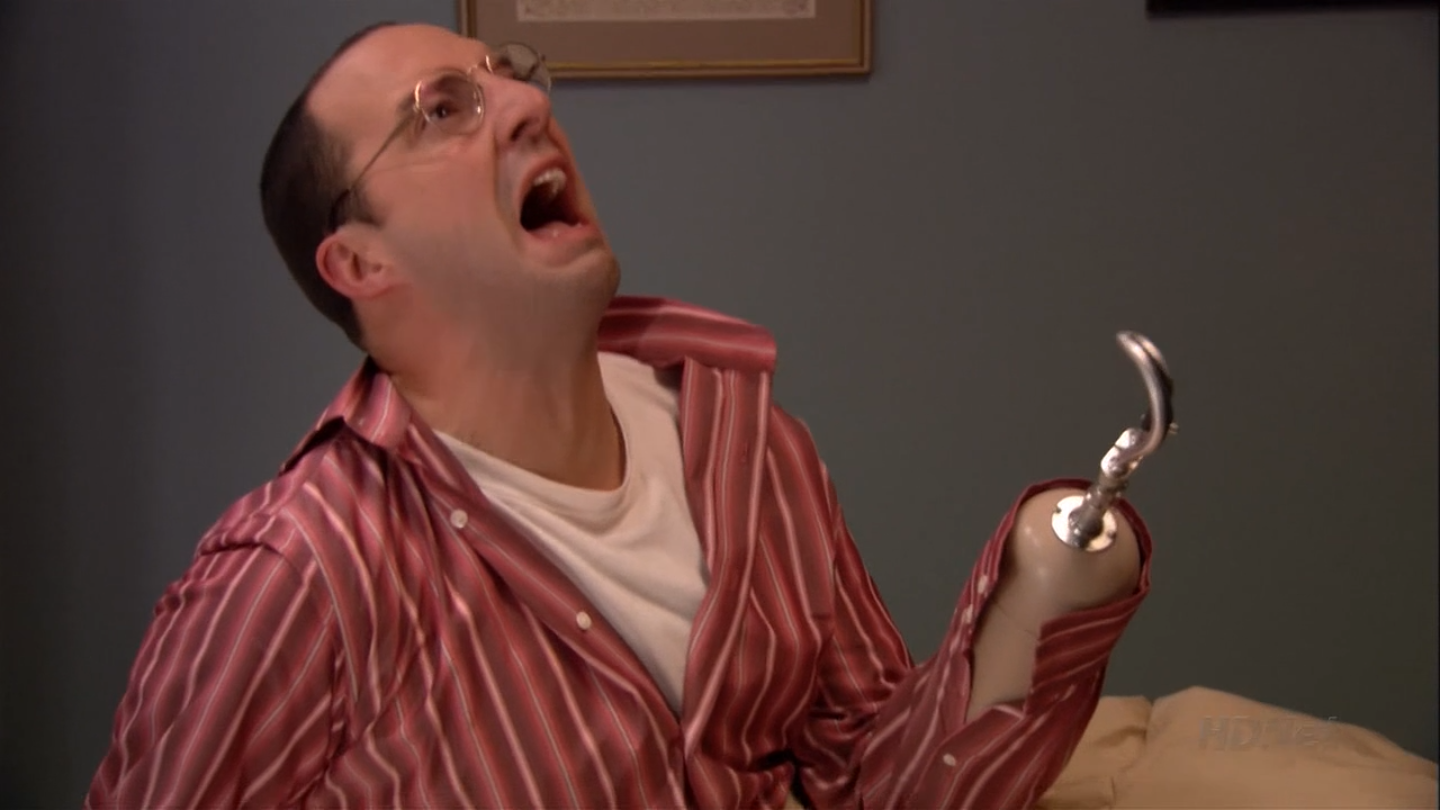
6.  Buster – Buster’s a great introductory character character, particularly because his humor is often loud. A lot of his best moments involve physical humor, particularly once he has a hook for a hand as well as his giant hand in the new season.  His devotion to his mother veers well into creepy territory, and he’s probably the most disturbing of any of the main characters, which in this show is saying a lot.  This is particularly on display in the new season, when he puts on a Psycho routine, constructing his own Lucille while she’s away in jail, and making her cocktails.  Many of the characters in Arrested Development are horrible people but Buster is the only one where I occasionally worry if there’s actually something wrong with him.  Of course there are plenty more lighter moments, where Buster’s just being a clueless idiot.  The early introduction of Buster in the first episode seems to indicate that, due to his continuous graduate studies, he’s book smart, but has no common sense. As the show goes on though, it’s hard to imagine him being even book smart.  He gets a little bit short-changed in the new episodes, largely I think because he was busy filming Veep, but he has some good moments with his new giant hand, even if it’s no hook.  His refrain of “I’m a monster”  after he acquires the hook is his best repeated catch phrase.

Best Line: “These are my awards, Mother. From Army. The seal is for marksmanship, and the gorilla is for sand racing. Now if you’ll excuse me, they’re putting me in something called Hero Squad.” – Season 2, Episode 6, “Afternoon Delight”

5 through 1 on Part 2, coming soon.

End of Season Report – Rectify, Season 1

17 Jun

Everyone gets ready to eat dinner

Rectify had an excellent first season overall and may have been the best new series from the past year.  In discussing the season, I’d like to start with the end, the powerful and vicious scene that closed Rectify’s debut season.

Few recent television scenes have incensed me with the furor that the last five minutes of the final episode of this season of Rectify did.  A pack of masked small-town middle-aged men descended on main character and freed death row convict Daniel as he visits the grave of the woman he was convicted of murdering and simply beat the living tar out of him.  Daniel, helpless, lies on the grass as blows are rained down on him by the masked men.  One of the men, the older brother of the woman whose gravesite Daniel is lying by, finishes the job by peeing on him.  Rectify had previously shown threats to Daniel by angry townspeople, including a damaged mailbox, but nothing even close to this extent. As I watched Daniel lie doubled over in pain before an ambulance arrived, I wanted to for someone to come and make these guys pay for what they did, legally or extralegally, but they just got back in their cars and went back from whence they came.

This scene triggered such strong emotions largely because so few shows aspire towards the level of realness of Rectify.  Moments in shows like Game of Thrones certainly supply anger and a visceral gut punch, but there’s always a detached perspective of a fantasy world.  Even shows like Breaking Bad take place in our world, but in a heavily stylized version of the world.  Not so with Rectify.  Few shows this side of David Simon truly feel like reality.  Everything in Rectify feels like it could actually happen in our world, a view enhanced by the gentle pacing and the emphasis on seemingly mundane events, like eating pieces of cake and taking trips to the store. Rectify led me to believe that I could drive down I-95 for a day and reach the town from the show, and it’s because of that sense of reality that each blow Daniel took raised my blood pressure and made me want to sock each and every man in masks.

The minimalism of the show also helped increase the power of that scene.  Unlike shows in which episodes routinely feature action and fighting, a punch means something in this world.  Violence isn’t something handed out in every episode.  This beating was an extraordinary event, that stood out starkly from the every day.

This reality is one of the factors that separates Rectify from everything else on television.  The whole season takes only a couple of days, and few shows make so much out of so little plot.  Little emotional moments are at the heart of Rectify, and they consistently hit.  The last scene was so powerful because you come to empathize with the characters.  We don’t yet know what really happened to the girl Daniel allegedly killed, but we do know that Daniel is a man who suffered deeply for two decades and who is honestly trying to face up and reckon with the opportunity for freedom he’s been given.  He still hasn’t quite figured out how to do make that peace, but his attempt at finding it stands in sharp contract to the simple-minded physical violence eye-for-an-eye strategy employed by the punks who beat him.

Flashbacks are difficult to use well, and in the past I’ve called out many shows for unnecessary flashbacks, which I think can be a crutch for exposition or character development best handled in the present.  I absolutely love the flashbacks in Rectify though, which show Daniel’s time in prison.  Daniel interacts primarily with another prisoner in the cell next to his, and their contact seems more free and natural than Daniel’s contact with anyone in the outside world once he gets out. Over time, this one fellow prisoner becomes his link to the remainder of humanity. The last episode features a moving scene in which Daniel’s friend is finally taken to die, and in his last moments finally sees Daniel, after years communicating only by sound, and confidently pronounces that he is sure that Daniel is innocent of murder.  It’s difficult to even imagine the very real plight of being released from prison after twenty years. At least in regular prison there’s at least a yard and some connection with the outside world, unlike death row.  Daniel has been in a box for twenty years, which has to have a huge effect on his ability to communicate with people who haven’t been.

People don’t know how to react around Daniel, and that difficult to bear awkwardness comes right through the screen.  People expect him to have trouble adjusting, but to have less trouble than he actually does, and to get over it real fast.  They project what they imagine twenty years in prison must be like onto him, even though it’s absolutely impossible for them to really understand. When he doesn’t sound unabashedly enthusiastic to be out of prison, people think he must be guilty.  He’s so haunted by the idea that he might be guilty that he’s convinced himself, over the years, that he’s not even sure what happened.  The difficulty that even simple person to person interaction poses Daniel is beautifully rendered and can be difficult to watch and enthralling at the same time.

As mentioned above, it’s often the little moments that really make Rectify stand out.  My favorite of the season was Daniel playing Sonic on Sega Genesis and rocking out to Cracker in the attic, dancing around in the way people only do if there’s no one else around.  It’s one of the few moments in the season where Daniel seems to be actually enjoying himself, appreciating the moment without the heavy emotional burden that every personal contact seems to take on him.  For a couple of minutes at least, Daniel can relax and really appreciate being free.

Summer 2013 Review: Motive

14 Jun

It's all in the eyes.  Or something.

Of all the generic police procedurals in the world, Motive may be the most generic yet.  Motive debuted recently on ABC, but it aired in its native Canada earlier in 2013.  Its one hook which is theoretically supposed to separate it from the glut of police procedurals on television is encapsulated in its title.  Like in Law & Order: Criminal Intent, the viewer learns the killer right at the start of the episode.  In fact, to make these easier for the visual learners amongst us, some nifty writing appears on screen labeling “The Killer” and “The Victim” and lingers on the screen for a moment so that we don’t miss it.  What kind of suspense is there then, if we already know the heart of any mystery, the whodunit? Ah!  It lies in, if you haven’t been able to figure it out yet, the motive!  As the police slowly piece together the crime and identify the culprit, the last piece of information to expose itself is the reason for the crime.

The crime itself in the pilot is painfully uninteresting, as if the eventual motive, which is anticlimactic at best.  The least you can expect from a procedural are some decent murder stories, especially in the pilot, which is your first and biggest showcase to the world. A teen outcast kills a popular teacher.  There are some red herrings; the police briefly believe the wife did it, because she was sleeping around, and that the kid’s friend did, but these diversions lack suspense entirely because we know who did it, and because it’s a police procedural, so we know there’s no chance they’re going to end up accusing the wrong person.  It turns out he did it because he had some weed and a notebook with lots of outcast-y thoughts, like wanting to hurt other students and such, and the teacher found it.  The kid snuck into the teacher’s house to grab it back, but when the teacher caught him and was about to call the police, the kid hit him over the head with a trophy.  It really was one of the more boring TV murders I’ve seen recently.

As per police procedural standards, our lead detective, played by former Zeljko Ivanek nominee and canuck Kristin Lehman, is smarter than the average cop. She has a number of gut instincts which end up all being correct, even when her partner points out that the evidence leads in a different direction.  She continues to sniff out incorrect leads and misdirection.  There’s lots of witty banter between her, her partner, and the new guy, whose taking notes on her behavior. Both her and her partner give the new guy tasks and advice.  There are also bizarre sections of the episode showing her cool mom relationship with her teenage son, as she watches him win a car race.  I have absolutely no idea how these fit into the scope of the show or why these sections are here, but you get to him and his girlfriend and his mom let him drive her car.

To say that it’s bad really misses the point.  It’s not good, but it’s taken genenicism (not a word, I know) to a new level.  It’s mind-blowingly bland.  You wouldn’t cringe after watching it.  You would just not realize you were watching anything.

Before I go, I should note that former New Kid on the Block Joey McIntyre plays the deceased high school teacher.  Also, former Jim Carey wife Lauren Holly plays the coroner and the actor who portrayed 24 agent Curtis Manning, Roger Cross, plays a cop.

Will I watch it again?  No.  Or, if I have nothing else to do for years, and I run out of every Law & Order, CSI, NCIS, and Criminal Minds, and am looking for more.  All this says to me is that there’s a lot of space to fill on television and the easiest way to do it is with police procedurals.

End of Season Report – Arrested Development, Season 4

12 Jun

There's Always Money in the Banana Stand

This is a general overview/review of the new season; I’ll probably do at least one or two more AD posts, but we’ll see. I would recommend against reading this unless you’ve completed Season 4.  If you haven’t, get to it, and come back when you have.

I made a decision not to make any serious judgments about the fourth season of Arrested Development before I had watched most, if not all, of it, and I implore you to do the same.  I made this decision because this is an unprecedented television event in several ways.  First, I can’t think of another example of a live action show brought back over a half a decade after it was originally cancelled. Animated programs like Futurama and Family Guy have returned from the dead, but voice work is a lot less arduous and animated programs are cheaper to make.  To reassemble the actors, a particularly large cast for a comedy, along with the writing staff, and the money and distribution outlet to get it done is a truly remarkable achievement. Secondly, it’s being distributed not by a traditional television network, but by Netflix,and  instead of once a week, all at once.  The season is uniquely designed to benefit from such a release, being more one giant 8 or 9 hour episode of Arrested Development than an unrelated series of shorter episodes.  The episodes do make sense by themselves, but not nearly as much sense as they make as part of a whole.  No comedy is as serial or plot-heavy as Arrested Development (Venture Bros. is the only other contender I can think of).  This is more than serial though.  Since each episode focuses on a single character, and the episodes all tread over the same time period through the point of view of different characters, events we saw in the earlier episodes are entirely turned on their heads by what we learn in later episodes.  Even in serial dramas which benefit from multiple viewings, rarely are events in earlier episodes as transformed by knowledge gained several episodes later. The earlier seasons were intricately plotted, but they have nothing on this fourth season, in which each of the nine main characters gets his or her own plots, but run into different members of the family at various points throughout the seven year period over which the season takes place, culminating in a series of events on fictional new Arrested Development holiday Cinco de Cuatro.

The season builds. The first Michael episode is so heavy with exposition that weighs it down at times, as it struggles to reconstruct seven years of plot.  However, it turns out this is going over territory that’s going to be touched on in just about every episode, so it’s worth going through this much narration once.  The episode sometimes feels off and rusty, especially burdened with all the expectations of seven years of anticipation wrapped up in it,  but I think (I haven’t done this yet) I’ll enjoy it a bit more on a second viewing with the knowledge of what’s to come.  Even this initially sub-par episode has moments.  I greatly enjoyed the constant machinations by Michael to construe a four-person vote that would eliminate P-hound, and the frequent references to the votes throughout the episode, including by the guys from Workaholics at the airport.

The reveals that come throughout the season alter our perspective of earlier events in ways that would have been hard to do without this level of freedom and fan dedication; this is Arrested Development writ large.  Most shows rely on the early episodes to keep viewers coming for later episodes.  Arrested Development could count on almost anyone who watched the first episode of the season watching them all.  Because of the Netflix model as well, the barometer of success is not necessarily how many people watch every episode, anyway. The best of these reveals is probably the discovery that George Michael’s much hyped internet company Fake Block is not based on privacy software at all, but is rather a simulated wood block.  For well over half the season it seems as if George Michael is the one successful Bluth whooing girls and capital with his software company, but it turns out this entire image is based on a series of lies.  George Sr.’s sweat lodge in the second episode turns out to be where G.O.B. planned his disappearing act from his wedding.  Herman Cain lookalike Herbert Love believed Lindsay was a prostitute because, unbeknownst to her, Maeby was acting as her pimp.

Repeated moments offered some great laughs as well.  My personal favorite was the constant hearkening back to Michael and his father making a deal outside of Michael’s office.  As the series progresses, we keep returning to flashbacks of them asking one another continually to do something else for each other.  Also great was the repeated viewings of the scene in Lucille’s apartment, where Michael, in the first episode, tells his family that he’s done with them.  In each character’s storyline we get a new look at that scene, slowly panning out to reveal more and more people there. What initially looks like a huge dramatic moment for Michael begins to feel more like yet another moment when utterly self obsessed Michael, thinking only of himself, ignores everyone else.  It’s fantastic when it turns out it’s George Michael’s graduation and Michael makes him tear up the check.  Another noteworthy repeated joke was when Michael telling his son that he can’t meet because he’s stuck in traffic turns into a two-way lie fest where both George Michael and Michael each stay on the phone for fifteen minutes doing their best to convince the other that the traffic is real.

It’s ultimately wonderful that the characters stay true to themselves.  It’s hard to watch Michael, the family’s one really successful member in the earlier seasons, just break down in the first episode, but it makes total sense, as what brings him down are all the traits that he displays earlier, his self-absorption and inability to listen to others.  George Michael , although it appears to the viewers initially that he has, can’t escape his awkwardness.  His solve for x scene was hilarious, and his episode was one of the best.  The others’ flaws are more obvious, but each of them break out with positive moments in their lives earlier in their episodes only to fall back into the mire as their plots move forward.

Arrested Development made a conscious effort to be relevant to the time over which the years took place.  There are repeated mentions of the housing crisis, particularly relevant, as the family works in real estate.  Tobias and Lindsay both read Eat, Pray, Love.  George W. Bush is dragged back up with what George Sr. thinks is a monument to the ex-President, but instead turns out to be a wall to keep immigrants out.  Herbert Love is a veritable Herman Cain ripoff.  These real life allusions actually work surprisingly well in shepherding a show which has the unenviable task of taking place over a seven year period through history.  George’s mistaken reading of the wall plans are vintage Arrested, as is the scene in which real estate agent Ed Helms, a callback to a one episode character in an earlier season, sells Tobias and Lindsay a house for no money with an endless variety of unnecessary features, just so, as they repeat so many times, they’ll have it.

This season was extra-heavy on the guest stars.  An incredibly high proportion of recurring or memorable one-time characters from earlier shows reappeared somewhere or other in the fourth season, which admittedly sometimes felt like fan service, but generally in a non-prolematic way.  They were joined by a generous proportion of new characters, who got more screen time in the new season because many of the single character episodes were light on Blush family interaction.  More Bluth family interaction would certainly be preferred, but the new characters largely held up their end for the limited roles asked of them.

I was hesitant to declare the fourth season of Arrested Development a huge success right after watching, but the more I’ve thought about it, the more I’ve enjoyed it.  It wasn’t perfect by any means.  The narration can be a littly hammy, and while to some extent the abject unsubtlety of the narration is much more artfully done than the awful narration on say How I Met Your Mother, a little more subtlely is called for sometimes.  As mentioned above, I’d love even more interaction between the Bluths, who sometimes get entirely lost in their own episodes and only run into their family members once or twice.  There are sparse moments and jokes that don’t quite work.  All told, the ambition level was so high that Arrested Development doesn’t always reach it.  Still, overall I’d vastly prefer setting ambitions this high and largely meeting them to meeting a moderate goal one hundred percent.  So many shows on television on happy to have very reasonable ambitions and pat themselves on the back for reaching them.  We’d do well for more shows that shoot for the sun and offer a lot to be enjoyed even when they don’t quite reach it.

Game of Thrones – End of Season Report, Season 3

10 Jun

Arya Horseface

Game of Thrones Season 3 ended yesterday with more of a whimper than a bang, especially compared to the penultimate episode.  During the silent credit sequence that followed that ninth episode, you could hear a pin drop due to the gaping silence and wide open jaws of the viewers, at least where I was watching.  Still, things happened last night, and plenty of things happened over the course of the year.  The last episode was primarily little bits of wrapping up loose ends and starting new ones.  I’ll take a look at some pieces of the last episode, some continued fall out from the red wedding, and some general season-long trends.

First, it can’t be underestimated how much the greater Westeros landscape has shifted post Red Wedding.  The Lannisters, for most intents and purposes, have won the war.  They know the battles aren’t over forever; there are marauding Ironborn in the north, and Stannis remains alive and everyone knows he’s not one to give in.  Still, Stannis’s forces are decimated.  Stannis will have to regroup and any fight that could actually challenge Lannister superiority is some time away.  The Lannisters and their allies have recaptured the north and their single greatest current threat was wiped out in one single brilliant blow.  The Lannisters now merely need to consolidate their power and make sure their growing unruly king can be corralled.

The three primary parties behind the Red Wedding had different motivations which lead to their hand in the event.  Tywin was out to win a difficult war and saw a way to do so in one fell swoop with a minimum of bloodshed to his side.  He’s not punitive beyond what he thinks will serve a practical purpose, such as to intimidate others from ever taking up arms against the Lannisters again.  He’s not interested in parading the wolf ‘s head around or gloating.  Tywin is an unsentimental pragmatist through and through.  Roose Bolton is a cold and calculating opportunist.  He begins to see, as the viewer does, that Robb, thanks to a series of blunders as well as overall strategic difficulties, is losing the war.  He knew that having supported a losing side for so long is unlikely to earn him mercy with Tywin and the eventual victors.  He’d lose lands at the least, and maybe members of his family as hostages. Instead, he saw a chance to turn his fortunes around by aligning himself with the winning side, and helping them out to prove his value.  Bolton is ambitious but within reason.  He’s going to become Warden of the North, a huge promotion, but he’s not so greedy that he would have made his move if he didn’t see it as a no-lose opportunity.  For Walder Frey, it’s old fashioned revenge, plain and simple.  He wouldn’t have acted without assurances from Tywin, but he’s less interested in the greater conflict than in getting back at Robb and the Stark family, who showed him up.  He is a bitter old man who was lied to.  Robb broke a promise, insulted the Freys, and must pay.

Tywin intriguingly asks whether it matters how they died, when discussing the moral repercussions of his actions with Tyrion.  A war won is a war won, and Tywin rightly points out that fewer people died this way than would have in a prolonged conflict on open battlefields, and not just on the Lannister side.  Still, Tyrion’s point that memories are long is at least equally correct and I think that’s not to be underestimated.  This is a kingdom with a long collective memory, and the North is not likely to put aside its animus towards the events of the red wedding, even as years and decades pass.  Bran explicitly reminds of us of this with the story of the Rat Cook, who was turned into a rat not for murder, or for cannibalism, but for violating sacred guest right.  The odds are against Tywin being haunted by that decision in the near future, but for a man who puts so much stock in considering his family as greater than himself, he may have caused them seriously long term negative reputational value.

Daenerys conquered two slave cities in short order with dragons, guile, and a host of now freed slave soldiers.  She had her best television moment fairly early in the season when she loosed the dragons on the Astapor slave sellers and told the unsullied she purchased to turn on and kill their masters.  I was pretty disappointed with her final scene, which was also the last scene of the season.  The previous two seasons have ended with serious WTF moments, where shocking supernatural events takes place.  This season’s ending did not compare to either the dragons hatching in the first season or the white walkers in the second.  The slave soldiers calling out to Dany, their mother, verged on cheesiness, and did nothing for me.  I may be biased because Dany isn’t my favorite character, but I still thought this was not adding anything new to the Dany narrative; the news she had conquered Yunkai  would have been a better place to end her season’s storyline.  Admittedly, the Dany scenes are among the hardest to place within episodes because she’s so far away from all the other characters both spatially and plotwise.  It’s hard to root against her freeing the slaves, and the slavers are some of the most one-sided characters on the show.  Still, I think there’s a more interesting dynamic to focus on in terms of what happens to the slaves and the cities once she conquers them, and how to take care of her huge number of ex-slave followers. I hope some time is spent with these challenges in the next seasons.

A couple of characters actually converge  and meet up with one another in this final episode!  Sam meets up with Bran, and even though they go their separate ways, it’s still a heartwarming little meet and greet.  Bran has gotten the bulk of the show’s supernatural activity this season and he demonstrates his warg power and his future vision or greensight.  His spirit guide Jojen seems to believe Bran could play a major role in fighting the white walkers in the upcoming battle. Bran’s plot is consistently the hardest to predict because it’s so steeped in the supernatural. Jaime also finally reunited with Cersei, providing an oddly sentimental moment for incest, though the one moment is about all we get from from their meeting.

In a plot beginning, Stannis is soon to be off to the wall with both rivals Melisandre and Davos agreeing on a plan. It’s an intriguing move for a king without a kingdom.  How to convince the people of the kingdom to join his side?  If he can’t beat his enemies within, attempt to defeat the kingdom’s enemies without, the white walkers.  The Stannis plots this season have been limited, but with him off to the wall, where Jon Snow and Sam are hanging about, it seems like they may get a lot more interesting soon.

The petulant young king Joffrey is a problem, but less so than when there was merely Cersei to corral him, as Tywin is clearly in control of the kingdom now.  Having the crown hardly makes one king in more than name.  That said, there’s at least a minimum of connection to the crown that one needs to obtain ultimate power as well. Varys reminds Shea of this when mentioning that he, as a foreigner, will never be able to hold more than a certain amount of sway no matter how much he knows.  I didn’t particularly care for the Varys – Shea scene, largely because it seemed as if Varys was saying a lot for our benefit that he would never have said to Shea in context, but the point still stands.  You don’t need to be the king to have power but having the family connection and the high born status doesn’t hurt.

Tyrion, who basically owned season 2, didn’t have a whole to do this season, but that’s okay.  He did marry Sansa, against both of their wills, and the little bit of banter we’ve seen between the two of them has been surprisingly entertaining.

Arya and the hound have become the latest buddy pairing to tear up the Westeros countryside, hot on the heels of Jaime and Brienne and before them Tyrion and Bronn.  The Hound has some of the more mysterious motives of any character in the show, as he’s done some monstrous deeds, but also seems to have some redeeming characteristics.  He also really does not like fire. Him and Arya make short work of four Frey soldiers sitting beside a fire, and Arya, perhaps not surprisingly considering all she’s dealt with, has begun to harden considerably in her treatment of men minding their own business hanging around the countryside.  Just last week, she asked the hound to spare a man’s life.  No more.

Jon finally makes it back home, ending his middling attempt to pose as a wildling.  It’s heartbreaking to see Ygritte aim at Jon Snow, and it’s an open question if she’s actually trying to kill him or not, but I think it’s oddly reaffirming that both of them are standing up for what they believe in.  I’d love for them to be together, but it’s difficult when they have belief systems that are diametrically at odds.  Jon stands up for the Night’s Watch and makes a daring return home to warm of the upcoming wildlings attack, while Ygritte tries to fulfill her promise that if Jon betrayed her she would kill him herself.  I’m certain glad, however, that she was unable to come through on hers.

A reveal in the finale is that the character torturing Theon for the entirety of the season is Ramsay Snow, Roose Bolton’s bastard, who took over Winterfell from the Ironborn.  The number of Theon scenes this season has seemed gratuitous – two or three scenes of torture were good enough to get the point across, and beyond that seemed unnecessary.  Still, here we have a truly evil, truly sadistic character.  To me, this actually makes view Joffrey in a different light.  Ramsay is a face of evil.  Joffrey is a spoiled immature brat who received the keys to a kingdom as a teenager when he normally would have received groundings and time outs.  He’s bad, unquestionably, but I think he’s more out of control than evil.  Now Ramsay Bolton, who continues to torture Theon for days and weeks on end simply for the fun of it.  That’s evil.

Summer 2013 Review: Mistresses

7 Jun

The four mistressesMy first impression of the show was, wow, there’s trashy, and then there’s Mistresses.  Within thirty seconds in the show’s first episode, three of the four primary female characters are having sex (obviously there’s no nudity; this is a network show).  The credit sequence which appeared shortly after revealed that Mistresses was adapted from a foreign series, and I immediately assumed it was adapted from a British series, because this species of trash reeks of the United Kingdom, and I was correct.  I’ve never actually watched any of those trashy British soaps (Footballers’ Wives comes to mind, but I’m sure there’s tons more) but this seems like an Americanized version of what I think those shows are like.  You can tell it’s attempting to be provocative by the very name Mistresses, implying our main characters will be occupying the socially taboo position of sleeping with married gentlemen.

However, it’s not really as provocative as it seems to want you to think it is.  That opening scene is pretty much the last sex you get in the entire episode, as it gets all drama-y and soap-y.  Four women, in different stages of relationships, are all dealing with men, or the lack there of, and life in general.  Alyssa Milano’s Savannah is a high-powered lawyer who is having serious problems with her chef husband due to their inability to conceive, particularly when it turns out that it’s because of him rather than her.  Her younger free-spirited sister, the only actual mistress in the series’ present time, is a real estate agent sleeping around with her boss.  She faces a dilemma when the boss/lover offers to buy her a house when her lease is up.  Karen (Lost’s Yunjin Kim) is a psychologist, who spent a time as a mistress when she recently had a tempestuous affair with a patient who was dying.  At the funeral, which occurs soon after the opening credits, the dead man’s son comes to her and tells her that he suspects his dad was having an affair.  Oops.  The fourth character is April, a single mom who is still dealing with the death of her husband three years ago and is having difficulty trying to return to the dating world.  She’s taken aback at the end of the episode, when another woman brings to her door a young child which the woman claims is April’s ex-husband’s.

Like so many female-centered shows in the past decade, it’s definitely a show consciously taking place in the post-Sex and the City world, where four women support each other, work hard towards career goals, and gossip openly and proudly about each other’s sex lives.  It’s certainly trashier than the Sex and the City, but, as mentioned above, the first three minutes of the show offer a misleadingly trashy view of what’s to be expected.  Instead, it’s a soupy personal drama about the four women and it’s not particularly interesting.  There are light moments but there really isn’t any humor, or attempts at humor. It’s just a soap, and without any interesting hook or fun conspiracies to keep the plot humming along like Revenge.  It’s just women doing jobs and getting into relationship problems, and life. It’s hardly awful; it’s just incredible mundane.  There’s absolutely nothing that pulls you in and I’ll be surprised if I can remember anything other than that Alyssa Milano and Sun from Lost starred in it in six months.  It’s not that stories about people can’t be good in and of itself, or that soaps can’t be, but you need excellent writing, or humor, or a really enjoyable sense of fun, none of which Mistresses have.

Will I watch it again? No.  I knew more or less right away that there was no chance of me watching another episode, and nothing in the remainder of the episode changed that initial reaction.  I do think doubling down on maximum trashiness would have been preferable to just generic drama.

Ranking the New Spring 2013 Shows

5 Jun

The Americans, again

Memorial Day has passed, June is here, and the spring TV season is finished. That means there’s no better time to take stock, and do a final ranking of all the new shows spring offered us.  I’ve seen at least one episode of each of these, and more of a few. Let’s have at it, with a few notes for each.

  1.  The Americans – This was probably my favorite pilot of the year. It dipped briefly into second or third midseason and then rose up again as it neared the end.  It’s really good.  I’ve started putting this out as the go-to watch for people who are up to date on the big three dramas (Mad Men, Breaking Bad, Game of Thrones) and want something to catch up on quickly.
  2. Rectify – Only six episodes long and on the Sundance Channel, this show could easily pass you by, and almost passed me by.  Still, if this is the type of show Sundance plans on bringing to its original programming, that’s a great sign.  About the reintegration of a man who served on death row for two decades in a small Southern town setting, it’s fascinating and well-acted and feels startlingly real for TV.
  3. Hannibal – Gorgeous and grotesque, this show feels like a cable show masquerading on a network.  It’s about cops and serial killers, not exactly bold new territory, but the dynamic between main characters Will, Hannibal, and Jack is exemplary and takes it above typical procedural quality.  It’s one of the most beautifully shot shows on TV.
  4. House of Cards – Spacey is good, aside from his accent, and it’s fun to track the endless over-complicated manipulations that land the primary characters in different places by the end of the season.  It’s fairly ludicrous and a little overdone, but it’s also quite a fun ride.
  5. Banshee – I will probably watch at least one more of this violent show about a criminal pretending to be a sheriff in but dangerous town in Pennsylvania. I really have no idea where this is going to go, but it has a Sons of Anarchy-vibe in the pilot.
  6. Bates Motel – This is probably the closest to 50/50 in terms of whether I watch another episode. It looked like it could be good, but also might not be up my particular alley with its horror movie feel.  I probably will watch at least one season of American Horror Story before I watch this.
  7. The Following – I havne’t watched any more like I thought I might and have heard it gets worse, but the first episode, while insane, at least made me consider watching more, which says something.
  8. Deception – A poor man’s Revenge from one episode, though it certainly seemed like it could have second season of Revenge level potential, for whatever that’s worth.
  9. Cult – Kind of a poor man’s The Following.  Another horror movie for TV, clearly a CW show, but tries to be a little too clever for its own good.
  10. 1600 Penn – Super wacky, in a way that I almost respect the effort, but it wasn’t very funny.  Probably will go down mostly for the trivia of Bill Pullman playing the president once again, after Independence Day.
  11. The Carrie Diaries – I can imagine the right person liking this, and I think Annasophia Robb, who plays young Carrie Bradshaw, does a good job.  Aside from the period soundtrack though, I have better shows to watch, and I already have one new show set in the early ’80s (The Americans).
  12. Red Widow – A widow from a small-time crime family must take her husband’s place and work with a scary crime lord.  It should be more riveting.  It was absolutely watchable, but not particularly compelling.
  13. Zero Hour – This year’s crazy conspiracy show, it hearkens back to the Nazis and the Bible both, taking two of the biggest conspiracy theory generators and combining them.  Not as captivating as a show that draws on those two conspiracy lode mines should be.
  14. Golden Boy – It’s a pretty standard cop show whose hook is that it’s told through flashbacks by the youngest ever police commissioner, about his time as an even younger homicide detective.  The best aspect of the show is that the main character is kind of a prick, which is unusual for this genre.
  15. How To Live With Your Parents (For the Rest Of Your Life) – cutesy Modern Family clones are hotter than the sun at the moment, and whoever can generate another even miniature hit with one will make a lot of money.  This is not it.
  16. Family Tools – I didn’t realize the ridiculous drama to comedy ratio of the new spring shows (14 to 3) until I wrote these all down.  Family Tools is really similar to How to Live With Your Parents above, and I could have put them in a virtual tie.  Shout out for JK Simmons, who deserves a better platform for his talents.
  17. Do No Harm – I’ll admit, I forgot I watched this show, and while this show doesn’t deserve to be higher, there’s no laughably awful Rob! or Work It to claim the last spot.  Still, this show, about a doctor with an evil split personality, was about as uninteresting as a show with that premise could be.

Game of Thrones: Season 3, Episode 9 Notes

3 Jun

Please scroll down immediately past this post if you have not seen this episode yet.  I’ll wait.

Robb Stark of House Stark

Phew.  Okay.  So, Red Wedding.  That’s what it’s called if the internet hasn’t told you a million times already and you haven’t read the books.  Red cause of you know, all the blood.  I have some broader Game of Thrones thoughts I’d like to posit after the season’s done. First, though, some notes on the Red Wedding, and Robb’s ultimate road leading up to it, now that it can be viewed as a whole.  This post ended up being much longer than I had planned, so apologies, but who doesn’t get carried away by Game of Thrones sometimes.

The notion of honor has often been at the crux of Game of Thrones, particularly since the dead patriarch of our main family, the Starks, was known for it, and passed it down as a crucial value if not the most important value, to his sons and daughters.  More than honor, unbending honor, to the point where it was not only not practical or smart, as Ned learned the hard way, and sometimes even difficult to comprehend by our modern standards of what’s important.  Although it’s hard not to like Ned overall (especially in memory), it’s also hard to sympathize with his position that Jaime is despicable and beyond redeemable for being an oathbreaker when killing the Mad King, even though Jaime’s decision may have spared hundreds or thousands of lives (though Ned is hardly the only one who feels this way, as this is a world moral absolutism, and as I’ll discuss below, there’s a reason for that sometimes). Ned sees honor as black and white; Jaime’s oath and his duty toward the king was bound in stone, while his opportunity to save random King’s Landing residents was not. Ned’s children all struggle with how to live honorably, as their father taught them, in a world that can be extremely dishonorable.  They try to figure out where the line is between keeping their heads, hopefully, while, at the same time, doing their father proud.

I think the Red Wedding was handled spectacularly on the show and overall I’ve been thrilled with the show and many of the adaptation choices they’ve made.  I’d like to dwell briefly on one I think was ill-advised.  In both the book and the show, Robb, in order to pass through a precarious patch of country known as the Twins and gain a large component of men for his army, agrees to marry cantankerous and bitter Lord Walder Frey’s daughter.  He violates that oath by marrying someone else.

In the show, he falls in love, and believing love to be more important than keeping a promise (or at least this promise), he chooses to marry the woman he falls in love with and deal with his broken oath to Walder Frey later.  While it’s nice to think that in this world people can actually be in love with the people they marry (I’m not being sarcastic. It is nice), I thought it came off as somewhat selfish, especially when his mom and his other advisers so ardently recommend that he not get married, at the least during the war, when violating the oath would have practical consequences. He just doesn’t listen and does it anyway.  For someone who values honor above all else (something we see again with his decision to execute Rickard Karstark), it’s hard to understand how his decision to marry Talisa would be consistent with his policy of honor above any other value, even love. This would have been a lesson his father, himself in an arranged marriage with his deceased brother’s former fiance, taught him at least.

In the book, Robb’s recovering from an injury suffered from battle far away from his mother and top advisers.  He’s recovering in the house of some minor nobles, and stricken after finding out the news that Theon betrayed him, took Winterfell, and killed his brothers. After he learns this news, his nurse, a young minor noble herself, decides to, uh, comfort him, above and beyond what’s normally expected of a nurse.  Robb, feeling ashamed after taking her virginity (which is a big deal in this world (also in Downton Abbey!), decides the honorable thing to do, being a Stark, is to marry her.  He’s not making the decision out of love, but rather out of his perhaps misguided view that the honorable path in the moment of marrying the girl supersedes the honor of keeping the oath.  His mom is not there to advise him otherwise; she’s miles and miles away and is horrified when she finds out, but it’s too late.  I think the immaturity is accentuated by the fact that Robb’s younger in the book.  While making all the characters a few years older in the show makes sense because actors age, this is one spot where the actions seem more excusable if Robb is younger, and just the couple of years could make a significant difference.  Certainly to some extent, immaturity is also a factor in his not appreciating the value of an oath in the show, and he certainly could have been firmer in refusing to have sex in the book. Still, I think the book both painted a more sympathetic figure of Robb and also doubled down, properly, on how honor, the essential value of the Stark family, played into his decision. It’s possible he was wrong, or at least questionable in balancing the honor at stake in the book, but at least it makes sense from his perspective.

The Red Wedding of course, is about the exact opposite of honor.  Not sadism or brutality, but total disregard for the rules, the willful violation of social norms that everybody in a society believes in to function where there doesn’t exist a modern state with clearly defined rules and well-enforced law.  These norms can be held together by religious beliefs, or a cultural belief so strongly shared that violating it would prompt instant outrage from society at large (in GoT, it’s both religious and cultural).  Oaths, in this world, have that kind of power.  Like in the Ancient Greek world, an oath is a bond.  It’s more than an oath would mean today when there’s so many other ways to enforce promises – we have contracts and courts.  The oath Robb broke is serious business, which can’t be underestimated, and they do a good job on the show of making out what a big deal this is (as mentioned above everyone still refers to Jaime as Kingslayer for his oath violation years and years ago).  You don’t have much more than your word.  Ned Stark wouldn;t have smiled on Robb’s choice in the show.

That said, there’s an even greater breach here in the Red Wedding which isn’t articulated so much in the show but which at least comes across strongly in the visuals of the scene.  I’m not sure it was a focus, but they definitely made a point of mentioning, in the scene in which Robb and his entourage arrived at the Freys, that the visitors were to receive bread and salt.  This means, book readers know, that, as guests, they’re now under the protection of their hosts.  Guest right is a sacred and important tradition in Westeros, much like it was in Ancient Greece, where it shows up crucially in both the Odyssey and the Illiad.  Once visitors have been welcomed with bread, they can not be harmed until they leave the premises.  This is so sacred that it’s basically unheard of; one famous song in the Game of Thrones universe known as the Rat Cook tells of a violation and the horrible consequences that came to the violator, and serves as an admonishment to would be guest right-breakers.  Both the shock and the disturbance of the betrayal by his allies are heightened by this visceral break with hundreds of years old tradition.  The fact that it’s a not simply a normal stay, but a wedding, a sacred and joyful ceremony, only multiplies the deeply felt wrongness of the perpetrators’ actions. This breach puts those who violated outside of the normal social order of Westeros. This may win the war for now, and it may be difficult to overstate the value of that, but this will not be something soon forgotten by anyone in the realm, just as Robb’s oath violation wasn’t forgotten.

Robb’s issues of course extended beyond breaking his oath to Walder Frey.  His campaign, while winning battles left and right, suffered from numerous off-the-field problems, chief among them, besides his marriage, his mother’s decision to release Jaime Lannister and his questionable decision to execute Rickard Karstark.  Still, even these blunders simply cover up a more basic issue with the Robb Stark strategy: there isn’t one.

Robb’s tactics are excellent; his strategy is non-existent.  It’s brought up explicitly by his wife when they’re first getting to know each other.  What’s the goal of his war and how does he make it happen.  He tells his soon-to-be-wife that he wants to get to King’s Landing and kill Joffrey, and she rightfully asks, what then.  He says he merely wants to be King of the North, but that means he has to find a way for whoever rules at King’s Landing to both accept his secession, and find a way to preserve a more permanent peace (who’s to say the next King wouldn’t seek to reconquer the North?) The goal becomes muddled, and even before he gets mired in problems with his troops, he doesn’t really know the best way to reach this goal. When the North gets taken over by Ironborn, his path to victory gets even more questionable and confusing, considering he doesn’t even possess the only place he claims he wants to be in control of.   Maybe if Robb decided he wanted to put himself on the throne, or put someone else on the throne, it would be just as unsuccessful but at least it’d be a coherent goal.  His plan to capture Casterly Rock seems like a desperate gambit that may provide only a temporary lift, even if successful.  It reminds me of the Confederacy’s plan to capture Washington D.C. during the Civil War (note for longer entry: compare the Confederacy’s secession to the North’s in Game of Thrones).  They knew they were outgunned and outnumbered, and no matter how many battles they won, the North just had more of everything.  They imagined if they had taken the heart of the North (US, not Winterfell), they would destroy morale, and break the North’s will.  There’s a world in which this strategy could have worked work, but luckily for the US, Lincoln’s will, like Tywin Lannister’s was indomitable.  Maybe taking Casterly Rock would have caused a lesser or less stubborn leader to give in, but I have a hard time seeing Tywin conceding.  Robb needed manpower and allies, strength, and those he was hemorrhaging, and probably never had enough of to begin with.