Archive | Summer 2015 TV Season RSS feed for this section

Summer 2015 Review: Sense8

3 Jul

Sense8

Sense8 spans the globe, telling a story based on a telepathic connection that exists between certain people around the world. In particular, the focus is on eight people who don’t know each other and have never met in person but have some sort of telepathic link and are bound to figure into each other’s lives in important ways from now on. The scope is vast, as would be expected in a TV show from the Wachowski siblings, who were behind good movies like The Matrix, and bad movies like The Matrix sequels (I’m not even going to mention Speed Racer. Oops, I guess I did).

Daryl Hannah plays a woman, struggling in agony, in the ruins of an abandoned church. Naveen Andrews appears next to her, tells her he loves her, and that she can do it, it being, well, who knows, but something difficult, because she insists she can’t, though he eggs her on. We’re led to believe that Andrews is a projection, talking to her through some sort of telepathy. He, any viewer who has watched television or movies would quickly ascertain, is some sort of force for good. He’s countered by an older gentleman, also an apparition, apparently the force for evil, who attempts to persuade Hannah to join his side instead, and he remains convinced that she will, while Andrews insists that she will not. The bad dude comes in in the flesh, causing Hannah to kill herself rather than be apprehended by him.

Somehow, I think, and I could be getting this wrong, we’re led to believe that she somehow activated the powers of the eight people shown throughout the rest of the episode. These eight, four male, and four female, and I’ll run through them quickly in a moment, have all just started seeing visions, both of Hannah herself, and of each other.

Here we go. First, a Chicago cop who works in gangland south Chicago with his partner. Second, a British DJ, whose boyfriend seems intent on robbing some other dude. Third, a Russian guy who with his brother or cousin robs safes. Fourth, a Mexican soap opera-type actor. Fifth, a South Korean businesswoman being overshadowed by her brother. Sixth, an Indian woman who is about to get married to a very successful man she does not love. Seventh, a San Francisco woman who seems to be some sort of intellectual. Eight, a Kenyan van driver.

Some get more screen time in the first episode than others. The cop, the DJ, the San Franciscan, and the Russian thief, get a lot, while the South Korean woman and then Kenyan driver get almost none.

Most serial supernatural shows go out of their way to lay out a premise and several distinct questions in a plot-heavy pilot, trying to pack as much in to get viewers hooked on the story from just 40 minutes. Sense8, possibly because it’s a Netflix original not shown weekly or subject to the traditional pilot process; it had a full season order straight out of the gate – doesn’t feel obliged to do this. There’s a relatively small amount of plot in the pilot.

And so, well, that’s all I have to go on. The set up feels like one a director or writer would love to put issues of fate all over it, but thankfully Sense8, at least initially, refrains from any fate talk; it doesn’t sound like Tim Kring fake-heavy Touch or Heroes. Still, though, and maybe I’m just used to the packing of plot, but it was kind of boring. It looks pretty; and spanning the world, there’s certainly an epic quality which is welcome in a television series. But, there wasn’t enough for me to bite into. Eight people are now telepathic and supposed to do something good, presumably. The series look good. But what it is stuffed with is characters, and while they seem fine enough I don’t really find any of them so interesting I want to know more from the get go.

It’s tough with these types of shows. You make an investment based on guesswork, and hope that it’s rewarded by watching the rest of the season and the series. Is the hook catchy? Are the dialogue, cinematography and character work sophisticated enough to lift the show to being more than merely its plot?

Could Sense8 turn into something really interesting? Maybe. Does it pull me in from the first episode and make me want to immediately watch a second? Not really.  Sense8 certainly aspires to be more than its mere story, and it well could be, but despite the fact that it sometimes seems like it I can’t watch every episode of every halfway decent looking show and Sense8 doesn’t quite make it over the hump.

Will I watch it again? No, not right now, anyway. The production was impressive, but there just wasn’t enough there for me. Maybe if I hear good things from others who have seen it all, I’ll revisit. I’d be very happy to admit I’m wrong.

Summer 2015 Review: Another Period

1 Jul

Another Period

Another Period is a ludicrous, silly show whose primary goal is to simply make you laugh, and fortunately, it does. Another Period is a spoof of Downton Abbey-esque upstairs/downstairs period shows, following a ludicrously wealthy family in New England around the turn of the 20th century.  The characters and dramatic storylines are overly absurd and the humor ranges from a combination of low-brow and clever wordplay to physical slapstick; the vast majority of the characters range from dumb to extremely dumb.

Creators Natasha Leggero and Riki Lindhome play daughters Lillian and Beatrice respectively, of the family Bellacourt. Both are demanding, immature and petulant. All that separates them is that Lillian has some semblance of intelligence, while Beatrice is a complete moron. Beatrice is married to Albert, played by David Wain, but in love with her brother, Frederick, played by Jason Ritter. Lillian is married to Victor, played by Brian Huskey. Michael Ian Black plays Mr. Peepers, the head butler, and Christina Hendricks is the new servant, originally named Celine, but named Chair by the less-than-sensitive Bellacourts. In total, it’s a very strong stable of comedic personalities, with some welcome faces newer to the world of comedy (Hendricks and Ritter).

The style is well over the top, and some people will merely Another Period is very stupid. And they’re right, it is very stupid. It’s very hard to articulate why some stupid humor is laugh-out-loud hilarious and some stupid humor is mind-numbing and cringe-worthy, and certainly everyone’s line between the two is very different. Another Period though lies squarely on the former side.

Another Period was probably conceived in response to Downton Abbey, and while the show makes hay out of the rich family vs. poor servants dynamic, there’s no attempt to be poignant or clever or meaningful with the period nature. It’s just there to serve as a vein for jokes and comedy. The period nature is ridiculous and flexible truth-wise. There’s no attempt to any reasonable semblance of fidelity; rather there’s an attempt to be as distinctly inaccurate as possible. One character makes a reference to Helen Keller, treating her as we would today rather than then. Guests are served cocaine wine; when Helen Keller and Annie Sullivan object as members of the Temperance Union, they’re told, helpfully, that it’s really mostly cocaine, anyway.  New servant Chair tells the others she has big dreams; the other servants scoff at her dreams of one day working in a factory.

The jokes are scattershot, fired left and right over the place, and they don’t all work by any means. Luckily it’s the type of show where the overall picture isn’t all that important – the show would rather drop a bunch of bad jokes and leave a whole bunch of good jokes in than go for something more refined but possibly less funny. That’s not always a successful formula, but it works here – the gags that don’t work are washed away as soon as something funny happens.

Will I watch it again? Yes. It’s funny, it’s easy to watch, and it’s got lots of people I like. Comedy Central continues its roll.

Summer 2015 Review: Catastrophe

29 Jun

Catastrophe

Catastrophe is that frequent film, but rare TV beast, the romantic comedy. It’s common on film but rare on TV, because by the nature of their respective lengths, film and tv rom coms are very different creatures. Film rom coms have an obvious arc, and a sense of finality. The couple generally has an unlikely meet cute, goes through a couple of trials, including a big one towards the end, and then gets together to finish the movie after some grand gesture, or occasionally in artier rom coms falls apart. TV rom coms more usually consist of unlikely couples getting together, and largely staying together, with plenty of trials and tribulations along the way but without the big dramatic sweeps of a movie.

Catastrophe is also a British series. Surprisingly, for a series and a theme that is replete with people embarrassing themselves constantly, it’s not that awkward to watch, relatively  (a British show featuring a Brit dating American Andy Samberg a couple of years ago called Cuckoo was awkward to the extreme). What really makes Catastrophe work, more than the jokes or the laughs or the story, is the tone. Catastrophe finds the perfect spot between earnest and cynical, awkward and mawkish, sentimental and restrained. This tone makes the show enjoyable and excessively watchable.

Here’s the pitch for Catastrophe: Rob is an American visiting London for a week for business. He meets Sharon at a bar, they hit it off, and have sex in his room. They both seem to actually like one another, and hang out and have lots of sex for the rest of the week until Rob has to go home. A couple months later, they’ve more or less moved on with their lives, having great memories of their time together and no hard feelings, until Sharon calls Rob and lets him know that she’s pregnant. It’s pretty much the premise of Knocked Up (and I’m sure many properties before that) but with a more mature, both emotionally and age-wise couple. Rob, unsure what to do, doubles down, and proposes to her, believing staying the together for the kid and making a real go of it as a couple is the right move. Countless hilarious mishaps happen between point A and B, as both parties examine their decision to try to make it together even though they barely know one another and try to figure out if this is the right move, while they seem to actually like, and maybe one day love, each other.

The chemistry between leads Rob Delaney and Sharon Horgan is casual and natural, and an essential part of what makes Catastrophe go. Everything is centered on the two of them and their relationship; if we don’t both believe deeply that they could be together and want to keep watching them interact, there’s no way the show can be salvaged. Luckily for Catastrophe, it works.

Catastrophe isn’t the funniest show, it isn’t a particularly unique show, and there’s nothing that makes it obviously stand out plot wise, or dialogue wise, or aesthetically. However, it successfully navigates the spaces within its genre to create an enjoyable viewing experience where you’re generally rooting for both of them; hardly a necessity for a show, but sometimes a welcome respite from more serious fare. I love big drama as much as anyone, but there’s nothing greater after watching an episode of Hannibal or Rectify, or whatever else, than watching a light half hour that can leave you smiling.

Will I watch it again? Yes. It’s British. There are six half hour episodes; it’s shorter than a Hobbit installment. I’ll probably be done by the time you’re reading this.

Summer 2015 Review: Mr. Robot

26 Jun

Mr. Robot

Mr. Robot is on USA and is a USA show in just about every way. USA over the past couple of years has attempted to get a little more serious and dark than their early Blue Sky days of White Collar and Royal Pains, perfect due to their decline in ratings and prestige. Mr. Robot fits perfectly into this evolution of USA. As for most USA shows, the floor for Mr. Robot is high while the ceiling is low. Mr. Robot is commendably competent and entertaining and snappy enough to make me consider watching another episode, but not quite interesting or different or superior enough to make me actually do it.

Protagonist Elliott is a master hacker. He works for a cyber-security firm by day, which he’s great at, but hates, helping protect evil one-percenter corporations and conglomerates, the biggest of which is his firm’s chief client, the eponymous E. Corp, known informally by the employees as Evil Corp. At night, he hacks to uphold his own personal sense of justice. In the first scene he confronts a coffee shop owner who is unbeknownst to anyone else running a kiddie porn ring, which Elliott discovered while hacking and then informed the police about.

Elliott is a Character, like all USA protagonists. He’s got paranoid delusions and serious social anxiety issues, and has trouble making friends or interacting in normal human fashion. He has one friend, Angela, who he seems interested in romantically, a shrink, who he likes, but who can’t seem to reach him, and a drug dealer who he occasionally sleeps with. Angela has a stereotypical white fratty boyfriend; the boyfriend’s love of Josh Groban is used as a point against him by Elliott.

Elliott sees signs of big evil wherever he goes; men in suits, watching him, waiting for him, but he’s also self-aware that he is delusional. This makes it all the stranger when he’s approached by Christian Slater, who he’s seen twice before ambling around the city, in a subway station, telling Elliott to follow him. Elliott finds that Slater has assembled a crack team of hackers, whose goal is to take down Evil Corp, which in one way or another, holds the digital information on loans and debt for millions and millions of ordinary folks. Taking down Evil Corp, thus, will result in cyber justice, a great wealth redistribution, taking money out of the hands of the rich and powerful and putting it in the hands of the people. Think of them as a hacker Occupy movement willing to break the law to achieve their means.

It’s not the entirely of the show by any means, but the politics of these hackers are vastly problematic; vague and poorly thought through at best. There’s a cheapness and a laziness to dealing with such an over generic political philosophy that sound great as a sound bite, but doesn’t bother to deal with any real life complexities. Have regular people been screwed by big companies on the whole, causing a frustrating feeling of general powerless? Sure.  There are real issues and even occasional crimes propagated by big companies; in the great 2008 financial collapse, corporate behavior along with other factors helped lead to the collapse. But these issues need to be reckoned with in a manner befitted the complexities of the problem; to simply say, destroy this company, free the world is lazy and naïve.

Murky politics aside, the show has its positive qualities. USA is skilled at putting on air shows that know how to pull viewers into their storylines, and Mr. Robot does this nicely. Production values are solid; the show looks good and is legitimately filmed in New York, which is always a plus to me. But there’s just something missing. Mr. Robot feels like it follows one too many tropes. The main character is a little too much of a Character. Maybe these will work themselves out, the show will get more complex and interesting as it goes along. But based on the show and USA’s reputation I’m not sure there’s enough to go on for me to keep going on faith alone.

Will I watch it again? No. I considered watching it again. It was in no way bad. But, USA-style, it wasn’t quite good enough either.

Summer 2015 Review: The Brink

24 Jun

The Brink

The thing about the Brink is, well, it’s not very funny. Now, that in and of itself isn’t necessarily a problem. Ballers, for all of its issues, clearly isn’t particularly interested in being funny, so its lack of laughs isn’t really one of its faults. The Brink, though, desperately wants to be funny. Going for something like Dr. Strangelove meets Homeland, The Brink really wants to be a trenchant modern satirical take on Middle Eastern finger-on-the-button terrorism politics. The probably is, well, it’s not funny. The characters are oversized and a bit much, and despite the strong cast of actors throughout, the lines just don’t land. If the writing doesn’t work, it’s hard to build on.

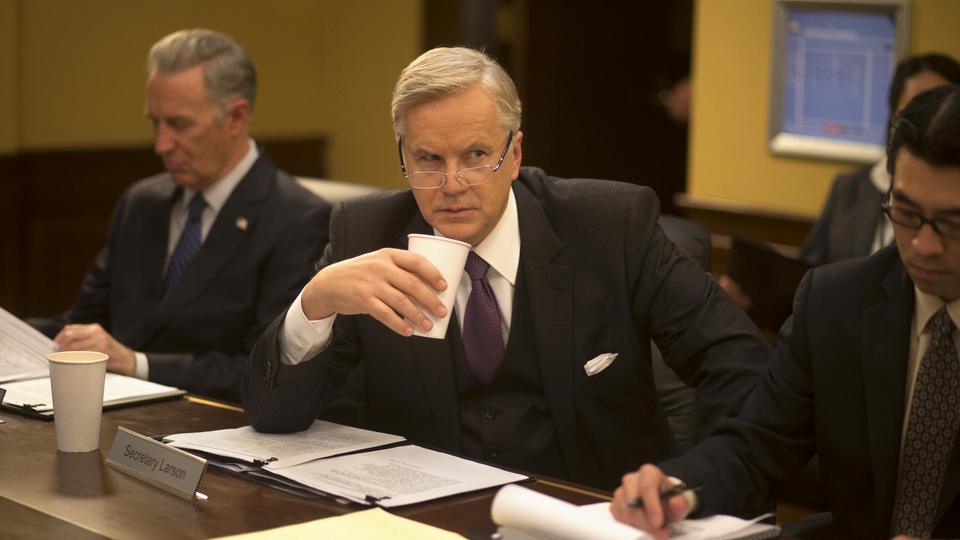
Pakistan is the setting. An unprepared for and out-of-nowhere regime change takes place, placing a crazy fanatic in charge of the Pakistani government. The American government and the president must decide what course of action to take – a preemptive violent strike, or cautious diplomacy. The stakes are as high as they get, dealing with a nuclear power. This is satire though, so the premise is very serious, but the execution is very silly. Primary characters include Tim Robbins as Secretary of State Walter Larson. Larson is a boozer and a philanderer who doesn’t seem to know his stuff, but when thrown in the heat of the war room with the president and the rest of the cabinet, seems to possess some innate competence, attempting to counsel the president against war, while getting into petty spats with his more militaristic colleague the Secretary of Defense.

Jack Black plays a womanizing low-level bureaucrat who could not and would not be more irrelevant to any meaningful lever of government if not for that fact that he ended up trapped behind enemy lines when the Pakistan power play went down. He’s in the company of Aasif Mandvi,, playing Pakistani cabdriver Rafiq Massoud. Paulo Schreiber portrays an enterprising pilot on an air force carrier, selling much needed drugs which help cadets, himself included, stay awake. He’s sent on a dangerous mission at the end of the episode.

Basically, The Brink doesn’t have the bite or the laughs to make it work on its own terms. I know what it’s going for, and the events it mirrors do feel very real – but relevance doesn’t make it good.

And, I have to say, for a show that’s not Ballers, it’s also surprisingly male forward. There aren’t troubling female characters as much as there just aren’t that many. This is part of what seems to be kind of the men block on HBO with True Detective, Ballers, and The Brink airing back to back to back.

Will I watch it again? No. At least not immediately. I’d like to like it. It’s on HBO and it’s got a bunch of actors I like, and there might be something here. But the first episode was a disappointment.

Summer 2015 Review: Ballers

22 Jun

Ballers

Ballers is created by Steve Levinson, one of the executive producers of Entourage, and it’s executively produced by Mark Wahlberg. It’s already becoming somewhat trite to simply call Ballers Entourage for sports, but it’s also not really wrong. If you’ve seen one trailer, if you’ve heard one thing about this show, or if you’ve seen any of Entourage, well, you probably don’t need to hear any further; you know exactly what this show is, and either feel like watching it or don’t need to waste your time. However, if you haven’t, here we go.

Entourage, a show that ended a mere four years ago (but to be fair, had been losing steam for a couple seasons before that), has come in for some piñata treatment from critics everywhere this year due to its spin-off feature film, highlighting the fact that the show seems crazily dated considering it existed so recently. The levels of misogyny and general male-fantasy fulfillment were among the top reasons for its negative critical reexamination, but Entourage had other issues as well. This being considered, it seems strange that HBO, either unaware of this, or having not watched a whole lot of Entourage since its conclusion, would come back to the team behind it for more. Entourage, which is worth remembering, certainly had its positive qualities as well, and if Ballers could harness what made Entourage a fun, breezy half hour that was a welcome break during an era of uber-serious hour long anti-hero driven dramas, while attending to Entourage’s flaws, it could be on to something. Unfortunately, it simply repeats Entourage, warts and all, without learning anything from its predecessor.

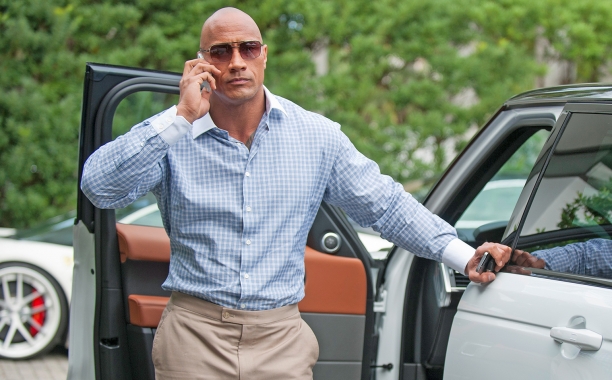
Duane Johnson stars as a former football player whose career was suddenly ended before he could realize it, and he’s trying to recover and find direction in retirement as a money manager of athletes who don’t have any idea how to handle their money. If there’s any chance of this show rising above the sports Entourage cliché, it’s on the back of the always charismatic Johnson, who you’d be hard pressed to find a bad word said about anywhere. The rest of the cast consists of another retired player with no plans, who gets a job as a car salesman, a quick-to-temper wide receiver Johnson is trying to help out, Johnson’s old agent and current friend, and Rob Corrdry as Johnson’s kind of asshole-ish co-worker.

Oh, and about the women problem. This was so expected, and while everything else is easy to mock from Entourage, this was probably the single most problematic aspect of the show, and Ballers doesn’t look like they’ve given this any thought. Ballers has one potentially strong women character, the retired football player-turned-car-dealer’s wife, who seems to have a pretty solid head on her shoulders and the actual respect of her husband. The woman who the Rock is sleeping with might be a PR person, or something, I’m unclear on that, but we saw her as much naked as non-naked in this episode. Otherwise, women of course are sex objects. It’s deeply disappointing that Ballers didn’t have a feel of the zeitgeist and try to remedy this problem. It’s a football show – no one is expecting there to be an equal amount of male and female characters, realistically. But, you know, they could try, a little.

Will I watch it again? No. I did watch all of Entourage, and for all I generally agree with the criticisms of the show, I’m not sorry I did. This does make me wonder if I would though if I started the show today.

Summer 2015 Review: Humans

19 Jun

Humans

Humans feels in essence like a series-long extension of an episode Black Mirror (not a particular episode, just a could-be episode). This is certainly largely because it’s broadly both British and science fiction but also on a finer level. Like most episodes of Black Mirror, it’s set in the near-future where the world, sans a couple of technological changes, is largely recognizable and because it clearly wants to wrestle with ideas about traditional big science fiction themes, in this case, what it means to be human, and what it means to have a consciousness.

Humans is, ironically enough, about robots. Synths, as their called in this universe, are humanoid looking robots, designed to be hyper-intelligent helpers to humans, doing the laundry, driving their cars, going out for groceries, and nannying their children, picking their fruit. They do them all without feeling, so they don’t mind doing whatever you tell them to do at all times. That is, except for a rogue strain of synths that somehow, unbeknownst to all but a few, somehow gained consciousness and have feelings and self-awareness.

There are a few primary plot strains in the first episode. There’s a typical suburban nuclear family. The father is exhausted from having to take care of the kids while the mother is constantly traveling for her job, so he purchases a synth, which happens to be one of the few with consciousness. An older man refuses to upgrade his synth; his old model, which he painstakingly tries to fix, has some important memories he is trying to maintain. A man runs with a rogue band of conscious synths who are being chased; they’re caught, and the synths are hauled off and strewn about. The man who chased down those synths wants them examined, and is concerned that consciousness in machines could lead to a singularity – a time when machines have no need for humans.

The acting is fine, and the writing is not particularly noteworthy or deficient. The humans don’t seem particularly compelling right off. The weight of the episode is in the portrayal of the synths and the high concept of the big science fiction ideas generally. If you like Humans, you’re going to like it because you find the premise fascinating, not because of the first episode’s characters or story. Because of this, the pilot really has to sell the premise, and by the end it’s intriguing enough to make a credible case to convince viewers to comeback for another episode, but not so much show to give viewers any confidence they’ll be sticking around all season.

The beauty of Black Mirror is the anthology style which gets in and gets out over the course of an hour, a short enough time to keep high concepts from wearing out. I skeptically wonder how the concept at the center of Humans will play over a longer period of time. There are obviously ample issues to grapple with, but there are also easy ways to drag out the same issues over a far longer number of episodes than is necessary.  Whether Humans can deepen its themes to survive the long haul will likely determine its ultimate success.

Will I watch it again? I think I will, because it’s been a pretty slow summer, and I’m kind of chomping at the bit for a new summer show to really get into, but I might not had this aired in the much busier spring. It was a somewhat entertaining plot, but it wasn’t amazing and I’m definitely concerned where it will go and how long it can last.

Summer 2015 Review: The Whispers

3 Jun

The Whispers

I didn’t know much about what type of show The Whispers was coming in, but what little I thought I knew was wrong, as was what I thought after the first ten minutes of the show. I was pretty sure The Whispers prominently featured the supernatural. Before watching, based on the commercials, I thought it was horror-based show, where fear, rather than mystery, was the enduring proposition. In the first ten minutes, I thought The Whispers was an X-Files/Fringe-like procedurally based supernatural show, with a gradual serial element they would slowly build up, while the show initially started smaller and more contained. When it came down to it though, The Whispers is yet another massive serial supernatural show bound to ask far more questions than it ever provides satisfying answers.

The Whispers stars Lily Rabe as an FBI agent who specializes in children’s cases. She’s an agent with a past, like any network police Character. She, until the events of The Whispers, was on leave for three months, mourning the recent death of her husband. Rumors spread throughout the department about her not because of that, but because of her reputed affair with a higher up in her department which preceded her husband’s untimely death in a plane crash. She investigates a case we see at the start of the episode. A little girl’s imaginary friend, Drill, convinces her to weaken a spot on the floor of her tree house and then convince her mom step on it, causing her to fall through to the ground and nearly die. Rabe, talking to the girl, thinks something’s up, and that the girl is not merely nuts, but her new partner, who clearly doesn’t trust her, is not buying her theory. She finds another similar instance in the database, where a boy, convinced by an imaginary friend, tried to blow up his mother, killing himself, and permanently scarring her. When the mother, now convalescing in an asylum, named her son’s imaginary friend as Drill, even Rabe’s killjoy of a partner was forced to admit she was onto something.

Kristen Connolly portrays a mother of a young girl who seems to meet this mysterious Drill early in the episode, and he has her playing his game which we know will likely lead to hers or her mother’s untimely death. Drill talks the daughter into cracking into Connolly’s husband’s secret government compute r files. Connolly’s husband, who was unfaithful, leading to a rift in the marriage that they seem to be trying to repair, is a top government agent of some sort, off in Africa on a mission. There he finds the ruins of a plane which was supposed to have been lost in the Arctic. The plane is in something called petrified lightning, the occurrence of which, in such quantity and formation, suggests something distinctly alien.

Milo Ventimiglia plays a strange hirsute man who faints and wakes up in a military hospital, where he speaks Arabic while unconscious, issuing an ominous warning, and doesn’t seem to remember his own name.

Everything comes together when it turns out that Lily Rabe was cheating with Connolly’s husband, and Rabe’s husband, presumed dead, was Ventimiglia, the pilot of the plane whose ruins were found in the African desert. And the end of the episode, Rabe’s son, who was rendered deaf a couple of years back, is agreeing to make a deal with the mysterious unseen Drill.

So, yeah. Mysterious, supernatural, aliens. There are bigger forces at work, conspiracies that go all the way to the top. You know the drill (no pun intended if you still remember that Drill is the name of the imaginary friend). The thing about these network supernatural serial shows (and I really need to come up with a helpful nickname for this genre) is that they tend, obviously not equally, but as a generally rule, not to worry about other elements of the show beyond the mystery; they’re plot heavy, and they load up on plot to try to hook you because you want to learn more, to find the answers to the questions asked in the premiere. They’re not particularly focused on characters; none of the characters in The Whispers seem particularly interesting. They’re not focused on cinematography or dialogue; in general the scene-by-scene care and cinematography tends to be the most obvious separator between most network shows and most premium cable shows. The acting is competent; there’s no problem there in The Whispers, though some of these shows have major acting problems. So, yeah, you better want to know more about these aliens, but there’s just not really much else to recommend it.

Will I watch again? No. I made a resolution to show extreme reluctance before getting swept up in network serial supernatural shows that are almost guaranteed to disappoint, and The Whispers isn’t close to the most intriguing of the serial supernatural shows I’ve passed up a second episode of in the past couple of years.


Summer 2015 Review: Aquarius

29 May

Aquarius

There isn’t a ton to say about Aquarius. It’s not particularly good, but it’s not really particularly bad either. It’s not even remarkably unmemorable, it’s just unmemorable enough. You’re probably not going to watch it, there’s no reason you should watch it, and you’ll probably forget about its existence within about five minutes of reading this if not sooner. I’ll get into the meat of the show for those would like to know what it’s about in a minute, but first I’ll quickly lay out the most (and by most I mean still not particularly) noteworthy facts about the show in a couple of sentences for those of you who wants to stop reading right there.

Aquarius takes place in the ‘60s, specifically in the late ‘60s when hippies and the summer of love and drugs and rock and roll music are a big deal, and it takes place in Southern California. David Duchovny stars as a cop. Famed multi-murderer Charlie Manson appears as the primary antagonist. The vast majority of spent on the Aquarius budget was clearly sent on music licensing, as “I Can See For Miles” by The Who, “Paint in Black” by The Rolling Stones, and “White Rabbit” by Jefferson Airplane all play in the first episode. And, lastly, NBC put the show online all at once, like Netflix, while airing it week to week, the first time it, or as far as I know any other broadcast network, has done that.

Okay, those are pretty much the only potentially interesting facts about Aquarius. Here’s the rest. A teen girl, always a bit of a troublemaker, goes missing, and her parents ask Duchovny to help look for her. Because the father is an enterprising local politician, he asks Duchovny to keep the investigation off the record, and the police department, who could benefit from influence with this pol, goes along with it. Duchovny partners with a young cop who is too cool for school, constantly rubbing other people in the department the wrong way with his sideburns and long hair. Duchovny though believes he’s just the man to go undercover with the hippie types who may know what happened to the girl. Duchovny isn’t above bending a few rules along the way and ignoring due process, and eventually him and his partner find out that the girl went off on her own accord with Manson and his crew, which operate something between a commune and a cult.

They also figure out that Manson holds a grudge against the girl’s father due to early events and is using her as leverage to get back at him. That’s more or less all you get in the first episode. It’s not really such a bad show, there’s nothing embarrassing or laughable outside of the well overplayed cop-who-is-willing-to-break-the-rules trope. It’s just a nothing show. You will not be offended if you watch it, but considering it prominently features Charles Manson as a character it’s surprisingly forgettable.

Will I watch it again? No.  Why?

Summer 2015 Review: Grace and Frankie

25 May

Grace and Frankie

Grace & Frankie is a weird somewhat tonally dissonant half hour show from Netflix starring two legendary actresses in their 70s (and co-starring two legendary actors of the same age) from one of the creators of Friends.  The premise isn’t exactly unique (TV Land mined a very similar premise for Happily Divorced a couple of years back) but it is potentially fruitful and bold in its starring choices of women of retirement age. Unfortunately, it’s not quite compelling enough to be worth following.

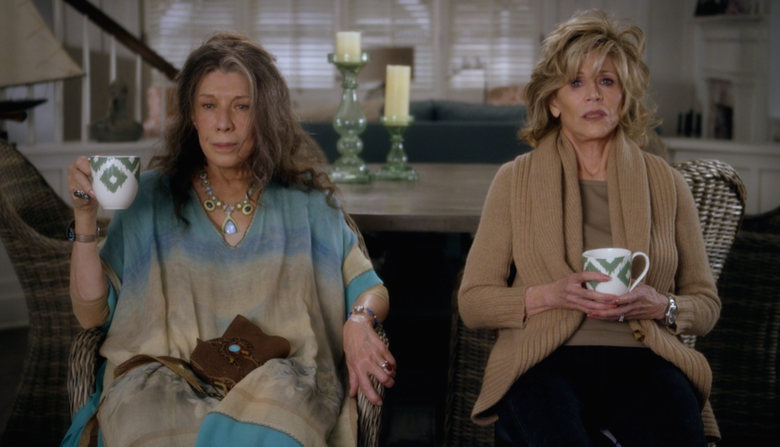
Grace (Jane Fonda) is a somewhat uptight and prideful WASP type, who wants to grow old with dignity. She never had a passionate dynamite love affair with her husband, Robert (Martin Sheen), but she liked and respected him, and when she grew up that was more than enough; she liked their life and their children and wanted it to stay that way. Frankie (Lily Tomlin) is a hippie-ish wild child who did have that smoldering relationship with her husband Saul (Sam Waterston), the love of her life. Grace and Frankie have opposite personalities and naturally do not care for one another. Their husbands however are business partners and great friends. Grace and Frankie’s lives are turned upside down when it turns out that their husbands are also long-time lovers and are only now finally coming out to their wives because they want to get married. Grace is pissed, Frankie is heartbroken, and both are crushed. They both, after meeting and receiving sympathy from their respective children, exile themselves to the beach house the two couples share, which had been pitched to them as a financially prudent proposition, but of course was really a convenient love nest for the two husbands.

The series is billed as a comedy, but it’s not very funny. I don’t simply mean it’s supposed to be funny and fails, like Two and a Half Men, although it sometimes tries to be funny and fails. But it’s really much more poignant and melancholy than most traditional half hours; certainly from the get go. That makes a lot of sense when considering how depressing the situation is outside of the high premise. These two women have had their entire lives uprooted when they’re in their 70s and don’t have a lot of time to start over. Their husbands carried on their affair for years, and they desperately want their coming out to be a triumphant celebration of courageous love, but their decision to string along their wives for decades leaves Grace and Frankie holding the bag, alone, in their twilight years.

Grace and Frankie is, at the same time, loaded with very silly, obvious broad comedy which plays on the contrasting Odd Couple-relationship between Grace and Frankie, and which provides a strange contrast to the serious emotion at stake. The climactic scene of the pilot involves Frankie doing peyote to find some peace, while Grace accidentally has some as well, and they have a classic broad comedy drug scene, being outrageously silly while also somehow bonding.

Of the two modes of Grace and Frankie, the poignant emotional side works better; the actresses really are legendary for a reason, and it’s an unusual situation portrayed, especially in that older women are rarely portrayed as protagonists on television. As a comedy, it’s less successful. It’s really not funny and the jokes just don’t come through. I get the idea; dignified elderly ladies doing very stupid things maybe are supposed to be funny, but it isn’t.

Ultimately, Grace and Frankie is an interesting idea, but really not enough to make you come back to watch week after week (or binge, half hour after half hour, as Netflix goes).

Will I watch it again? No. It’s an interesting exercise, not without any merit, and it’s great to see people in their 70s, and women in particular, getting a chance to star. Still, there’s not enough there to be worth watching.