Archive | Summer 2013 TV Season RSS feed for this section

Summer 2013 Review: The Bridge

12 Jul

They're on THE BRIDGE

A body is found on a bridge which connects America and Mexico across the Rio Grande, between Juarez and El Paso.  A determined local young female American detective who presumably has a form of mild autism – probably Asburgers or I’m not sure if it’s just autism spectrum disorder now – (Diane Kruger, of Inglorious Bastards) is determined to make the case her own.  She works by the book, and due to her disorder, often rubs people the wrong way with a lack of empathy and social norms. She’s guided by her mentor, the only figure in the police station who seemingly she respects or respects her, Lieutenant Hank Wade, who oozes old-school Texas charm (Ted Levine, who has come a long way from Buffalo Bill in Silence of the Lambs) and who appears to be somewhere between Fred Thompson in Law & Order and Tommy Lee Jones in No Country for Old Men.

Wade agrees to try to hold off the feds and other cops from her case, but she’s forced to work with a Mexican detective, Marco Ruiz (Academy Award nominee Demián Bichir), who, after turning the case over to her initially, shows renewed interest when it turns out one of the bodies was a young woman whose other remains (only the legs were found on the bridge) were found near his home.

They start investigating as a duo.  She’s the more classic single-minded cop, focused on doing things immediately, correctly, and following procedure – she wants to report the Ruiz for allowing an ambulance through part of the crime scene on the bridge where the bodies were found even though the man in the ambulance likely would have died if he hadn’t (he dies anyway, but that’s not the point).  He’s more laid back, but interested, an honest detective who from a city where everyone is corrupt either because they want in, or because everyone else is already doing it, so what’s the point in even bothering.  She constantly lambastes him for the shoddy procedure he and the entire Mexican law enforcement division shows, not understanding the challenges he faces and that he has to carefully save up his reserves of actually giving a shit for when it can do something.

Juarez is famous for both its overall murder rate, its drug violence, and its mysterious and prolific murders of women, largely young women who work in the factories and manufacturing centers that have come to dominate Juarez’s landscape (If you’re really interested, I recommend Roberto Belano’s excellent but crazy long novel 8666 about a fictional Juarez equivalent).

This presents an interesting angle to work with above and beyond the simple solving of a murder, such as the  cooperation and divide between Mexico and America, trying to find justice navigating the famously corrupt and troubled Juarez government.  The border is a contentious area, and it’s certainly remarkable the difference that the border makes; El Paso is extremely safe, while Juarez is crazily dangerous and Mexican authorities have struggled to get any handle on the crime problems, trying to figure out to supply effective law enforcement without being paid off or intimidated by the cartels.  Now, it was entirely unnecessary and weirdly on the nose then for a recorded message from the presumed killer to spell this out blatantly, telling our detectives that El Paso’s a pretty safe place, while Juarez is crazy dangerous, and hell, that ain’t fair, so he’s going to be terrorizing El Paso for a while.

There’s two other strands to the plot, outside of the primary buddy cop duo.  First, the man who was in the ambulance crossing the bridge at the beginning ends up dying at the hospital anyway.  His widow starts to find out some shady parts of his life she didn’t know about, leading to a scene at the end of the first episode when she opens the barn door that will seemingly lead to some sort of unsavory surprise.

Secondly, there’s an American in a trailer in the desert who has kidnapped a young girl from Mexico.  We don’t know if he’s related to the main murders or not, but he seems at the least like he’s up to no good, and one presumes he’ll be connected in to the main plot somehow or another if not as simply the killer.

The first episode of The Bridge was above average, but not great.  The police scenes seemed to only be a couple steps ahead of the standard police tropes, and sometimes got lazy and fell back into them for a minute or two.  At its less tropy, The Bridge felt dark but more importantly grittily real, highlighting the fascinating setting of the border through location shots not only of the border but of the police stations and deserts that suggested the surroundings.  At its lesser moments, the three most prominent cop characters settled into established roles, and Diane Kruger’s character in particular recalled, and not in a good way (I don’t think there is a good way), the main character from The Killing.

It’s a cop show.  That doesn’t mean it’s just a cop show, but when you choose to make a cop show, you’re going up in a sense against every cop show that’s ever been on TV.  It’s hard to be new.  When I see a crusty old sheriff, while I should be focusing on just this particular sheriff, my brain rushes to compare him to every similar sheriff character I know, and that makes it harder for any one cop show to separate itself.

There were glimpses of separation, of becoming more than a cop show set on the border, which is the bare minimum I like to see from a pilot that I’m going to consider continuing to watch, but I hope that this is a launching point rather than an exact model.

Will I watch it again?  Yeah, I’ll give it another shot.  The show is only outrunning tropes by a couple seconds at this point, but that’s enough to give it an effort to separate itself.  I’m wary, but there were enough good parts that I’ll hope for the best.
End of Season Report – Hannibal, Season 1

5 Jul

Listen to the music Marge! He's evil!

Right from the beginning, I described Hannibal as dark.  It’s dark in its plot and it’s sensibility but also simply in its look; lots of shadow and lots and lots of blood and guts.  This isn’t your grandmother’s show about serial killers.  There’s some gimmickry, but none of the flash and glamour that surround solving crimes on the big crime procedurals.  No, the crimes committed by the serial killers in Hannibal are disgusting and horrific and there’s no getting away from that.  So much so that main character Will Graham is constantly haunted by the crimes, as he gets way too close in his mental exercises to find the killers.    Sometimes it was even to dark for NBC.  There was an episode where a woman kidnapped kids and convinced them to kill their families, which was yanked from the schedule in the wake of, I’m not sure, just because, well, it’s shocking that this is even on NBC to begin with.

Point being, I knew the show was dark.  But the ending of the season even outdid my reasonably dark expectations.  How many first seasons end with their protagonist in an insane asylum?  One for the criminally insane, I might add; this is a special loony bin for the most depraved.  Yes, that’s what happens.  Cannibal and psychopath Hannibal Lecter, who at this point in our story is a revered psychoanalyst assisting the FBI, frames agent Will Graham, who also happens to have a very serious neurological condition called encephalitis which basically interferes with his very ability to deal with reality.  Just about every character thinks by the end of the season that Will Graham is responsible for a slew of murders including one of the girl who was the daughter of a serial killer and whom he has been mentoring for the entire season.

Of course, this is every so slightly lightened by the fact we know eventually Hannibal Lecter is going to wind up in that loony bin himself, with Graham on the outside, assuming creator Bryon Fuller doesn’t totally decide to throw the source material into the garbage can.  Plus, there’s only so much Graham can do from inside the mental asylum.  You’d have to think merely for plot purposes he’d get out sooner or later.  Still, this is a pretty rough stretch for Graham.  How he worms his way out of this, picks up on Lecter’s guilt, and convinces anyone else should be an interesting journey for the next season.

I complimented Bryon Fuller on this early on in the season but again I think plaudits are in order for his ability to take source material we know and make it fresh again. This is doubly so because it revolves around the tension of a free Hannibal, who we all know is a killer, screwing up the FBI and our protagonist even while we want to shout out, come on, he’s evil, have you guys never seen Silence of the Lambs?.

This is a serial show that would normally be a procedural.  I could imagine this show produced by Jerry Bruckheimer and it would be an extremely different show.  Watching the first few episodes, I kept expecting it to break out in a full procedural with a new killer every episode and little hints and bits of continued serial plot just to keep us interested in not missing an episode.  But that’s not what happened at all.  Instead it played by its own schedule, weaving seamlessly between new killers and the existing long term serial plots.  The one continued strain was the general unraveling of Will Graham’s mental state.  A slower episode would be followed with a faster episode, an high action episode with an more patient psychological pot boiler.

This show isn’t covering new territory.  We see the FBI and police catching murderers all over TV.  Will is a savant, a character, we see in different forms throughout TV and movies as well.  What we don’t see as often is the downside to savant-dom.  Usually the heroes of killer-catching movies and TV shows are one sided; they may have tragic pasts but they rarely have tragic presents.  With Will, there’s a cost of doing what he’s the best at.  Watching Will slip slowly deeper into the bounds of mental instability is both difficult to watch and captivating at the same time and is what makes Will a  much more interesting character than most versions of this stock model.

It’s gorgeous, it’s dark and it’s compelling.  If you don’t like excessive gore, it’s not for you, but otherwise it is.  It’s not a brilliant revelatory show like Mad Men or Breaking Bad, but there isn’t any other show on TV quite like it.

Summer 2013 Review: Under the Dome

3 Jul

Dome-tastic

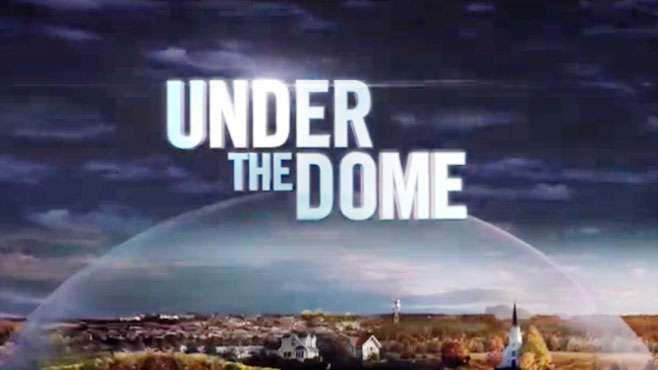
Under the Dome is an extremely literal title.  The main characters, primarily the residents of the small (presumably New England, since it’s written by Stephen King, but not specified that I can recall) town Chester’s Mill, along with some people who were passing through, are completely trapped from the outside world under a giant mysterious dome.  So far, we know nothing can go through the dome, including sound, and citizens haven’t yet found a way to contact anyone outside the dome.  The only method of communication is through sight on either side of the dome.

So that’s our big premise, taken from a recent Stephen King novel of the same name.  That’s by far the most important part of the first episode.  The second task of the pilot is to get a passing look at who we can guess will be our major characters.  Here they are in short.  First, you’ve got chief of police veteran Duke (Jeff Fahey, pilot Lapidus on Lost), and his younger chief deputy Linda, engaged to a firefighter outside of the dome.  Due to poor timing, many of the town’s police were out of town participating in a parade.  There’s “Big Jim” Rennie, car salesman and town council member (played by Dean Norris, Hank from Breaking Bad).  Big Jim and Duke have a tet a tet most of the way through the episode and appear to be keeping some sort of secret from most of the town involving bringing in lots of propane.

There’s a pair of erstwhile summer lovers, teenagers Junior and Angie.  What was a fun little fling goes bad when Angie doesn’t reciprocate Junior’s love, and Junior turns out to be some sort of psycho and kidnaps Angie and locks her away in a fallout shelter.  Joe, a high schooler, is Angie’s younger brother.  They’re both parentless for the duration of the dome.

There’s a Barbie, an ex-military out of towner who was looking shady at the beginning and could be either good or bad.  He appears to have been on some sort of mission that involved needing a gun and looks a little like Jeremy Renner.  He’s staying with local journalist Julia for the time being whose husband is missing and/or dead and/or having an affair.

Phil is a local radio DJ, and Dodee is his engineer at the station.  Alice and Carolyn are parents just passing through en route to drop off their troubled, rebellious daughter Mackenzie at camp, before they get trapped (if only they hadn’t stopped at that one gas station).

Those are from what I could suss out the major characters, though there may be more introduced later, and some of the characters I described may turn out to be more minor than I could have figured from the premiere.

There are two major fronts then to work with in Under the Dome.  There’s the question behind what the dome actually it is, how the characters find that out, if they can communicate outside the dome, get anything in, etc.

Then, what will probably occupy more time, is how everybody deals with the situation that arises when the characters realize they’re cut off from the rest of the world.  Separating all the characters from the rest of society under the dome should give us a set up for the classic science fiction situation of an external futuristic (or supernatural) power forcing humans into difficult and unusual situations.  They’ll have to decide whether to work together or compete and act outside of the ways they do every day, revealing their true natures. Do people look out for each other and help to store food for the good of the whole town?  Do they form gangs and compete and engage in violence?   It’s a classic Lord of the Flies scenario, and the dome is their island.

As I’ve said time and again, I’m a sucker for high concept serial science fiction shows.  I know by now better than to get too excited from a mere one or two episodes of a series.  Big sci-fi series like these so often disappoint, and they’re a thousand times easier to begin than to end (or to, well, middle, for that matter).  It’s not particularly difficult to think of a wacky situation and create a cast of characters; it’s much harder to flesh out those characters with realistic and believable motivations and create a plot that obeys the rules set out by the show, and is compelling, well-paced, and not anti-climactic.

This has the building blocks.  The reason it’s intriguing is solely the future possibilities but it’s hard to ask for too much more out of a first episode.  There’s nothing about the writing or the characters or the film work that stands out, but I’m affirmatively intrigued due largely to the plot, and with pilots, if the plot is compelling enough that can be enough, especially for sci-fi or fantasy.

Will I watch the next episode?  Yes.  It’s on CBS.  I can’t remember the last show I’ve watched a second episode of on CBS.  I’ve repeatedly faced let downs with these types of shows; I watched multiple episodes of Revolution which I regretted quickly, as well as Terra Nova.  I’m probably never going to learn completely.  All I can do is know my own biases and prepare myself for the likely disappointment.  In its favor, this at least this has some source material by a credible writer to work with, and is created by Brian K. Vaughan, a comic writer whose work I’ve enjoyed.

Summer 2013 Review: Ray Donovan

1 Jul

Liev Schreiber is RAY DONOVAN

After an opening which shows Jon Voight getting out from prison, Ray Donovan begins like a USA program; I could even imagine the narrator explaining the premise, with something like this.  “Ray Donovan, LA’s fixer to the stars, is the best at what he does.  The rich and famous have problems, and he, along with his super team, including the accent-challenged Avi and the spunky lesbian Lena, fix them.”  We quickly see just how effective they are when they solve two problems with one stone, getting a sports star who woke up next to a women who ODed overnight out of his situation by swapping in an actor who was dealing with accusations of having picked up a transvestite hooker.  See, for actors, being found next to a dead woman ain’t no thing.  Hollywood!

We also see that Ray is a bit of a rebel.  He doesn’t play by the rules, and that sometimes gets him in trouble with his team, and his boss, who is played by the always wonderfully sniveling Peter Jacobson.  Supposed to spy on a woman for a scummy rich dude, he instead warns the woman, who he happens to know from an earlier encounter, of a stalker.  He then proceeds to make out with her.  He’s not afraid to get his hands dirty either, threatening the stalker, covering the stalker in green die, and then beating him with a baseball bat when his earlier threats don’t succeed.

Ray is a very serious character who comes from a very fucked up Boston Irish-Catholic family (if you can’t recognize the Boston accent from real life, you should recognize it from Ben Affleck movies over the years).  His dysfunctional family includes his two brothers, one of whom was molested by a priest as a child and is now an alcoholic, and the other who developed Parkinson’s from one too many shots to the head during a boxing career.  His sister jumped off a building years ago while drugged up.  And his dad, whom he hates most of all, just got out of prison after 20 years and is coming to find him and his wife and kids, whom are the last people Ray wants his dad spending time with.

So those seem to be the two main threads of the series, his job and his family, all shaken up now by the reappearance of his hated dad after many years.  Ray’s got to balance his job, doing terrible things for rich people, with his inner sense of right and wrong, and he has to be the rock in his otherwise fucked up family, keeping together his troubled brothers while fending off his father.  I half expected the narrator to announce during a credit sequence, “This is the story of a family from Boston living in LA, and the one son who had no choice but to keep them all together.”

Ray’s got to do it all, and you can probably understand why he doesn’t crack a smile during the episode, or, really, say more than maybe 50 words.  His silence and straight face imbue him with some combination of mystery, intimidation, and sex appeal, to the different characters in the show.

Ray Donovan was not a bad show, but it was a surprisingly generic show.  Rather than seem inherently different and new, it seemed like it was trying to take some of the same themes that show up all the time on broadcast and the “light cable” (TNT and USA) networks and give them some serious edginess so that you know it’s premium cable.  Ray gets drunk.  Ray considers screwing a post-adolescent pop star who adores him.  Ray beats up a man with a baseball bat.  Unlike in an USA show as well, Ray’s job involves not infrequently doing what all involved admit are terrible things.  These facets made the show darker and give it a wider swath of possibilities for future development; shows on Showtime are allowed to have more complicated, serial plots, that USA shows can’t or won’t. However, nothing in this first episode takes advantage of those possibilities.  It seems more like a matter of degree than a fundamental difference from that classic USA or TNT format.

Ray’s got demons, and he’s going to have to face these demons.  He’s great at a really cool but risky job.  I can see the avenues worth exploring,   The tensions between his old family and his new.  The moral difficulties of committing terrible acts as part of a living because that’s his job. There’s clearly a mystery to his past, and to what he did to ensure his father stayed in prison and why.

I liked the family plot better than the work plot from the first episode, but still it hewed a little too close to cliché.  These clichés can be broken with the detail and depth that hours and hours of a television series can offer, which is one major advantages over film.  Still, I wish the pilot had delved deeper into one area of Ray Donovan’s life to try to really heighten the appeal and show off a little early complexity rather than throw the kitchen sink of potential plots (his family, his brothers, his work, his mentor) but attack them all on a surface level just as a preview of all the characters you’ll be seeing this season.  There was no semblance of focus.

The genericism of the story lines isn’t necessarily something that can’t be transcended through further episodes.  In the first few episodes, Justified looked like a simple procedural with a cop who didn’t play by the rules before it grew into something excellent.  I enjoyed the first season of Hannibal, which hardly breaks new ground, greatly.  Still, it’s hard to make this type of show work without a charismatic lead.  What everyone in the show saw as mysterious or silently uber-competent, I saw as stiff and uninterested.

There was enough that I was on the fence.  All I wanted was a five minute sequence in the episode that convinced me, damn, this is a show that is required viewing, a moving moment, a stirring speech, and a stunningly filmed confrontation, and then I could figure out exactly what’s good about it later.  I didn’t get that.

Will I watch it again?  Honestly, from this episode, probably not.  If it picks up buzz and I start hearing that it gets good, I’m perfectly willing to give it a second chance, and I do think there’s a non-negligible chance that I’ll have given it a couple more episodes before the end of the season.  My expectations are always ramped up a little bit for premium cable shows and I was kind of let down, less by the show being bad, and more by the protagonist not seeming particularly compelling, and the show not offering me at least a little something new or different or exciting me in any particular way.

Summer 2013 Review: Motive

14 Jun

It's all in the eyes.  Or something.

Of all the generic police procedurals in the world, Motive may be the most generic yet.  Motive debuted recently on ABC, but it aired in its native Canada earlier in 2013.  Its one hook which is theoretically supposed to separate it from the glut of police procedurals on television is encapsulated in its title.  Like in Law & Order: Criminal Intent, the viewer learns the killer right at the start of the episode.  In fact, to make these easier for the visual learners amongst us, some nifty writing appears on screen labeling “The Killer” and “The Victim” and lingers on the screen for a moment so that we don’t miss it.  What kind of suspense is there then, if we already know the heart of any mystery, the whodunit? Ah!  It lies in, if you haven’t been able to figure it out yet, the motive!  As the police slowly piece together the crime and identify the culprit, the last piece of information to expose itself is the reason for the crime.

The crime itself in the pilot is painfully uninteresting, as if the eventual motive, which is anticlimactic at best.  The least you can expect from a procedural are some decent murder stories, especially in the pilot, which is your first and biggest showcase to the world. A teen outcast kills a popular teacher.  There are some red herrings; the police briefly believe the wife did it, because she was sleeping around, and that the kid’s friend did, but these diversions lack suspense entirely because we know who did it, and because it’s a police procedural, so we know there’s no chance they’re going to end up accusing the wrong person.  It turns out he did it because he had some weed and a notebook with lots of outcast-y thoughts, like wanting to hurt other students and such, and the teacher found it.  The kid snuck into the teacher’s house to grab it back, but when the teacher caught him and was about to call the police, the kid hit him over the head with a trophy.  It really was one of the more boring TV murders I’ve seen recently.

As per police procedural standards, our lead detective, played by former Zeljko Ivanek nominee and canuck Kristin Lehman, is smarter than the average cop. She has a number of gut instincts which end up all being correct, even when her partner points out that the evidence leads in a different direction.  She continues to sniff out incorrect leads and misdirection.  There’s lots of witty banter between her, her partner, and the new guy, whose taking notes on her behavior. Both her and her partner give the new guy tasks and advice.  There are also bizarre sections of the episode showing her cool mom relationship with her teenage son, as she watches him win a car race.  I have absolutely no idea how these fit into the scope of the show or why these sections are here, but you get to him and his girlfriend and his mom let him drive her car.

To say that it’s bad really misses the point.  It’s not good, but it’s taken genenicism (not a word, I know) to a new level.  It’s mind-blowingly bland.  You wouldn’t cringe after watching it.  You would just not realize you were watching anything.

Before I go, I should note that former New Kid on the Block Joey McIntyre plays the deceased high school teacher.  Also, former Jim Carey wife Lauren Holly plays the coroner and the actor who portrayed 24 agent Curtis Manning, Roger Cross, plays a cop.

Will I watch it again?  No.  Or, if I have nothing else to do for years, and I run out of every Law & Order, CSI, NCIS, and Criminal Minds, and am looking for more.  All this says to me is that there’s a lot of space to fill on television and the easiest way to do it is with police procedurals.

Summer 2013 Review: Mistresses

7 Jun

The four mistressesMy first impression of the show was, wow, there’s trashy, and then there’s Mistresses.  Within thirty seconds in the show’s first episode, three of the four primary female characters are having sex (obviously there’s no nudity; this is a network show).  The credit sequence which appeared shortly after revealed that Mistresses was adapted from a foreign series, and I immediately assumed it was adapted from a British series, because this species of trash reeks of the United Kingdom, and I was correct.  I’ve never actually watched any of those trashy British soaps (Footballers’ Wives comes to mind, but I’m sure there’s tons more) but this seems like an Americanized version of what I think those shows are like.  You can tell it’s attempting to be provocative by the very name Mistresses, implying our main characters will be occupying the socially taboo position of sleeping with married gentlemen.

However, it’s not really as provocative as it seems to want you to think it is.  That opening scene is pretty much the last sex you get in the entire episode, as it gets all drama-y and soap-y.  Four women, in different stages of relationships, are all dealing with men, or the lack there of, and life in general.  Alyssa Milano’s Savannah is a high-powered lawyer who is having serious problems with her chef husband due to their inability to conceive, particularly when it turns out that it’s because of him rather than her.  Her younger free-spirited sister, the only actual mistress in the series’ present time, is a real estate agent sleeping around with her boss.  She faces a dilemma when the boss/lover offers to buy her a house when her lease is up.  Karen (Lost’s Yunjin Kim) is a psychologist, who spent a time as a mistress when she recently had a tempestuous affair with a patient who was dying.  At the funeral, which occurs soon after the opening credits, the dead man’s son comes to her and tells her that he suspects his dad was having an affair.  Oops.  The fourth character is April, a single mom who is still dealing with the death of her husband three years ago and is having difficulty trying to return to the dating world.  She’s taken aback at the end of the episode, when another woman brings to her door a young child which the woman claims is April’s ex-husband’s.

Like so many female-centered shows in the past decade, it’s definitely a show consciously taking place in the post-Sex and the City world, where four women support each other, work hard towards career goals, and gossip openly and proudly about each other’s sex lives.  It’s certainly trashier than the Sex and the City, but, as mentioned above, the first three minutes of the show offer a misleadingly trashy view of what’s to be expected.  Instead, it’s a soupy personal drama about the four women and it’s not particularly interesting.  There are light moments but there really isn’t any humor, or attempts at humor. It’s just a soap, and without any interesting hook or fun conspiracies to keep the plot humming along like Revenge.  It’s just women doing jobs and getting into relationship problems, and life. It’s hardly awful; it’s just incredible mundane.  There’s absolutely nothing that pulls you in and I’ll be surprised if I can remember anything other than that Alyssa Milano and Sun from Lost starred in it in six months.  It’s not that stories about people can’t be good in and of itself, or that soaps can’t be, but you need excellent writing, or humor, or a really enjoyable sense of fun, none of which Mistresses have.

Will I watch it again? No.  I knew more or less right away that there was no chance of me watching another episode, and nothing in the remainder of the episode changed that initial reaction.  I do think doubling down on maximum trashiness would have been preferable to just generic drama.

Summer 2013 Review: The Goodwin Games

31 May

Goodwin Games The Goodwin Games, which is being released at a time of year which virtually ensures the show will be cancelled shortly, is a Fox series from How I Met Your Mother creators Craig Thomas and Carter Bays.  How I Met Your Mother relies on a storytelling gimmick, but a gimmick that, while dictating the way the story is told, doesn’t necessarily materially affect every episode.  The Goodwin Games’s gimmick is far more high concept and integral to the show.  The Goodwin patriarch, Benjamin (played by Beau Bridges) whose death leads to the events of the show, was an eccentric single parent who alienated his children over time through his strange parenting style.  He attempts to make up for his failings in life after his death through an extensive series of video tapes which catalog what amounts to a kind of hyper-complicated scavenger hunt for his fortune, which unbeknownst to his kids, is over $20 million.

The kids are three.  First, Scott Foley plays go-getter Henry who is a very busy surgeon who makes time to give back to the community and has a fiancé.  He’s brash, arrogant, patronizing and kind of a dick, but very successful, and his biggest crime seems to have been leaving a long-term girlfriend that his siblings loved from his hometown.  Middle child Chloe is a popular girl in high school turned wanna-be actress played by Becki Newton who seems to be relatively care free and possibly their father’s favorite, as her knowledge of Morse code wins her prizes from him in the past and present.  TJ Miller plays the youngest, idiot screw up Jimmy, who means well but has been in and out of jail due to a compulsion for thievery.  He has a daughter whom he loves, and who loves him, and who he sneaks up into her to see behind her mom’s back.  They’re all called back to their quaint New Hampshire hometown for the funeral, and they are invited for a reading of their dad’s will, which is a video tape.  This video tape provides the rules for the titular games; the three of them, and a random dude, will compete in a game of Trivial Pursuit for his millions.  Unfortunately, this family has a reputation for not being able to finish a game of Trivial Pursuit without breaking out into a game-ending fight, and this ensues doubly when they discover the game is a special edition composed of questions about themselves.  When everyone except Chloe forfeits, the proper video of their dad says they’ve all lost, but after they decide to finish the game out for dad at the local watering hole, someone at the bar passes them a card that lets them know the game is not just over (that would have been a really short series otherwise).  Apparently half the people in this town are in on The Goodwin Games.  The three kids leave the pilot episode reinvigorated, ready to play their dad’s game, and find out the first requirement is that they all move home.

It’s hard to tell if this was simply in my head the whole time because I knew who the creators were, but similarities with How I Met Your Mother were abound.  The humor was wacky, the dialogue was crisp, and it was all told with an undercurrent of sentimentality which has always been my primary hang up with How I Met Your Mother (in the early seasons, when the show was funny).  I don’t think the pilot for The Goodwin Games was particularly funny, but I could imagine how it could be, and some lines hit, or at least make me slightly smile.  It will never exactly be my cup of tea, but there’s a level of craftsmanship there that I can recognize when How I Met Your Mother is working, and I can imagine The Goodwin Games having the same.  It’s not even there yet, but as I’ve said often, a lot of watching a comedy pilot is not judging what it is, since very few comedy pilots are very funny, but trying to judge what it has the potential to be.  That said, while I think this could be very decent, I think there’s also very low probability it could ever be great, and unlikely very good, though I suppose decent is still a pretty good get for a comedy these days.

Will I watch it again? No.  It’s probably going to be cancelled because of when it’s airing, but even beyond that, as much as I hate to hold old shows by the creators against a new one, it’s hard not to.  I have a like-hate relationship with How I Met Your Mother that’s veered towards hate over the years, and since I’m long done with that show, unless Goodwin Games really knocked it out of the park, it would have been pretty hard to get me on board.  It wasn’t bad, it was kind of cute, but my standard was higher for this one.

Summer 2013 Review: Family Tree

27 May

Family Tree

Family Tree is a new HBO show from Chris Guest, the man behind cult mockumentary style films Best in Show, A Mighty Wind, Waiting for Guffman, and For Your Consideration, as well as his most famous but most different from the others, This is Spinal Tap, which came several years before the rest.  Many directors and writers have recurring elements and favored actors and actresses, but Guest is much more consistent than most in both of these matters.  Basically all of his films, and this TV show, are satirical documentaries, with people talking to the camera, and a high rate of overall silliness and bizarre characters, just taking on different subjects – a reunion concert of folk bands, a film festival, and a dog show, for example.  In addition, he’s developed a full repository of actors who appear in all of his films; Michael McKean, Ed Begley Jr, Catherine O’Hara, John Michael Higgins, Fred Willard, and others.

Family Tree is also co-produced by the BBC so we know that Britain or British people will be involved somehow, and indeed England is where we begin.  The premise of Family Tree, advertisements and trailers have told me,  is that it’s about a young Englishman searching for and discovering his crazy family, full of Christopher Guest players, in Los Angeles.  However, I would never have known that from the first episode which doesn’t even get out of Britain.  Family Tree is the only show I can think of which doesn’t actually get up to its ostensible premise in the first episode.

What does happen is this.  Chris O’Dowd (Kristen Wiig’s love interest in Bridesmaids) plays a young man who has been kind of depressed of late, having lost his job and his girlfriend in the past few months. He and his sister meet his dad for dinner, where he finds an old photograph in a chest left by a deceased family member as part of a shabby inheritance.  He begins to investigate the photo, taking it to an old expert on these things who lets him know that the photo is not of his relative, but rather was taken by his relative.  That’s where we end up. Presumably that somehow leads to his eventual family history trip stateside as he continues to learn more information.

What this does contain is many classic Christopher Guest elements.  Every single character, with the exception of our straight man, played by O’Dowd, is extremely bizarre and quirky.  His sister is a ventriloquist who must carry around a monkey puppet at all times to ensure her continuing mental stability; we see a quick scene of her working at a bank with the monkey.  Their dad, portrayed by Michael McKean is a very strange dude who retired to begin his life’s work of creating a great invention.  All he has so far is a shoehorn attached to a fan which keeps your shoes cool on a hot day before you put them on.  The man to whom O’Down is directed to bring his photograph for research purposes is a very odd older gentleman with his own distinctive strange mannerisms, and he creates landmarks in a bottle, which he considers vastly superior and more interesting to ships in a bottle. O’Dowd watches ten seconds of a fake TV show Tudors rip-off, The Plantagenets.  Even the minor characters are a bit off.  O’Down is set up on a date with a seemingly nice girl who seems to believe the Loch Ness monster is real.

It wasn’t mostly laugh out loud funny, though there were a couple of solid moments, but I did enjoy the experience overall.  If you like Christopher Guest movies, you’ll probably like it, if you don’t, there’s a good chance you won’t.  Chris O’Dowd is an extremely likable straight man, and I think his presence may increase the chance of people liking the show who don’t like Christopher Guest movies, as those sometimes don’t even have any normal characters to center them.  It wasn’t quite as exciting as I was expecting right off the bat, but it’s a promising enough beginning.  It doesn’t promise at this juncture to be an overall classic but it seems like some solid programming.

Will I watch it again? Yes, but at least as much based on the track record of the people involved in the show than on the quality of the episode alone.  That’s not to say it was bad; rather it felt more incomplete than nearly any other show I can remember watching.  More than most pilots, this felt like the first half hour of a movie, or at least a miniseries, rather than a self-contained episode pitching a premise for an ongoing series.  I look forward to revisiting the whole when it’s all done and seeing how it stacks up.