Archive | Spring 2012 TV Season RSS feed for this section

Spring 2012 Review: NYC 22

20 Apr

The rookies in the 22

NYC 22 came in with one major factor going for it, and one major factor against it.  For it, is that it’s created by Richard Price, acclaimed crime novelist and writer on The Wire.  I read two of his novels, Clockers and Lush Life, and enjoyed both of them greatly, and working on The Wire, well that really goes without saying (He’s credited with the scripts for a couple of season 3 episodes, a couple of season 4s, and a season 5).  Against it, is the fact that, well, it’s on CBS.  CBS police procedurals are far from the worst shows on TV; there’s plenty of terrible CBS comedies to thank for that.  They’re generally watchable, but they’re hardly appointment viewing.  They’re more like second-tier hungover Sunday marathon viewing if Monk isn’t on any channel.  So the Richard Price who has written for  The Wire doesn’t seem exactly like an ideal fit for the short form of a CBS procedural.

And it’s not.  The show is a little bit clunky, and a little bit forced.  Still, the Price touch on the writing and storytelling does take it a step above a typical police procedural.  There’s plenty of cliche and standard police procedural rigmarole, but there’s less than in CSI or NCIS.  It’s not quite better enough to make it a really good show, sadly.  It feels boxed in; if the show could roam free to where it really wanted to go, there might really be something.

NYC 22 follows six NYPD rookies in the 22nd precinct up in Harlem.  The six rookies include – Jennifer Perry, a slim blonde who was an MP in Iraq, Kenny McLaren, a legacy cop who comes from generations of boys in blue, Ahmad Khan, a Afghani cop who migrated from the UK, Ray “Lazarus” Harper, a long-time beat reporter who decided to become a cop after being laid off, Tonya Sanchez, a Hispanic female cop whose family is composed of criminals, and Jayson “Jackpot” Terry an African-American who used to be a basketball hot shot before he blew out his knee.  The six, paired in twos, are mentored by Officer Daniel Deen, played by Oz’s Terry Kinner, who comes with the old wise man nickname of “Yoda.”  In just their first day on foot patrol, the officers have to deal with a variety of massive crises, learning on the job.

Lazarus and Sanchez are supposed to be watching a dead body to ensure no one interferes with it, but instead get held hostage by an irate ex-pharmaceutical employee who has been beating his wife since he got fired, and they have to talk him down.  The other four get caught up in a massive melee between teenage gangs, and have the temerity to not even radio in for help, slowing down the response of the rest of the police units.  At the end, classic, tough-guy-with-heart-of-gold Yoda gives all the officers a strict talking-to, explaining all the mistakes they made, and how they came extremely close to not even making it through day one, but when one the rookies asks how the new cops assigned to other officers did, Yoda responds, “worse.”  Awww.

It a review I posted about Scandal a couple of days ago, I talked about how people described The Wire, in the highest of compliments of being, “Not TV.”  After The Wire, the bar is set higher for police shows, and it’s hard to match that.  NYC 22 is certainly TV, but within the limits it’s trapped in, it does a halfway decent job.

Will I watch it again?  I might.  At first I was going to say to be honest, I probably wouldn’t, but writing that sentence I changed my mind.  I might.  It’s not great, and it probably will never be great, but it’s fairly decent, and I don’t think it will get worse.  Low expectations, I know, but I enjoyed it an all right amount.
Spring 2012 Review: Don’t Trust the B in Apartment 23

19 Apr

Non-B and B

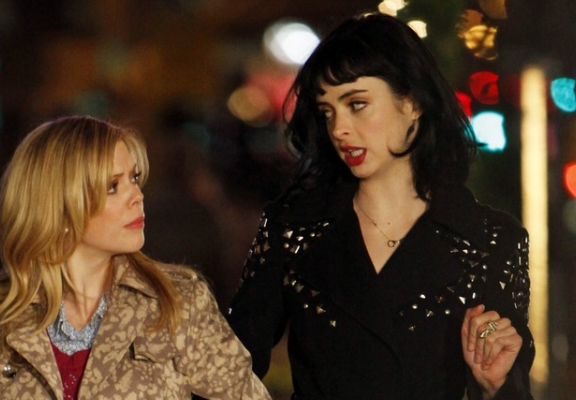
Perennial rom-com bitchy best friend Krysten Ritter plays the title bitch (assuming I’m correctly positing that “B” stands for “bitch”).  Ritter is also known for her recurring TV roles on Veronica Mars, Breaking Bad, as Jesse’s one-time girlfriend Jane, and her unforgettable role as Brad Garrett’s daughter on ‘Til Death.

One note before I get to the meat of the episode:  The episode uses the single most overused television episode storytelling gimmick, which is showing the end of the episode, chronologically, at the beginning, and then having the rest of the episode show us how we got there.  Just quickly thinking, there are enough examples that I should save this for an entire entry, but suffice it to say, that while I do think the gimmick can be used in a really interesting way, it’s usually merely used as a lazy storytelling device to develop cheap suspense or interest.  Moving on.

In this particular beginning, the roommate of the B in Apartment 23 opens the show by telling us that she found her roommate, said B, hooking up with her fiancé on her birthday cake, and that that was the best thing to ever to happen to her (whaaaaat?  but these are all horrible things – how could they be good?).  This woman, June, our narrator, is a nice, mild-mannered midwesterner come to big NYC with a life plan:  She’s got a job for some big corporation, which is providing her with housing, and soon her scientist fiancé will join her, and they’ll get married and make babies.  Only, when she gets to work, it turns out the Feds have raided the place, and well, work doesn’t exist anymore.  She’s thus, in one shot, out a job and an apartment.  After a montage of following roommate wanted ads to weird apartments and people, she finds a seemingly nice roommate in Ritter’s Chloe, who shows her around, seems normal and asks for a couple of months rent.  Chloe then confides her plan to act crazy/irritating enough to drive her new roomie out, while keeping her already paid rent money, to her best friend James Van Der Beek, playing a self-obsessed Entourage cameo-esque version of himself.

June fights back, however, when Chloe tries to screw her, and Chloe starts to actually, well, not hate her.  June’s fiance shows up, and Chloe learns that he’s been cheating on June, but still naive June refuses to believe it.  Thus, Chloe sees as her only option showing June in person that her boyfriend is a cheat by having June walk on herself with June’s boyfriend.  June walks in, is outraged, but then the truth comes out, and although she’s depressed, she thanks Chloe, and thinks maybe, well, she does have a friend in big NYC after all.

Wacky side character alert:  It’s a fairly wacky show, so we have a couple.  First, neighbor Eli, who creepily spies on the girls but also offers friendly advice from time to time.  Next, we have Robin, another creepy neighbor, this time a female who is obsessed with Chloe.  Third, less wacky than the other two, we have Mark, June’s old boss briefly at her corporate job, and her new boss at the coffee shop at which she now works.

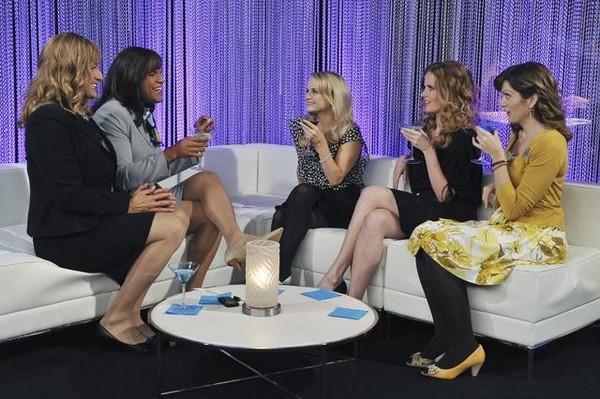
I didn’t laugh a whole lot.  I like the idea, and I think Krysten Ritter is well cast in the role, and I could see where the show was going with some of the jokes and gags.  But it wasn’t really funny.  ABC comedies seem to have developed a reputation for mediocre first couple of episodes, with the potential to develop into something still inconsistent, yet, significantly better.  Suburgatory and Happy Endings are two shows that have followed this model, and Don’t Trust The B seems like it could certainly fall in here.  It’s an okay show, with the potential to be better, and with comedies it takes at least a few episodes to see if a show can deliver on that potential.  Very few comedies are hilarious or fantastic right out of the rate, so while not being funny certainly isn’t a compliment, it’s not a definitive judgment.

Will I watch it again?  Yes, I think I’m going to.  It’s certainly easier to watch half hour comedies than hour long dramas, and while it’s certainly not great right now, I’ll see if the writers can find their footing with some good building blocks to work with.

Spring 2012 Review: Scandal

18 Apr

Sometimes when describing shows like The Wire, or maybe now a show like Girls, critics, or myself, may describe them as “real” or “not TV,” placing them in juxtaposition with typical television.  Rarely is something described as extremely TV, though I suppose it’s partly because TV is the default setting for a TV show.  Scandal, for better or worse, is extremely TV.

While I’d argue, if I had to make a general rule, “not TV” is better than “TV”, if only because it’s more interesting because TV has been done a thousand more times, TV is by no means necessarily bad.  TV has positive attributes, and within TV, there’s a wide range of quality.  That said, because of the repetition, it’s a lot harder to stand out in “TV” than in “not TV.”   Scandal’s not bad.  But maybe it’s just that watching so much really good TV makes it hard for me to take something so TV seriously without some humor or irony, intentional or unintentional.  I think on some level, NCISs and CSIs, certainly CSI:Miami, at least are semi-self aware of their nature and all the easy ways to make fun of their techno speak and one liners, at least implicitly.  Maybe not, but, although I don’t watch those shows very often, I can enjoy the tropes and viewer humor on a level if I do.  Scandal is just so over the top and fully serious it’s making it difficult.  I usually develop an appreciation for over the top tropes, such as in rom coms, but it’s just not happening here.

Kerry Washington plays Olivia Pope, former White House employee, and current head of Olivia Pope and Associates.  What does Olivia Pope and Associates do, you ask?  Well, they’re lawyers, but they don’t practice law.  They SOLVE PROBLEMS.  They FIX CRISES.  Insert similar euphemism here.  Pope leads a team of dedicated associates who follow her lead and believe in her with all their hearts; they don’t always agree, but they trust her decision making.  Among her team are Stephen (played by Henry Ian Cusick – best know as Desmond from Lost), who requires a pep talk from Olivia convincing him to get engaged, Abby, Harrison, and Huck, the resident techie.  Introduced in the first scene is new hire Quinn, who goes to a bar thinking she’s been set up on a blind date, only to find out upon talking to Harrison that she’s been hired by Pope.  At Pope & Associates, they’re “gladiators in suits.”

Olivia Pope is a living legend.  She’s the best and whatever it is she does, the force for ULTIMATE GOOD and Quinn is literally (maybe not literally) foaming at the mouth to start working for her.  After she’s hired, Quinn and Harrison go back to the office, where the Quinn, the new girl, who only knows of the legend of Olivia Pope, learns how her new firm really works. She’s tutored by Harrison, who gives her constant guidance about Olivia, such as “Never say I don’t know.  Olivia doesn’t believe in I don’t know.”  Well, then.  That solves that.

The firm’s primary case in this episode (they’re not lawyers though, they remind us – so maybe case isn’t the right word) is the defense (but not legal defense) of a Iraq (might have been Afghanistan – don’t quote me) war hero who is now a big time conservative republican speaker, who found his fiancée dead, and knows he’ll be accused of the murder.  The team goes on an interview montage to see whether they should take the non-legal case and although three of the four votes go against taking it, like the old Abraham Lincoln story (I can’t find a good link in two minutes – but google “the ayes have it Lincoln”), Pope’s vote for it takes the day.  Her gut tells her the marine didn’t do it, and her gut is ALWAYS RIGHT.  Remember that!

Olivia is so badass! Within the first fifteen minutes of the show, she tells a presidential aide, that the PRESIDENT of the UNITED STATES had damn well better make time for her if he wants her services.  He does, though, and he wants her to shut down a woman who claims that she slept with the Prez.  She worked for the president before, and she trusts her gut, so she’ll do it, but we get a little Kerry Washington twinge indicating HER GUT MAY REALLY BE BE TELLING HER HE’S LYING.

Olivia fixes cases, of course, as we’ve seen.  But she doesn’t just fix cases.  Oliva fixes PEOPLE.  So says Huck (Guillermo Diaz from Half Baked; apparently she fixes careers as well (way harsh; Diaz has had a perfectly respectable career, including recently the bizarre “I Wanna Go” Britney Spears video)).  Of course, the only one Olivia can’t fix is herself.  She doesn’t date she tells us, but that’s kind of a lie.  We’ll get to this in the first episode spoiler section upcoming.

Just when it seems like every shred of evidence is against their GOP marine, it turns out a a camera captured him and his (FIRST EPISODE SPOILER) GAY LOVER on tape.  At first, he’d rather go down with the ship than admit his homosexuality; he’s supposed to be a hero after all.  However, Pope uses LIFE EXPERIENCE to convince him to let the tape exonerate him from spending at least 20 years in jail.  “She’s not one of the good guys.  She’s the best guy.”  is the last line of wisdom mentor Harrison tells the rookie Quinn.  Olivia is THE BEST GUY.

I’m sorry.  I don’t know where along my years of growing up I lost an ability to take anything seriously, but I certainly can’t take this seriously.  I’m probably not entirely supposed to, and honestly, if you ask me what the real difference is between this and Leverage or any of any number of other shows, I don’t really have a good reason.  Maybe I’m just not watching it in the right mood.

First episode spoiler #2:  SHE HAD AN AFFAIR IN THE PRESIDENT!  THIS IS IN THE FIRST EPISODE.  That’s it.  I’ve changed my mind.  If you’re going to go in, at least go all the fuck in.  You do your thing, Olivia Pope.  You can FIX everyone and everything but you can’t fix yourself.  I take back everything I said earlier in this review.  This show is wonderful.  THE PRESIDENT LIED TO HER AND NOW SHE IS OUT TO GET THE PRESIDENT OF THE UNITED STATES.  MORE PLEASE.

Will I watch it again?  Yeah, it’s probably not going to happen.  Though, writing this was fun.  Maybe I’ll recap the show.  Also, Desmond’s in it.  That might be enough.

Spring 2012 Review: Best Friends Forever

17 Apr

So I’m going to belatedly review a bunch of shows that if they’re still on the air, won’t be for very long, and which most of you will never watch.  If a show airs and no one watches it, was it ever on?  Still, somebody must do the thankless jobs; attention must be paid and all that.

The titular best friends are Jessica Black (played by Jessica St. Clair) and Lennon White (Lennon Parham).  Jessica is talking to Lennon via video chat as the show opens, Jessica in San Francisco, where she is awaiting the return of her husband, with whom she has apparently been having problems, and Lennon in New York.  When, instead of her husband, divorce papers show up, she’s so despondent that she hops on a plane to New York and visits Lennon, who attempts to comfort her as she slips back into her old pre-marriage New York routine (apparently they lived in what is now Lennon’s apartment together).  But, wait, there’s a problem!  Getting in the way of the best friend Steel Magnolia viewing sessions is Lennon’s new-ish live-in boyfriend, Joe, who feels like he’s getting the squeeze now that Jessica has come to stay.  He doesn’t like the way they want to spoil his chili Sundays, or move his blow up Michigan chair.  Jessica doesn’t trust Joe either; upon the hilarious miscommunication plot device of finding a ring and thinking Joe is going to propose, she innately suspects that Joe is not up to the caliber of man Lennon deserves, and makes it her mission to ensure Lennon won’t be marrying this guy she simply doesn’t know enough about.

Luckily for the BFFs, crisis is averted when it turns out that the ring is not an engagement ring at all, but rather a super-sweet memento of Lennon and Joe’s first date at Medieval times, which Joe bought to remember the occasion.  Jessica realizes Joe makes Lennon very happy, and that he’s a legit good guy, while Joe realizes that he needs to make room in his life for Jessica, since Jessica is so important to Lennon, and there’s a big hug at the end (I am absolutely not lying about the hug).

Oh, and in town is also a mutual friend of the crew’s named Rav, who Jessica seems to have maybe a romantic past with, which she seemingly ended.  Rebound, anyone?

Wacky side character alert (I’m tempted to add this to my reviews from now on as a regular feature):  The fifth main cast member is precoicious African-American 9-year old Queenetta, a neighbor who constantly hangs outside their building and apparently verbally spars with the two women.  In the pilot, she criticizes Jessica’s choices of dress, particularly her khaki pants.

It’s not a terrible sitcom.  We’re not in Whitney, or Last Man Standing, or 2 Broke Girls, or Are You There Chelsea territory, by any means.  It’s merely the more common brand of forgettable sitcom.  I hold no animus towards any of these characters, and they seem like perfectly nice people on the whole, but nor was there a whole lot to make me sad when this show inevitably dies off after five episodes of a terrible NBC time slot (trick question! All NBC time slots are terrible!).  It’s worthy of a big ol’ meh.

Will I watch it again?  I’m not going to.  If watching it again would help get Whitney or Are You There Chelsea get cancelled, I would watch it 18 more times, but as it is, there’s just miles and miles of sitcoms to go before I sleep, and mediocrity, while not terrible, but without a spark of promise that it will develop into something really good, isn’t worth spending time on.

Spring 2012 Review: Girls

16 Apr

Three Out Of Four Titular Girls

It’s hard to review this show because there’s been so many lines already written about it, before the show even aired, that I feel like I’ve become burdened with expectations, good and bad, though mostly good, that have far outweighed whatever the mere half hour of television that I’ve seen could possibly offer.  I don’t think I can remember the most recent show to come out of the gate with such critical buzz (I’m sure there was one, but I can’t pull it at the moment), and I feel handcuffed.  I’ll probably take another stab at this when three or four episodes are under my belt.  However, it’d be cheating if I didn’t at least try based on the first episode.

For whoever may actually not know what Girls is about, it’s about four women in their mid-20s trying to put their lives together in New York City.  Let’s specify further.  It’s about four white, fairly entitled, women, in their mid-20s, trying to put their life together.  I don’t mean anything by adding those qualifiers to my description, but it’s important, and much of the early criticism of the show has centered on either the all-white or the entitlement aspect, neither of which I think, on their face are fair.  I generally don’t agree with straight out subject matter criticism, except in terms of the difficulty of bringing something new to a ground trampled so many times before, and that’s really more of a problem for police and lawyer and doctor shows, than just about any show about women of any age or status anyway.

So here are the actually contents of the show.  Primary character Hannah, portrayed by creator, auteur, writer, director Lena Dunham, who has been interning for a year without pay while writing her memoir, finds out that she’s getting cut off, financially, from her Midwestern professor parents.  She’s despondent, having no cash, and has to figure out how to deal.  She also goes over to her boyfriend’s (maybe just a fuckbuddy (one word or two?) type) place, an actor/carpenter who doesn’t respond to her texts and appears to not really care much about her, and proceeds to have sex with him, leading to one of the most-talked about aspects of the show, the super awkward uncomfortable sex scenes.  I thought the hype here was a little overblown.  It’s unquestionably awkward, and certainly not glamorous, but hardly revolutionary or worth expending thousands of words over (maybe there’s plenty more to talk about in the next few episodes?).  Hannah’s friends include Marnie (I honestly had to look up the names of these characters, besides Hannah, I couldn’t figure them out/didn’t remember them from the episode), who is dating an oversensitive wus, who she can’t stand the touch of, but seems to be afraid of breaking up with.   The other two main characters are Hannah’s other friend, European Jessa who appears to be everything Marnie is not, flighty and pretentious, and Jessa’s roomate, Shoshanna (I really don’t remember hearing this name) who appears at least mildly airheady, who makes the obligatory lampshade hanging Sex and the City joke, acknowledging the parallel, that for good or ill, it’s impossible not to draw about a half hour show on HBO about four female friends.

An article I read felt that Girls’ closest contemporary, rather than Sex in the City was FX’s Louie, and in this short time I can see some resemblance.  Girls has funny lines, but it’s not a traditional comedy, in either having jokes, or in any kind of significantly “ha ha” moments.  It’s focus seems to be more on being poignant and “real;” far less absurdist than Louie, but probably trying to get at the same ideas.

Basically, I feel like I don’t know how I feel (that’s a ponderous sentence, no).  It was a watchable, and interesting, if not please-sir-can-I-have-some-more viewing experience, and I do feel fairly confident I’d at least come back for seconds without all the expectations hanging over the show.  As an entitled 20-something white person, albeit a male, I fit at least some of the categories the show is discussing, so I’ll grant that the show has the potential to have more resonance for me than for some others.  I’m not blown away into the sphere of what a visionary Dunham is, but hey, it’s just one episode.

Will I watch it again?  Yeah, I need to know more for better or for ill.  I really do think it will be for better, though.  Can this many critics be wrong?

Spring 2012 Review: Rob

10 Feb


I’m still a bit confused about the actual title of this show, and how many !s should be in it, and where they should be placed.  So let’s just accept that I’m talking about the new Rob Schneider sitcom, in which he impulsively marries a Mexican woman, and boy does he not realize, that’s he’s married to her family also!  Where Work It indulged heartily in stereotypes about women, Rob digs in to Mexican stereotypes.

Disclaimer:  After writing the Work It review and this one, I do want to say, it’s not that the use of stereotypes can absolutely never ever be funny.  It’s just that it’s usually not funny, and is usually terrible and offensive.  I just want to leave that door open for the few who trade in this general type of humor more effectively, a la Chapelle’s Show.  Stil, for ever Chapelle’s Show that does it well, there’s ten Mind of Mencias that do it terribly.

Either way, I would like to focus in on how bad Rob is as a television program.

Basically, Rob meets his wife, Maggie’s family, and while needing to impress them, constantly embarrasses himself (think Meet the Parents but with a stereotypical Mexican component).  Rob was as difficult to watch as Work It, but for a very different reason.  Rob basically contained the this-man-can’t-do-anything-right type of pratfalls, as he stumbled through physical comedy bits embarrassing himself, but without any of the actual laughter which comes from when this type of humor actually works.  You get the hard to watch part without the funny.

Rob takes on hard hitting issues like illegal immigration, mentioning to Cheech Marin, who plays his wife’s father, that he feels that the borders should be open, while Marin responds that he wants a wall to be erected so he doesn’t have any competition.  Rob mentions he’s a landscape architect to his wife’s mother, who labels him a gardener.  I love that they think they’re turning stereotypes on their head, for example by showing us that these Mexicans are successful – father Cheech Marin says he owns several car washes, contrary to what us stupid Americans, who have low expectations for Mexican=-Americans, think.

There’s a lot of low brow, physical comedy.  It’s not that I think all low brow comedy is unfunny, but there’s caught-in-a-situation-where-someone-mistakes-you-as-masturbating joke, and there’s a caught-in-a-situation-where-someone-mistakes-you-as-masturbating joke.  Party Down manages to pull it off when goofy boss Ron gets caught trying to use a stain pen on his pants, but Rob not so much when his wife’s grandmother catches him trying to put out of the fire that has erupted on his pants when accidentally knocks over his wife’s grandmother’s devotional candles to her dead husband.  Rob even follows it with an extremely creepy and terrible joke and he ends up in an awkward sexual position vis a vis the grandmother, after trying to cover her mouth to prevent her from screaming out what a mess he’s made setting the room on fire.

What’s really sad is that there is a dearth of Latin American actors on television, and likeSt. Louisdeserves better than Work It, Latin American actors and actresses deserve better than Rob.

Will I watch it again?  No.  Sadly, while Work It was quickly cancelled, this is on CBS, so people watch it.  I look forward to never having to think about this program again, except in the litany of terrible projects Rob Schneider has been associated with.  It’s amazing how the man, in a town where so many talented comedians never get a chance, manages to continue to get a work, and get a project where he gets to have an attractive, much younger wife.

Spring 2012 Review: Work It

9 Feb

It’s long past due that I reviewed this show that I called the Lebron James of shows-picked-to-be-cancelled (don’t think too hard about thea analogy) which was as predicted added to the great list of shows cancelled after a mere two episodes.  Still, late is usually better than never, and if I didn’t watch every new broadcast show eventually I wouldn’t be staying true to myself so here it is.  The show, for those who don’t know, is in a sentence, about two unemployed best friends who discover that women can get jobs in the terrible economy but men can’t, and thus dress up as women to get said jobs.

Let’s start out by saying that this show is cringe-worthy bad, hard to watch bad, and not hard to watch in a British comedy sense, where it’s like a traffic accident that you want to look away but you always want to watch, more that you just don’t want to watch. I had to watch the show in approximately 2 to 3 minute segments just to get through it at all.  Maybe a half a dozen comedies a year make you truly feel like you’re losing brain cells watching them (not that anyone actually knows what that would feel like, but let’s let that pass) and this is the worst of them all.  This is dare I say, more insulting than 2 Broke Girls, and I don’t pass that judgment lightly.

With the assumption accepted that the show is mind-bogglingly awful, let’s move on with some specific comments.  First, the show takes place in St. Louis.  What a sad fate for a  proud city.  Not that I have any strong feelings about the city one way or another, but it seems like the Gateway to the West deserves if not one great series, one half-way decent one.  The bestSt. Louiscurrently has is either AfterMASH or The John Larroqette Show. It deserves better than Work It.  (New great idea: Power Rankings of shows by city, or cities by show – look for it soon).

The main character I recognized from his stint playing Robin’s co-anchor and serious boyfriend in an arc of How I Met Your Mother.  In addition, Rebecca Mader, who played Charlotte in Lost, plays the bitchy office top dog, who is poised for sales competition with the main character.

The show is simply jam-packed with insulting shows about seriously out-moded gender stereotypes, and without a hint of winking self-awareness under which the creators could at least cover themselves, claiming everything is done in an ironic fashion.  It reminds me of the insulting stereotypes rife in Tim Allen’s Last Man Standing, but worse.  It takes until just two and a half minutes into the episode for the jokes about women to begin, as the worst character in a show of terrible characters, third friend Brian talks about a world in which women will take over, leaving only some men women will take as sex slaves, but not the good kind of sex – kissing and cuddling, and can you believe it, listening!  Boy, do women love to make men listen to them, an extremely emasculating pursuit.

In the theme sequence, the creators have their names appear in big letters.  I hope, for their sakes, that they’re pseudonyms, because otherwise it’s a big sign saying “don’t hire me ever again!”  Lucky for them few enough people were watching to ever remember their names.

In order to live in Work It’s world, we have to accept that people could unquestionably accept both of these men terribly dressed in far lower than Mrs. Doubtfire quality drag as women.  There’s so many insulting jokes about women that it would be impossible to list them all.

The single best part of the show may have been that in the closing seconds my file includes a promo for “Gary Busey and Ted Haggert: The Premier of Celebrity Wife Swap” which I still don’t believe is real.

Will I watch it again?  Well, obviously I don’t have a choice, since it will not air more than two episodes.  The answer would obviously be no anyway, but I still think it bears wondering how this ever got on the air.  On ABC, too, which while having far from a perfect record on sitcoms, has largely focused on laugh-track free slightly smarter sitcoms of late like Modern Family and Happy Endings.  I hope someone is laughing out there who created this show as a giant joke just to see if could ever get on the air.  At least one person would laugh then.

Spring 2012 Review: Key & Peele

8 Feb

Evaluating a sketch show by nature comes with a different standard than evaluating any other type of show.  Instead of coming at you with a coherent episode, sketch shows give you a handful of mini-episodes, which tend to be premised on one, or just a few, jokes each.  These sketches are often really good or really bad.  More than that, it’s okay to have a bad sketch; once the next sketch starts, it’s almost as if the bad sketch never happened, rather than in an episode of a normal show, where a shaky first few minutes can have a bigger impact on the entire show.  That’s not to say it’s good to have a couple of stinkers; all gold would be best.  Still, if there’s one thing sketch shows generally need its an editor, and because a couple of great sketches more than outweigh a couple of lousy sketches, because you can just ignore the bad sketches, a sketch show that hits .500 isn’t that bad.  It’s certainly a lot better than a normal sitcom hitting .500.  In addition, a lot of sketch shows are bad.  That doesn’t mean all sketches are bad.  Saturday Night Live, which I think is the most overrated culture institution of the last 30 years, has churned out plenty of good sketches over the course if its history, but because its batting average is so low I’m content to wait and hope the really good sketches funnel through youtube or the blogosphere to get to me.

The first episode of Key and Peele hit just about .500, and I actually saw that as a good sign.  We’ll take it sketch by sketch, though let’s note that my text is no substitute for watching, for good or ill.  Also, we’re going to skip the talking part at the beginning, where Key and Peele chat in front of the audience, introducing the show, much like Chapelle did or Mr. Show did.  There’s enough to talk about already.

First sketch:  One couple meets another couple at their house.  The men and women separate.  The men, whenever they’re together, look around, several times, and make sure the women are nowhere nearby before calling their girlfriend a bitch.  They repeat, each time moving to a more obscure location, and ending up space.

Verdict:  This one took the classic Family Guy Peter falling and hurting his knee path – it was a little bit funny, the tiresome and repetitive, but went far enough that it came around again and was a little bit funny.

Second sketch:  Chefs are in line to be judged by a Gordon Ramsay-like chef on a cooking reality show.  The Ramsay-like character goes back and forth between saying the contestant’s food is good and terrible, in a confusing manner, so much so that the contestant has no clue what the chef thinks.

Verdict:  I chose to describe this is an unfunny manner, but it was pretty good sketch, a good idea with good execution.

Third sketch:  A reality crew follows the life of Lil Wayne in prison.  That’s just the wikipedia description.  I don’t have a ton to add, but the joke is that Lil Wayne talks a tough game, but is nobody in prison.

Verdict:  It’s a pretty good idea, but it mostly didn’t work, though the fact that the idea was a good one meant it at least came through in one or two jokes, this sketch actually was repeated in little bits throughout the episode.

Fourth sketch:  Imitating a commercial for ancestry.com, people speak about the joys of tracing their lineage back to a famous person.  The white people go back to people like George Washington or Alexander the Great, but the black people always find their way back to Thomas Jefferson.

Verdict:  Success – I honestly thought this was a commercial as it started, and didn’t pay attention initially, which shows how closely they imitated.  It was short, and to the point, and they got good leverage out of the joke without overdoing it.

Fifth sketch:  A man goes to the doctor, planning on giving fake symptoms to get a prescription for marijuana.  While the doctor is willing, the man keeps giving ridiculous diseases, such as leprosy, or AIDS, every time the doctor presses him for a new less serious disease.

Verdict:  Success – this is one of those sketches that fell about half on the idea, and half the execution.  The writing isn’t that important past the idea; the only important part is to think of sufficiently ridiculous conditions, which admittedly isn’t obvious, but isn’t impossible either.  The job by Peele as the patient particularly helps sell the skit and makes it funnier than it should be.

Sixth sketch:

Because President Obama must appear calm and reasoned, he enlists a translator to express what he really means, much more angrily, when he says things.  This was on all the commercials.

Verdict:  Not so great.  Again, it’s not a failure of idea, but this one just didn’t come together in practice.  I could see it working in theory, but it was a little bit off and I don’t have the exact best way to fix it but think that it could possibly be funny.

Will I watch it again?  I haven’t yet, but I will.  Since it’s a sketch show, it doesn’t give the same impetus to watch week-to-week but the show has definitely earned at least a second look.  Looking back, even the sketches that didn’t work, could have worked, which says more about execution than concept, which I think is easier to improve upon in the future.

Spring 2012 Review: The River

3 Feb

The River is brought to us by Oren Peli, best known to the world for Paranoraml Activity, a horror-type movie which was supposed to be a cut above the average film in the genre.  It’s a genre that’s never been my particular cup of tea, and I have yet to see the film, but from what I know, it’s notable for its distinctive “found footage” style, similar to the Blair Witch Project, with scenes viewed as it from cameras set up by the primary couple in the film, who are being haunted.

This gave me a couple of impressions going into The River and two primary concerns.  First, I understand the appeal of the “found footage” style but I worried that the hurky jerky camera work could prove too gimmicky if overused during the course of a series.  Second, and this is a more personal bias, I wondered if this would venture too far into the Paranormal Activity-type genre for my liking.  However, I found the premise interesting, and I was willing to trust the general consensus that this Peli guy had some idea of what he was doing and wasn’t just a horror movie hack.

The River is about a nature explorer, Emmett Cole, a lot like say a Steve Irwin, who travels throughout the world, showing off nature with , occasionally with his family, on a nationally televised TV show.  He’s done this for over twenty years until he gets lost on an expedition into the amazon.  After rescue teams try to find him for six months and fail, he’s declared dead, and his family mourns his loss, but when his rescue beacon goes off, his wife, Tess, tries persuade his son, Lincoln, to go down and attempt to find him. Lincoln only agrees when he learns that the television network will only pay for the expedition if both he and his mother are on board.

The team, including some cameramen, a security person, Cole’s wife and son, an engineer who worked with Cole, and his daughter, starts down the river, where they run into their last member, Lena Landry, the daughter of another man who worked with Cole and was on the missing expedition.  They find the beacon quickly, and are about to turn around, when Landry tells them she’s been able to figure out where to go next, and they follow her instructions and find the ship.

This is where it starts getting all Paranormal Activity.  Apparently the panic room is welded shut, and inside is a shell which it turns out contains some sort of evil spirt which had been trapped, but is now out and wants blood.  There’s a bunch of crazy camera angles as we look from the crew’s camera perspective, and we switch back and forth in vantage points quickly, wondering where the evil spirt’s at.  Eventually, one guy gets killed, the spirit gets trapped again, and the wife leaves more certain than ever that her husband’s still alive.  Many of the crew are pretty quick to accept the supernatural, and the show does not spend almost any time on any serious disbelief of the idea of spirits.

I thought for a minute that the show might not actually be about the supernatural, and might just involve animals, and wild tribes, and drug runners, and what not, but that was obviously misguided.  There’s going to be tons of supernatural, and I can live with that in and of itself, but it’s always a tricky direction to go in because you need rules.  The camera work was a little much for me, but not so much that I wasn’t intrigued.  I have major doubts about the sustainability of a show like this, and since the crew number is probably more or less set, it limits the ability to keep killing them off.   It’s interesting; I’ll give it that, and that’s worth a lot with a pilot, but I have serious doubts about its lasting power.

Will I watch it again?  Yes, I will. Alcatraz seems a safer bet, but The River seems to have more potential. Alcatraz is the college draft pick pitcher who likely has a ceiling as a #3 starter but is likely to reach it, while The River is a high school lefty who can’t help but intrigue you even if you wonder if his unusual motion will lead to an inevitable injury.  Okay, long analogy over.  I’m going to go watch it again, for at least a couple of episodes.

Spring 2012 Review: Smash

1 Feb

So NBC, you win.  I watched Smash.  Are you happy now?  My favorite game during the Super Bowl was counting the Smash commercials.  NBC has been bombarding the three viewers of the network with Smash ads for a full half year, and I was concerned that the network might literally implode from within if the show was a failure.  Anyway, it did well enough, and though putting one’s faith in Smash as a network savior may or may not be a sound strategy depending on the type of demographic you hope to gain, I’m glad to say that it was a pretty solid episode of TV.

Smash is the story all the steps and pieces that go into putting on a Broadway musical.  It begins with the conception of an idea by a man and woman songwriting team, and over the course of the first episode they record a quick demo of a song they come up with which leaks onto the internet, leading to interest from producers.  The musical is about Marilyn Monroe (which you’d know if you’ve seen one of the thousands of commercials) and the episode gets through two rounds of auditions at which point it looks like the casting of Marilyn is between two actresses, a veteran chorus girl and an up and coming youngster from Iowa.  The show appears to be a true ensemble piece, focusing on the songwriting team, the two women auditioning for the part, the producer, and the director.

Overall, I really enjoyed the show.  The cast was excellent, and I enjoyed the show for a number of reasons, but I do want to point out the fact that I appreciate the covering of a subject matter that hasn’t been done a hundred times.  I love The Wire and Law & Order but it’s nice when every show on TV is not about cops, or lawyers, or doctors.  More that that, it makes it easier on the show as well, because there are many fewer clichés already out there for the show to just walk into.  Sure, maybe there are archetypes associated with musicals in general, but not nearly as many in terms of characters as there are for cops, who, for example, care too much about every case or doctors who, for example, are jerks but really care on the inside.  The characters in general seem well-built.  There were no caricatures and no one I couldn’t believe, and aside from the director propositioning the young starlet, just about no clichés.  The potential conflicts on the show so far, between the male half of the songwriting team and the director, and between the two candidates for the role of Marilyn have potential and more that, don’t have an obvious villain or hero, which I appreciate.

I remember having heard Smash billed as an adult Glee, but that’s really inaccurate.  There’s absolutely nothing alike between the two shows except that they both feature musical sequences.  They’re different in that regard as well, as Glee’s numbers are much more elaborate and outside of the direct story, while Smash features fewer songs per episode and more original songs.  Where the Glee songs often seem to be totally unnecessary and sometimes disjointed from the rest of the show (I mean, they’re necessary in so much as that’s what Glee is, but my friend watches the show without the songs and can follow along just as well), the Smash songs make a lot more sense so far in the context of the show, as about a production of a musical.  I think there will be fewer originals per episode in the future, and more covers, and the very small amount of musical sequence which felt outside of the plot was probably my least favorite part of the show, but I’ll willing to give some leeway for now.

I have mixed feelings regarding musicals.  Growing up, my parents would take my brothers and I to musicals fairly frequently, and I enjoyed them, but I have kind of stopped going in the past few years.  This is less a complete indictment of musicals, than a realization of the fact that musicals generally fall below other things I’m interested in doing.  Still, I appreciate the art form.  I guess what I’m trying to say is that if you hate musicals, you probably won’t like this, but you don’t need to love musicals to enjoy it.  I do wonder what kind of appeal this will have in the fly-over states, but maybe NBC should just give up on CBS demographics and try and aim for the educated, high-income viewers that are already the only ones who watch its programs.

Will I watch it again?  Yes.  Smash didn’t excite me in the way Homeland did or have the distinctive voice of Luck or even the trashy fun of Revenge but it appears at least so far to be just a solid, well-executed show.  It’s nothing flashy and there’s nothing instantly compelling enough to vault it into my top shows but the people connected to it seem to really know what they’re doing, behind and in front of the cameras.  Right now it looks like a Matt Holliday – a player who got a big contract which generated a lot of hype, but doesn’t do anything flashy other than produce day in and day out and live up to the contract’s terms.  Of course, this could all go sour in a half season like Glee did, but it’s earned more of a chance from its first episode than a vast majority of shows do.