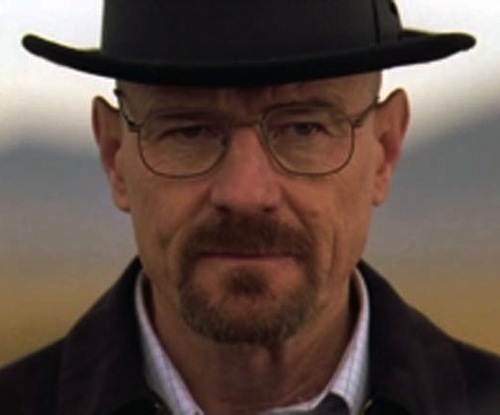
I’ll have my belated post about the finale and the final season soon enough but here I’m going to combine a couple of other Breaking Bad-related topics I’ve been thinking about into one entry. Bear with me. I want to address two separate issues here. First, I want to touch on the is-Walt-evil debate, and second, after hopefully I’ve least convinced you I’m not one of those terrible Walt apologists everyone keeps complaining about, I want to explain the aspects of Walt that I respect, in spite of the more obvious aspects that I don’t.
Walter White is definitely a bad guy, not in the sense of villain or antagonist, but in the sense of the moral antecedent to good. He does things throughout the show that are bad things by just about all but the most relativist standard. If I had to choose, the worst was poisoning a child, but of course it’s silly to choose. He’s done bad shit, There’s no doubting that, and there’s no getting around. Is he evil though?
The definition of evil is obviously largely a matter of semantics (don’t worry, I’m not going to bust out a whole Websters-defines-evil-as here). Still to me, evil is such a damning word that to use it when it’s not warranted is to lessen Its power. Some people throw about the word evil while talking about Walter White in ways that I I think undermine what evil truly is.
Many people, people I know, and people who seriously care about television consider Walter White evil. Walter White, the Onion AV Club’s Todd VanDerWerff describes Walter White, in an article about good and evil in Breaking Bad as a “very evil man.”
I don’t see it. Part of this is semantics. In my admittedly stiff definition evil consists of causing harm for absolutely no reason. Walt commits several horrific acts during the course of Breaking Bad, but he never commits the act because he enjoys it or because it’s fun or because people should just die. Every horrific act has internal logic behind it. Even the poisoning of Brock was done for a reason, as it started the events in motion which led to the death of Gus Fring. Fring’s eventual demise likely would never have happened without Brock’s poisoning. It doesn’t make Walt’s act any less vile or wrong, but it does make him not necessarily evil for doing it.
I am currently reading the excellent “The Storm of War” by Andrew Roberts about World War II. I read chapters about the holocaust and the no less despicable Japanese brutality that occurred in the Eastern war. I’ve read these stories time and again, but the enormity of the acts never fails to strike me emotionally every time I do. The deliberate killing of people because you don’t like them. That’s fucking evil. Killing people because they pose a threat to your criminal empire? It’s terrible, it’s morally wrong, and it’s criminal. But it isn’t evil to me. I admit I’m cheating here by using Nazism as a counter-example, which is just about as evil as evil gets; but the point stands.
Still, let’s move on from the extremes and the semantics, VanDerWerff compares Walter White unfavorably evil-wise to Tony Soprano. I’d list out the terrible acts both have committed and try to compare and contrast but that’s really beyond the point, and his argument is admittedly less about the acts each of the characters commit than how they are viewed in the context of the show. It’s an intelligently written and worthwhile piece but it’s far too extreme in its reading of Breaking Bad. More than that, it shortchanges Breaking Bad. There’s an internal logic to almost everything that Walt does that we can follow along with even when we don’t agree with him. We know why he’s doing it, or at least why he thinks he’s doing it. The beauty of the show is that each act takes him a little farther from home, moving him away from a moral compass a little more, but because it’s step-by-step, it seems to make a little bit of sense each time.
The genius of Breaking Bad is more than this though. Mr. Chips to Scarface, is the line Vince Gilligan has used to describe his goal for Breaking Bad from day one, and the show was almost there by the start of the final season. Walt was finally going to turn on the only couple of beliefs he had ever claimed to really care about. Except he doesn’t and that’s part of what makes all the internally consistent but externally terrible choices he made over the past few seasons really hold up in hindsight.
Walt’s actions led to Hank’s death but after events in the final season there’s no question he actually cares about Hank. Walt may not have acted like he cared but he made several decisions in the final season which showed he did. He actually cared about Jesse as well. Their relationship may have gone to shit eventually and Walt often didn’t act in Jesse’s best interest, but if you really don’t think Jesse meant anything to Walt you weren’t watching the same show. Walt has some tiny, little semblance of a moral compass. It’s broken and perverse but Walt did have something he believed in, something he cared about, even when he didn’t actually act in the way that bettered that belief, and that adds a dimension to the show that VanDerWerff shortchanges.
I’m not a Walt apologist. He’s a bad dude. He makes many, many bad decisions, and he absolutely deserved everything that came to him. He’s committed many crimes and some unforgivable acts. Still, I declaring him out and out evil lacks the nuance with which Vince Gilligan and his writers due such a brilliant job of imbuing Breaking Bad.
Okay, second half where I talk about what I admire about Walter White. This is a vastly more polarizing viewpoint, I think, and I hope I’ve convinced you that I’m not a total Walt is number one awesome badass supporter to follow along.
Here’s what I actually admire about Walter White. I’ll again repeat how terrible a person he’s been to Jesse and his family, and how many morally repulsive and criminal acts he’s committed along the way as I disclaimer to my not thinking Walt is the coolest drug lord eva. Moving forward.
Over the course of the series, Walter White makes something out of himself. What he achieves is certainly a sordid twist on the American Dream, but it’s not that hard to see the dream in there. As a man, at a time of desperation, beaten down at age 50, having learned he has a deadly disease, it would be easy to pack it in. Instead, largely through his own ingenuity, ambition, and genius, he finds a market with an opening, creates a product that’s vastly superior to whatever’s available currently and slowly begins to take over levels of distribution through vertical integration. Is it an illegal product, a highly addictive substance. But essentially it’s still a American definition of economic success, capitalism 101.
Walter White doesn’t have a gift. He wasn’t born with this. He’s smart, but he could never figure out how to use his particular abilities, and the one time he did, ended up not working out. He settled into a groove, and that was fine. He lived a satisfying life. But he, in a way that I think is very relatable, craved something more. He felt like he had never really done all he could with his skills, achieved his potential. While most people might have that feeling, he actually went out and did something about it.
I understand this is maybe an extreme way to feel. Walt clearly hurt a lot of people in his path, and it hasn’t been smooth, easy, or legitimate. But Walter White, at the same time he was doing all these awful things, started showing off an array of skills that I wish I had, albeit it not to use the same way. The confidence, the braggadocio that causes many of Walt’s problems are an integral part of the reason he’s able to be so successful in the first place. That confidence when, it wasn’t a hindrance, was a huge asset. Walter White, at a more advanced age than most, changed in his life. While these changes eventually led to his downfall, even his most ardent critics couldn’t say what he did wasn’t impressive or that anybody could do it.
Walt is not an admirable person on the whole, and it’s obviously important to note that. But biographies are written about controversial and infamous figures because studying people isn’t that easy. Under all unabashed ego and reprehensible acts are some admirable qualities and I think it’s worth taking a second to point them out.

 Television, the Drug of the Nation