Archive | September, 2013

A Salute to the Great Game Show Boom of the Early ’00s

6 Sep

Is that your final answer?

The summer of 1999 marked the seeming emergence of two unscripted genres on primetime network television. One was a call back to television’s past, and one had never really been seen on network primetime before.  The latter, reality TV, came about after the unbelievable success of the first season of CBS’s Survivor, and reality, though the form has mutated in all sorts of ways, has stuck around and come to play a huge role in primetime network television.  Survivor, while a fraction of the phenomenon it was that first year, still, er, survives, to this day.  The other genre was the return of the primetime game show.  The primetime game show hasn’t quite thrived the way reality has, but with the debut of NBC’s limited series, the unsurprisingly confusing Million Second Quiz, there’s no better time to reflect on what’s come to be known (to me) as the Great Game Show Boom of the Early ‘00s.

There were several shows that played their role in the boom, some first tier, some second tier, and some third, tier, but like CBS’s Survivor, was responsible for the initial popularity of the reality format, there was one show really doing the heavy lifting for game shows and enjoying the lion’s share of the success.

That show, of course, was ABC’s Who Wants to Be A Millionaire?  Millionaire, like so many of the game shows to come, was an adaptation of a foreign show, British in this case.  The game show, which first appeared in the UK in 1998, was already making waves across the pond. The US version, which debuted in August 1999 and was hosted by morning television icon Regin Philbin, was a sensation right off the bat.  Everybody and anybody was watching; it was being watched by a mindblowing 30 million viewers a night, ABC, smelling opportunity, expanded the show, eventually airing it five days a week.  The show was the most watched of the 1999-2000 season; its  three weekly additions filled the first three spots on the list, topping Friends and ER.

In an episode of Millionaire, for anyone who wasn’t alive or was too young during this time period,contestants were chosen but finishing first in a “fastest finger” in which a number of potential contestants attempted to order a series of four items correctly as quickly as possible. The winning contestant was seated in “the hot seat” and answered up to 15 progressively more difficult questions worth progressively larger amounts of money. After hearing each question, the contestant would either choose to answer, risking all the cash they’ve acquired up until that point, or to walk away and take the money.  The final question was worth, as the show’s title implied, a million dollars, Each player had three lifelines he or she could use if stumped; phone a friend, where they could dial a prearranged friend for help, 50/50 which would eliminate two of the four answer choices, and ask the audience, where the studio audience was polled. John Carpenter was the first man to win the million, and was so confident of the final question that he used his remaining phone a friend lifeline to dial his father and tell him he had won the million. Regis’s retort after a candidate either answered a question or decided to walk away became a catch phrase still well known to anyone who lived through the era – “Is that your final answer?”

Goodbye.

Sensing an chance to piggy back off a popular idea, other networks scrambled to gobble up the spillover interest from Millionaire’s popularity, quickly debuting game shows of their own.  NBC aired The Weakest Link -1A to Millionaire’s #1 position in the Great Game Show Boom. While Millionaire was adapted from a British show, it took on an American flavor with Regis, a quintessentially American host.  Weakest Link’s most notably feature was its distinctly British host Anne Robinson, and her patented line spoken to each losing contestant. The contemptible “You are the weakest link. Goodbye” was the show’s versions of Millionaire’s “final answer.” No one really understood the rules, but then that was the case with most of these follow up game shows, and a partial explanation of why the far easier to grasp Millionaire led the way.  Still, one watched The Weakest Link for the caustic Robinson and the way she castigated contestants who slipped up.

Greed is good.

Greed was Fox’s entrant into the game show sweepstakes.  It was probably my favorite of the non-Millionaire shows as it was a little edgier. Fox called upon  game show legend Chuck Woolery to host and he was as able and professional as ever.  Greed’s gimmick was that a group of five players worked together as a team but slowly had opportunities to turn on each other.  Woolery asked questions to the contestants, which like in most of these shows, were worth increasing amounts of cash. In Greed, the captain of the team had the right to overrule any other contestant’s answer.  Occasionally a “Terminator” round would occur in which a randomly chosen contestant could choose to challenge another contestant to a face off in which the winner would get the loser’s share of the team’s cash, while the loser would be off for good with nothing.  The rules were quite complicated and very few teams actually made it all that far.

Maury Povich briefly hosted a revival of infamous game show Twenty One on NBC. The revival receives all of three lines on Wikipedia in the entry for the original fifties version, which was best known for the scandal which changed the way game shows operate and inspired the movie Quiz Show.   Winning Lines, an adaptation of a British game show, was hosted by Dick Clark on CBS, and lasted an even shorter period of time; it’s best known now, if known at all, as Dick Clark’s final game show.  Fox aired five episodes of an Australian import called It’s Your Chance of a Lifetime and ABC briefly adapted popular witty computer game You Don’t Know Jack, hosted by Paul Ruebens, better known a Pee Wee Herman.

ABC’s short-shortsightedness led to incredible short term gains, but likely shortened Millionaire’s primetime life span, as viewers grew weary of a show that was fed to them every day of the week.  The show dropped in just a couple of years from the #1 show on TV to cancellation, and the last episode aired in 2002, and with its cancellation the Great Game Show Boom of the Early ‘00s officially came to a close.  Millionaire lives on to this day in syndication, doing well enough, but its not quite the same as succeeding in the much more game show-unfriendly realm of primetime.  Game shows have appeared in limited doses on primetime since, often during slow network summers, or as special short-term events, but never as prolifically or popularly as during that brief period in the early ‘00s.  Deal or No Deal is probably the closest game shows have come to that level of massive popularity since, and but Dead or No Dead, while, a big deal, wasn’t  as popular as Millionaire, nor did it spawn a legion of imitators.  (It was, however, a lot dumber).  It bodes well to remember that at any given time some television program can come out of nowhere and unexpectedly, for even a short period of time, take over the world.
Spring 2013 Review: Da Vinci’s Demons

4 Sep

His demons

An initial dislciaimer: Da Vinci’s Demons is a ridiculous show.  For me, as a former history major, to be able to divorce absolutely everything I know about history and enjoy the show requires me to change my mindset going in.  Not quite realizing how uninterested in history Da Vinci’s Demons was, I actually paused the show, sat and thought for ten minutes, ,and rearranged my expectations.  It’s not to say I expected a historically based show to actually be entirely accurate, but most of the Showtime/Starz historical shows of the past few years (The Tutors, The Borgias, The white Queen) attempt to be by and large historically accurat-ish at least in the very broad strokes if not so much in the minutia.  That’s what I thought Da Vinci’s Demons would be like, It’s not.

Da Vinci’s Demons is much more similar to the much farther removed from history/ historical fantasy stylings of Abraham Lincoln: Vampire Hunter.  Fidelity to historical actuality is extremely limited; some of the characters are based on historical equivalents, but that’s really about it.  It’s not that this is and of itself a bad thing in anyway as much as I had to quell all my historical impulses before I could watch further.  Even the language is ridiculous.  Sure, most historical fiction likely has everybody speaking in ways that are not similar in anyway from how they spoke in the original time period, but at least there’s some attempt to sound like what we think people from that time sounded like.  Da Vinci’s Demons made no such concessions – people throw around words and phrases that sound right out of modern day. Realizing what I was dealing with, I began watching again and did my best to give it back a clean slate.

Tom Riley, who plays Leonardo Da Vinci, owes his performance to, in order, Robert Downey Jr. as Tony Stark, Robert Downey Jr. as Sherlock Holmes, and Robert Downey Jr. as himself.  He portrays the combination of confident swagger, bald-faced arrogance, and brilliant genius that Downey brings to any of these roles.  It’s one step away from the House anti-hero model that Hugh Laurie made so popular during his eight seasons portraying Gregory House, a flawed but brilliant antihero that rubbed many of his fellow characters the wrong way but ultimately had good deep down at heart.  The Downey/Da Vinci model is equally arrogant but generally more well-liked, has fewer blatant flaws, and seems to do pretty well with the ladies.  Leonardo da Vinci, after all, is the original renaissance man; he excels in painting, math, fighting, wit, and so much more.

So, Leonardo, when we meet him, is an up and coming young artist of limited repute, much promise, and big dreams.  He’s brash and thinks three steps ahead of just about everyone else.  He’s great with the women, as mentioned above, but is particularly obsessed with Lorenzo de Mecidi‘s (the leader of Florence for those not remembering their high school history) mistress, Lucrezia.  He hangs out with other creative folk who try to live below the radar, and they seem like the most interesting people in an otherwise hyper-serious city. It certainly seems like they’re having a ton of fun in the scenes where da Vinci and his buddies get wasted together.  His big opportunities come when he pitches the leaders of Florence on a flying bird he’s designed for some big festival, and when he manages to meet with the mysterious Lorenzo and pitches him on a role as military engineer whereby da Vinci can get paid to try out some of his contraptions which could modernize Florence’s military.

In the meantime, we find out Leonardo’s mom, of whom he knows little, was a Turk who was somehow associated with some secretive masonic-like order who relentlessly pursue something called the Book of Leaves, which has all the secrets to future progress. This Turk, who Leonardo saves from a couple of mercenary toughs, tasks Leonardo with digging further into his own past, and looking for the Book of Leaves himself.

Da Vinci is doing all this at a time where Italian city states with sinister leadership are all conspiring against one another with hyper secret meetings and cabals.  Within the first couple of minutes of the show, a leader of Milan is assassinated, and a character that I think is the pope is about to sexually abuse a teen, before the pope’s minions kill the boy after he accidentally finds out too much about their plans. The big twist, at the end of the episode, (FIRST EPISODE SPOILER ALERT) is that Lucretia, the object of Leonardo’s affection, who he sleeps with at the end of the episode, is actually a spy for some other Italian city state, and informs on him to those who would do him harm.  The people she informs him on know the Turk well and the Book of Leaves, and clearly this conspiracy will be a major plot point going forward.

For this show to work, the plot should be riveting and keep me at the edge of my seat.  This conspiracies and secrets are something I should really get behind and want to learn more about, and Riley should be incredibly charismatic as Da Vinci. I think Riley holds up his end of the bargain better; I still think the Da Vinci character is a little much with his always being so dashing and reckless and always having a witty line at every possible juncture but I think Riley does more or less as good job of carrying it as he can.  I feel like Da Vinci’s less bold friends seem to feel when watching da Vinci getting into a scuffle at the bar; I want to say, come on Leonardo, do you have to make a scene at every possible moment?  Can’t we just have a chill Friday night out? The story, I had a hard time getting into.  There’s an ancient order that maybe da Vinci is a part of by birth and that’s cool but I certainly didn’t feel invested at all when I finished the episode. It’s possible that later episodes would wrap me up in it better and pull me in, but setting up an intriguing plotline is something that first episodes of dramas generally do well, so I’m less than impressed that I’m not swept up right away.  Historical city states and their squabbles I also normally find fascinating which made it all the more noteworthy that it didn’t take here; part of buying da Vinci as ahistorical possibly made me less interested in vagaries of Italian politics in the show.

Will I watch it again?  No, probably not.  Once I was able to get over my historical biases it was not bad, but I’m just not intrigued enough by the intricacies of the court in Florence and the secret orders within the Italian states that I want to watch more at this time.  I could imagine getting into it, but unless someone I trust bowls me over with how good it is I doubt it’s going to happen.

End of Season Report: Orphan Black, Season 1

2 Sep

Many Orphans, All White

I like deep and meaningful television shows.  I do.  My favorite shows on TV are wrapped twice over in complicated themes that resonate powerfully and lovingly drawn characters with strong emotional cores, shows like Game of Thrones, Mad Men, and Breaking Bad.  Orphan Black is not that.  That’s not to say it’s dumb by any means or unworthy of a modicum of thought; it’s not, and it is.  But you don’t watch Orphan Black and ponder on it in the same way that those shows (and those are the very best on TV, so it’s hardly insulting to be compared unfavorably to them anyway) stick in your head for hours after you finish an episode (Rectify is a new show that fits this profile).  Orphan Black, you watch because, well, it’s a damn fun ride.  You may not want to ruminate too long on the plot or the characters, but when you finish an episode you find yourself immediately throwing on the next one.

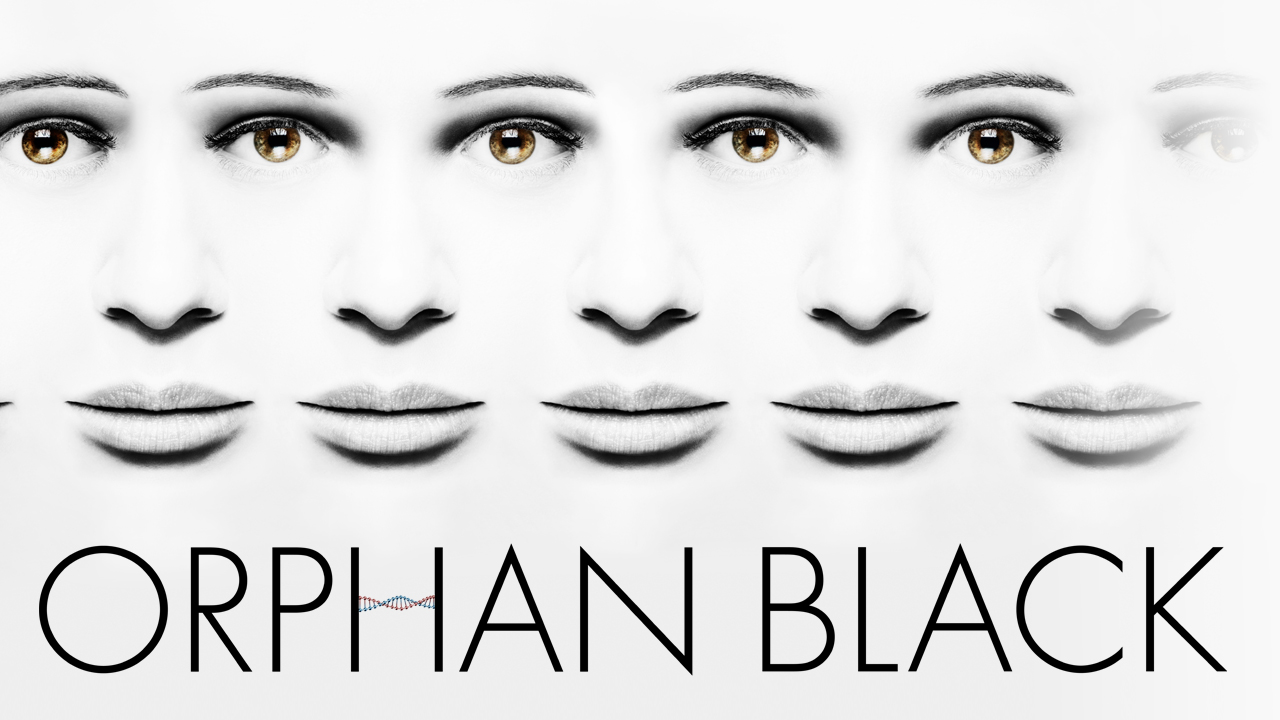
I’m required to start my qualitative take on this season, as any article about Orphan Black does and should, by piling accolades upon Tatiana Maslany, who plays main character Sarah Manning along with a bajillion different clones of all shapes and sizes (I think she plays six of them for at least a moment, but I could be missing someone, and yes, technically I suppose they’re all the same size, but I’m trying to make a point).  She does a phenomenal job of portraying not just different accents but plays different looks and expressions and demeanor so well that even though it’s obviously the same actress playing these roles, sometimes I forget and temporarily think they are just two actresses who look really similar.  More than in nearly any other show, or nearly any other main character, Maslany is the foundation of the show and makes the show go, there aren’t many shows where the star quite literally plays multiple characters.

Jordan Gavaris is the other standout cast member, as Sarah’s foster brother and best mate Felix.  He provides the most constant source of comic relief during the series, and his wit is on point, often deflating otherwise serious situations.  His chemistry with Tatiana is outstanding, both during her performances as primary clone Sarah as well as with her other characters (Alison, primarily).  Orphan Black succeeds because it’s fun; a dreary and over serious Orphan Black wouldn’t work, and Gavaris does the heavy lifting in preventing it from getting there.

This is particularly so when the other main cast members, all of whom are fairly peripheral characters, don’t really add a lot.  Dylan Bruce plays charisma-less hunk Paul, who was in a relationship with clone Beth and now takes up with Sarah, while formerly but no longer working for the evil clone corporation.  Kevin Hanchard is dead clone Beth’s police partner, and he’s, well, he’s fine, and he has more charisma than Bruce, but don’t take that as more than it is because it’s an incredibly low bar.  Michael Mando is slightly more amusing as the mentally unstable drug addled former beau of Sarah (what the fuck she was doing with this guy is never satisfactorily resolved – he shows not one redeeming quality in his sporadic appearances in Orphan Black where his only role is as antagonist gumming up the plot).  Maria Doyle Kennedy plays Mrs. S, Sarah and Felix’s foster mom, who has been caring for Sarah’s daughter Kira, and who is stern but caring, and one of the only secondary characters who gets a chance to show a little bit of pathos in the course of the season. And don’t worry if you don’t recognize these actors’ names; they’re largely Canadian; amazingly just about nobody in the cast is even remotely famous from anything else that an American might know.

So, the side characters by and large aren’t the best.  But that’s okay.  Orphan Black is a roller coaster ride, complete with twists and turns as Sarah and soon her clone buddies Alison and Cosima investigate and learn about a shady underground cloning project they were part of.  It gets seriously conspiratorial but never takes on the super-heavy all encompassing tone that BIG sci-fi shows (Lost, of course the most prominent example, but Heroes, Revolution, Under the Dome) tend to take on.  The plot is important, sure, and there are questions – where did they come from – but there’s no BIG deep premise question which could cause the show to implode upon itself.  The show is more action sci-fi than drama, and it keeps the suspense up and the high-brow stuffiness out.

I’ll admit that if you think too much about the plot it comes apart in lots of little ways, and it relies on a whole series of exceptionally unlikely circumstances happening.  These are points that would likely annoy me if I wasn’t having such a good time watching the show.  If the plot of Lost didn’t work (and it didn’t), I would be (and was) devastated because I spent so much time trying to piece everything together and it didn’t work out.  I didn’t think for a second after watching an Orphan Black episode about where everything fits into place.  Every little plot element might not exactly work together, and sure, it should, but I enjoyed it in the moment in a way I couldn’t enjoy Lost because Lost was buried so deep under its own expectations.

My biggest concern is that Orphan Black is not built for too many seasons. I’m not sure how much plot the writers thought out ahead of time, and while, as mentioned above, it doesn’t have to be sewn together tightly to work, it does have to make a minimum of sense and keep the excitement levels up.  Extending the plot line runs the risk of either artificially stretching it out or making it overly complicated.  I want more Orphan Black; I don’t want a show that’s like Revolution or Under the Dome.  I want a bunch of clones acting in ridiculous ways, and conspiring with one another to infiltrate some vaguely evil corporation.  I don’t want to greater lessons about mankind.