Archive | August, 2013

End of Season Report: Breaking Bad, Season 5 – Part 1

7 Aug

Hey! Bitch! Magnets!

Breaking Bad’s fourth season was a season long one-on-one battle between Walt and Gus, focusing on how Walt deals with utter desperation and ultimately prevails.  The first half of the fifth season is about what happens when Walt wins, and there’s no single enemy to pit himself against.

The season begins with a flash forward to Walt’s 52nd birthday, where he’s eating at a diner under a different name. He purchases a serious weapon from the weapons dealer (played by Jim Beaver) from whom he purchased his gun way back in the second episode of the fourth season.  I don’t often like flash forwards, because I think they usually give away more than they add, and I don’t particularly like this one, but I don’t hate it as much I do some others because it doesn’t either give away far too much or seem like a tease.  Too many flash forwards are gimmicks to make you think one thing is happening, only to show you that you were misled, and this at least doesn’t seem like it exists simply to generate cheap suspense.

Breaking Bad has done a good job of introducing and building a couple of new characters each season, and If season 4 was about expanding the character of Gus, season 5 expands the character of Mike.  Mike despises Walt, seeing all too clearly the traits that are likely to bring about Walt’s downfall; the ego, the arrogance, and the need to be noticed.  Jesse is blinded by his viewing of Walt as a father figure, but Mike isn’t.  Mike wants to kill Walt, threatening to do so in the first episode of the fifth season, and would certainly not want to work with Walt ever again, but the writers know a winning character when they see one, so they not unwisely figure out a way to keep Mike in the show.  The writers find two reasons for Walt to stick around. First, because it’s also in Mike’s interest to figure out a way to destroy Gus’s hard drive, and second, because, in a slight Deus a Mike-ina, he realizes he needs to money to keep Gus’s employees from talking as they’re slowly rounded up and arrested, as the money originally set aside for them is taken by the DEA.  Breaking Bad has excelled throughout its runs in finding ways for certain plot points to happen without making them feel forced, and although we knew nothing about the payoffs Mike was making before this season, the reasoning fits in with all the background information we know.

Mike’s level head continues to provide a contrast to Walt’s fiery ego throughout the season as Mike is reluctantly forced to work with Walt. Naturally, this leads to conflict between Mike and Walt; Walt, as greedy as ever, doesn’t anticipate the extent of the payments coming out of their operation to compensate Mike’s guys and isn’t happy about it.  Walt, the smartest guy in the room, just can’t get it through his thick head how this helps all of them, and as socially stupid as ever, can’t seem to understand the benefit of having a harmonious working relationship at the cost of even a single dollar that’s his.

This is the most caper-happy season, with capers like the magnet ploy of the first episode (obligatory shout out to possibly the best line in Breaking Bad’s history – “Yeah! Bitch! Magnets!”) along with the train robbery, the idea of cooking in the fumigated houses, and to some extent, Walt’s final episode plan to knock off every one of Mike’s guys in prison at the same time.  The train robbery is clearly the capery-ist of these, and while the episode is shot beautifully as always, it seemed a little out of place in Breaking Bad.  They accomplish some incredible feats, and the magnet play fits in line with those, but the train robbery seems one level too far.

Lydia is the new character of the season the way Gus was in the third season and Mike is in the fourth season, though she’s not nearly as interesting as either of those two characters yet, at least.  I wonder if the writers will invest Lydia with more development in the second half of the season, or not want to waste that limited time on her, and merely keep her presence to a minimum.  She seems to serve merely as someone to move the plot along, as she has the list of names of Mike’s guys, she helps Walt and company obtain methylamine, and she spots the barrel that leads the crew to find out the cops are onto them.

My biggest single problem with this season is that Skyler changes her behavior on a dime with no real precedent.  She’s now suicidal and terrified of Walt, and while some of this behavior is justified; I feel like it comes out of nowhere. This is the woman who was okay with lying to the IRS, threatening Ted, and had made her peace, even if unhappily, to launder Walt’s drug money.   It’s not as if it in inherently bothers me even that someone would react that way as much as it does not seem true to character from the Skyler we’ve seen in previous seasons. Utter resignation was never an emotion I got from Skyler, and I couldn’t understand what changed between the end of the fourth season and the beginning of the fifth season that caused her to shift that dramatically.

Train robbery episode Dead Freight presents one of the few instances in which I think Breaking Bad takes a cop out that feels a little bit cheap.  When the little kid sees Walt and Jesse during the train robbery, Todd shoots him before any other member of the crew can issue any instruction.  I think it would have been more difficult and more interesting if Jesse, Mike, and Walt had to figure it out or if one of them had decided to act, but we don’t really know Todd, so his decision has less impact emotionally than Walt, Mike, or Jesse shooting the boy.

With the DEA getting closer, Mike decides things are too hot to continue and Jesse agrees.  Both of them want out, especially when Mike finds someone who will buy the methylamine off them for 5 million each.  Walt, though, wants to continue.  Walt has nothing else in his life at this point.  His wife hates him, as Jesse sees when he stays over Walt’s house for the most awkward dinner of all time, and Skyler does her best to keep his children away from him. Making meth is something he does better than anyone else and he’s finally in the catbird seat after doing it for other scary people.  If he gives this up, he has nothing.  There’s no assurances he’ll ever get his family back at this point.

More notes on the first half of season five coming up on part 2!

End of Season Report: Orange is the New Black

5 Aug

Orange Is Indeed the New Black

Orange is the New Black largely lived up to the hype.  I’m not quite ready to declare it a great show, but it’s certainly a quite good one, and one that better than any show that I can think of in recent times carefully weaves its web in the narrow spaces between comedy and drama.

In fact, what makes Orange is the New Black successful is its placement at the crossroads of comedy and drama. If it were further down on the drama end of TV’s tone spectrum, the show wouldn’t really work.  The light moments would seem inappropriate, improbable, and feel forced.  The occasionally cartoonish behavior of some of the characters would be hard to fathom, and the sense of humor which pervades Orange is the New Black isn’t the type that would transfer well to a serious show, like The Sopranos or The Wire, shows which are both funny but not silly.

If this show would farther on the comedy end of the TV’s tone spectrum, it wouldn’t really work either.  While it’s funny, in the sense that you watch it and say to yourself occasionally, “that was funny,” it’s not laugh out loud funny like Parks and Recreation or New Girl, and the dramatic subject matter and deep bonds generated between the woman in prison along with the actual gravity of their situation – prison is real, and not a joke – would be under-served by the excess humor.  Too much humor would obscure the legitimate terror Piper and the other women occasionally feel in the prison at the mercy of male guards who can be almost as vindictive as they like.

Prison is both real and absurd in the world of Orange is the New Black; it’s both a terrible, restrictive, and scary place to be and a place in which women have to manage to get by day to day, and the mix between drama and comedy suits that contrast so well.  The girls fight constantly but also stick by each other in difficult situations.  People form deeply meaningful individual relationships and get into petty squabbles.  These women aren’t just criminals who don’t have any natural home in civilian society; they’re people like you and me who made bad decisions when put in difficult situations.  While, as in real prison, the inmates are disproportionately poor and minorities, Piper is the representative for the middle class college-educated white twenty-to-forty something which is one of the prime demographics for Orange is the New Black.  People from any walk of life can make one boneheaded mistake and end up in prison.

A couple of quick notes on qualms with the show. I love the lightness and the girls working together; but occasionally the show pushes too far into whimsy for my taste.  The pageant in the final episode offered some great moments, but the notion that of course the one prisoner who had been silent up to that point saves the day with her surprisingly great voice was a little bit too Glee for me; because it’s part-comedy I’m willing to cut a lot of slack, but come on.  I like Pornstache a lot as a villain (and the great name Pornstache) , and he offers some of the best lines, but there are two problems here.  First, I get he’s an asshole, but does he really have to be so ridiculously stupid that he thinks he’s in love with Daya?.  It offers some funny moments, sure, but I think something’s lost in having a show fully of generally intelligent characters have someone just cartoonishly stupid rather than at least simply regular stupid.  Second, it’s a little bit disappointing overall that while the prisoners are portrayed with such complexities, the guard characters get a surprising lack of depth.  I understand it’s a show about the prisoners first and foremost, but a little more development wouldn’t hurt.  The prisoners, who are criminals, are largely decent people who made mistakes – are the guards all one-sided villains?

Secondly, I think the show pushes a bit too hard to make sure we know almost everyone in jail is objectively a good person, no matter how long they’ve been in prison.  The show chooses to do this with the aid of extremely sympathetic flashbacks which show the main prisoner characters and how they get to where they are now, which is prison.  These flashbacks inevitably portray this behavior in a favorable light; even if they did something wrong, they did it for an understandable reason which we can empathize with.  I think the writers were possibly afraid they couldn’t convince us that prison is loaded with pretty good people if the acts that led them there weren’t relatable, otherwise I’m not sure why they felt this was necessary.  In today’s world of complicated television (and, you know, real life), we have the mental machinery to compute that people who did bad things and made mistakes could be good people at heart. After all that’s where Piper stands and if the show thinks we can’t at least figure out that if Piper’s a pretty decent person, even though she made some mistakes, there’s a good chance some of these other women in prison are also, then the show needs to have a little more faith in itself or the viewers.

Overall, though, I don’t need to spend any more time working on what’s wrong with a show that’s such an enjoyable watch.  I plowed through the episodes, often wanting to start a new one just as a finished the previous, no matter what time it was.

I think the show does a very good job overall in displaying the difficulties in maintaining Piper and Larry’s relationship throughout her prison sentence, and blame for its struggles is apportioned all around.  She is the one with the far more difficult situation, obviously, but he didn’t sign up for this when he entered into a relationship with her.  It’s hard to really gin up sympathy for Larry until Piper decides to take up again with Alex, her ex, but that’s such a big deal that it takes a lot of the weight off Larry’s primary transgression (in terms of the relationship anyway; he can be irritating in some scenes outside of prison, like when he’s complaining to a bartender that he’s kind of but not quite hitting on), which is writing about Piper’s prison experiences without her permission.  That’s pretty bad, but her getting together with Alex is a pretty big stab in the heart as well.  In this writer’s subjective opinion, it’s one thing for Piper to cheat on Larry only in terms of sex while in prison, it’s another entirely when it’s with a woman she was in a long-term relationship with previously.  Either way, it’s clearly a topic they should have seriously discussed earlier. These escalating tensions lead to Larry calling off the engagement by the end of the first season, but at least for me, it was a slightly less emotional moment than it probably was intended to be because it seems inevitable that the two of them will reconcile, though maybe the show will surprise me.

After the first few potential villains for Piper become if not friends, people who seem to be able to at least occasionally see eye-to-eye with her, she does get a nemesis eventually in Tiffany “Pennsatucky” Doggett, and she is well, an idiot, and a character who is hard to sympathize with and who is well, wrong, in just about everything she does., The last scene is of the first season is particularly shocking, but I still felt little sympathy for Pennsatucky; all I felt was “Shit, Piper’s going to get in trouble big time for this one.”  Piper’s impulse control is extremely limited and it’s a problem.  Several times during the show she makes impulsive decisions which get her in to trouble, in situations where she may not wrong, but in which her response is not the best one at the time.  To paraphrase the Dude, sometimes you’re not wrong Piper, you’re just as asshole.  Her sense of entitlement is both a frequent source of humor and of irritation.  While I likely sympathize with it more than many, because I’m afraid I’d act the same way, sometimes I just want to shake her and tell her shut the fuck up.

What makes Orange is the New Black succeed most of all is the love and complexity it imbues its characters with and its impressive ability to display the seemingly obviously truism that  people aren’t usually all right or all wrong, but are usually a little of both. I’m not sure what the natural next phase is for the show’s second season but I’m looking forward to it.

Lastly, the theme song began to grate after watching several episodes in a short period of time; I’m on the first half of this argument, especially since I have a personal policy of never skipping a theme song, no matter how many episodes are watched in a row.

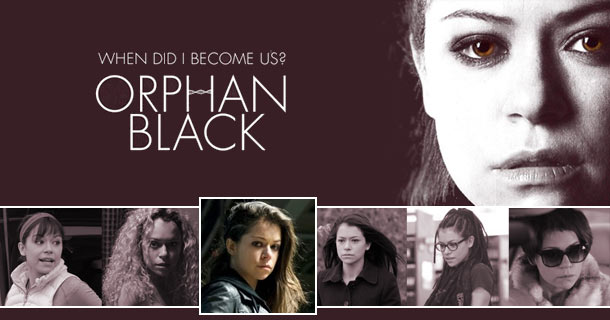
Spring 2013 Review: Orphan Black

2 Aug

OrphanBlack1

Orphan Black takes place in what seems to be the very near future in what I think is actually Toronto but seems to be an unnamed Canadian city.  I can tell it’s the near future because it looks pretty much like today but the train station at the beginning is called “Huxley Station” which sounds like a perfect dystopian name for a train station and it seems like their science is ever so slightly more advanced than ours.

Sarah, who we don’t even know is Sarah at this point, is transferring trains when she sees a woman slowly and methodically put her bag down, take her shoes off, and walk right out in front of a train.  Watching a woman commit suicide would be traumatizing in any situation, but the thing is, this woman looked exactly, and I mean exactly, like Sarah.  Sarah, who seems to be some kind of minor criminal personage, thinks enough to take the woman’s bag.

It turns out Sarah is on the run from a crazy ex-beau, Vic, and back into whatever this city is, where she’s left her best friend/foster brother, Felix, and her kid (looks to be about, I don’t know 6?), for the better part of a year.  She’s being chased by said ex-beau, and a brilliant idea comes to her when she snoops around and find out that the woman who killed herself has a nice apartment and 75K in the bank, and really, really looks like her.  She’ll pretend the dead body was hers and take over the woman’s life.  What Sarah wants at this point is to get her daughter, who’s being raised by her foster mom, and Felix, and get out of Dodge (proverbially; I don’t think the city is named Dodge, though I can’t be certain).

Problem is, she realizes, the woman, Elizabeth Childs, has troubles of her own.  She’s a cop, who has to face an inquest after shooting a civilian a few months ago, apparently has some sort of pill-popping issues, and has birth certificates from other woman born around the same time as Sarah and herself in a safe deposit box.  Sarah gets a call, on Beth’s phone, from someone, who is on one of the birth certificates.

She’s watching her own wake from afar when a German who has pink hair but otherwise looks exactly like her gets into her car, and then very shortly after gets shot; the person on the phone tells her to go bury the body, which she does.

All Sarah wants to get out of town with some money, Felix, and her daughter, who she’s hoping won’t think she’s dead, but before she can do that she has to get through the troubles that Beth’s life has caused her, while still facing her inherent curiosity into why there are several people running around town who look exactly like her, and a couple of them seem to be dying.

Tatiana Maslany, who plays Sarah, and every Sarah lookalike, gives an incredible performance as multiple characters with different looks and personalities; she’s so convincing at separating the characters that I often forget that it’s her playing every role. The show gives you just enough information to make you really want to know more about what’s going on.  Many serial science fiction shows try this feat – to dole just enough plot  each episode to make you hungry for what you’re missing, but it’s a difficult pacing battle that most shows in this genre fail at.

Additionally, very few succeed in the most important test for a first episode – after I finished watching, do I immediately want to pop on the next episode.  I did, when watching Orphan Black, which feels more like a tight science fiction thriller than one of these grand central mystery science fiction shows like Under the Dome, Revolution, or Terra Nova, etc.   It also has some of the classic paranoia/conspiracy vibe of ‘70s neonoir; there are people watching you everywhere, you never know if anybody is really on your side or working against you, and you don’t know if anybody really is who they say they are.

On first impression, Orphan Black feels cool (I know that’s such a non-technical world, but that’s really the first word that comes to mind, both in the sense of low-key ’70s sunglasses-on slick, and the thirteen year old (or hell, me, still) watching a stadium implode thinking “that’s so cool”) and well-executed. The camera work is smooth, the plot moves, not action-movie fast, but fast enough that it never feels plodding, and we know just enough to know how little we know. We follow along with Sarah, knowing, for the first episode anyway, what she knows and nothing more, and we’re constantly being surprised when she finds a new piece of the puzzle.

There’s always the caveat that these things go wrong, because it’s easy to screw up, but I think this should be less difficult to handle than the big sci-fi shows (Revolutions, Under the Domes, etc) because Orphan Black smartly slowly rolls out its premise, rather than putting out an epic central mystery right away which is hard to fulfill while being both plausible but not anticlimactic.  It should be easier to have a taut story that works, unless this plot goes so much wider and deeper than I’m imagining at this point. Again, dramas are lost but rarely won in the first episode but there’s easily enough here to move forward. It’s fun, which is something a lot of the more bloated science fiction shows on television lose in their attempt at deeper meaning and emotional heft.

Will I watch it again?  Yeah.  It was pretty exciting, and had a cool factor, like a well-engineered science-fiction action movie.  Plus, there’s only ten episodes, so the commitment is relatively minimal, which doesn’t hurt.  It’s a fun ride without any of the huge overarching-ness of the epic sci-fi series that have just disappointed me over and over again in recent years.