Archive | July, 2013

Who had the most affairs? Tony Soprano vs. Don Draper

10 Jul

Tony's hungry

In the light of The Sopranos’ star James Gandolfini’s unfortunate recent passing, and the end of Mad Men’s sixth and penultimate season, there’s no better time to answer the most pressing question concerning those two shows.  Who cheated on his wife with more women, Tony Soprano or Don Draper?  To find out we’ll dive through the respective sordid pasts of these two legendary television philanderers, going back and forth one-fo-one chronologically between the shows.  Because the Sopranos started first, we’ll start with Tony.  Apologies if I’ve missed any; I did my best to scour through the episodes of both shows for every affair, no matter how brief, but these two characters didn’t make it easy.

Tony:

Irina Peltsin – One of the two longest extramarital relationships Tony is involved in over the course of the series, Irina is Tony’s comare from the pilot until the second to last episode of the second season when he attempts to break up with her, thinking she deserves to have a real life.  She doesn’t take it well, breaking down and trying to kill herself, which will be the start of somewhat of a tradition for Tony’s mistresses.  Tony sends Silvio over to her place to give her a nice $75,000 severance package and urge her to move on.

Don:

Midge Daniels – Like Tony, Don Draper is cheating on his wife from the get go.  In the first episode we meet the bohemian artist Midge who seems fittingly more reminiscent of the late ‘50s than the ‘60s.  Seemingly opposites, they  nevertheless have a fairly good run, as one of Don’s longer extramarital affairs, lasting until the eight episode of the first season, when Don unsuccessfully tries to get her to go to Paris with him. Things don’t go well after that for Midge who shows up in a later season as a drug addict.

Tony:

Connie Desapio – Desapio is a receptionist at Barone Construction, a Soprano family operation which Tony spends some time at, based on legal advice to appear like he’s actually doing the job he claims to have.  They have sex to pass the time in season two, episode 11, “House Arrest” until Tony goes back to Satriale’s eventually out of boredom.
Department Store Heiress

Don:

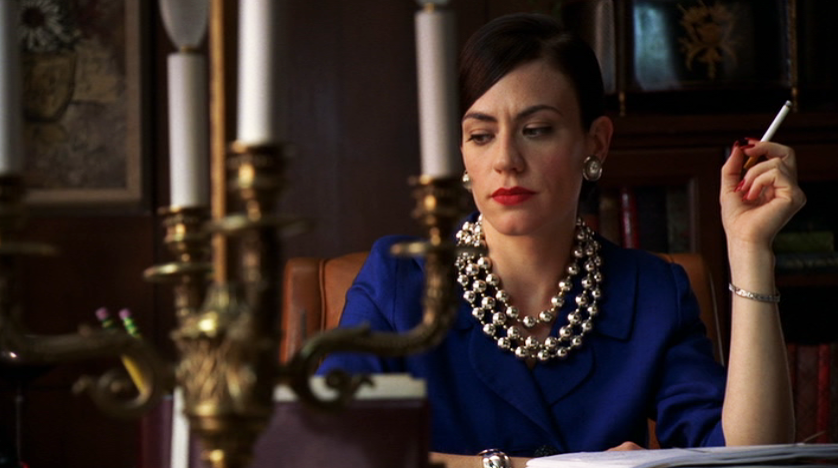
Rachel Menken – Rachel, who initially hires the firm to create interest for her department store, was a very different kind of woman from Midge.  She meets done in the series’ first episode as a client, and initiaully rebuffs Don’s advances, upon finding out that he’s married.  They finally begin the affair in the tenth episode of the first season.  She puts the kibosh on the affair in the 12th episode of the first season, when, after Don proposes running away to LA together, she realizes that he just wants to run away, but not necessarily with her.
Globe Motors Saleswoman

Tony:

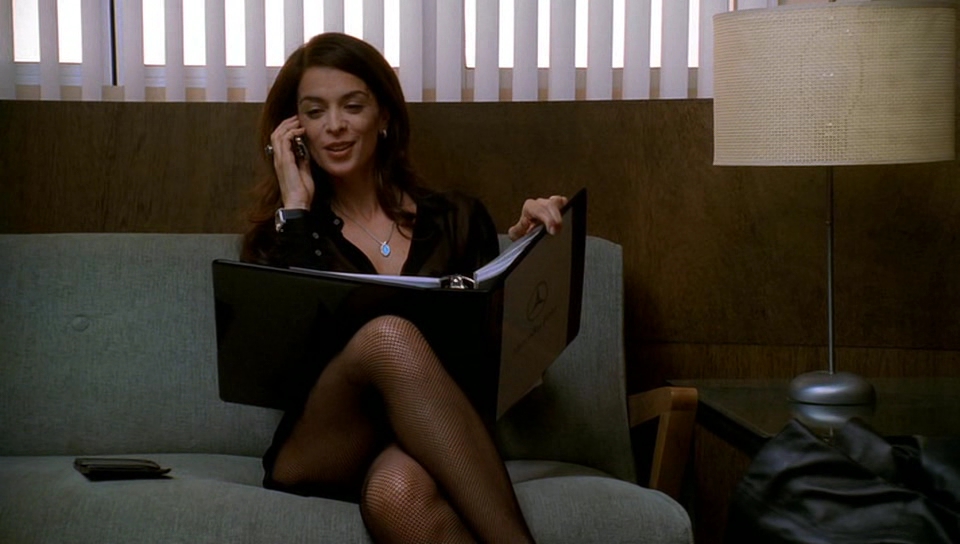
Gloria Trillo – Trillo is a car salesman who Tony meets in Dr. Melfi’s office in season three’s “He is Risen.”  The most mentally unstable of Tony’s affairs, which is a dubious honor, she tries to provoke Tony into violent reactions.  Tony breaks up with her because of this, and Patsy Parisi threatens her, telling her to never come near Tony or his family again.  Later she hangs herself.

Don:

Bobbie Barrett – Barrett, introduced in season two’s “The Benefactor,” is married to and manages insult comic Jimmy Barrett, who Sterling Cooper recruits to appear in ads for Utz potato chips.  Barrett is the only woman Don sleeps with that we know is married, and she affirmatively seduces Don, who makes a brief attempt to turn her down.  The affair hits an awkward moment when Don and Bobbie are caught in a car accident together, but ends finally when Don finds out Bobbie has been gossiping about him behind his back.

Valentina

Tony:

Valentina La Paz – La Paz is the other long-time Tony Soprano comare.  She’s dating Ralph Cifaretto at the time that Tony and her get together after having lunch at Hesh’s house in season four episode “Mergers and Acquisitions.”  Tony breaks up with Valentina towards the end of season five when he arranges to move back in with Carmela, after she suffers a serious burn injury.  She, continuing a pattern, threatens to kill herself when he leaves.

Don:

Joy – In season two, episode 11, “The Jet Set”, Don takes a trip out to Los Angeles, where he meets a young woman, Joy, near the pool at his hotel. They attend a surreal dinner party and afterwards have sex.  Later, she and her friends and her dad move to the Bahamas, while Don returns to reality in New York.

Tony:

Svetlana Kirilenko – Tony and Kirilenko, earlier comare Irina’s cousin and Junior’s nurse, have sex just once, as far as we know, in season four episode “The Strong, Silent Type.”  She is far and away the most put together woman Tony cheats with on the show and she breaks off their relationship, though Irina later spills the beans to Carmela, helping to lead to Tony and Carmela’s separation.

Don:

Shelly – In the first episode of season three, “Out of Town,” Don meets a stewardess named Shelly on a flight to Baltimore.  She invites him and Sal to dinner at the hotel at which they’re all staying and after their meal, one thing leads to another.

Tony:

Sonya Aragon – An exotic dancer Chris used to hang out with, Tony meets up with her in Las Vegas after Chris’s death in season six episode “Kennedy and Heidi.”  They have sex, smoke weed, and take peyote.

Suzanne

Don:

Suzanne Farrell – Suzanne and Don first meet during a parent teacher conference in the second episode of season three while she’s Sally’s teacher.  They meet several times before the relationship becomes romantic.  She’s a bit of a hippy, and has a troubled brother who she cares for deeply.  She falls for him and wants to go out together in public, something Don almost grants while Betty is out of town.  The affair ends when Betty returns early and inquires about Don’s past which causes Don to call Suzanne to let her know it’s over.

Sylvia Rosen

Don:

Sylvia Rosen  – It seemed like Don had finally become faithful with Megan, but his faith waned at the start of the most recent sixth season when it turns out he’s been having an affair with neighbor Sylvia.  This affair was doubly nefarious because Don seemed to actually like Sylvia’s husband Arnold, and there aren’t very many people in Mad Men that Don likes.  The affair came to a temporary end when Don was simply too cruel and Sylvia decides it’s over, but is rekindled when Don helps get Sylvia’s son out of serving in Vietnam.

Don:

Betty Francis – Yes, I almost forgot this but Don cheats on his second wife with his first wife.
Don

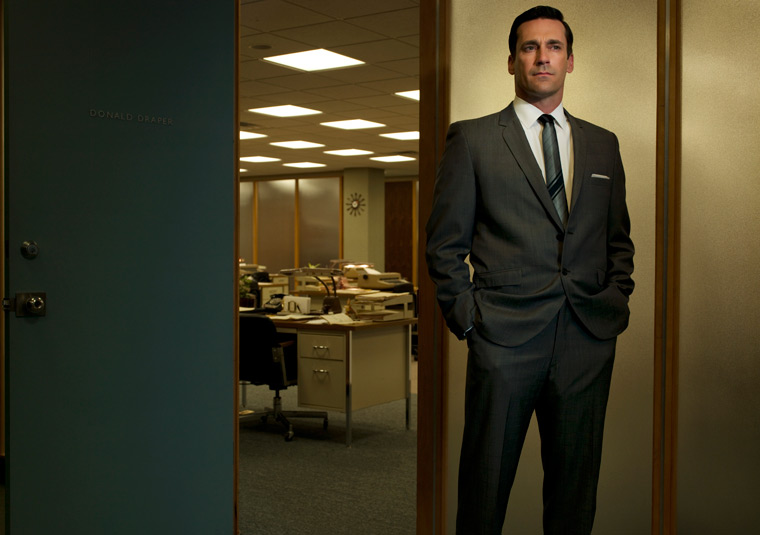
Don takes a tight 8-6 victory, but with all the other people Don and Tony must have slept with before the shows started, who can possibly say what the actual score might be.

A couple of quick notes on women who were excluded:

This is a comparison of women Don cheated with, so in season four, when he was divorced, all his affairs were on the up and up.  Still for completion’s sake, here’s a quick rundown of all the women he slept with in season four.  His most ongoing relationship was with the age appropriate Faye Miller, a ratings analyst who he breaks up with at the end of the season when he instead chooses to be with Megan, who he proposes to soon after.  In between, he sleeps with a call girl Candace, in the first episode of the fourth season, a secretary named Allison whose heart he breaks in the second episode, a waitress named Doris in the sixth episode as well another unnamed woman, and Roger’s wife’s Jane’s friend Bethany in the eighth episode.

Tony was separated from Carmela for most of the fifth season of The Sopranos, so I chose not to count any sleeping around during the separation.  In the 11th episode of the fifth season, “The Test Dream,” he hires an escort while he’s staying at the Plaza, and they presumably sleep together. In the first episode of season four, Tony and his gang party with a bunch of Icelandic stewardesses but there’s no clear evidence indicating Tony necessarily slept with any of them.  Tony almost has an affair with real estate agent Juliana Skiff, but they never consummate it as Tony decides to remain faithful to Carmela, and Skiff and Chris take up together instead.
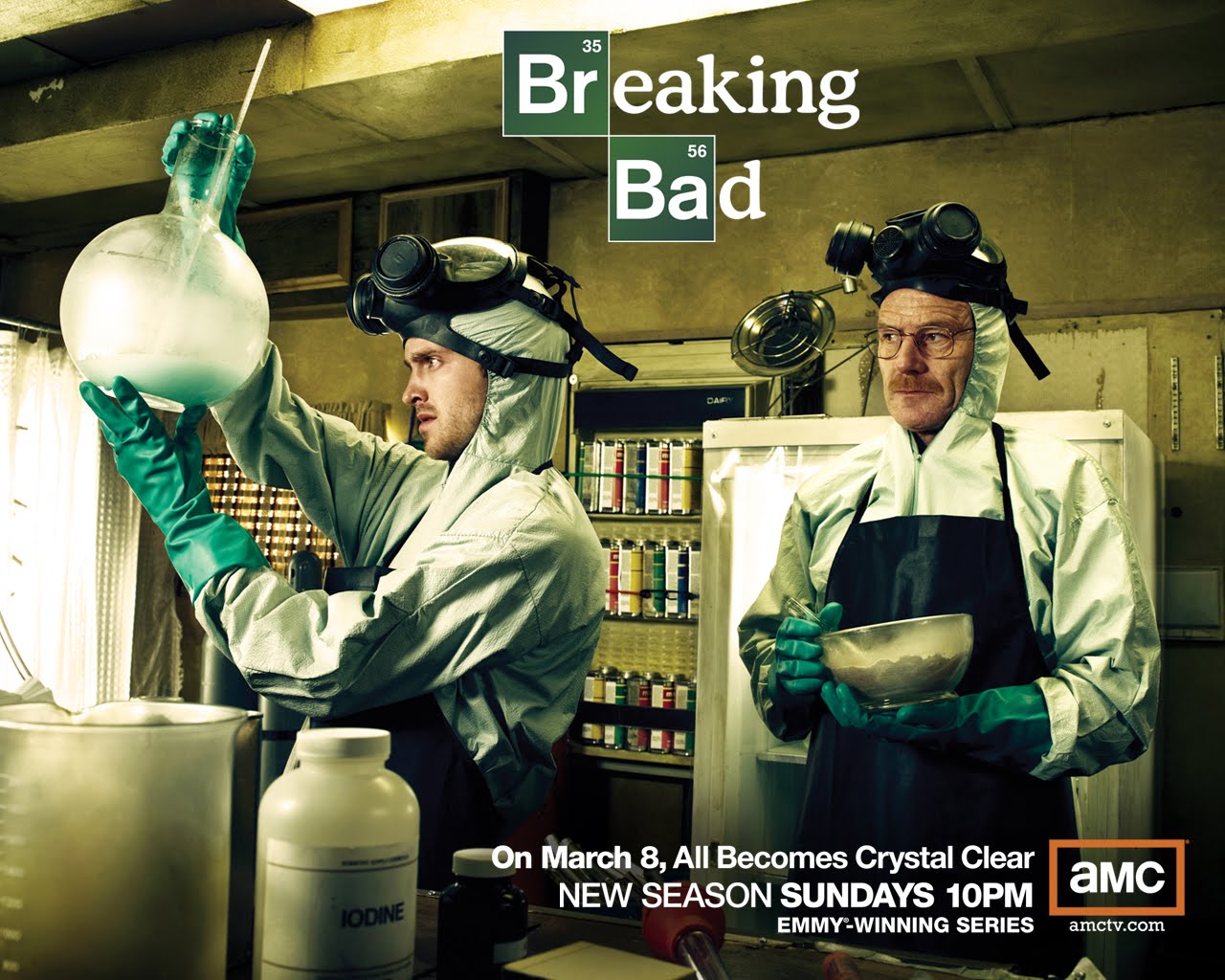

End of Season Report – Breaking Bad, Season 3

8 Jul

It's a cookbook!

The pivotal moment in the third season comes about halfway through when Walt makes his most serious attempt, at least until the current season, to quit the meth business.  Rewatching the season, he came even closer to leaving than I remembered. Looking back from the fourth and fifth seasons, his time in the super lab seems so inevitable, but it really wasn’t.  By the later seasons Walt has made peace with being the bad guy to some extent.  But in season three that’s still problematic for him.  He’s still out largely to make money for his family, even if that motive has comingled with his enjoyment of doing something that he’s good at and his ego-fueled refusal to know when to leave enough enough.  He takes concentrated stock of his life.  He didn’t imagine losing his family and isn’t happy about it.  Maybe he’s gone too far, he thinks, and maybe it’s time to put his family first. His marriage is looking to be in pretty awful shape with the revelation that Skyler fucked Ted, but Walt isn’t ready to give it up.

Jesse, who, unlike Walt, sees himself as the bad guy now, in the wake of Jane’s death, unsuccessfully tried to talk Walt into making more meth, and when that failed announced that he was planning to go forward with a solo venture.  That succeeded in making Walt furious. What right did Jesse have to make his product, Walt thought, but it wasn’t enough to make him reconsider.  Rather, getting Walt back to cooking took the deft convincing of chicken restaurant owner and drug kingpin Gustavo Fring.  In his persuasive oratory, Gus gives one of the most famous speeches of the series, and rightfully so, when he explains to Walt that “A man provides.” Gus is a studied master in the art of dealing with people, and in this speech he plays upon all of the personality aspects likely to convince Walt.  He speaks to Walt’s ego, and his desire to be the provider.  He gives Walt an out for being the villain.  All that matters is that he’s making money for his family, because that’s what a man does.  Who cares what other people think of him?  Who even cares what his family thinks of him now – he got in the business to leave something behind when he’s gone, and he needs to do it, whether they appreciate it or not.  After the speech, Walt is in, and he’s now all in.

Season three, like several Breaking Bad seasons, takes a while to get going.  The cousins are mysterious but are more responsible for a couple of the great vignettes that Breaking Bad is so good at putting together than for any actual plot.  They’re hardly characters themselves; their primary value is in how they affect the other characters, which doesn’t come until later in the season.

I’d like to put an end to the idea that Walt doesn’t care about Jesse, which I’ve heard so many times in the past couple of years in the wake of Walt becoming more hard-headed and full of himself.  I’m hardly calling Walt an altruistic saint, but what he does in the second to last episode of season three, he does at least partly because he cares for Jesse.  It’s easy to forget that Gus and Mike wanted to kill Jesse, and Walt basically tells them that he won’t work for them if they do.  He puts his ass on the line for Jesse.  Walt kills those two drug dealers because otherwise Jesse would have, and he shelters Jesse when Gus wants him dead.  Walt may ask a lot from Jesse to kill Gale, but it’s hardly unearned.

Famous bottle episode Fly, the tenth episode, marks the second major transition in the season.  The episode itself slows everything down for forty minutes.  It’s a look back before the final three episodes move forward at breakneck speeds.  The episode itself builds; the first few minutes are paced in such a way that you feel like Jesse, thinking who the hell cares about this stupid fly, but then, like Jesse, as Walt goes forward, you get involved.  Walt, and the show, use this moment to take stock and reflect on how far we’ve come in three seasons and what mistakes were made and how the original plan didn’t turn out exactly like it was supposed to.  By the time that Walt admits it’s not really about the fly anyway, as was pretty obvious from the beginning, it no longer really matters.

The last two episodes are riveting and in and of themselves worth the slow build of the season.  I challenge someone who hasn’t seen them before to find a chance to take a breath during either Half Measure or Full Measure.  It’s remarkable how quick the suspense is ratcheted up after the comedown of Fly.  The clock is ticking for Walt and Jesse after the events of Half Measure, where Walt kills two drug dealers to spare Jesse from doing it himself. The last episode is basically a race to figure out how in the world Jesse and Walt are going to make it through the next forty minutes of TV with their lives, considering Gus Fring is a much more serious enemy than any they’ve ever faced before.

Season three marks a transition between seasons two and four.  The show becomes less about little personal moments and more about broad strokes that are intricately plotted.  The scale is much bigger.  Walt and Jesse are no longer working out of a trailer, but instead are supplying meth to the entire southwest.  Some of the small, everyday moments from the earlier seasons are lost.  Walt is no longer a regular person with a small hobby, and his family is no longer a regular family.  After my rewatching, I have more understanding of people who choose the second season as their favorite than I did the first time I watched through. However, with the loss of the small comes the gain of the big.  Subtlety goes out the window but Breaking Bad also plays well on a much more epic scale.    Breaking Bad continually breaks out twists and turns that are never obvious but don’t feel forced either.  Character motivations are extremely well-handled; the decisions made by all the major characters which lead to the various predicaments make sense within the context of the show.  Gus and Mike come into play and both are hugely welcome additions to the show.  This is the big time now.  Walt and Jesse are no longer dealing with chump change and highly unstable drug dealers like Tuco.  Walt may make mistakes, but they’re because of his greater personal flaws, rather than because of his bumbling I-can’t-believe-I’m-dealing-with-violence-I’m-just-a-chemistry-teacher attitude.

I wouldn’t leave off a Breaking Bad review without a shout out to the sheer cinematic qualities of the show.  The technique is brilliant; there are beautiful set pieces.  Even scenes that seem irrelevant to the plot are beautifully filmed vignettes in their own right that tell their own micro story with style.  No show films better montages than Breaking Bad, and I’ll leave with the montage of Jesse’s friendly hooker friend Wendy, set incongruously to The Association’s “Windy.”


End of Season Report – Hannibal, Season 1

5 Jul

Listen to the music Marge! He's evil!

Right from the beginning, I described Hannibal as dark.  It’s dark in its plot and it’s sensibility but also simply in its look; lots of shadow and lots and lots of blood and guts.  This isn’t your grandmother’s show about serial killers.  There’s some gimmickry, but none of the flash and glamour that surround solving crimes on the big crime procedurals.  No, the crimes committed by the serial killers in Hannibal are disgusting and horrific and there’s no getting away from that.  So much so that main character Will Graham is constantly haunted by the crimes, as he gets way too close in his mental exercises to find the killers.    Sometimes it was even to dark for NBC.  There was an episode where a woman kidnapped kids and convinced them to kill their families, which was yanked from the schedule in the wake of, I’m not sure, just because, well, it’s shocking that this is even on NBC to begin with.

Point being, I knew the show was dark.  But the ending of the season even outdid my reasonably dark expectations.  How many first seasons end with their protagonist in an insane asylum?  One for the criminally insane, I might add; this is a special loony bin for the most depraved.  Yes, that’s what happens.  Cannibal and psychopath Hannibal Lecter, who at this point in our story is a revered psychoanalyst assisting the FBI, frames agent Will Graham, who also happens to have a very serious neurological condition called encephalitis which basically interferes with his very ability to deal with reality.  Just about every character thinks by the end of the season that Will Graham is responsible for a slew of murders including one of the girl who was the daughter of a serial killer and whom he has been mentoring for the entire season.

Of course, this is every so slightly lightened by the fact we know eventually Hannibal Lecter is going to wind up in that loony bin himself, with Graham on the outside, assuming creator Bryon Fuller doesn’t totally decide to throw the source material into the garbage can.  Plus, there’s only so much Graham can do from inside the mental asylum.  You’d have to think merely for plot purposes he’d get out sooner or later.  Still, this is a pretty rough stretch for Graham.  How he worms his way out of this, picks up on Lecter’s guilt, and convinces anyone else should be an interesting journey for the next season.

I complimented Bryon Fuller on this early on in the season but again I think plaudits are in order for his ability to take source material we know and make it fresh again. This is doubly so because it revolves around the tension of a free Hannibal, who we all know is a killer, screwing up the FBI and our protagonist even while we want to shout out, come on, he’s evil, have you guys never seen Silence of the Lambs?.

This is a serial show that would normally be a procedural.  I could imagine this show produced by Jerry Bruckheimer and it would be an extremely different show.  Watching the first few episodes, I kept expecting it to break out in a full procedural with a new killer every episode and little hints and bits of continued serial plot just to keep us interested in not missing an episode.  But that’s not what happened at all.  Instead it played by its own schedule, weaving seamlessly between new killers and the existing long term serial plots.  The one continued strain was the general unraveling of Will Graham’s mental state.  A slower episode would be followed with a faster episode, an high action episode with an more patient psychological pot boiler.

This show isn’t covering new territory.  We see the FBI and police catching murderers all over TV.  Will is a savant, a character, we see in different forms throughout TV and movies as well.  What we don’t see as often is the downside to savant-dom.  Usually the heroes of killer-catching movies and TV shows are one sided; they may have tragic pasts but they rarely have tragic presents.  With Will, there’s a cost of doing what he’s the best at.  Watching Will slip slowly deeper into the bounds of mental instability is both difficult to watch and captivating at the same time and is what makes Will a  much more interesting character than most versions of this stock model.

It’s gorgeous, it’s dark and it’s compelling.  If you don’t like excessive gore, it’s not for you, but otherwise it is.  It’s not a brilliant revelatory show like Mad Men or Breaking Bad, but there isn’t any other show on TV quite like it.

Summer 2013 Review: Under the Dome

3 Jul

Dome-tastic

Under the Dome is an extremely literal title.  The main characters, primarily the residents of the small (presumably New England, since it’s written by Stephen King, but not specified that I can recall) town Chester’s Mill, along with some people who were passing through, are completely trapped from the outside world under a giant mysterious dome.  So far, we know nothing can go through the dome, including sound, and citizens haven’t yet found a way to contact anyone outside the dome.  The only method of communication is through sight on either side of the dome.

So that’s our big premise, taken from a recent Stephen King novel of the same name.  That’s by far the most important part of the first episode.  The second task of the pilot is to get a passing look at who we can guess will be our major characters.  Here they are in short.  First, you’ve got chief of police veteran Duke (Jeff Fahey, pilot Lapidus on Lost), and his younger chief deputy Linda, engaged to a firefighter outside of the dome.  Due to poor timing, many of the town’s police were out of town participating in a parade.  There’s “Big Jim” Rennie, car salesman and town council member (played by Dean Norris, Hank from Breaking Bad).  Big Jim and Duke have a tet a tet most of the way through the episode and appear to be keeping some sort of secret from most of the town involving bringing in lots of propane.

There’s a pair of erstwhile summer lovers, teenagers Junior and Angie.  What was a fun little fling goes bad when Angie doesn’t reciprocate Junior’s love, and Junior turns out to be some sort of psycho and kidnaps Angie and locks her away in a fallout shelter.  Joe, a high schooler, is Angie’s younger brother.  They’re both parentless for the duration of the dome.

There’s a Barbie, an ex-military out of towner who was looking shady at the beginning and could be either good or bad.  He appears to have been on some sort of mission that involved needing a gun and looks a little like Jeremy Renner.  He’s staying with local journalist Julia for the time being whose husband is missing and/or dead and/or having an affair.

Phil is a local radio DJ, and Dodee is his engineer at the station.  Alice and Carolyn are parents just passing through en route to drop off their troubled, rebellious daughter Mackenzie at camp, before they get trapped (if only they hadn’t stopped at that one gas station).

Those are from what I could suss out the major characters, though there may be more introduced later, and some of the characters I described may turn out to be more minor than I could have figured from the premiere.

There are two major fronts then to work with in Under the Dome.  There’s the question behind what the dome actually it is, how the characters find that out, if they can communicate outside the dome, get anything in, etc.

Then, what will probably occupy more time, is how everybody deals with the situation that arises when the characters realize they’re cut off from the rest of the world.  Separating all the characters from the rest of society under the dome should give us a set up for the classic science fiction situation of an external futuristic (or supernatural) power forcing humans into difficult and unusual situations.  They’ll have to decide whether to work together or compete and act outside of the ways they do every day, revealing their true natures. Do people look out for each other and help to store food for the good of the whole town?  Do they form gangs and compete and engage in violence?   It’s a classic Lord of the Flies scenario, and the dome is their island.

As I’ve said time and again, I’m a sucker for high concept serial science fiction shows.  I know by now better than to get too excited from a mere one or two episodes of a series.  Big sci-fi series like these so often disappoint, and they’re a thousand times easier to begin than to end (or to, well, middle, for that matter).  It’s not particularly difficult to think of a wacky situation and create a cast of characters; it’s much harder to flesh out those characters with realistic and believable motivations and create a plot that obeys the rules set out by the show, and is compelling, well-paced, and not anti-climactic.

This has the building blocks.  The reason it’s intriguing is solely the future possibilities but it’s hard to ask for too much more out of a first episode.  There’s nothing about the writing or the characters or the film work that stands out, but I’m affirmatively intrigued due largely to the plot, and with pilots, if the plot is compelling enough that can be enough, especially for sci-fi or fantasy.

Will I watch the next episode?  Yes.  It’s on CBS.  I can’t remember the last show I’ve watched a second episode of on CBS.  I’ve repeatedly faced let downs with these types of shows; I watched multiple episodes of Revolution which I regretted quickly, as well as Terra Nova.  I’m probably never going to learn completely.  All I can do is know my own biases and prepare myself for the likely disappointment.  In its favor, this at least this has some source material by a credible writer to work with, and is created by Brian K. Vaughan, a comic writer whose work I’ve enjoyed.

Summer 2013 Review: Ray Donovan

1 Jul

Liev Schreiber is RAY DONOVAN

After an opening which shows Jon Voight getting out from prison, Ray Donovan begins like a USA program; I could even imagine the narrator explaining the premise, with something like this.  “Ray Donovan, LA’s fixer to the stars, is the best at what he does.  The rich and famous have problems, and he, along with his super team, including the accent-challenged Avi and the spunky lesbian Lena, fix them.”  We quickly see just how effective they are when they solve two problems with one stone, getting a sports star who woke up next to a women who ODed overnight out of his situation by swapping in an actor who was dealing with accusations of having picked up a transvestite hooker.  See, for actors, being found next to a dead woman ain’t no thing.  Hollywood!

We also see that Ray is a bit of a rebel.  He doesn’t play by the rules, and that sometimes gets him in trouble with his team, and his boss, who is played by the always wonderfully sniveling Peter Jacobson.  Supposed to spy on a woman for a scummy rich dude, he instead warns the woman, who he happens to know from an earlier encounter, of a stalker.  He then proceeds to make out with her.  He’s not afraid to get his hands dirty either, threatening the stalker, covering the stalker in green die, and then beating him with a baseball bat when his earlier threats don’t succeed.

Ray is a very serious character who comes from a very fucked up Boston Irish-Catholic family (if you can’t recognize the Boston accent from real life, you should recognize it from Ben Affleck movies over the years).  His dysfunctional family includes his two brothers, one of whom was molested by a priest as a child and is now an alcoholic, and the other who developed Parkinson’s from one too many shots to the head during a boxing career.  His sister jumped off a building years ago while drugged up.  And his dad, whom he hates most of all, just got out of prison after 20 years and is coming to find him and his wife and kids, whom are the last people Ray wants his dad spending time with.

So those seem to be the two main threads of the series, his job and his family, all shaken up now by the reappearance of his hated dad after many years.  Ray’s got to balance his job, doing terrible things for rich people, with his inner sense of right and wrong, and he has to be the rock in his otherwise fucked up family, keeping together his troubled brothers while fending off his father.  I half expected the narrator to announce during a credit sequence, “This is the story of a family from Boston living in LA, and the one son who had no choice but to keep them all together.”

Ray’s got to do it all, and you can probably understand why he doesn’t crack a smile during the episode, or, really, say more than maybe 50 words.  His silence and straight face imbue him with some combination of mystery, intimidation, and sex appeal, to the different characters in the show.

Ray Donovan was not a bad show, but it was a surprisingly generic show.  Rather than seem inherently different and new, it seemed like it was trying to take some of the same themes that show up all the time on broadcast and the “light cable” (TNT and USA) networks and give them some serious edginess so that you know it’s premium cable.  Ray gets drunk.  Ray considers screwing a post-adolescent pop star who adores him.  Ray beats up a man with a baseball bat.  Unlike in an USA show as well, Ray’s job involves not infrequently doing what all involved admit are terrible things.  These facets made the show darker and give it a wider swath of possibilities for future development; shows on Showtime are allowed to have more complicated, serial plots, that USA shows can’t or won’t. However, nothing in this first episode takes advantage of those possibilities.  It seems more like a matter of degree than a fundamental difference from that classic USA or TNT format.

Ray’s got demons, and he’s going to have to face these demons.  He’s great at a really cool but risky job.  I can see the avenues worth exploring,   The tensions between his old family and his new.  The moral difficulties of committing terrible acts as part of a living because that’s his job. There’s clearly a mystery to his past, and to what he did to ensure his father stayed in prison and why.

I liked the family plot better than the work plot from the first episode, but still it hewed a little too close to cliché.  These clichés can be broken with the detail and depth that hours and hours of a television series can offer, which is one major advantages over film.  Still, I wish the pilot had delved deeper into one area of Ray Donovan’s life to try to really heighten the appeal and show off a little early complexity rather than throw the kitchen sink of potential plots (his family, his brothers, his work, his mentor) but attack them all on a surface level just as a preview of all the characters you’ll be seeing this season.  There was no semblance of focus.

The genericism of the story lines isn’t necessarily something that can’t be transcended through further episodes.  In the first few episodes, Justified looked like a simple procedural with a cop who didn’t play by the rules before it grew into something excellent.  I enjoyed the first season of Hannibal, which hardly breaks new ground, greatly.  Still, it’s hard to make this type of show work without a charismatic lead.  What everyone in the show saw as mysterious or silently uber-competent, I saw as stiff and uninterested.

There was enough that I was on the fence.  All I wanted was a five minute sequence in the episode that convinced me, damn, this is a show that is required viewing, a moving moment, a stirring speech, and a stunningly filmed confrontation, and then I could figure out exactly what’s good about it later.  I didn’t get that.

Will I watch it again?  Honestly, from this episode, probably not.  If it picks up buzz and I start hearing that it gets good, I’m perfectly willing to give it a second chance, and I do think there’s a non-negligible chance that I’ll have given it a couple more episodes before the end of the season.  My expectations are always ramped up a little bit for premium cable shows and I was kind of let down, less by the show being bad, and more by the protagonist not seeming particularly compelling, and the show not offering me at least a little something new or different or exciting me in any particular way.