Archive | May, 2013

Spring 2013 Review: Family Tools

8 May

Family Tools!Well, when season finales for all your favorite network shows are airing, you know it’s time to burn off the shows that at some point were meant to air as midseason replacements but were later chosen to simply die off quickly and quietly in the months of April and May (shows like Bent and Best Friends Forever were featured in this role last year).  Family Tools, which will not be on the air long, fits the bill, and stars the official new king of the quickly cancelled comedy, Kyle Bornheimer.  Bornheimer, who stars in Family Tools as Jack, a wanna-be do-gooder screw up who can’t find a career and takes over his ailing father’s handyman business, is being featured in what is remarkably his fourth new show since 2008.  The other three are Worst Week, Perfect Couples, and Romantically Challenged, though I remember him best as asshole Ken Marino rival Mark Delfino in the high school reunion episode of Party Down.

There’s a surprising amount of star power in this mediocre sitcom which has no chance of being successful.  Bornheimer’s dad is played by the legendary JK Simmons, who you will have to torture me before I say a bad word about, and his aunt, Simmons’ sister, is played by Leah Remini of The King of Queens fame.  When Simmons has a heart attack, Remini makes him cede his business to his clueless son, who means well but has absolutely no idea what he’s doing.  The son has to contend with a co-worker who half asses it, his slightly off 15-year old cousin who he must share a basement with, and his co-worker’s attractive sister who works at the hardware store and flirts with him constantly (I guess not so much contend with that last one).

Even if I hadn’t known Family Tools was an ABC show, I would have guessed as much, as it totally vibes with the ABC house style.  It stars a wacky family, it’s got some narration, and at least the first episode ends with a heartwarming moment that let’s you know that theirs is a crazy family, but it’s their crazy family and they love each other through the craziness.  It has that ABC mix between being a CBS-style traditional sitcom on one-hand and an NBC-style (well, not for much longer after the CBS-ification of NBC, but you know) edgy new sitcom on the other.  It’s single camera and with no laugh track, but even within the first scene there’s lots of classic old-school humor. JK Simmons’ dad is a familiar father figure who displays his feelings through actions rather than words; he shows his son at the end of the pilot that he’s glad he’s home by fixing up his bedroom rather than by telling him.  It’s suitably wacky as these ABC shows are; the characters are Characters.  The humor is generic, but Bornheimer does a pretty good job with what he gets and I may have even smiled once or twice.  Let’s not mistake that for me saying it’s good, or above average, but it’s somewhere in the vicinity of solidly mediocre. The actors are trying their best to execute fairly by the numbers material that mostly isn’t crazily dumbed down but isn’t the height of wit either. It’s just, well, not noteworthy in any way.  It exists to be forgotten.  I can totally imagine this and other recent throwaway ABC comedy How to Live with Your Parents for the Rest of Your Life coming out of the same ABC sitcom factory, off the conveyor belts produced by the assembly line they house there.

Will I watch again?  No.  It’s not like it’s going to be on for long anyway.  But it’s thoroughly mediocre.  I think I mean that as almost a compliment, considering what I was expecting, but it cuts both ways.  It didn’t make me cringe (with the one exception of JK Simmons calling being emotional “fruit loops”), but I’ll have forgotten it within an hour after writing this.  Maybe poor Bornheimer will finally get a better vehicle one day.
Saying Goodbye to Happy Endings

6 May

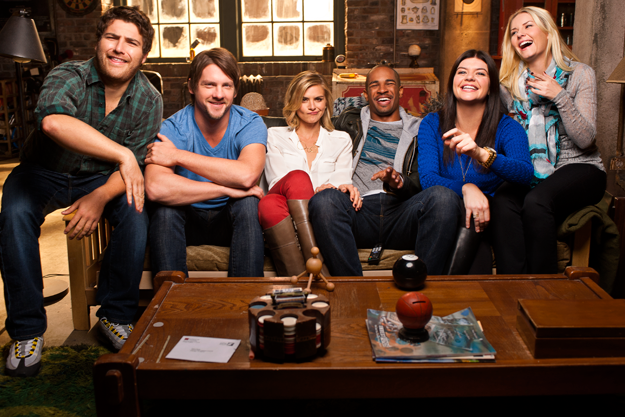
The Happy Enders My views on Happy Endings have changed over time.  I was introduced to the show by a friend who recommended it early in the second season and made me watch an episode while he was there. It had some funny moments, though I was hardly enamored with it.  Still, based on what humor there was and his recommendation, I plunged in further, and it was still fairly funny, but I didn’t love it.  More than that, even though I watched it, I found myself focusing on what it wasn’t rather than what it was. I complained that it was kind of funny, but kind of hit or miss, and I wasn’t wrong.  I complained that it didn’t have the ambition of shows like  Community or Louie, or the strong but not overly sentimental character development and consistency of Parks and Recreation or New Girl, and I wasn’t wrong.  The characters weren’t deep, it wasn’t always laugh out loud funny (it wasn’t funny enough like Curb Your Enthusiasm or It’s Always Sunny in Philadelphia that I didn’t give a shit about character development), and it didn’t seem to have any real thematic depth.  I noted that it was the volume shooter, the JR Smith, of sitcoms, firing away jokes at a rapid pace, sometimes hitting at high percentages, and often missing several in a row, and viewed that as a negative.

Sometime between the end of last season and the beginning of this, the third season, though, I realized that it was time to stop focusing on what Happy Endings wasn’t, and start focusing on what it was.  What Happy Endings is, is an often funny, and always fun show.  I’ve pronounced before that Bob’s Burgers has become my preferred choice for a show to watch before bed that will simply make me smile and lead me to good dreams before I go to sleep.  It has humor, and just general air of positivity and happy things that sometimes one needs after a tough day watching the Mad Mens and Breaking Bads of the world.  Happy Endings might be the next show on that list.  Even when you’re not laughing, watching the show, you’re usually smiling.  The cast, whose chemistry makes jokes work that wouldn’t, and makes jokes that don’t work, not seem like outright duds, is just having a great time and it absolutely shines right through the screen.  The volume shooter aspect was no longer a negative; I felt confident I’d get a few good laughs, and instead of frowning at the misses, I’d just be smiling through the camaraderie.  There are very occasional character building moments or relationship changes, but there’s none of the heavy and sometimes burdensome oversentimentality of How I Met Your Mother that drives me crazy.  Instead of having to choose between being a show where the characters really develop like Parks and Recreation, or a show that’s just one thousand percent about the laughs like Sunny or Curb, Happy Endings took a slightly middle path and instead of beng a comprimise, it works for them.  Almost every episode begins with the six characters together in one place having a good time, cracking jokes at somebody’s expense, and most episodes end the same way.

If Modern Family is a newer take on the traditional family sitcom (Home Improvement, Everybody Loves Raymond, and so forth), Happy Endings is a modern update of Friends, with the classic six friends, three guys, three girls set up.  However, while I never really liked Friends (and don’t love Modern Family much), Happy Endings takes the fun of six characters you like with a sense of humor updated for the second decade of the 21st century. In addition, Happy Endings was a meta-traditional sitcom, and it did that, embracing the 21st century’s obessession with meta-humor, as well as anyone, ir not better.  Instead of being limited by its traditional sitcom – these are six characters who only spend time with each other – format, it’s liberated by that.  When it wants to play with any classic sitcom-y storyline, it just adds in the characters and plot it needs, and cleverly hangs the lampshade by having the characters comment on the sitcom conventions they’re falling into.  It’s the most knowing, winking, sitcom on the air, in this way. In the season (and what turns out to be, unless another network (hear me USA!) picks it up, series) finale, sisters Jane and Alex’s older sister, Brooke, gets married.  Of course, fans of the show have never seen or heard of their other sister, and while old shows would glaze over this point, Happy Endings takes the opportunity to have the characters point out how unusual it is that they’ve never mentioned her, as Adam Pally’s Max says, “We never see her, we never talk about her, she never shows up in any of your flashbacks.”  When others are confused, Dave notes that “Flashbacks” are what Jane and Alex call their photo albums, which he produces to show to the room.  Simple, knowing, well-executed, funny.  Good show.  This is a trope employed over and over again by the show, and it was done deflty and funnily, and with the proper amount of winking, which made these jokes some of the best in the show.

There’s at least a possibility that this isn’t the end, and that a cable network will pick up the show.  I think it would be a good fit for basic cable.  That said, if it doesn’t get picked up, so long Happy Endings.  I’m sorry to see you go.

Spring 2013 Review: Banshee

3 May

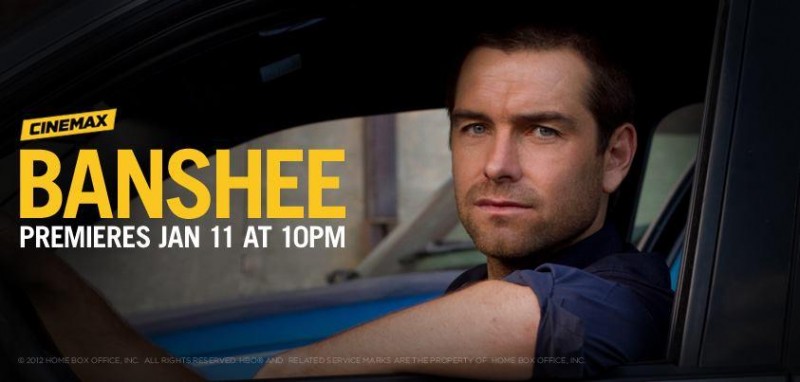
Banshee

I’ve been saying for a while now that soon all good shows will be on cable, and after watching Rectify and now Banshee on channels not known for their original programming, I think we may be getting closer and closer to this time.   I tend to come into cable shows with a little bit less knowledge than I have coming into broadcast shows, and that can be a treat sometimes.  I did see that Banshee is co-created by Jonathan Tropper, a novelist who I enjoy, so I was at least looking forward to the show based on that information.

After a super stylish chase sequence through New York City, it takes a little bit of time to figure out exactly what Banshee is about, but here’s the basics.  A con gets out of prison after fifteen years for participating in a diamond heist of a very prominent and dangerous criminal.  He seeks out the woman with whom he stole the diamonds, who did not get caught, and it turns out she’s living under a different name with two kids, married to a local small town central Pennsylvania district attorney.  She also doesn’t have the diamonds, she claims, because she was robbed when she tried to fence them.  Through a strange series of circumstances best learned through viewing, the protagonist has an opportunity to impersonate the new sheriff, who is coming to town all the way from Oregon because the mayor is worried about a more local sheriff being corrupted by the local man-who-runs-town figure.  This figure basically has his finger in every sinister soup going on throughout the county, and the young mayor is determined to actually stop him.  That’s more or less where we stand after one episode, with our primary outlaw now acting as law enforcement, while the overlord he originally stole from is still after him, while he has to concern himself with the local overlord, and hopefully figure out what ever happened to his girl and his diamonds.

The first show Banshee recalled to mind was Sons of Anarchy, as both are shows where sex and violence are on prominent display in a stylized manner, and outlaw protagonists in small towns where they’re a big deal battle up against other organized crime figures.  The towns are small enough that they live in their own bubbles where local power brokers can have an undue amount of influence.  While Sons of Anarchy feels country rock, Banshee feels industrial, and while this most obviously applies to the music, it also applies to the general feel.  Sons of  Anarchy is grindhouse rough and dirty, while Banshee is flashy and stylish.  Like Sons, Banshee seems like it may also be about at an attempt by a career criminal to walk some sort of moral middle ground (the main character was a theif, which is always the most redeemable of all serious criminals), but we don’t know how that will go just yet. It’s got some very unnecessary skinemax soft-core which maybe was demanded by the network, but at it’s heart its a very interesting concept which looks good, had some very fine action scenes, and definitely kept me on the edge of my seat.  It looks pretty, and it seems cool, and I mean that not just in the generic sense of “good” but in the sense of cool, edgy, hip, smooth, and I’m honestly not sure whether it’s trying to be a really interesting series or just a really aesthetically appealing and suspenseful one, but either way, there’s room on TV for it if it keeps up.  As a drama, there’s plenty of room for it to sink fast, but for some reason, maybe misguided, I’m at least optimistic that it should be a fun ride.

Will I watch it again?  Yes, I will.  It’s not quite in the Rectify or The Americans territory from the pilot, but sometimes the flash gets you.  It passed the test of once I finished one episode, I immediately wanted to see the second, which is definitely a large part of what a good pilot should do.  As alluded to above, it’s definitely yet another example of acable drama seeming a cut above the network variety.  This isn’t necessarily groundbreaking television, but it’s not exactly like every other show on TV, and it s seems to already have a sense of its own style, and I like it.

Six Shows I Stopped Watching, Part 3

1 May

Part 3 of a brief list of six shows I actively decided to stop watching.   Part 1 and a full intro can be found here, while part 2 can be found here.

Glee

Rocky Horror Glee Show


24 is the only show on this list that I even have to think about why I stopped watching.  Heroes and Glee are the two shows that I think had the least amount of actual quality content before they went off the rails.  For half a season, I actually went around defending the show, even outright supporting it, saying that, yes it looks silly, and I am often ambivalent about the singing (it had its moments (4 minutes by Madonna, for example), but sometimes was just too much), but Glee was high school parody done right for a short time.  There were central plots holding the show together, in particular, Will’s wife’s fake baby, and cheerleader Quinn’s real one, that anchored the show.  The show kept a consistent roster of character personalities and plot strands besides merely how the Glee Club fares through the Christmas break, where characters maybe showed gradual change, but were who they were.  And then it all fell apart.  It was clear there was no more meticulous planning, or honestly planning at all.  Instead, everything, including characters’ personalities and storylines, was at the mercy of what the writers decided they wanted for a particular episode, whether it was a message they wanted to send, or a particular musical theme.  Quinn’s cheerleader character was perhaps the biggest casualty of this let’s-not-think-beyond-the-next-episode policy.  She was friendly and helpful one episode, she was a total bitch in another, she was emotional and depressed in a third. Sure, people are complicated and change, but there was absolutely no coherence.  Consistent plotting and characters was simply no longer something those running the show were interested in.  I complained and complained throughout the end of the first season and the start of the second but the official end came when Glee took on Rocky Horror in the fifth episode of the second season to celebrate Halloween.  I didn’t initially intend to just stop watching, but the episode just sat on my DV-r for weeks and then months passed before I realized the inevitable.  I didn’t really like Glee at that point, and I had never much cared for Rocky Horror, and realizing I didn’t care about the show later passed on towards active dislike the more detached I was.

True Blood

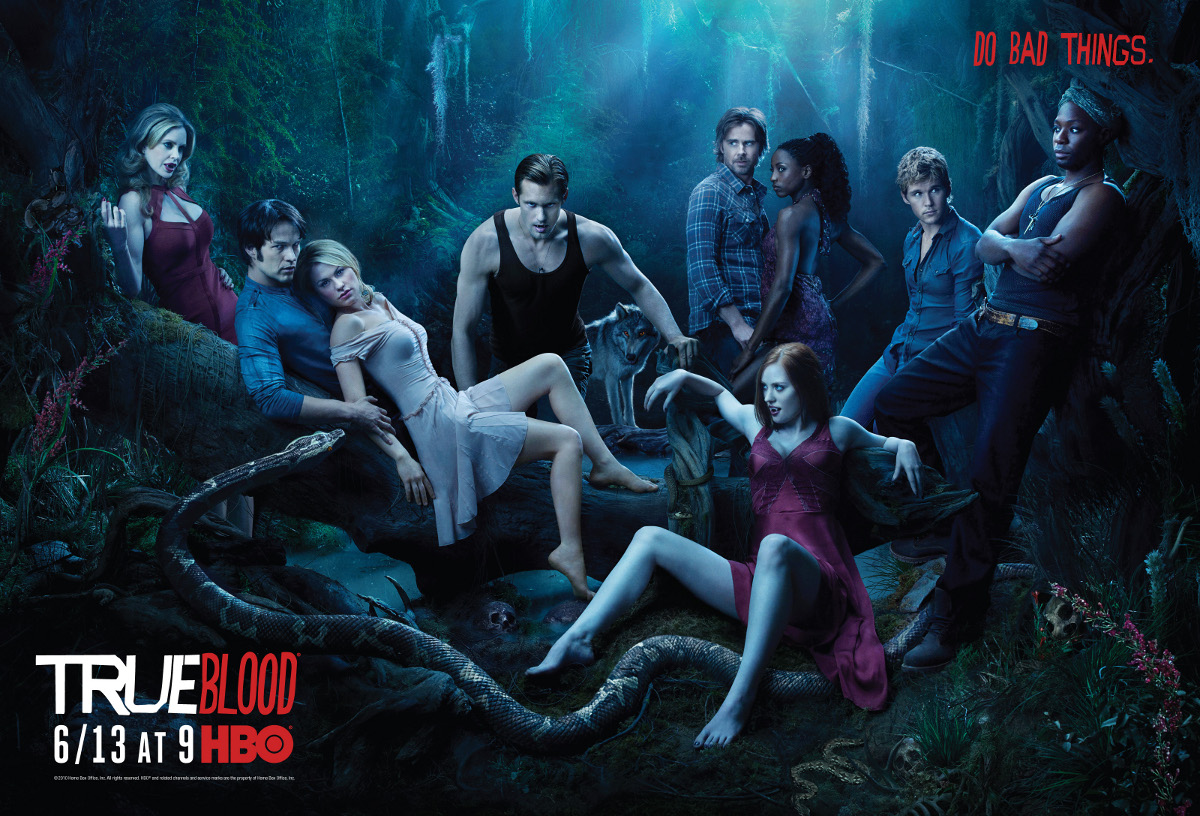
True Blood

I searched my google chat logs to figure out when exactly I caught up on True Blood, which I did not start watching right from the pilot.  In fact, what’s ironic is that when I caught up, was just about when I thought the last good episodes were.  This was in September of 2009, when the second season was finishing up, and I watched both seasons at a furious pace, desperately trying to catch up in time to watch the Season 2 finale live.  I say just about because I think the beginning of Season 3 was pretty good as well.  The last few episodes of Season 3, however, were both anticlimactic and terrible, and I found my first official gchat complaint about the show just after the fourth season started, in June of 2011, when I tell my friend I haven’t watched the first episode yet because I didn’t think the last season was so good.  I’m not sure I ever turned on a show as quickly as True Blood.  I was very into when I was marathoning.  I thought the second half of the first season and the entire second season were riveting, addictive TV, and the third season built up in such a way that it seemed to have a solid chance of matching the first two.  But then the show just cratered, and I didn’t even finish season4.  I watched a couple episodes, and then just gradual faded out, noticing that I really didn’t want to watch anymore.  Most shows I’d give at least a full season to let them back on their path, or see if it was just a bad run of episodes that the writers realized as well and had time to correct, but I didn’t give that to True Blood, and history proved me right, as whenever I caught pieces of other episodes, they were terrible, and friends who were still watching told me as much.  The biggest culprits were that first, the universe just became too big too fast, and there were absolutely no natural limits.  Time travel, fairies, witches, it was impossible to keep up with, and more than that, I didn’t really want to.  It lost its fun trashiness quotient into just bad trashiness.  Second, the careful plotting of the early seasons disappeared; where there were smaller individual plots that coalesced into a couple of big plots in time for the end of the season, now every character had his or her own plot, and some of the characters had absolutely no business with one.  Jason’s werepanther plot was terrible (which was a shame because Jason was one of the best characters) as was the plot with Sam’s brother.  More of the plots were bad than good, and I found it harder and harder to pick out main characters that I really liked.  Recently, I’ve had friends describe for me the plots of the end of the last two seasons, and laughed and laughed at how ridiculous they sounded.  It’s possible in context they don’t seem as ridiculous but I enjoyed the short narrative recitation of the plot much more than I would have watching the show and that says a lot.