Archive | March, 2013

Spring 2013 Review: The Following

6 Mar

The Following

The Following is at its heart a cat and mouse game between a crazy sociopathic serial killer named Joe Carroll (played by James Purefoy) and his troubled FBI nemesis Agent Ryan Hardy (Kevin Bacon).  Carroll was a charismatic literature professor obsessed with Poe and with killing college-aged women, knocking off over a dozen, before Hardy, who was obsessed with the case (think of Hardy as Jessica Chastain to Carroll’s Osama bin Laden in Zero Dark Thirty), managed to crack it, catching Carroll red-handed while saving his last intended victim.

Since Carroll was caught, ten years ago, he’s been in jail, and is sentenced to die soon.  He breaks out of prison at the beginning of The Following’s premiere, with the help of a prison guard he’s seduced into learning to become a serial killer himself.  Carroll then makes a beeline to take care of the only victim he didn’t manage to finish off, who Hardy saved.  Hardy, who has been out of the FBI for years, fighting his own demons, one of which is the bottle, is called back in to help find Carroll, and he’s the foremost expert, having penned a true crime bestseller about his chase for Carroll.

Carroll is rounded up at the end of the first episode and returned to prison after causing lots of damage, but not until it’s learned that in his time supposedly researching his legal appeals, he’s used the internet to round up tens and possibly hundreds of followers, willing to kill for him, die for him, or do any number of insane tasks for the cult of Joe Carroll.  In the first episode alone, it turns out that the gay neighbors and best friends of Sarah Fuller, the last intended victim, are actually cult members, willing to spend three years of their life living as a gay couple just to strike at the moment Carroll got out.  His ex-wife ‘s (Justified’s Natalie Zea) babysitter also turns out to be a cult member.

The Following is created by Kevin Williamson, best known for Dawson’s Creek, the Vampire Diaries, and the Scream series.  The Following is closest out of those to Scream (or Scream copycat I Know What You Did Last Summer, which Williamson also wrote) but without the cheeky meta-humor that was  a hallmark of those films.  There’s none of Scream’s humor in The Following.  It’s not a funny show.  It’s a gory thriller, somewhere along the lines of Seven.  The characters don’t seem particularly well thought out and the cult is pretty ridiculous in the amount that they’re both willing and able to do at the behest of Carroll.  I don’t think there’s likely to be a ton of depth or meaning or themes in this show.  That said, it’s not what the show’s about.  It’s an action thriller, in the vein of former Fox stalwarts 24 and Prison Break, and while I’ll never like a more purely action-oriented show as much as I’ll like Breaking Bad or Mad Men, there’s absolutely room for that type of show on TV.  Thus, if The Following keeps delivering the thrills with plotting that doesn’t seem too farfetched within its own world, it can be successful on its terms.

Repetition is a definite concern looking forward.  It’s a show that seems best designed for an American Horror Story-like single season anthology; I can imagine getting wary after one season of repetitive battles between Hardy and Carroll, knowing neither of them can lose entirely (probably anyway; if Williamson went rogue and killed one of them off at season’s end, it would be a pretty bold and respect-worthy move).  Still, I should at least give Williamson the chance to show that he can avoid seeming repetitive before knocking it.

Will I watch it again?  Maybe.  I was learning towards no at the beginning of the episode, and now I’m slightly leaning towards yes, though it could be a casualty of more spring shows that are better.  It’s flawed and simplistic to some extent; the one on one battle has distinct limits, but as a sheer thriller, some of its flaws take a back seat.  Williamson noted that he brought the show to Fox because his favorite show ever was 24, and I think there’s something that makes sense about that watching The Following.  Like 24, the characters aren’t particularly deep, but if The Following achieves its goals, it keeps you at the edge of your seat every week, and the first episode did a decent job at that.
Spring 2013 Review: The Carrie Diaries

4 Mar

Carrie, '80s style

There was a show you probably heard of called Sex and the City, on HBO in the late ’90s and early ’00s.  Sex and the City was based on the autobiographical columns of New York writer Candace Bushnell.  Sex and the City was hugely successful, spawning two movies (the second less successful than the first), and single-handedly increasing brand awareness of products like Manolo Blahnik shoes, at least among people like me, who would never have heard of them otherwise.  After the fantastical success of the Sex and the City TV show, Bushnell, in 2010, wrote a two-part series called The Carrie Diaries to serve as a prequel to Sex and the City, about Carrie Bradshaw’s life as a senior in high school.  It’s these prequel books that are now being adapted into the TV show The Carrie Diaries.

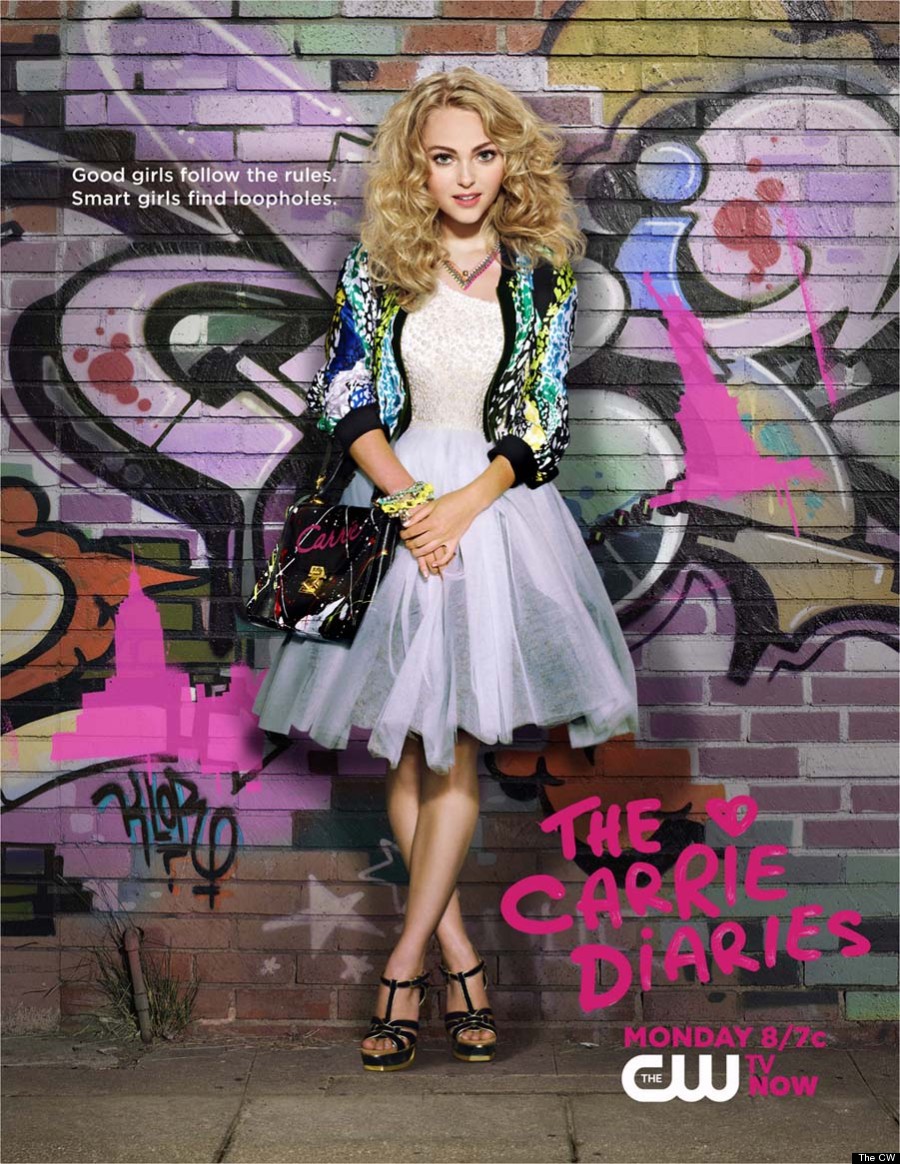
Okay, so The Carrie Diaries.  The star is of course teenager Carrie Bradshaw, a high school junior in 1984.  It’s part classic ’80s John Hughes movie.  Carrie’s got her own crew wacky friends, where everyone has a role.  There’s bookish Asian girl Jill, who everyone calls the mouse (Ellen Wong from Scott Pilgrim vs. the World, who has to be almost 30 by now), slutty drunk Maggie (played by Katie Lindlay, best known as dead teenager Rosie Larson from The Killing), and a guy, Walt, who’s dating Maggie but is clearly probably gay, staring at pictures of Rob Lowe late in the episode.  There’s a mean girl (exactly how mean has yet to be determined, but you know the type), Donna, and her posse who run around the school like they own the place, and there’s a rich bad boy, Sebastian with a good heart who Carrie clearly likes, Andrew McCarthy in Pretty in Pink style.  There’s lots of ’80s style all around and plenty of period music in the first episode, including Blue Monday, Footloose, Burning Down the House, Just Can’t Get Enough, and several others.

There’s a serious side to the show as well (it is, after all, an hour long and it doesn’t seem like CW does half hour comedies anymore).  Carrie’s mom died just months before the show begins, and her, her dad, and her rebellious sister are all suffering in the aftermath of her death and handling it in different ways.  Her dad looks like a cross between Dennis Leary and Tim DeKay from White Collar, and is having a hard time filling the role of both parents, and knowing when to try to take over his wife’s role, and when he’ll never be able to.  Her 14-year old sister, Dorrit, was the outcast to the good girl Carrie, even before her mother’s death, and she acts out, frustrating both her dad and Carrie, who don’t know how to handle her behavior.  Carrie struggles as well, trying to be the good girl, help her sister and dad, and live her own life.

There’s yet one more important aspect.  In order to help her both grow up and recover from the devastation of her mom’s death, Carrie’s dad arranges for her a one day a week internship at a law firm Manhattan, where she’s always wanted to live (get it?  that’s her future home!).  While there, she meets a crazy artsy socialite, Larissa (played by Freema Agyeman, Dr. Who’s Martha Jones), who has Carrie help her steal a dress from Century 21 and takes her to a super wacky artsy party where she meets a bunch of fascinating people (her first gay people!) and pretends to be older than she is.  She also says the worst line of the episode as she leaves, narrating about how infatuated she was with New York – saying that she doesn’t need a boy, because she’s found her man – Manhattan. Boooooo.

There it is, one part ’80s teen comedy, one part heartwarming dealing-with-serious-issues teen drama, and one part teen pretending-to-be-someone-else in Manhattan.  As for quality, well, it’s okay.  That’s really about it.  The acting was fine, the treatment of the ’80s mimicked the classic ’80s of films without being grossly over the top, and the tragedy of Carrie’s mom’s death seemed well handled by the show in the first episode, with pathos but not overdramatic.  If you like what you’ve heard so far, there’s nothing negative enough about the quality of the show that would recommend against watching it.  If you don’t like what you’ve heard so far, there’s nothing positive enough about the quality that would recommend watching it.  It certainly doesn’t transcend it’s genre, but it’s not an embarrassment either.   CW’s made a number or programs in this vein, and while I don’t think it’s ever going to get close to the kind of buzz of Q rating of its notable progenitor, The Carrie Diaries does seem clearly aimed at CW’s core demographic. As for comparisons to Sex and the City itself, The Carrie Diaries are a little bit more serious, more teen (obviously), thus more emo, and less irreverent, and also, fairly obviously, less bawdy.

Will I watch it again?  No.  This show falls into the vast chasm of shows that aren’t so good but aren’t so bad.  I don’t really have so many bad words for The Carrie Diaries; I could imagine why someone might want to watch it.  It just has nothing particularly interesting for me in a world where there more than enough good and interesting shows out there that I haven’t seen yet.

Spring 2013 Review: The Americans

1 Mar

Johnny and Linda American

The Americans is about a couple of Soviet sleeper agents living in America, posing as a typically American family during the late cold war period.  I’ll get to more about it, I promise, but follow me for a minute as I take a diversion onto a more general point about the Cold War in pop culture, and then back to The Americans particularly.

I grew up too late to really experience the cold war.  I don’t really remember the fall of the Berlin Wall, and even if I did know it at the time, I certainly didn’t understand what it meant.  The Cold War itself doesn’t seem like a great time in which to live, but for movies and television it seems like a constantly underused time period, especially in terms of the use of Soviet antagonists.  While World War II Nazis are crazy super evil and immediate, reflecting the fact that World War II was a concentrated war centered on armed conflict, Cold War Soviets, at least post-Stalin, are less here and now evil and more mysteriously and michievously villainous.  Everyone knew the Nazis wanted to basically take over the world and kill all the Jews and Russians and whatever other ethnic groups, but no one exactly knew what the Soviets wanted or what they were willing to do to get it.  The beauty of the Cold War from a broad literary perspective is that neither side knew exactly what the other was thinking, and at anytime, one misplaced step could set off a chain reaction to mutual destruction.  And while, unlike in the third easily literarily interpretable international relations event of the 20th century, the Vietnam War, it’s pretty clear we’re the good guys in the Cold War, it’s not exactly clear how bad the other guys are (No one seems to do World War I or Korean War movies in America, aside from M*A*S*H; World War I just doesn’t have the same place in the American psyche as it does in the European, and no one knows anything anymore about the Korean War).

Thus, while World War II works best as a setting for sweeping large-scale action like in Saving Private Ryan or clear cut good vs. evil revenge like Inglorious Bastards, the Cold War plays best to sneaky subterfuge and taut suspense.  There’s a number of already-on-the-way-to-destruction movies like  Dr. Strangelove or Fail-Safe, but in terms of pre-nuclear destruction, The Hunt for Red October is one of the best examples of movies that follows these themes.

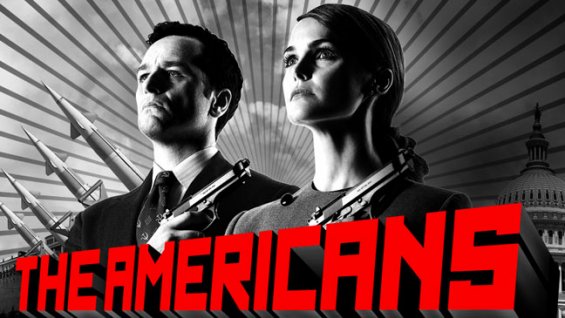
So, back to The Americans.  As per that deviation, The Americans fits that Cold War narrative to a T.  The series stars Keri Russell and Matthew Rhys as the Soviet sleeper agents who have been in the US for a decade and a half at the start of the show, set in  1981.  Flashbacks tell us that they were chosen two decades ago to be married and infiltrate the US, and in the present day, they’ve got two kids who know nothing about their true professions.  They’ve started to become Americanized in their home lives while constantly executing missions for their Soviet overlords.  We learn in the first episode that Rhys’ Phillip is more loyal to his wife than to his country, while Russell’s Elizabeth would die before defecting.  It’s unclear whether that dynamic will reappear as a potential stress on the couple in later episodes, but it certainly seems possible.  In the pilot we also see their difficulties in maintaining a normal family life and carrying out these missions, as they get by a couple of very close scrapes in the first hour alone, and a Soviet superior tells Elizabeth it’s only going to get harder.

Across the street, new neighbor FBI Agent Stan Beeman (Noah Emmerich) moves in, completely coincidentally, but Beeman, who works in the counter intelligence department and recently relocated to Washington DC after spending three years undercover, immediately suspects something is off about Elizabeth and Phillip.  Initially, I thought the FBI was going to look pretty naive and incompetent in the show, and Beeman in particular seems bright eyed and bushy tailed, and when he introduces himself to Elizabeth and Phillip straight out as a FBI agent, it seems as if they can spy circles around this guy.  However, smartly, it seems like the FBI in general, and Beeman in particular, are more capable than we think and the episode ends with the FBI declaring war on these sleeper agents.  Shows and movies are almost always better with well-matched adversaries, rather than one  competent side and one incompetent.  Whether we end up rooting for the KGB agents or the FBI, the show has more long term potential if both are relatively capable.

The Americans looks like it will have all the hallmarks of Cold War fiction; simmering tension with punctuated burst of activity, and constant paranoia on either side; the KGB agents that they’re about to get caught at any time, and the FBI agents that KGB sleeper agents could be anyone and anywhere.  The show also reminds me of Breaking Bad in the sense that our primary protagonists are the ostensible villains (Walt, the KGB agents), while our secondary protagonists are the ostensible good guys (Hank, FBI agent Stan).  It’s unclear as of yet exactly how likeable or unlikeable the KGB agents will be as characters, and how they’ll manage to make the FBI-is-or-is-not-onto-them plot keep moving without stalling or engendering the concept of the show, but there are certainly enough possibilities out there to be worthy of seeing where the creators go with it.

It’s also worth noting that there is already some great period music, and hopefully will be more of it.  In particular, the show opened with Quarterflash’s Harden by Heart, which was already a great sign for my liking it.

Will I watch it again?  Yes. It wasn’t amazing or mind blowing (see: Homeland’s premiere) but it was definitely good enough to come back to.  Also, it’s worth noting that FX is creating itself quite a brand; recent solid-or-better dramas include this, Justified, and Sons of Anarchy.