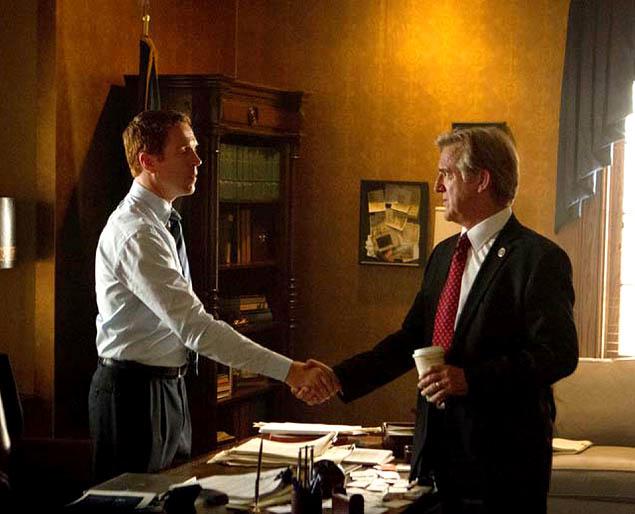
Homeland’s great; the new season has just started, but based just on the first season alone, it’s one of my top four hour long programs on TV (along with Mad Men, Breaking Bad, and Game of Thrones), a very prestigious group. However, no show is completely perfect and it’s always fun to slightly pick at the ones we love, in good fun, of course.
There’s something that rings false about talking about politics in a serious way on a television show or movie and trying to keep everything non-partisan. With a show like Veep, it’s mostly doable, because it’s a comedy, and because the show is short on policy and long on silliness – the whole show is based around the idea that the Vice President essentially has no real power. It’s still not ideal, but it’s simply less important – it still feels false that party never comes up, but it’s less of a big deal that it feels false, because of the above reasons, and because the stakes are so low.
As long as politics is on the fringes, like it was in most of the first season of Homeland, this isn’t an issue. The Vice President was mostly important because of his being a target, and his relationship with CIA director David Estes. In this limited role, where the Vice President was mostly acting as a particularly political figure, it didn’t feel like party was necessarily relevant. However, once Brody’s name was brought up as a Congressional candidate, Homeland veered into the trouble area. There is simply no way you go into a congressional campaign, and the meetings and parties which Brody attended, without party coming up.
This season, with Brody a congressman, and being talked up in the first episode as a potential vice presidential candidate, already looks to be entering the more political sphere of Washington D.C. Party is so wrapped up in today’s political scene that it feels false to have meetings with the Vice President talking about political matters without it ever coming up, even offhand. Homeland tries to skirt this by only dealing with the Vice President, rather than the President or other prominent political figures, but now that the Vice President is clearly revving up his Presidential campaign, honestly avoiding parties just feels forced. It feels like the otherwise natural conversations were jury-rigged to remove any natural hints of political party.
Sure, I understand the benefits of avoiding mention of political parties – choose the wrong one, and you immediately alienate half of your audience. That’s a problem for TV sure, and it’s a calculation weighed against the negative lack of lack of naturalism, and as for the limited relationship with the CIA, in the first season of Homeland, it’s not really important.
Several other shows have had this issue. Boss, in which I assumed from the get go that the mayor was Democratic, because there hasn’t been a Republican mayor of Chicago since the Great Depression. Particularly in that situation, such a one-party system, not mentioning parties at any point seems to make even less sense than it does in other instances – the benefits to be gained by keeping out partisanship are lessened when everyone will just assume it’s Democratic anyway. 24 went back and forth; initial presidential candidate (and later president) David Palmer was clearly labeled a Democrat which made sense, and even though of course 24 wasn’t really about politics, it made a lot more sense to name the party, especially in the second and third season when he dealt with his cabinet, and his reelection campaign, and had a specific opponent. However, 24 seems to stop talking about it as the show goes on, and by the time of the final president (there’s an insane number of Presidents in 24, but that’s a story for another day) party stops being mentioned entirely and it can only really be back engineered by figuring out the timeline of 24 that Allison Taylor is a Republican (or the very nature of American two party politics have drastically changed in the fictional 24 world).
In The Wire, which features a very Boss-like situation of a one party city, there’s no shying away from mentioning party. David Simon, whose aim is to provide as realistic portrayals as possible, clearly labels Carcetti and essentially every other important political figure in the show as Democrats; to go throughout a campaign without party mention would break that naturalism. The single most politics based show in recent memory is of course The West Wing, and the main characters are basically all Democrats; it would be ludicrous to imagine that show without party identity. In a recent failed show which heavily revolved around politics, Commander in Chief, which starred Joan Allen as a Vice President, who ascends to President when the President dies, the creators partially cop out by having Allen play an independent (a Republican nominating an independent as his vice presidential candidate in this decade’s political climate? ha), but at least labels her as a former moderate Republican, and the President she was elected with as a Republican.
Simply put, the fact is that it seems ridiculous to showcase a presidential election campaign nowadays without mentioning party, far and away the most important identifier of a candidate. I’m not sure how close Homeland is going to take us into a potential Brody run in a presidential campaign as the vice presidential nominee, but the closer it decides to take us, the more limiting it feels to not label the party.
While I find this issue minorly troubling, clearly it doesn’t deal with the very fabric of Homeland, and thus the show can and will still be excellent without it. Still, I’m sure they won’t deal with it unless they absolutely have to, otherwise they would have by now. For a show in which nearly every other interaction and scene feels true (even if it isn’t, what the hell do I know about the CIA, but that’s not really the point), the political scenes feel off with the deliberate aversion of party.

 Television, the Drug of the Nation